

How a Direct Cash Sale Saves Fees on Your Home
TL;DR:
- Selling to cash buyers eliminates agent commissions, closing costs, and pre-sale repair expenses, increasing net proceeds for homeowners. Cash sales close faster, often within two weeks, reducing carrying costs and eliminating last-minute repair negotiations. Although cash offers are usually lower, the savings on fees and quicker closing often result in higher net benefits compared to traditional sales.
A direct cash sale saves homeowners thousands of dollars by eliminating agent commissions, reducing closing costs, and removing repair expenses that quietly drain proceeds in traditional transactions. The industry term for this process is a direct or off-market sale, and understanding how direct cash sale saves fees is the clearest path to protecting your net proceeds. Agent commissions alone typically run 5%–6% of the sale price. On a $400,000 home, that single fee can reach $24,000 before you account for anything else. When you add closing costs, concessions, and repairs, the total cost of selling traditionally can consume a significant share of what you worked hard to build.
How direct cash sales save fees: the full breakdown
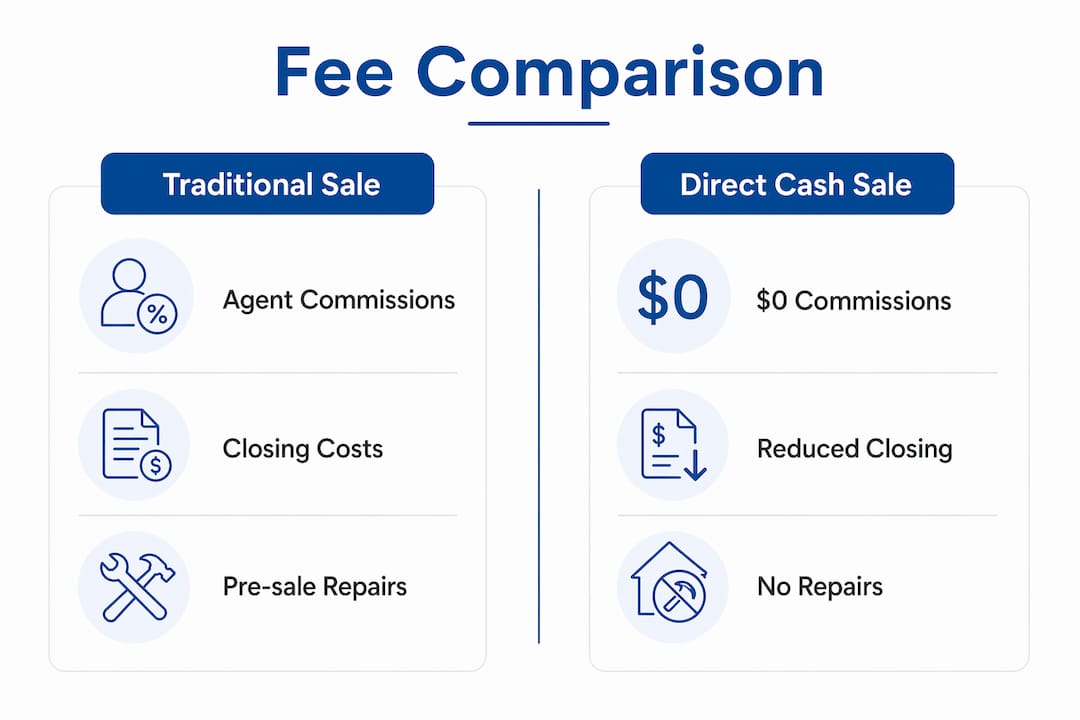
The fees you avoid in a direct cash sale fall into four clear categories: agent commissions, closing costs, seller concessions, and pre-sale repairs. Each one represents real money leaving your pocket in a traditional sale.

Agent commissions
Agent commissions typically cost 5%–6% of the sale price and represent the single largest fee in any traditional transaction. A direct cash sale removes this cost entirely because no listing agent or buyer’s agent is involved. That savings alone can be the difference between financial relief and financial strain for homeowners already under pressure.
Closing costs and concessions
Sellers generally pay 1%–3% of the sale price in closing costs, covering title insurance, escrow fees, and transfer taxes. Cash sales reduce these costs because there is no lender involved, which eliminates underwriting fees, loan origination charges, and appraisal fees on the buyer’s side that often get pushed back to the seller. Seller concessions, which help buyers cover closing costs or repair credits, run another 1%–3% in traditional deals. Cash buyers rarely request concessions, so that line item disappears from your cost sheet.
Pre-sale repairs
Cash buyers purchase properties as-is, which means you skip the repair and staging costs that traditional buyers expect. The real estate commission structure in a traditional sale often comes bundled with agent expectations around presentation, pushing sellers toward costly updates before listing.
| Fee Category | Traditional Sale | Direct Cash Sale |
|---|---|---|
| Agent commissions | 5%–6% of sale price | $0 |
| Closing costs | 1%–3% of sale price | Reduced or minimal |
| Seller concessions | 1%–3% of sale price | Typically $0 |
| Pre-sale repairs | $5,000–$15,000+ | $0 (as-is purchase) |
| Total estimated range | 8%–11% of sale price | Significantly lower |
Pro Tip: If you are comparing a cash offer to a traditional listing, subtract the full 8%–11% in fees from your expected list price before deciding which net figure is higher.
How does selling to cash buyers protect you from unpredictable costs?
Pre-sale repairs are the most unpredictable cost in any traditional home sale. A budget that starts at $5,000 can balloon past $15,000 once inspectors flag roofing issues, foundation cracks, or outdated electrical systems. Cash buyers purchase homes as-is, which removes that risk entirely.
Pre-listing repairs are the most unpredictable cost sellers face. What begins as a manageable budget can escalate quickly once inspections reveal structural or system-level issues. Cash buyers eliminate this exposure by accepting the property in its current condition, giving sellers certainty over their net proceeds from day one.
Beyond repairs, traditional sales carry holding costs that accumulate every month the home sits on the market. Mortgage payments, property taxes, insurance, and utilities continue while you wait for a buyer to secure financing. Cash sales typically close within two weeks, cutting that holding period dramatically. A faster closing means fewer months of carrying costs eating into your proceeds.
The benefits of cash sales also extend to inspection negotiations. In a traditional sale, a buyer’s inspection report becomes a negotiating tool. Buyers request repair credits or price reductions based on findings. Cash buyers generally waive these demands, so the price you agree on is the price you receive.
- No repair demands after inspection
- No staging or cosmetic update costs
- No extended holding period with ongoing monthly expenses
- No risk of a buyer’s financing falling through after weeks of waiting
- No appraisal contingency that could force a price renegotiation
Learning more about selling as-is can help you understand exactly what “as-is” means in practice and what protections you retain as a seller.
What are the practical financial benefits of a direct cash sale?
The real financial benefit of a direct cash transaction becomes clear when you compare net proceeds side by side. Total selling fees in a traditional sale, including commissions, closing costs, concessions, and repairs, often consume 8%–11% of the sale price. On a $450,000 home, that translates to $35,000–$50,000 in costs before you see a dollar.
| Scenario | $400,000 Traditional Sale | $370,000 Cash Sale |
|---|---|---|
| Agent commissions (6%) | $24,000 | $0 |
| Closing costs (2%) | $8,000 | $2,000 |
| Concessions (2%) | $8,000 | $0 |
| Pre-sale repairs | $10,000 | $0 |
| Estimated net proceeds | $350,000 | $368,000 |
The cash offer in this example is $30,000 lower than the list price, yet the seller walks away with more money. That is the core argument for direct cash transaction savings: the number on the offer letter is not the number that matters. Your net proceeds after fees are what you actually keep.
Cash buyers also remove appraisal contingencies, which eliminates one of the most common reasons traditional deals collapse or get renegotiated at the last minute. No lender means no appraisal is required, and no appraisal means no surprise gap between the appraised value and the agreed price. That certainty has real financial value, especially when you are working against a deadline.
Pro Tip: Request an itemized estimate of all fees from any traditional agent before comparing it to a cash offer. Most sellers are surprised by how much the total exceeds their initial estimate.
For homeowners facing foreclosure, divorce, or an inherited property they cannot afford to maintain, the speed and certainty of a cash sale can function as a financial lifeline. Closing in days rather than months stops the accumulation of late fees, penalties, and carrying costs that compound quickly in distressed situations.
Are there trade-offs when choosing a direct cash sale?
A cash offer is almost always lower than a traditional list price. That is the trade-off you accept in exchange for speed, certainty, and reduced fees. The question is not whether the offer is lower. The question is whether your net proceeds after all fees are comparable or better.
Market conditions affect how wide that gap is. In a strong seller’s market, traditional buyers compete aggressively and may bid above asking price, which can make the traditional route more attractive. In a slower market, homes sit longer, carrying costs rise, and the certainty of a cash offer becomes more valuable.
- Verify proof of funds. A legitimate cash buyer provides written proof of funds before you sign anything. This confirms the buyer can close without financing.
- Understand the as-is terms. “As-is” means the buyer accepts the property’s condition, but you should still disclose known defects as required by Michigan law.
- Compare net proceeds, not offer prices. Use the fee breakdown table to calculate what you actually keep from each option.
- Consider your timeline. If you need to close in 7–14 days, a cash sale is the only realistic path. Traditional closings typically take 30–60 days minimum.
- Work with reputable buyers. Negotiating commissions and concessions in traditional sales requires effort and rarely eliminates fees entirely. A reputable cash buyer removes that friction from the start.
The right choice depends on your financial situation, your timeline, and how much uncertainty you can absorb. For homeowners who need speed and predictability, the cash sale advantages outweigh the lower offer price in most scenarios. For homeowners with time, equity, and a property in excellent condition, a traditional listing may yield a higher net figure.
Key takeaways
A direct cash sale delivers more net proceeds than most homeowners expect because the fees eliminated in a traditional sale routinely exceed the difference between a cash offer and a list price.
| Point | Details |
|---|---|
| Commissions eliminated | Cash sales remove the 5%–6% agent commission, the largest single fee in a traditional sale. |
| Closing costs reduced | No lender involvement means fewer fees at closing, lowering your total cost to sell. |
| Repairs not required | Cash buyers purchase as-is, removing $5,000–$15,000+ in unpredictable pre-sale repair costs. |
| Faster closing cuts carrying costs | Closing in as little as two weeks stops mortgage, tax, and insurance payments from accumulating. |
| Net proceeds often higher | A lower cash offer frequently results in more money kept after all traditional fees are subtracted. |
Why I think most sellers underestimate what fees actually cost them
After working with homeowners across Detroit for years, the pattern I see most often is this: sellers focus on the offer price and ignore the fee stack underneath it. They see a $400,000 list price and assume that is roughly what they will receive. By the time commissions, closing costs, concessions, and a surprise repair bill from the inspection clear, the actual figure is closer to $350,000 or less.
The sellers who make the clearest decisions are the ones who do the math before they list. They calculate their realistic net proceeds from a traditional sale, compare it to a cash offer with minimal fees, and make a choice based on actual numbers rather than assumptions. That comparison almost always surprises them.
The other thing I have observed is that speed has financial value that rarely gets quantified. Every month a home sits on the market costs money in mortgage payments, taxes, and insurance. For a homeowner already under financial pressure, two extra months of carrying costs can erase thousands in potential gains. A cash sale that closes in 7–14 days stops that clock immediately.
My practical advice: treat the fee breakdown as a required step, not an optional one. Get the full cost picture before you decide. The cash home sale benefits are real, but they are most visible when you compare them against a complete and honest accounting of what traditional selling actually costs.
— Real Estate Team
How Sell Dave Your House helps you keep more of your proceeds
Sell Dave Your House has worked with Detroit homeowners for over 16 years, providing fair all-cash offers within 24 hours and closing in as little as seven days. There are no agent commissions, no repair requirements, and no surprise fees at closing.

Whether you are facing foreclosure, managing an inherited property, or simply want to sell without the cost and delay of a traditional listing, Sell Dave Your House removes the fee burden that typically consumes 8%–11% of your sale price. The process is straightforward: you request an offer, review the numbers, and close on your timeline. Learn exactly how selling for cash works and see what a no-fee sale could mean for your net proceeds. Detroit homeowners can also get a fair cash offer directly and receive a response within one business day.
FAQ
How much do sellers save with a direct cash sale?
Total traditional selling fees typically run 8%–11% of the sale price, covering commissions, closing costs, concessions, and repairs. A direct cash sale eliminates most of these costs, often resulting in comparable or higher net proceeds despite a lower offer price.
Do cash buyers pay all closing costs?
Cash sales reduce closing costs significantly because there is no lender involved, removing underwriting and appraisal fees. Sellers typically pay minimal closing costs in a cash transaction compared to the 1%–3% common in traditional sales.
How fast does a cash sale close?
Cash sales typically close within two weeks, compared to 30–60 days for a financed purchase. Sell Dave Your House can close in as little as seven days for qualifying Detroit properties.
Do I need to make repairs before a cash sale?
Cash buyers purchase homes as-is, so no repairs, updates, or staging are required. This removes the risk of pre-listing repair costs that can exceed $15,000 in a traditional sale.
Is a cash offer always lower than a traditional sale price?
Cash offers are typically lower than traditional list prices, but your net proceeds after fees are often comparable or higher. Subtracting the full fee stack from a traditional sale price gives you the accurate comparison figure.