

Cash buyers handle probate homes by making all-cash offers that close in weeks, not months, cutting through the delays that traditional financing creates during estate settlement. The probate home buying process involves court approvals, executor duties, and title complications that most buyers never encounter. Understanding how cash buyers navigate these steps gives you a real advantage when you inherit a property and need to sell it without a drawn-out ordeal. This guide covers offer pricing, court timelines, fiduciary responsibilities, and the practical pros of cash buyers in probate so you can make a confident, informed decision.
How cash buyers handle probate homes step by step
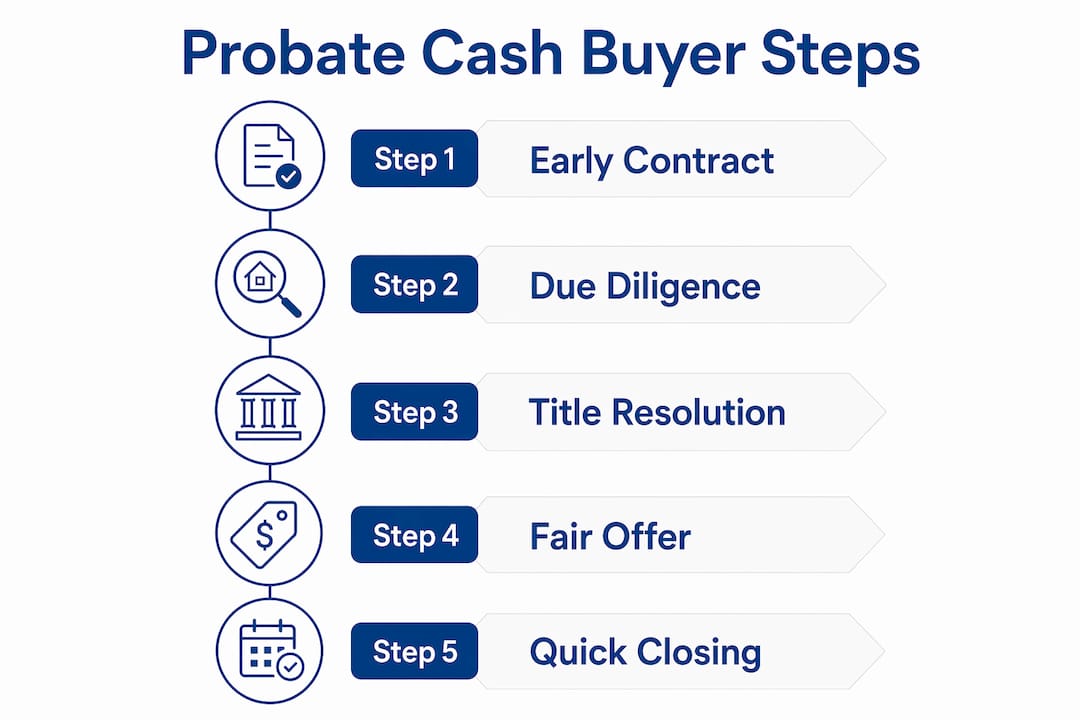
The probate home buying process starts before the executor even has formal legal authority. Probate-contingent purchase agreements allow a cash buyer to lock in a price early, before Letters Testamentary or Letters of Administration are issued by the court. This matters because it protects both sides: the buyer secures the property, and the estate avoids the risk of the market shifting during a long wait.
Once the executor receives legal authority, the sale moves into the court approval phase. The level of authority the executor holds determines how fast things move. In states like California, the Independent Administration of Estates Act (IAEA) gives executors either full or limited authority to act on behalf of the estate. Full authority allows the executor to sell without a court hearing. Limited authority requires a formal court confirmation process, which adds time and complexity.
Here is the typical sequence for a cash sale of a probate home:
- Negotiate and sign a probate-contingent purchase agreement with the cash buyer before formal authority is granted.
- Obtain Letters Testamentary or Letters of Administration from the probate court to confirm the executor’s legal right to sell.
- Determine authority level under IAEA or your state’s equivalent statute.
- Submit the sale for court confirmation if operating under limited authority, including a public notice period.
- Clear title issues with a probate-specialized title company, addressing unpaid debts, Medicaid claims, and heirship gaps.
- Close the sale once the court approves and title is cleared.
Title issues such as unpaid debts and prior deaths in the chain of title frequently delay probate sales. A probate-specialized title company manages heirship affidavits, estate claims, and creditor liens that a standard title company may miss entirely.
Pro Tip: Work with a cash buyer who has a standing relationship with a probate-experienced title company. This single factor reduces closing delays more than almost anything else in the process.

How do cash buyers determine fair offer prices for probate homes?
Cash offers on probate homes typically range between 70% and 90% of the property’s after-repair value (ARV). ARV is the estimated market value of the home after all needed repairs are completed. The gap between the offer and full market value reflects the buyer’s repair costs, carrying costs, and profit margin.
Several factors push an offer toward the lower or higher end of that range:
- Property condition: Homes needing major structural, electrical, or plumbing work receive lower offers.
- Local market demand: High-demand markets narrow the discount because buyers compete more aggressively.
- Carrying costs of vacant properties: Taxes, insurance, and utilities accumulate fast on an empty estate home.
- Estate debt urgency: Creditors with claims against the estate can pressure executors to close quickly, sometimes at a lower price.
| Offer scenario | Typical offer as % of ARV | Key driver |
|---|---|---|
| Move-in ready, strong market | 85%–90% | Low repair risk, fast resale |
| Average condition, moderate market | 75%–84% | Moderate repairs needed |
| Poor condition, slow market | 70%–74% | High repair costs, longer hold time |
Executors have a fiduciary duty to beneficiaries, which means they cannot simply accept the first offer without justification. Documenting urgent debt payments, maintenance costs, and time savings from avoiding a traditional listing gives the executor a defensible paper trail. That documentation protects against beneficiary disputes later.
Pro Tip: Get at least two cash offers before accepting one. Even a 3%–5% difference in ARV percentage can represent thousands of dollars on a Detroit-area home. Use competing offers as leverage.
What timelines and court approval processes affect cash sales?
The single biggest variable in a probate cash sale is the executor’s level of court authority. Full IAEA authority enables closings in about 15–25 days. Limited authority requiring court confirmation pushes that timeline to 45–75 days. That difference matters enormously when the estate is paying property taxes, insurance, and utilities on a vacant home every month.
| Authority level | Typical closing timeline | Court hearing required? |
|---|---|---|
| Full IAEA (or equivalent) | 15–25 days | No |
| Limited authority | 45–75 days | Yes, with public notice |
| No IAEA state | Varies by jurisdiction | Yes, mandatory |
In limited authority cases, the court schedules a confirmation hearing where other buyers can submit overbids. This public overbid process can displace the original cash buyer if a higher offer appears. Experienced cash buyers factor this risk into their process and stay prepared to adjust.
“A key risk is choosing buyers unfamiliar with probate court timelines who may withdraw if the process extends unexpectedly.” — Lonergan Law
Experienced cash buyers coordinate with probate attorneys to align their closing schedule with the court’s calendar. They submit required documentation proactively and avoid last-minute delays. Buyers who lack this experience often underestimate how long court confirmation takes and back out when the timeline stretches, leaving the estate in a worse position than before.
What practical benefits and challenges do cash buyers bring?
The clearest benefit of selling a probate home to a cash buyer is certainty. Cash buyers eliminate financing and appraisal contingencies, removing the two most common reasons traditional sales fall apart. When a financed buyer’s mortgage falls through at the last minute, the estate restarts the entire process, often months later.
The practical benefits for executors and heirs include:
- No repair requirements: Cash buyers purchase properties as-is, so the estate avoids the cost and coordination of fixing up a home before listing.
- Reduced carrying costs: A faster close means fewer months of taxes, insurance, and utilities draining the estate.
- Predictable closing date: Cash buyers set a firm timeline, which helps executors coordinate with attorneys, accountants, and beneficiaries.
- Simplified negotiations: No lender underwriting, no appraisal disputes, and no repair request lists after inspection.
The challenges are real too. The offer price will be below what a fully renovated home might fetch on the open market. Executors must weigh that gap against the savings from avoiding prolonged carrying costs and the certainty of a completed sale. For an estate with active creditors or beneficiaries who need funds quickly, the math often favors the cash offer.
Executors should maintain a clear paper trail of every pricing decision. Written justification for accepting a below-market offer is the executor’s best protection if a beneficiary later challenges the sale.
Pro Tip: Ask any cash buyer you consider for references from probate sales specifically. A buyer who has closed probate deals before will have a checklist, a title partner, and a realistic timeline. One who has not will learn on your estate’s time.
Key Takeaways
Cash buyers handle probate homes most effectively when they combine probate-specific legal knowledge with a firm, all-cash offer that removes financing risk and closes within a documented timeline.
| Point | Details |
|---|---|
| Lock in early with contingent contracts | Probate-contingent agreements let you secure a buyer before court authority is finalized. |
| Offers range 70%–90% of ARV | Property condition, market demand, and estate debt urgency determine where in that range you land. |
| Authority level drives timeline | Full IAEA authority closes in 15–25 days; limited authority adds 45–75 days for court confirmation. |
| Document every pricing decision | Written justification for accepting a cash offer protects the executor from beneficiary disputes. |
| Choose probate-experienced buyers | Buyers unfamiliar with court timelines may withdraw when the process runs longer than expected. |
What I’ve learned from watching probate sales go right and wrong
After years of working in real estate, the pattern I see most often is this: heirs focus on the offer number and ignore everything else. They turn down a solid cash offer chasing a higher price through a traditional listing, then spend six months managing a vacant property, paying for repairs they did not budget for, and watching the estate bleed carrying costs. By the time they close, the net proceeds are often lower than the cash offer they passed on.
The probate process has real legal weight. Executors carry fiduciary responsibility, and that responsibility does not disappear because the sale feels urgent. The right cash buyer understands this. They bring documentation, work with your probate attorney, and do not pressure you to skip steps that protect you legally. If a buyer pushes you to move faster than the court allows or discourages you from involving an attorney, that is a serious warning sign.
The other mistake I see is choosing a cash buyer based on a phone call and a verbal number. Probate sales require buyers who have experience with estate home sales and a track record of closing when court timelines extend. Ask for that track record. Verify it. The difference between a buyer who closes and one who walks away mid-process can cost the estate months of delay and thousands in additional costs.
My honest recommendation: pair a knowledgeable cash buyer with a probate attorney from day one. That combination moves faster, protects the executor, and gives beneficiaries a clear, defensible outcome.
— Real Estate Team
Sell Dave Your House makes probate home sales straightforward
Inheriting a property and managing a probate sale at the same time is genuinely hard. Sell Dave Your House works specifically with homeowners and executors in Detroit and surrounding Michigan communities who need a fast, fair cash offer without the complications of a traditional listing.

Sell Dave Your House has over 16 years of experience handling estate and inherited home sales. The team delivers fair cash offers within 24 hours and can close in as little as seven days when court authority allows. There are no repair requirements, no agent commissions, and no hidden fees. The process is built around your timeline and your legal obligations as an executor. If you are ready to move forward, selling your inherited home starts with a single conversation.
FAQ
What legal authority does an executor need to sell a probate home?
An executor needs Letters Testamentary or Letters of Administration from the probate court to legally sell an estate property. In some states, a probate-contingent purchase agreement can be signed before that authority is granted, locking in the buyer early.
How fast can a cash buyer close on a probate home?
With full IAEA authority or its state equivalent, a cash buyer can close in 15–25 days. Limited authority requiring court confirmation typically extends the timeline to 45–75 days.
Do cash buyers purchase probate homes as-is?
Yes. Cash buyers purchase probate homes in their current condition, with no repair requirements. This removes the cost and coordination burden from the executor and the estate.
Can an executor accept a below-market cash offer without legal risk?
An executor can accept a below-market offer if they document the reasons clearly, including urgent debt obligations, carrying costs, and time savings. That written justification fulfills fiduciary duty and protects against beneficiary disputes.
What is the biggest risk when selling a probate home to a cash buyer?
The biggest risk is choosing a buyer who does not understand probate court timelines. Inexperienced buyers may withdraw when the process takes longer than expected, forcing the estate to restart the sale from the beginning.