

A cash home buyer is an individual or company that purchases a property outright using available funds, without relying on mortgage financing or lender contingencies. The industry term for this transaction is an “all-cash sale,” and it works very differently from a traditional financed purchase. All-cash purchases accounted for 31% of total US home sales as of February 2026. That share tells you this is not a niche strategy. It is a mainstream path that millions of sellers choose every year, and understanding it can save you time, money, and stress.
What is a cash home buyer and who are they?
A cash home buyer is any party who can fund a real estate purchase without a mortgage. That includes individual investors, real estate investment companies, and institutional buyers known as instant buyers, or iBuyers, such as Opendoor. It also includes private individuals who have sold a previous home and are sitting on liquid assets. The defining feature is not where the money comes from. It is that no bank or lender controls the closing timeline.
Some cash buyers use short-term financing tools like hard money loans or transactional funding behind the scenes. From your perspective as a seller, that distinction rarely matters. What matters is that they can close fast without mortgage contingencies, and they can prove it with documentation.

Cash buyers range from solo investors buying distressed properties to large companies that make hundreds of offers per month. Sell Dave Your House, for example, has operated in the Detroit market for over 16 years and makes fair all-cash offers within 24 hours. Knowing who you are dealing with shapes how you negotiate and what terms you can expect.
What are the main advantages of selling to a cash buyer?
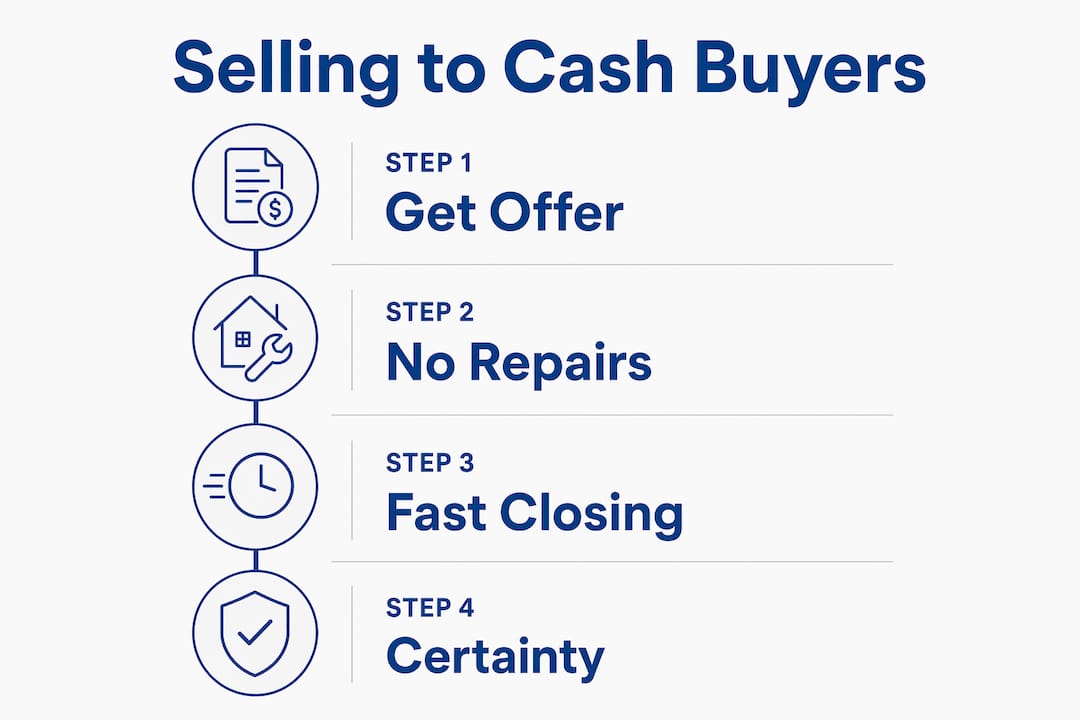
Speed is the most immediate benefit. Cash sales close in as little as 7 to 30 days, compared to 30 to 45 days for financed purchases. That difference matters enormously if you are facing foreclosure, relocating for work, or simply need to free up capital fast.
The advantages go well beyond speed:
- No financing collapse. Cash buyers eliminate mortgage underwriting and appraisal requirements, which are the two most common reasons financed deals fall apart at the last minute.
- No agent commissions. Selling directly to a cash buyer means skipping the standard 5 to 6% agent commission. Those savings on commissions and repairs often offset a lower sale price.
- No repairs required. Most cash buyers purchase properties as-is. You do not need to repaint, replace appliances, or fix the roof before closing.
- Fewer contingencies. Strong cash offers waive financing, appraisal, and inspection contingencies, which makes the deal far more certain from day one.
- Less paperwork and fewer parties. Without a lender involved, the transaction involves fewer steps, fewer documents, and fewer people who can delay the process.
These advantages are especially valuable in distressed situations. If your property needs significant work, a traditional buyer's lender may refuse to approve the loan until repairs are made. A cash buyer skips that hurdle entirely.
How do cash offers differ from traditional financed home sales?
The core difference is certainty. A financed buyer's offer depends on a lender approving the loan, an appraiser confirming the value, and an inspector not uncovering deal-breaking issues. Any one of those steps can kill the deal weeks into the process. A cash offer removes all three variables.
| Factor | Cash sale | Financed sale |
|---|---|---|
| Closing timeline | 7 to 30 days | 30 to 45 days |
| Financing contingency | None | Required |
| Appraisal required | Usually waived | Required by lender |
| Inspection contingency | Often waived | Common |
| Agent commission | Often none | Typically 5 to 6% |
| Sale price | Below market value | Closer to market value |
| Deal collapse risk | Low | Higher |
The trade-off is price. Cash buyers, particularly investors, use a formula called the 70% rule. Cash offers typically equal 70% of after-repair value minus repair costs. That 30% margin is not pure profit. It covers repair costs, holding costs, transaction fees, and investment risk.
Understanding this formula helps you evaluate offers honestly. A cash offer of $140,000 on a home worth $200,000 after repairs is not necessarily lowball behavior. It reflects the real costs the buyer is absorbing so you do not have to.
What is the cash buyer process and how can sellers prepare?
The cash buyer process is simpler than a traditional sale, but it still follows a clear sequence. Knowing each step helps you move confidently and avoid surprises.
- Request and review proof of funds. Before accepting any offer, ask the buyer for a current bank statement or escrow confirmation showing they have the funds available. This document should be dated within the last 30 to 60 days.
- Receive and evaluate the offer. The buyer submits a written offer with the proposed price and terms. Review whether contingencies are waived in writing, not just verbally.
- Negotiate terms. Price is negotiable, and so are closing costs. Many cash buyers cover closing costs as part of the deal. Confirm this in writing before signing.
- Sign the purchase agreement. Once terms are agreed, both parties sign a contract. This document should explicitly state that no financing or appraisal contingency applies.
- Complete any agreed inspections. Some cash buyers conduct a brief walkthrough or inspection for their own records. This is not the same as a lender-required inspection and does not typically affect the offer.
- Submit disclosures and documentation. You will still need to provide standard property disclosures required by your state. Gather these early to avoid delays.
- Close and receive funds. At closing, you sign the deed transfer and receive payment, typically via wire transfer or certified check.
How to identify legitimate cash buyers and avoid common pitfalls
Not every “cash offer” is as solid as it sounds. Hidden contingencies undermine the certainty of cash offers. Some buyers label their offer as cash but include inspection or financing clauses buried in the contract language.
Watch for these red flags and verification steps:
- Verify proof of funds immediately. Do not proceed past the offer stage without a current bank statement or escrow letter. Failing to verify proof of funds exposes you to renegotiation risk and deal failure.
- Demand written contingency waivers. Ask if the buyer waives inspection and appraisal contingencies in writing. A verbal promise is not enforceable.
- Be cautious of unrealistically low offers. An offer far below the 70% rule threshold may signal a buyer who plans to renegotiate after inspection.
- Check the buyer's track record. Look for reviews, references, or a verifiable history of closed transactions in your area.
- Understand the funding source. Some buyers use hard money loans or transactional funding. This is not automatically a problem, but you should confirm they can close on the agreed date regardless of their funding source.
- Avoid wire fraud. Always confirm wire transfer instructions by phone with a known contact before sending or receiving funds.
Working with an established company reduces these risks significantly. Sell Dave Your House has a documented track record in Detroit and operates with full transparency on offer terms and timelines.
Where and how to find cash buyers for your home
Finding a credible cash buyer does not require a real estate agent, though agents who specialize in investor sales can be a useful resource. Several reliable channels exist:
- Direct cash buying companies. Companies like Sell Dave Your House operate locally and make offers directly to sellers. You can request a cash offer without listing your home or paying commissions.
- Instant buyer platforms. National instant buyer platforms provide digital cash offers based on automated valuations. They are convenient but often offer less flexibility on terms than local buyers.
- Local real estate investor networks. Many cities have investor meetups and online groups where active cash buyers connect with sellers. These networks are searchable on platforms like Meetup and BiggerPockets.
- Referrals from real estate professionals. Agents who work with investors regularly can refer you to vetted cash buyers. Ask specifically for buyers with a history of closing without contingencies.
- Online listing platforms. Some sellers list directly on platforms like Craigslist or Facebook Marketplace and attract investor inquiries. Vet any buyer from these sources carefully before sharing personal information.
The fastest path for most sellers is a direct cash buying company with a local presence and verifiable reviews. You skip the search process entirely and get an offer within 24 hours in most cases.
Key takeaways
A cash home buyer removes lender control from the transaction, which is what makes cash sales faster, more certain, and simpler for sellers willing to accept a below-market price.
| Point | Details |
|---|---|
| Cash buyer definition | A buyer who purchases property without mortgage financing or lender contingencies. |
| Speed advantage | Cash sales close in 7 to 30 days versus 30 to 45 days for financed purchases. |
| Pricing trade-off | Cash offers typically use the 70% rule, reflecting real repair and holding costs. |
| Verification is critical | Always confirm proof of funds and written contingency waivers before signing. |
| Finding buyers | Direct cash buying companies, instant buyer platforms, and investor networks are the fastest sources. |
Why I think most sellers underestimate the real value of a cash offer
After years of watching homeowners navigate the selling process, I have seen the same mistake repeated: sellers fixate on the gross sale price and overlook the net result. A traditional listing at $200,000 sounds better than a cash offer at $155,000. But subtract a 6% commission, $8,000 in requested repairs, two months of carrying costs, and the stress of a deal that fell through once already, and the cash offer often wins on net dollars and certainly wins on peace of mind.
The sellers who benefit most from cash buyers are not just those in financial distress. They include people who inherited a property they cannot maintain, landlords tired of problem tenants, and retirees who need to move quickly without the uncertainty of a long listing period. For all of these situations, the certainty of a cash close is worth more than the number on paper.
The one area where I urge caution is verification. The cash buying space includes serious, reputable companies and it also includes opportunists who use “cash offer” language to get a signed contract, then renegotiate after inspection. The difference between a good experience and a bad one almost always comes down to whether the seller asked for written proof of funds and written contingency waivers upfront. Do not skip those two steps.
The trend toward more cash sales is real and growing. As more sellers recognize the net value of speed and certainty, cash offers will become an even more standard part of the market. Getting comfortable with how they work now puts you ahead of that curve.
— Dave Joseph, Owner of Sell Dave Your House
How Sell Dave Your House makes cash selling simple in Detroit
Sell Dave Your House has helped Detroit homeowners sell fast for over 16 years, with no repairs required, no agent commissions, and no hidden fees. The process is built around your timeline, not a lender's schedule.

You can receive a fair cash offer within 24 hours and close in as little as seven days. Whether you are facing foreclosure, dealing with an inherited property, or simply want to move on without the hassle of a traditional listing, Sell Dave Your House provides a straightforward path forward. Learn exactly how the cash selling process works or go straight to getting your cash offer today. There are no obligations and no pressure.
FAQ
What is the cash home buyer definition in real estate?
A cash home buyer is a person or company that purchases a home without using a mortgage or lender financing. The buyer pays the full purchase price using liquid assets, which eliminates lender-required contingencies and speeds up the closing process.
How fast does a cash sale actually close?
Cash sales typically close in 7 to 30 days, compared to 30 to 45 days for financed purchases. The exact timeline depends on the buyer's process and how quickly the seller provides required documentation.
Will a cash buyer always offer less than market value?
Most cash buyers offer below full market value because they absorb repair costs, holding costs, and transaction risk. Many investors use the 70% rule: offer equals 70% of after-repair value minus estimated repair costs. Sellers often recover the difference by avoiding agent commissions and repair expenses.
How do I verify that a cash offer is legitimate?
Ask the buyer for a current bank statement or escrow confirmation as proof of funds, and confirm in writing that all financing, appraisal, and inspection contingencies are waived. A legitimate cash buyer will provide both without hesitation.
What types of homes do cash buyers purchase?
Cash buyers purchase a wide range of properties, including homes that need significant repairs, inherited properties, rental properties, and homes facing foreclosure. Most cash buyers accept properties as-is, which is one of the primary reasons sellers choose this route.