

An as-is property sale is a real estate transaction where the seller offers the home in its current physical condition and will not make repairs, upgrades, or provide price credits for defects found before closing. This type of sale is the standard industry term for what many homeowners simply call “selling without fixing anything first.” If you are facing financial pressure, dealing with an inherited home, or just need to move fast, understanding what an as-is property sale means can save you time, money, and a great deal of stress.
What is an as-is property sale? Definition and legal basics
An as-is property sale means the seller provides the home in its present condition and will not perform repairs or offer credits for defects discovered before closing. The clause applies to structural and mechanical components but does not remove the seller's title obligations or other standard contract duties. That distinction matters more than most sellers realize.
Selling as-is does not mean selling in secret. Sellers must disclose all known material defects regardless of the as-is clause. Most states require sellers to complete formal disclosure forms covering defects that are not visible during a casual walkthrough. Concealment or fraud can invalidate the entire as-is clause, exposing the seller to legal liability after closing.
The as-is clause also does not remove the buyer's right to inspect the property. Buyers typically have an inspection contingency period lasting 10 to 17 days to evaluate the home, even in as-is transactions. During that window, buyers can negotiate the price, request concessions, or cancel the contract entirely based on what the inspection reveals.
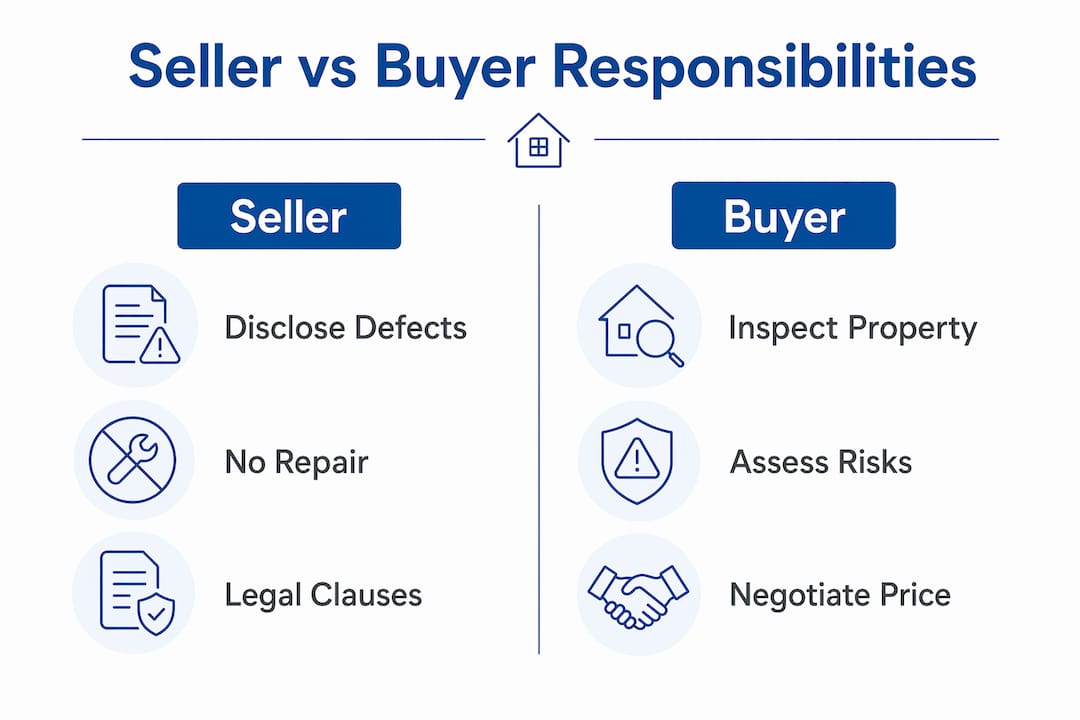
What are the seller and buyer responsibilities in an as-is sale?
Both parties carry specific obligations in an as-is real estate sale, and confusing those obligations is where most deals fall apart.
Seller responsibilities:
- Disclose all known material defects in writing before closing.
- Provide clear title and fulfill all standard contract terms.
- Allow the buyer reasonable access for inspections.
- Avoid concealing defects, which can void the as-is clause and trigger fraud claims.
Buyer responsibilities:
- Conduct thorough inspections within the contingency period.
- Assume the physical condition risk after the inspection period closes.
- Arrange financing that fits the property's condition.
- Negotiate price or cancel based on inspection findings, not after closing.
Misunderstanding as-is can lead to costly mistakes on both sides. Buyers sometimes waive inspection contingencies thinking that is what as-is requires. Sellers sometimes believe they have no disclosure duties at all. Both assumptions are wrong and both can result in expensive disputes after closing.
For the as-is clause to hold up legally, it needs precise language. The contract should include explicit disclaimers of warranties and a written acknowledgment from the buyer that they had the opportunity to inspect the property. A real estate attorney can draft this language correctly.
How does financing affect an as-is property transaction?
Financing is the most common obstacle in an as-is property transaction, and sellers often underestimate how much it narrows the buyer pool.
FHA and VA loans have strict minimum property standards that many as-is homes simply cannot meet. A property with a damaged roof, faulty electrical, or significant structural issues will likely fail FHA or VA appraisal requirements. When that happens, the buyer loses their financing and the deal collapses.
Buyers who want an as-is home but cannot pay cash have limited options:
- All-cash purchase: The cleanest path for as-is sales, with no lender property requirements.
- Renovation loan (FHA 203k or Fannie Mae HomeStyle): Wraps purchase and repair costs into one loan, but involves more paperwork and longer timelines.
- Conventional loan with a large down payment: Possible if the property condition is marginal rather than severely distressed.
- Hard money loan: Short-term, high-interest financing used by investors who plan to renovate and resell.
Buyers should anticipate unknown repair costs and financing complications when purchasing as-is homes. That uncertainty shifts negotiating power toward the seller in some cases and toward the buyer in others, depending on how many qualified buyers are competing for the property.
As a seller, knowing these financing realities helps you price the home correctly from the start. A home that cannot qualify for FHA or VA financing will attract a smaller pool of buyers. Pricing it to reflect that reality upfront prevents wasted time and failed contracts.
Why do homeowners choose to sell as-is?
Selling as-is is not a last resort. For many homeowners, it is the most practical decision available given their circumstances.
- Financial constraints. Repair costs can run into tens of thousands of dollars. Sellers who cannot afford those costs before listing have no realistic alternative to selling as-is.
- Inherited properties. Heirs often receive homes that have been deferred on maintenance for years. Selling the property without repairs avoids the cost and complexity of renovating a home they never lived in.
- Relocation deadlines. Job transfers, military orders, and family emergencies create hard move-out dates. Waiting months for contractors and repairs is not an option.
- Foreclosure or financial distress. Homeowners facing foreclosure need speed above all else. An as-is sale to a cash buyer can close in days, not months.
- Rental property exits. Landlords selling occupied or recently vacated rentals often prefer as-is sales to avoid managing repairs from a distance.
Selling a house as-is can speed up the sales process and reduce seller expenses related to repairs and upgrades. The tradeoff is typically a lower sale price. That is a fair exchange for many sellers who value speed and certainty over maximum profit.
You can also explore the reasons to sell fast to see whether your situation fits the as-is model before committing to a listing strategy.
How do you sell your house as-is without repairs or traditional fees?
Selling your home as-is effectively comes down to three things: honest disclosure, realistic pricing, and finding the right buyer.
Disclose everything you know. Transparency builds trust and protects you legally. Buyers who feel informed are far less likely to back out or pursue legal action after closing. Accurate disclosure and transparency build buyer trust even in as-is transactions, reducing last-minute disputes.
Price the home to reflect its condition. Overpricing an as-is home wastes everyone's time. Research comparable sales in your area, factor in the estimated cost of repairs, and price below that adjusted value. Buyers will run their own numbers, and a realistic price signals that you are serious.
Target the right buyers. Not every buyer is suited for an as-is purchase. The most efficient path is often selling directly to cash buyers or investors.
| Selling method | Repair requirement | Timeline | Fees |
|---|---|---|---|
| Traditional listing (agent) | Usually required | 60 to 90 days | 5 to 6% commission |
| For sale by owner (FSBO) | Often required | 60 to 120 days | Minimal, but time-intensive |
| Cash buyer or investor | None | 7 to 30 days | None or minimal |
| Auction | None | 30 to 60 days | Auction fees apply |
Cash buyers and investors prefer as-is sales because they renovate properties themselves and skip repair negotiations entirely. Selling to a cash buyer reduces sale time and eliminates realtor commissions and repair costs for the seller.
If your home needs significant work, a house in disrepair sale to a cash buyer is often the fastest and cleanest exit available. You skip the contractor bids, the open houses, and the financing contingencies that drag out traditional sales.
My honest take on as-is sales after 16 years in Detroit real estate
The biggest mistake I see sellers make is assuming that “as-is” means they can hide problems and walk away clean. That is not how it works, and it is not how you want it to work. Sellers who disclose fully and price honestly close faster and with far fewer headaches than those who try to obscure issues.
The second mistake is pricing the home as if it were in perfect condition and then expecting buyers to accept the as-is terms without negotiating. Buyers are not irrational. They will factor in repair costs, financing risk, and uncertainty. If your price does not already account for those factors, you will sit on the market and watch motivated buyers walk to better-priced properties.
What I have found is that the sellers who do best in as-is transactions are the ones who treat the process like a business decision rather than an emotional one. They get a realistic estimate of repair costs, subtract that from market value, and price accordingly. They disclose everything upfront. And they target cash buyers who can close quickly without lender interference.
The as-is route is not for everyone. But for homeowners facing real time pressure or financial constraints, it is a legitimate and often the smartest path to a clean exit. The key is going in with clear expectations and the right buyer on the other side of the table.
— Dave Joseph, Owner of Sell Dave Your House
How Sell Dave Your House makes as-is home sales simple
Sell Dave Your House has spent over 16 years helping Detroit-area homeowners sell their properties fast, without repairs, and without paying realtor commissions. The process is direct: you request a cash offer, receive a fair all-cash offer within 24 hours, and can close in as little as seven days.

There are no repair requirements, no open houses, and no hidden fees. Whether you are dealing with an inherited property, financial hardship, or simply need to move quickly, Sell Dave Your House handles the details so you do not have to. You can get a cash offer today, or check where we buy houses to get started.
Key takeaways
An as-is property sale is the fastest and most cost-effective exit for sellers who cannot or choose not to make repairs, provided they disclose all known defects and price the home to reflect its condition.
| Point | Details |
|---|---|
| As-is definition | The seller offers the home in current condition with no repairs, credits, or upgrades before closing. |
| Disclosure is mandatory | Sellers must disclose all known material defects regardless of the as-is clause. |
| Buyers keep inspection rights | Buyers retain the right to inspect and cancel during the contingency period, typically 10 to 17 days. |
| Financing limits the buyer pool | FHA and VA loans often cannot fund as-is homes, making cash buyers the most reliable option. |
| Realistic pricing closes deals | Pricing below adjusted market value, accounting for repair costs, attracts serious buyers and prevents failed contracts. |
FAQ
What does as-is mean in a real estate contract?
As-is means the seller will not make repairs, upgrades, or offer price credits for defects found before closing. The buyer accepts the property in its current physical condition.
Can a buyer still inspect an as-is home?
Yes. An as-is clause does not remove the buyer's right to inspect. Buyers typically have a 10 to 17 day contingency period to evaluate the property and can cancel the contract if the findings are unacceptable.
Do sellers have to disclose defects in an as-is sale?
Sellers must disclose all known material defects even when selling as-is. Concealing defects can invalidate the as-is clause and expose the seller to fraud claims.
Why do cash buyers prefer as-is properties?
Cash buyers and investors prefer as-is sales because they plan to renovate the property themselves. They skip lender property requirements and repair negotiations, which speeds up the closing process for both parties.
Is selling as-is always a lower price?
Selling as-is typically results in a lower sale price than a fully repaired home. However, the savings on repair costs, agent commissions, and carrying costs often offset the price difference for sellers who need a fast, clean sale.