

iBuyer offers differ from cash buyers primarily because iBuyers use automated valuation models and strict home condition requirements, while cash buyers purchase properties as-is with no service fees. Understanding why iBuyer offers differ from cash buyers can mean thousands of dollars in your pocket at closing. The two approaches look similar on the surface. Both deliver fast cash offers without a traditional listing. But the mechanics, costs, and flexibility are fundamentally different, and choosing the wrong option for your situation is a costly mistake.
How do iBuyer offers work?
An iBuyer, short for “instant buyer,” is a tech company that generates home offers using automated valuation models (AVMs). These models pull recent comparable sales, neighborhood data, and market trends to calculate an offer price within 24 to 48 hours. Companies like Opendoor operate this way.
The catch is that the initial quote is rarely the final number. After you accept, an iBuyer sends an inspector to your home. That inspection often triggers mandatory price reductions based on repair estimates, and those adjustments are non-negotiable post-inspection. You either accept the revised number or walk away.

iBuyers also impose strict condition requirements. They restrict purchases to homes in good condition, disqualifying properties with fire damage, code violations, or significant deferred maintenance. If your home needs real work, most iBuyers will not make an offer at all.
On top of inspection deductions, iBuyers charge a service fee of 5 to 6% of the sale price. This fee is a convenience charge, not a commission, but it reduces your net proceeds just the same. Add closing costs and repair holdbacks, and the final number can be well below what the initial quote suggested.
- AVM pricing: Offer generated by algorithm, not a human walkthrough.
- Condition restrictions: Homes with major issues are disqualified.
- Service fees: Typically 5 to 6% of the sale price.
- Inspection adjustments: Price reductions after acceptance are mandatory.
- Closing timeline: Fixed at 10 to 21 days with limited flexibility.
How do cash buyer offers differ from iBuyer offers?
Cash buyers are individual investors or companies that purchase homes directly, without algorithms, condition filters, or service fees. They conduct an early walkthrough to assess the property and then make a firm offer that prices repairs upfront. That offer does not change after acceptance.
This is the defining difference in the iBuyer vs cash buyers comparison. A cash buyer's offer already accounts for the home's condition. There are no surprise deductions at closing. What you agree to is what you receive.
Cash buyers also buy properties in any condition. Fire damage, foundation issues, inherited homes sitting vacant for years — none of these disqualify a property. This makes cash buyers the practical choice for homeowners whose homes would never pass an iBuyer's condition screening. You can read more about the benefits of selling as-is if your property needs significant work.
- As-is purchases: No repairs, cleaning, or staging required.
- No service fees or commissions: The offer is the net amount.
- Firm offers: No post-inspection price reductions.
- Flexible closing: Cash buyers close in 7 to 60 days, on your schedule.
- Any condition accepted: Including code violations and deferred maintenance.
The flexibility on closing timeline is a real advantage. If you need to close in seven days because of foreclosure or financial hardship, a cash buyer can accommodate that. If you need 45 days to find your next home, that works too.
What are the net cost differences for sellers?
The financial comparison between iBuyers and cash buyers is where most sellers get surprised. iBuyer offers typically range from 90 to 95% of market value, but that figure comes before fees and deductions. Cash buyers often offer 60 to 80% of market value with no fees, no commissions, and no repair holdbacks.
The math does not always favor the higher gross offer. A seller who receives a $250,000 iBuyer quote may net $220,000 after a 5% service fee, closing costs, and $10,000 in inspection-driven repair deductions. A cash buyer offering $210,000 with zero fees may actually deliver a higher net amount. iBuyer service fees reduce net proceeds in ways that sellers frequently underestimate.
| Factor | iBuyer | Cash buyer |
|---|---|---|
| Offer range | 90 to 95% of market value | 60 to 80% of market value |
| Service fees | 5 to 6% of sale price | None |
| Repair deductions | Post-inspection, mandatory | Priced into upfront offer |
| Closing costs | Seller typically pays | Often covered by buyer |
| Net proceeds | Lower than initial quote | Firm from day one |
| Condition requirement | Good condition only | Any condition accepted |
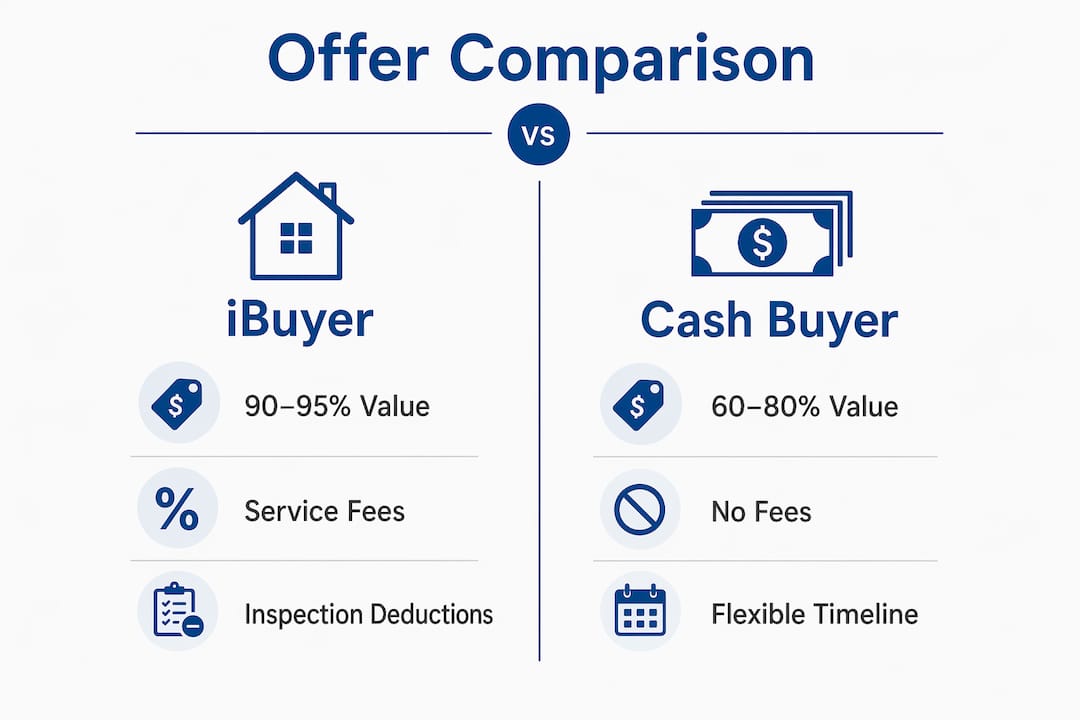
The scenario where cash buyers deliver more net cash is common for homes needing repairs. If your property has deferred maintenance, the iBuyer's inspection will find it and deduct it. A cash buyer already priced it in. You avoid the unpleasant surprise.
When should you choose an iBuyer versus a cash buyer?
The right choice depends on your home's condition, your timeline, and how much you want to net at closing. Neither option is universally better. Each fits a specific seller situation.
iBuyers work best when your home is in good condition, you want a quick offer with minimal negotiation, and you are comfortable paying a service fee for convenience. If your home is updated, well-maintained, and located in a market where iBuyers operate, you may receive a competitive gross offer. The 24 to 48 hour offer timeline suits sellers who want speed without dealing with showings or open houses.
Cash buyers are the better fit in these situations:
- Your home needs significant repairs or has structural issues.
- You want to sell a house in disrepair without making any improvements.
- You need a closing date that matches your personal timeline.
- You want to avoid service fees and inspection-driven price cuts.
- You are facing foreclosure, financial hardship, or an inherited property situation.
Sellers who prioritize certainty over maximum gross price consistently favor cash buyers. The offer is firm, the timeline is flexible, and there are no fees eating into the final number. For homeowners in Detroit dealing with financial stress, that certainty is often worth more than a slightly higher initial quote that may not survive the inspection process.
What are common misconceptions about iBuyer and cash buyer offers?
Several widespread misunderstandings cause sellers to make the wrong choice between these two options.
The initial iBuyer quote is not the final price. Sellers commonly mistake the online quote for the final amount. The AVM generates a starting number. The inspection generates deductions. The final net figure is often meaningfully lower than what appeared on screen.
Cash buyers do not always net you less money. This is the most persistent myth in the iBuyer offer comparison conversation. A lower gross offer with zero fees can outperform a higher gross offer burdened with a 5 to 6% service fee plus repair holdbacks.
iBuyer transactions are not free. Some sellers assume that because there is no real estate agent, there are no costs. The service fee replaces the commission. You are paying for convenience, not avoiding costs.
As-is does not mean a lowball offer. Cash buyers price condition into the offer upfront. That is not the same as an arbitrary discount. It reflects the actual cost of repairs the buyer will absorb.
“The biggest mistake sellers make is comparing the headline numbers without accounting for fees, deductions, and condition requirements. The offer that looks higher on paper is not always the one that puts more money in your pocket.” — Dave Joseph, Owner of Sell Dave Your House
Key takeaways
iBuyer offers differ from cash buyers because iBuyers use algorithm-driven pricing with service fees and inspection deductions, while cash buyers provide firm, as-is offers with no fees and flexible closing timelines.
| Point | Details |
|---|---|
| iBuyer pricing uses algorithms | AVMs generate initial quotes that are often reduced after mandatory inspections. |
| iBuyer fees reduce net proceeds | Service fees of 5 to 6% plus repair holdbacks lower your final cash amount significantly. |
| Cash buyers accept any condition | Properties with damage, code violations, or deferred maintenance qualify for cash offers. |
| Cash buyer offers are firm | Repairs are priced upfront, so the agreed amount does not change at closing. |
| Net proceeds matter more than gross offers | A lower cash buyer offer with no fees can outperform a higher iBuyer quote after deductions. |
What I have learned comparing these two options
After working with homeowners in Detroit for over 16 years, I have watched sellers make the same mistake repeatedly. They see the iBuyer's higher initial number and assume it is the better deal. They sign the agreement, go through the inspection, and then face a list of repair deductions they did not anticipate. By that point, they have already passed on a firm cash offer that would have netted them more.
The thing that rarely gets discussed is the emotional cost of the iBuyer process. You accept an offer, feel relief, and then get hit with a revised number that is thousands lower. That whiplash is real. Cash buyers eliminate it entirely because the offer accounts for your home's condition from the start.
My honest advice is this: if your home is in excellent shape and you are in a market where iBuyers are active, get their offer and do the math after all deductions. But if your home needs work, if you are under financial pressure, or if you simply want certainty, a local cash buyer will almost always serve you better. The reasons to sell your house fast are real, and the method you choose should match your actual situation, not just the headline number.
Do not let a higher gross offer distract you from what you will actually walk away with. That is the number that matters.
— Dave Joseph, Owner of Sell Dave Your House
How Sell Dave Your House helps you get a fair cash offer
Sell Dave Your House has been buying homes directly from Detroit homeowners for over 16 years. The process is straightforward. You contact the team, receive a fair all-cash offer within 24 hours, and can close in as little as seven days. There are no service fees, no repair requirements, and no inspection-driven price cuts.

Whether your home needs significant repairs, you are facing foreclosure, or you simply want to sell without the uncertainty of the iBuyer process, Sell Dave Your House buys properties as-is in any condition. The offer you receive is the amount you take home. If you are ready to move forward, get a fair cash offer today and see exactly what your home is worth with no obligation. Sell Dave Your House also serves homeowners across Detroit, Harper Woods, Hazel Park, and surrounding Michigan communities through its fast cash home buying program.
FAQ
What is the main difference between iBuyers and cash buyers?
iBuyers use automated algorithms to price homes and charge service fees of 5 to 6%, while cash buyers assess properties directly and make firm as-is offers with no fees or inspection deductions.
Do iBuyers or cash buyers offer more money?
iBuyers typically offer 90 to 95% of market value before fees, while cash buyers offer 60 to 80% with no fees. After deductions, cash buyers often deliver equal or higher net proceeds for homes needing repairs.
Can I sell a damaged home to an iBuyer?
No. iBuyers restrict purchases to homes in good condition and disqualify properties with major damage, code violations, or significant deferred maintenance. Cash buyers accept homes in any condition.
How fast can a cash buyer close compared to an iBuyer?
Cash buyers can close in as few as seven days and accommodate timelines up to 60 days. iBuyers operate on a fixed schedule of 10 to 21 days with limited flexibility.
Is the iBuyer's initial offer the final price?
No. The initial iBuyer quote is generated by an algorithm and is frequently reduced after the inspection. Inspection-driven deductions are mandatory and non-negotiable, meaning your final net amount is often lower than the number you first saw.