
What Percent of Market Value Do Cash Home Buyers Pay?
Cash home buyers typically offer a wide range of percentages of a home’s market or after-repair value, depending on condition, title status, and how fast you need to close. The single strongest data point behind that range comes from UC San Diego’s Rady School of Management, which found that all-cash buyers pay about 10% less on average than mortgage-backed buyers across the broader housing market.
- Cash home buyers typically offer a wide range of percentages of a home’s market or after-repair value, depending on condition, title status, and how fast you need to close. The 10% Rady School average applies to general cash purchases, not distressed property sales.
- Investor and company offers on fixer-uppers usually sit in the 50% to 85% band, depending on repairs and urgency.
- Your exact percent depends on condition, comps, title, and how many buyers you’re comparing.
Table of Contents
- What Is the 70 Rule in Real Estate for Cash Offers?
- What Makes a Cash Offer’s Percentage Higher or Lower?
- How Do You Calculate a Cash Offer From Percent to Dollars?
- Is a Cash Offer Fair? An 8-Point Checklist
- How Speed Changes Your Net Proceeds
- When Should You Accept, Negotiate, or Walk Away?
- How Sell Dave Your House Makes Fast Cash Offers Work
- A Straight Answer From the Real Estate Cash home buyers typically offer a wide range of percentages of a home’s market or after-repair value, depending on condition, title status, and how fast you need to close.
- Key Cash home buyers typically offer a wide range of percentages of a home’s market or after-repair value, depending on condition, title status, and how fast you need to close.
- Sources
- FAQ
What Is the 70 Rule in Real Estate for Cash Offers?
In cash home buying, the “70 rule” isn’t a rigid formula. It’s shorthand for the percentage-of-value approach that shapes almost every all-cash offer you’ll receive: a buyer starts with a number based on market or after-repair value, then subtracts what it will cost them to fix, hold, and eventually sell the property.
Here’s the plain-language version of how that math works, step by step:
- Cash home buyers typically offer a wide range of percentages of a home’s market or after-repair value, depending on condition, title status, and how fast you need to close. The buyer estimates the home’s market value or after-repair value (ARV) using recent comps.
- Cash home buyers typically offer a wide range of percentages of a home’s market or after-repair value, depending on condition, title status, and how fast you need to close. They subtract estimated repair costs, based on a walkthrough or your own disclosures.
- Cash home buyers typically offer a wide range of percentages of a home’s market or after-repair value, depending on condition, title status, and how fast you need to close. They subtract holding costs, which is what it costs to own the property while it’s vacant, like insurance, utilities, and taxes.
- Cash home buyers typically offer a wide range of percentages of a home’s market or after-repair value, depending on condition, title status, and how fast you need to close. They subtract resale costs, including any commissions or closing fees they’ll pay when they sell.
- Cash home buyers typically offer a wide range of percentages of a home’s market or after-repair value, depending on condition, title status, and how fast you need to close. They subtract their required profit margin, which varies by buyer type and local competition.
- Whatever’s left becomes your cash offer.
Cash home buyers typically offer a wide range of percentages of a home’s market or after-repair value, depending on condition, title status, and how fast you need to close. The components that move the needle most are:
- Repair estimates, which vary wildly between buyers who eyeball a house and buyers who send a contractor.
- Holding costs, higher in slower markets where a resale might take months.
- Resale costs, since buyers who flip retail pay commissions that wholesalers avoid.
- Profit margin, which investors typically calculate as a percentage baked into the offer, not an afterthought.
Pro Cash home buyers typically offer a wide range of percentages of a home’s market or after-repair value, depending on condition, title status, and how fast you need to close. Tip: Hand a buyer your own recent comps and a rough repair list upfront. Buyers price in uncertainty as risk, and reducing their guesswork often lifts the offer because they no longer need to pad the number for the unknown.
What Makes a Cash Offer’s Percentage Higher or Lower?
Six variables drive whether you land near the top or bottom of the typical range, and they don’t carry equal weight.
- Property condition and repair scope — the single biggest lever; a home needing a new roof and foundation work pulls the percent down fast.
- Clear title versus liens — unresolved liens, unpaid taxes, or ownership disputes add legal risk buyers price into a lower offer.
- Local inventory and comps — in a seller’s market with tight inventory, buyers compete harder and offers rise; in a buyer’s market, they don’t need to.
- Your timeline and urgency — a 7-day close for a foreclosure deadline is worth more to some buyers than a leisurely 60-day window.
- Buyer type — wholesalers, fix-and-flip investors, and direct cash-buying companies all price differently based on their business model.
- Appraisal risk — buyers who plan to resell retail worry about future appraisals coming in low, which can shave points off their offer.
Ranked by typical impact, condition and repair scope matter most, title issues come second, and market timing and buyer type round out the list. Certainty moves offers in your favor: no financing contingency, no inspection games, and a firm close date all signal lower risk to a buyer. Unknown repairs discovered mid-contract or a title search that turns up a surprise lien do the opposite, and they can also delay closing regardless of how fast the buyer intended to move.
How Do You Calculate a Cash Offer From Percent to Dollars?
Here are two realistic examples that convert percent into dollar offers so you can compare them against what a traditional sale might net you.
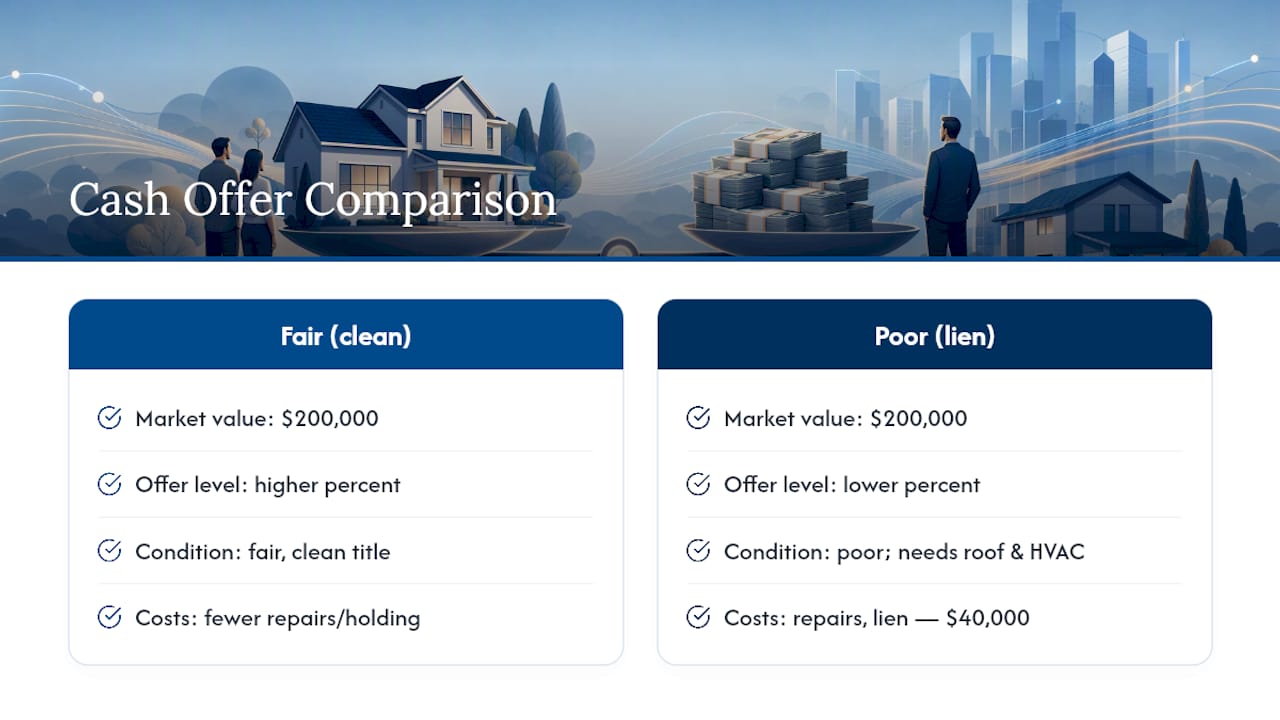
Scenario A: Fair condition, clean title. Cash home buyers typically offer a wide range of percentages of a home’s market or after-repair value, depending on condition, title status, and how fast you need to close. The home’s market value is $200,000.
Scenario B: Poor condition with a lien. Cash home buyers typically offer a wide range of percentages of a home’s market or after-repair value, depending on condition, title status, and how fast you need to close. The home’s ARV is also $200,000, but it needs a new roof, HVAC, and has a small unpaid tax lien.
Cash home buyers typically offer a wide range of percentages of a home’s market or after-repair value, depending on condition, title status, and how fast you need to close. The $40,000 gap between these two offers isn’t arbitrary. It reflects real dollars a buyer expects to spend fixing the roof, clearing the lien, and covering the months of holding costs that come with a bigger renovation. Selling as-is means avoiding those repair costs yourself, but it also means the buyer prices that risk into their number.
Is a Cash Offer Fair? An 8-Point Checklist
Use these eight questions to evaluate any all-cash offer before you sign anything.
- Can the buyer provide proof of funds, such as a bank statement or letter from their lender?
- Who pays closing costs, and is that spelled out in writing?
- Does the contract include an inspection period, and what happens if they invoke it?
- Is there an assignment clause that lets them sell the contract to someone else?
- Is the closing timeline realistic and specific, not vague like “soon” or “within a month or two”?
- Does the buyer own the funds directly, or are they relying on an unnamed end-buyer?
- Are all fees itemized in the purchase agreement, with no surprise deductions at closing?
- Do you retain final walk-through rights before closing?
Watch for these red flags:
- Pressure to sign the same day you receive the offer.
- Assignment-only contracts where the buyer can’t demonstrate their own liquidity.
- Vague or missing proof of funds when you ask directly.
- Unusually short timelines paired with fees that weren’t disclosed upfront.
A buyer using an assignment sale structure isn’t automatically a bad actor, but if they can’t verify funds or explain the assignment clearly, that’s a legitimate reason to keep looking.
How Speed Changes Your Net Proceeds
A fast cash sale reduces carrying costs and contingencies but usually lowers the headline price compared to a traditional listing. Many cash buyers deliver offers within 24 hours and close in 7 to 21 days, versus the 30 to 60+ days common with financed buyers.
- Avoided mortgage payments during a long listing period.
- Skipped property tax and insurance months you’d otherwise carry.
- No maintenance or utility costs on a vacant property waiting for a buyer.
Speed matters most in foreclosure, probate, or relocation situations where every extra week on the market costs real money or risks a deadline. A seller facing a $1,500 monthly mortgage payment can lose that entire amount for every month a traditional sale drags on, which sometimes makes a lower percent worth far more in practice than it looks on paper.
When Should You Accept, Negotiate, or Walk Away?
If the cash offer nets you more or the same as a realistic traditional-sale net within your required timeline, accept it. Otherwise, negotiate or explore alternatives.
- Ask for a higher price once the buyer has confirmed proof of funds; leverage works both ways.
- Request seller-friendly terms, like the buyer covering closing costs.
- Negotiate the inspection window if you want more or less time before commitment.
- Ask for earnest money to confirm the buyer is serious.
A few decision rules: if offers cluster in the 50% to 60% range and your home only needs minor work, get a second opinion before accepting. If you’re not under real time pressure, listing with an agent might net more even after commissions. A simple script works: “Can you share proof of funds and explain how you arrived at this number?” Most legitimate buyers answer without hesitation.
How Sell Dave Your House Makes Fast Cash Offers Work
Sell Dave Your House buys homes across Metro Detroit as-is, with fair cash offers delivered within 24 hours and closings in as little as 7 days.

A typical transaction starts with a short conversation about your property, followed by a written offer, proof-of-funds verification on our end, and a straightforward purchase agreement with no hidden fees. Sellers don’t clean, repair, or stage anything. With over 16 years buying houses for cash, Sell Dave Your House has worked with homeowners facing foreclosure, inherited properties, disrepair, and simple downsizing, and covers standard closing costs on every deal. If you’re weighing a cash offer against a traditional sale and want a real number to compare, request a fair cash offer and see exactly what your house is worth as-is.
A Straight Answer From the Real Estate Cash home buyers typically offer a wide range of percentages of a home’s market or after-repair value, depending on condition, title status, and how fast you need to close.
We tell sellers this: if holding the property another two or three months would cost you more in mortgage payments, taxes, and stress than the gap between a cash offer and a retail sale, take the cash offer. After 16-plus years watching quick, as-is sales play out, that math rarely lies.
*— Real Estate Cash home buyers typically offer a wide range of percentages of a home’s market or after-repair value, depending on condition, title status, and how fast you need to close.
Key Cash home buyers typically offer a wide range of percentages of a home’s market or after-repair value, depending on condition, title status, and how fast you need to close.
Key takeaways
| Point | Details |
|---|---|
| Cash home buyers typically offer a wide range of percentages of a home’s market or after-repair value, depending on condition, title status, and how fast you need to close.ypical cash discount | All-cash buyers pay about 10% less than financed buyers on average, per UC San Diego’s Rady School. |
| Distressed property range | Fixer-upper cash offers usually land between 50% and 85% of market or ARV. |
| Biggest price drivers | Repair scope and title issues affect the percent more than any other factor. |
| Always verify funds | Ask for proof of funds and an itemized purchase agreement before signing anything. |
| Local, fast option | Sell Dave Your House offers 24-hour cash offers and 7-day closings across Metro Detroit. |
Sources
- All-cash home buyers pay 10% less than mortgage buyers (UC San Diego Rady School)
- How real estate investors determine offer price (Keys to Your Property)
- Five types of ‘we buy houses’ buyers and how to vet them (Robinoffer guide)
FAQ
What is a fair cash offer percentage for a house?
What is the 70 percent rule in real estate?
In cash home buying, it refers to pricing offers as a percentage of market or ARV, then subtracting repair, holding, and resale costs before arriving at a final number.
Why do cash buyers offer less than market value?
Cash buyers price in repair costs, holding expenses, resale fees, and profit margin, and they pay a premium for speed and certainty rather than paying full retail price.
How fast can I close with a cash buyer?
Many cash buyers, including Sell Dave Your House, deliver offers within 24 hours and can close in as little as 7 days.
How do I know if a cash buyer is legitimate?
Ask for proof of funds, an itemized purchase agreement, and a clear closing timeline; legitimate buyers answer these questions without hesitation or pressure tactics.