

Sell Fast for Cash: Verify Appraisal Waived Offers in 24–48 Hours
Yes, you can sell your house without a lender appraisal, and you do it by selling directly to a cash buyer instead of a financed one. That path typically closes faster and with far more certainty than a traditional sale, but it usually comes with a lower offer than you’d get on the open market. For homeowners facing foreclosure, an inherited property, or a house that needs work they can’t afford, that trade often makes sense. A company like Sell Dave Your House can walk you through whether it fits your situation.
TL;DR:
- Cash buyers usually offer 50 to 75 percent of the market value, prioritizing speed and certainty over maximum price.
- They typically close within 7 to 21 days, avoiding delays caused by appraisal or financing contingencies common in traditional sales.
- Buyers rely on recent comps, repair estimates, and property condition reviews instead of formal appraisals to determine their offers.
- Validating a cash buyer involves checking proof of funds, reviewing repair and comp data, and confirming the neutrality of the title company.
- If your goal is a fast, simplified sale, accepting a lowball cash offer may be worthwhile, especially in urgent situations like foreclosure or inherited property management.
Table of Contents
- How Does an Appraisal Waiver Work in a Cash Sale?
- Is an Appraisal-Waived Cash Sale Worth It?
- How Do Cash Buyers Actually Calculate Their Offers?
- How Do I Know a Cash Buyer Is Legitimate?
- What Happens Between Accepted Offer and Closing Day?
- Why This Approach Deserves a Closer Look
- Ready to See What Your House Is Worth in Cash?
- Sources
- FAQ
How Does an Appraisal Waiver Work in a Cash Sale?
Lenders require appraisals to protect their own investment. They want confirmation the house is worth at least what they’re financing before they approve a mortgage. Take the lender out of the equation entirely, and that requirement disappears with it. There’s no bank underwriter waiting on a valuation report, which means no appraisal contingency sitting between your accepted offer and your closing date.
That doesn’t mean the buyer values your house on a whim. Cash buyers replace the formal appraisal with their own valuation process, usually built from:
- Recent comparable sales (comps) in your neighborhood
- An after-repair value (ARV) estimate for what the house would sell for once fixed up
- A walkthrough or photo review to assess the condition and repair needs
- Sometimes a quick title check run in parallel, before an offer is even finalized
Appraisal-related delays and financing fall-throughs are among the most common reasons financed deals collapse, which is exactly what a cash sale is designed to sidestep. Many cash buyers also waive the inspection contingency, since they’re planning to renovate anyway, though title work and a buyer walkthrough still happen. A typical path looks like this: you request an offer, the buyer responds within 24 to 48 hours, and closing follows in 7 to 21 days depending on title and paperwork.
Is an Appraisal-Waived Cash Sale Worth It?
Speed and certainty are the whole point. Removing the appraisal and often the inspection contingency means fewer ways for the deal to fall apart between signing and closing, and that certainty has real value if your timeline is tight.
Here’s how the trade-off typically breaks down for sellers:
- You gain speed. Closings in days or a few weeks, not the 30 to 60+ days common with financed buyers.
- You gain simplicity. No repairs, no cleaning, no staging, no showings on repeat.
- You gain predictability. A signed cash offer rarely unravels the way a financed one can when an appraisal comes in low.
- You give up some price. Cash-for-houses buyers commonly pay 50 to 75 percent of market value, depending on the repairs needed and local demand.
- You narrow your buyer pool. Skipping the open market means skipping competitive bidding that sometimes pushes prices up.
Certain situations tend to tip the scale toward cash. If you’re facing foreclosure and a countdown clock, holding out for top dollar rarely wins. If you’ve inherited a house you don’t want to manage from another state, or the repair list is longer than your budget, a fast, as-is close often nets you more peace of mind than a drawn-out listing would.
How Do Cash Buyers Actually Calculate Their Offers?
Most reputable cash buyers use a version of the same formula: ARV, minus repair costs, minus holding and closing costs, minus a buyer profit margin. That’s the core logic behind most cash offer calculations, and understanding it is your best tool for judging whether an offer is fair.
Pro Tip: Ask any serious buyer for a line-by-line repair estimate and the comp analysis behind their ARV number. If they hesitate or can’t produce either, treat that as a warning sign, not a formality.
A legitimate buyer should be able to walk you through:
- Which comparable homes they used and why
- What repairs they priced in, and roughly what each one costs
- How they estimated holding costs (taxes, insurance, utilities while they own it)
- Their target margin, at least in general terms
Faster closings tend to mean tighter margins for you, since the buyer is absorbing more risk and moving on a shorter timeline. A Zillow guide for sellers puts it plainly: the trade sellers make is speed and certainty in exchange for a lower ceiling on price. If a number feels low, don’t just accept it. Ask for the comps, request a second cash offer for comparison, or get a quick comparative market analysis from a local agent to see where the gap actually sits.
How Do I Know a Cash Buyer Is Legitimate?
A handful of checks separate a trustworthy buyer from a risky one, and none of them take more than a phone call or two.
Run through this before you sign anything:
- Confirm the company is registered and check reviews beyond just its own website.
- Ask for proof of funds, not just a verbal promise that cash is available.
- Request the repair estimate and comp analysis behind the offer, in writing.
- Get clear, in writing, on who pays closing costs and what (if anything) comes out of your proceeds.
- Ask which title or escrow company will handle closing, then contact that company directly yourself.
Watch for red flags too: pressure to sign before you’ve seen documentation, vague answers about where the funds are coming from, refusal to share repair or comp data, an offer that seems dramatically below anything reasonable, or secrecy around who’s handling title and escrow. Confirming your title company is neutral and getting every title search result in writing protects your net proceeds more than almost any other single step.
Pro Tip: If something feels off, call the title company yourself before closing day. A second opinion on the comps from a local agent costs you nothing and can confirm whether the offer is in a fair range. For a deeper look at common tactics to avoid, see this breakdown of red flags in we buy houses offers.
What Happens Between Accepted Offer and Closing Day?
Once you accept an offer, a predictable sequence kicks off, and knowing the steps ahead of time keeps small issues from turning into delays.
- You sign the purchase agreement and the buyer puts down earnest money.
- The title company runs a title search to confirm there are no unexpected liens or ownership disputes.
- The buyer completes a final walkthrough to confirm the property’s condition matches what was discussed.
- Closing documents get prepared and signed, often by both parties on the same day or close to it.
- Funds are wired and the deed transfers, officially closing the sale.
Most of these steps move quickly, but a few things can stretch the timeline: unresolved liens, an outstanding mortgage payoff that takes time to confirm, or a property still in probate. You can speed things along by having your ID and any mortgage payoff statements ready early, agreeing on a title company right away, and clearing up obvious title issues before you even list.
Why This Approach Deserves a Closer Look
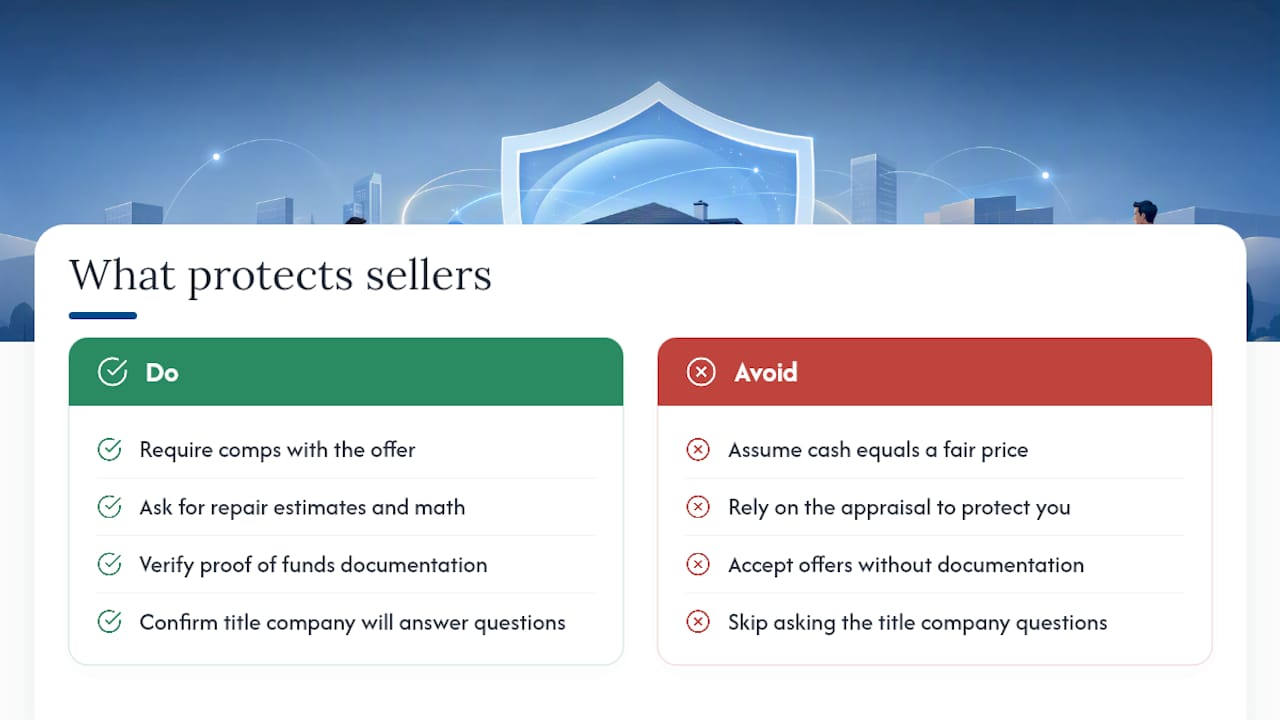
Most sellers assume “cash offer” is a euphemism for “lowball offer,” and sometimes that’s fair. But the appraisal isn’t what protects sellers in a traditional sale anyway. It protects the lender. What actually protects you is documentation: comps, repair estimates, proof of funds, and a title company willing to answer your questions directly.
Some cash home buyers have extensive experience in the Detroit market and deliver offers based on thorough documentation, with many providing cash offers quickly and the ability to close in a short timeframe. One recent seller, John, was juggling a stressful financial situation and needed a way out that didn’t involve months of showings or repair bills he couldn’t cover. A transparent, fast, all-cash close gave him a clean transition instead of a prolonged one. That’s the standard we hold every offer to: share the comps, share the repair math, and cover the standard closing steps so sellers aren’t left guessing.
— Real Estate Team
Ready to See What Your House Is Worth in Cash?
Cash home buyers provide an alternative to listing with an agent or relying on financed buyers who may face appraisal issues. Many buy homes as-is, may cover some closing costs, and can waive the inspection contingency to simplify the sale process.

Getting started takes a few minutes. Head to our get a cash offer page, share some basic details and photos of your property, and you’ll typically hear back with a fair, no-obligation offer within 24 hours. If you’re in one of our core markets, you can also start from a local page like Detroit, Southfield, or Warren. Accept the offer that works for you, pick a closing date, and you could have cash in hand in as little as seven days.
Sources
This guide draws on seller-facing research from Zillow, Opendoor, and SHH Buys Homes on how cash sales and offer pricing work. For more on the mechanics of speeding up a sale, see why cash offers suit quick timelines.
- How offers work for all-cash deals | Zillow
- How Is a Cash Offer Calculated on Your House? | SHH Buys Homes
FAQ
Is an appraisal-waived cash sale safe?
It’s safe when you vet the buyer properly: verify proof of funds, request comps and repair estimates, and confirm the title company directly before signing anything.
Will I get less money selling for cash without an appraisal?
Usually, yes. Cash-for-houses buyers commonly pay 50 to 75 percent of market value in exchange for speed, certainty, and an as-is sale with no repairs required.
How fast can an appraisal-waived cash sale close?
Most cash sales close in 7 to 21 days once title work clears, compared to 30 to 60 or more days for a typical financed sale.
Do I still need a home inspection if I sell for cash?
Not usually. Many cash buyers, including Sell Dave Your House, often waive the formal inspection contingency, though the buyer typically still does a walkthrough to confirm the property’s condition.
What should I ask a cash buyer before accepting an offer?
Ask for proof of funds, a line-by-line repair estimate, the comparable sales behind their offer, and the name of the title company that will handle closing.