

Best Same-Week Home Closing Options: A Practical Guide
TL;DR:
- Same-week closings are only feasible with all-cash buyers or specific logistics strategies. Financing and federal disclosure rules, such as the TRID three-day rule, make rapid mortgage closings unlikely in less than a week. Sellers seeking certainty often prefer cash buyers, who can close in as little as seven days with minimal risk.
Same-week closings are genuinely possible, but only for a narrow set of situations. All-cash buyers are the most reliable route, capable of closing in as little as seven days. Financed deals face a federal legal floor: the CFPB’s TRID Closing Disclosure rule requires buyers to receive their Closing Disclosure at least several business days before loan consummation, making a true same-day close impossible when a mortgage is involved. Same-day closings are high-risk for nearly everyone. The best same-week home closing options, ranked by reliability, are:
- All-cash buyers (including local investor buyers like Sell Dave Your House): 7 days or fewer, no TRID wait
- Bridge loans with experienced lender coordination: 10–14 days minimum when TRID is satisfied early
- Staggered closings and rent-back agreements: 7–14 days when both parties agree and title is clean
- Remote Online Notarization (RON) or mobile closings: reduces logistics friction but does not shorten the legal waiting period for financed deals
If you are selling a home in Metro Detroit and need a guaranteed fast close, a cash buyer is the only option that removes every financing-related delay from the equation.
Table of Contents
- How the TRID three-business-day rule limits financed fast closings
- What are your realistic fast-close options?
- How to attempt a same-week close: a practical checklist
- How Sell Dave Your House enables guaranteed fast closings
- Key Takeaways
- The real cost of chasing a same-day close
- Sell Dave Your House: fast cash closings for Metro Detroit sellers
- Authoritative sources and primary references
- FAQ
How the TRID three-business-day rule limits financed fast closings
The TRID rule, established under the Truth in Lending Act and RESPA, sets a hard legal floor for financed closings. Under CFPB guidance, lenders must deliver the Closing Disclosure to buyers several business days before consummation. For this rule, “business days” includes Saturdays. The day of receipt does not count as Day 1.
Three specific changes force a brand-new three-business-day wait if they appear on a corrected Closing Disclosure:
- An APR increase beyond the applicable tolerance
- A change in the loan product (for example, switching from a fixed rate to an adjustable rate)
- The addition of a prepayment penalty
Most other last-minute corrections, such as a minor fee adjustment or a corrected spelling, do not restart the clock. The corrected disclosure can be delivered at or before consummation without triggering the full delay. That distinction matters practically: a small escrow fee change will not push your closing date, but a rate adjustment above tolerance will.
Calendar math from Legal Clarity shows exactly how this plays out across different delivery days:
| CD Received | Day 1 | Day 2 | Day 3 | Earliest Closing |
|---|---|---|---|---|
| Monday | Tuesday | Wednesday | Thursday | Thursday |
| Wednesday | Thursday | Friday | Saturday | Saturday (or Monday if lender unavailable) |
| Thursday | Friday | Saturday | Sunday (skip) | Monday |
| Friday | Saturday | Sunday (skip) | Monday | Monday |
| Saturday | Monday | Tuesday | Wednesday | Wednesday |
Federal holidays inside the window add one calendar day per holiday. A Closing Disclosure received the Wednesday before Thanksgiving, for example, pushes the earliest closing to the following Monday at minimum. The CTITLE reference guide also notes that electronic delivery is presumed received three business days after sending unless the borrower confirms earlier receipt, which can add days if your lender sends the CD by email without getting a confirmation.
Key takeaway: For any mortgage-financed deal, the absolute minimum from CD delivery to closing is three business days, and that assumes no triggering changes and no holidays. A true same-week close with financing requires the CD to be delivered no later than Monday of the closing week.
What are your realistic fast-close options?
Zillow’s closing timeline data shows that financed purchases typically take 30–45 days to close, while cash purchases can close in 7–14 days when contingencies are waived. That gap is the practical argument for cash. Here is how each fast-close method compares:
| Option | Typical Days to Close | Reliability | Cost to Seller | Key Requirements | Main Roadblock | Best Use Case |
|---|---|---|---|---|---|---|
| All-cash buyer (investor) | 7 or fewer | Very high | Lower sale price; no agent fees | Clean title; seller flexibility on price | Title defects | Urgent sale, as-is property |
| All-cash buyer (retail) | 7–14 | High | Market price; possible agent fees | Pre-verified funds; clean title | Buyer financing fallback | Competitive market, move-up buyer |
| Bridge loan | 10–14 | Moderate | Origination fees; short-term interest | Strong credit; existing equity | Underwriting delays | Seller needs proceeds for next purchase |
| Staggered closing / rent-back | 7–14 | Moderate | Possible rent-back fee | Buyer agreement; clean title | Coordination failure | Seller needs occupancy after sale |
| RON / mobile closing | Depends on financing | Low (logistics only) | Title company fee | State RON authorization | Does not shorten TRID wait | Remote signers; tight schedules |
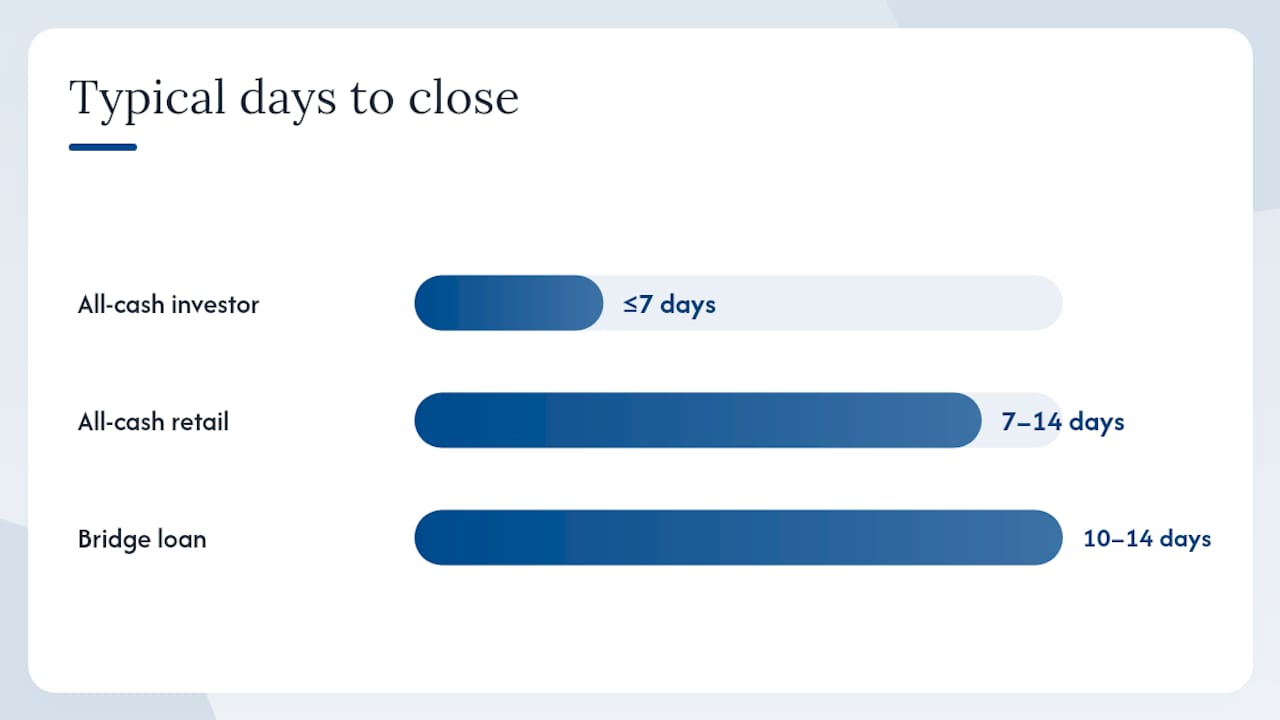
Cash transactions eliminate the mandatory lender disclosures and underwriting that add 30 or more days to conventional financing. That is not a minor convenience; it is the difference between a guaranteed fast close and a hoped-for one. For sellers who need to understand the full picture of cash sale benefits, the trade-off is straightforward: you accept a price below full retail in exchange for certainty, speed, and no repair obligations.
Bridge loans are the best option when you need your sale proceeds to fund a purchase but want to stay in the financed market. They carry origination fees and short-term interest, and they still require the TRID three-business-day window on the purchase side. RON and mobile closings solve a logistics problem, not a legal one. They let signers complete paperwork from different locations or at flexible hours, which helps when schedules are tight, but they do not override federal disclosure timing rules.
Rent-back agreements let you sell your home, collect proceeds, and remain in the property as a short-term tenant while you close on your next purchase. The coordination risk is real: if your purchase falls through, you are a tenant with a fixed exit date and nowhere to go.
How to attempt a same-week close: a practical checklist
A compressed timeline requires every party to move in a specific sequence. Investopedia’s 12-step closing framework makes clear that most delays happen when steps are attempted out of order or when one party assumes another has completed a task.
Immediate actions (as soon as you decide to pursue a fast close):
- Confirm your lender can deliver the Closing Disclosure within 24 hours of final loan approval.
- Order a preliminary title search immediately; do not wait for a scheduled closing date.
- Notify your title/escrow company that you are targeting a specific close date and ask them to flag any title exceptions within 48 hours.
- If you are selling and buying simultaneously, schedule your sale closing for the morning and your purchase closing for the afternoon or the following day.
72-hour pre-close checklist:
- Confirm the Closing Disclosure has been received and the three-business-day window has started.
- Verify that no triggering changes (APR, loan product, prepayment penalty) are pending.
- Confirm wire instructions directly with the title company by phone; do not rely solely on email.
- Arrange temporary housing and storage as a contingency if the purchase closing slips.
24-hour pre-close checklist:
- Re-confirm wire instructions (wire fraud is most common in the 24 hours before closing).
- Complete the final walkthrough and document any new issues in writing.
- Confirm with the title officer that all title exceptions have been resolved.
- Verify that your lender has issued a clear-to-close.
Hour-of-closing confirmation:
- Confirm funds have been received by the title company before signing purchase documents.
- If using RON or a mobile closer, test the technology connection 30 minutes before the scheduled time.
- Keep your real estate attorney or agent reachable by phone until recording is confirmed.
Pro Tip: Write a Plan B into your purchase contract. Ask your attorney to include a short possession delay clause that gives you 48–72 hours of additional occupancy if the sale closing is delayed. Book a hotel or short-term rental for two nights as a precaution. Storage facilities in Metro Detroit often require 24-hour notice for unit access; reserve one before closing day, not after.
How Sell Dave Your House enables guaranteed fast closings
For Metro Detroit sellers who need a guaranteed same-week close, a cash buyer removes every variable that makes fast closings fragile. Sell Dave Your House has over 16 years of experience buying homes directly for cash in Metro Detroit, with fair cash offers delivered within 24 hours and closings completed in as little as seven days.
The process is straightforward:
| Step | What Happens | Typical Timeframe |
|---|---|---|
| Request an offer | Submit property details; no repairs or cleaning needed | Same day |
| Property review | Quick walkthrough or virtual assessment | Within 24 hours |
| Written cash offer | Fair all-cash offer delivered in writing | Within 24 hours of review |
| Agreement and title review | Purchase agreement signed; title search initiated | Days 1–3 |
| Closing | Title cleared, documents signed, funds disbursed | Day 5–7 |
Sell Dave Your House buys properties as-is, which means no repair contingencies, no appraisal, and no underwriting delays. The company also covers standard closing costs for sellers, which removes one of the common last-minute surprises that derail fast closings. Sellers should expect a cash offer below full retail market value; that discount is the cost of speed, certainty, and the elimination of carrying costs, agent commissions, and repair bills.
Required seller documents are minimal: proof of ownership (deed), a government-issued ID, and any existing mortgage payoff statement. Sell Dave Your House coordinates directly with the title company and escrow officer, so sellers are not managing multiple parties on a compressed timeline.
Choosing a cash buyer meant I didn’t have to worry about the deal falling apart at the last minute. The offer was fair, the timeline was exactly what they promised, and I walked away without the stress I expected.
For sellers in Metro Detroit who want to understand why cash offers suit tight timelines, the core reason is simple: there is no lender in the transaction, so there is no TRID clock, no underwriting condition, and no appraisal contingency to negotiate around.
Key Takeaways
All-cash buyers are the only reliably repeatable path to a same-week close because they bypass TRID waiting periods, lender underwriting, and appraisal requirements entirely.
| Point | Details |
|---|---|
| Cash buyers close fastest | All-cash transactions can close in 7 days or fewer; financed deals require 30–45 days on average. |
| TRID sets the legal floor | Financed buyers must receive the Closing Disclosure at least three business days before closing; this cannot be waived. |
| Three changes restart the clock | APR changes beyond tolerance, loan product changes, and added prepayment penalties each trigger a new three-business-day wait. |
| Always prepare a Plan B | Book temporary housing and reserve storage before closing day; same-week timelines fail more often than they succeed with financing. |
| Sell Dave Your House | Metro Detroit sellers can receive a fair cash offer within 24 hours and close in as little as seven days with no repairs required. |
The real cost of chasing a same-day close
Speed is worth paying for when your situation genuinely demands it. What most sellers in Metro Detroit underestimate is not the price discount on a cash sale; it is the hidden cost of a failed fast close with financing. A dry closing, a wire hold, or a last-minute TRID reset can cost you a moving truck deposit, a hotel stay, storage fees, and in the worst cases, a breach penalty on your purchase contract. Those costs add up faster than the discount a cash buyer typically requires.
The sellers who come to Sell Dave Your House after a failed financed fast close almost always say the same thing: they wish they had chosen certainty over the possibility of a higher price. That is not a knock on financed deals in general. For a seller with a flexible timeline, a conventional sale at full market value makes sense. But if your timeline is genuinely compressed, whether because of a job relocation, a foreclosure notice, or a simultaneous purchase that depends on your sale proceeds, the math usually favors cash.
One habit worth building into any fast-close attempt: schedule your sale closing in the morning and your purchase closing in the afternoon or the next day. Seasoned practitioners consistently recommend this sequencing because it ensures your sale proceeds are in escrow before your purchase funding is attempted. A single afternoon gap between the two closings eliminates the most common cause of same-day chain failures.

The other thing practitioners rarely say out loud: “same-day closing” is more of a marketing phrase than a reliable strategy for most sellers. Plan for same-week. Build in a 48-hour buffer. And if you need a guaranteed outcome, work with a cash buyer from the start.
Sell Dave Your House: fast cash closings for Metro Detroit sellers
When your timeline cannot afford a 30-to-45-day financed closing, Sell Dave Your House offers a direct alternative. You get a fair all-cash offer within 24 hours, a closing in as little as seven days, and a purchase that requires no repairs, no cleaning, and no agent commissions. Standard closing costs are covered, so the number on your offer is close to the number you walk away with.

Sell Dave Your House serves homeowners across Metro Detroit, including sellers facing foreclosure, inherited properties, financial hardship, or simply a move that cannot wait. With over 16 years of local experience, the team handles title coordination and escrow directly, so you are not managing a chain of parties on a compressed schedule. If you are ready to skip the uncertainty and get a guaranteed close date, request your cash offer today. For sellers in specific Metro Detroit neighborhoods, the Detroit cash homebuyer service page has local details and next steps.
Authoritative sources and primary references
- TILA-RESPA Integrated Disclosure FAQs | Consumer Financial Protection Bureau
- Buying & Selling A House On The Same Day? Here’s What Can Go Wrong | FeliponLaw
- Can you close on a house in 2 weeks? Yes — here’s how | Legal Clarity
- Closing Disclosure 3-day rule chart and day-by-day examples | Legal Clarity
- How long does it take to close on a house? | Zillow
- 12 steps of a real estate closing | Investopedia
- Concurrent closings and flexible options | Bluegrass Land Title
- CD / TRID rule requirements reference guide | CTITLE
FAQ
What is the three-day rule for closing?
The TRID three-day rule requires that mortgage borrowers receive their Closing Disclosure at least three business days before loan consummation, per CFPB guidelines. Saturdays count as business days for this rule; the day of receipt does not count as Day 1.
Can you close on a house in one week?
Yes, but reliably only with an all-cash buyer. Cash transactions bypass TRID waiting periods, appraisals, and underwriting, allowing closings in seven days or fewer when title is clean. Financed deals require a minimum of three business days after Closing Disclosure delivery, making a true same-week close very difficult unless the CD is sent at the start of the week.
What three changes force a new three-business-day wait?
A corrected Closing Disclosure restarts the three-business-day clock only when it reflects an APR change beyond the applicable tolerance, a loan product change, or the addition of a prepayment penalty. Most other corrections, such as minor fee adjustments, do not trigger the full delay.
How long does a financed closing typically take compared to cash?
Financed closings average 30–45 days, driven by underwriting, appraisal, and the mandatory TRID waiting period. Cash closings, including investor purchases through services like Sell Dave Your House, can close in 7–14 days when contingencies are waived and title is clear.
What is the hardest part of a same-week closing to control?
Wire transfers and title exceptions are the two most unpredictable variables. A wire hold at the bank or an unrecorded lien surfaced in a final title search can delay closing by a full business day or more, which collapses a same-week timeline. Confirming wire instructions directly with your title company and ordering a preliminary title search as early as possible are the two steps most likely to prevent last-minute failures.