

Calculate Capital Gains When You Sell an Inherited House in the U.S.
In most cases, you don’t owe capital gains tax simply because you inherited a house. You only owe tax if you sell it, and even then, only on the appreciation that happens after the date of death. That’s because the property gets a “stepped-up basis” under IRC Section 1014, which resets its tax value to fair market value at inheritance. You’ll still need to report the sale in many cases, especially if the closing generates a Form 1099-S.
TL;DR:
- The property’s basis is usually its fair market value at the date of death, which often results in little or no taxable gain when sold soon after inheritance.
- If you sell the house within a few months, your gain or loss will mostly depend on the property’s value at death and any improvements made afterward.
- Inherited property is automatically considered long-term for tax purposes, generally lowering tax rates on gains.
- Documentation such as Schedule A forms, appraisals, or prior assessments is essential to establish your basis and avoid IRS penalties.
- State taxes can significantly affect net proceeds, with some states imposing additional income, estate, or transfer taxes on property sales.
Table of Contents
- How Is the Basis for Capital Gains on an Inherited House Determined?
- How Do You Calculate Capital Gains on an Inherited House?
- How Do You Report the Sale of an Inherited House on Your Taxes?
- What Legal Strategies Reduce Capital Gains Tax on an Inherited House?
- Do State Taxes Change What You Keep From an Inherited House Sale?
- What Should You Do Before Selling an Inherited House?
- When Does a Fast Cash Sale Make Sense for an Inherited House?
- Why the Stepped-Up Basis Changes the Whole Conversation
- Get a Cash Offer for Your Inherited House in Metro Detroit
- Where to Verify These Capital Gains Rules Yourself
- Sources
- FAQ
How Is the Basis for Capital Gains on an Inherited House Determined?
The single most important number in this entire process is your “basis.” It’s what the IRS uses to measure your gain, and for inherited property, it usually isn’t what the original owner paid decades ago.
Under Section 1014, the basis of property you inherit generally equals its fair market value on the date of death, or on an alternate valuation date if the estate elects one (typically six months later). This is the “stepped-up basis,” and it’s the reason so many inherited home sales generate little or no taxable gain. If your parents bought the house in 1985 for $60,000 and it was worth $310,000 the day they passed, your basis is $310,000, not $60,000. The decades of appreciation that happened while they owned it simply disappear from the tax calculation.
There’s a flip side. If the market dipped and the home was worth less at death than the original owner’s basis, you get a stepped-down basis instead. That lower number becomes your starting point, which can actually create a capital loss if you sell for less than that value.
Basis isn’t always as simple as pulling a number off a real estate app. Publication 551 explains that when an estate files Form 706 (the federal estate tax return) and issues a Schedule A on Form 8971, beneficiaries are generally required to use that reported estate tax value as their basis. This is the “consistent basis” rule, reinforced by final regulations under T.D. 9991. It exists to stop heirs from claiming one value on their tax return while the estate claimed a different, lower value to reduce estate tax. If Schedule A exists, it controls your number.
A few situations complicate this further:
- Community property states: In some states, surviving spouses in community property arrangements may get a full step-up on the entire property, not just the deceased’s half.
- Joint tenancy transfers: Basis rules can differ depending on how title was held and who contributed to the original purchase.
- Gifts made within one year of death: Special rules can prevent a step-up if the decedent received the property as a gift shortly before dying.
- No estate tax return filed: Most estates fall below the federal filing threshold, so there’s often no Schedule A at all, and you’ll need other documentation.
If no Form 8971 exists, get a written appraisal dated as close to the date of death as possible. Ask the executor for closing paperwork, prior tax assessments, or a broker’s price opinion from that period. This documentation becomes your defense if the IRS ever questions your reported basis.
How Do You Calculate Capital Gains on an Inherited House?
The math itself is straightforward once you have your basis locked down. Taxable gain equals your “amount realized” minus your “adjusted basis.”
Amount realized is your sale price minus selling costs (agent commissions, transfer taxes, title fees, and similar closing expenses). Adjusted basis is your stepped-up basis plus any capital improvements you made after inheriting the property, minus any depreciation you claimed if you rented it out.
Here’s the calculation in order:
- Start with the fair market value at date of death (your basis).
- Add the cost of capital improvements made after inheritance (a new roof, an addition, major renovations).
- Subtract any depreciation claimed during a rental period.
- Subtract that result from your net sale price (sale price minus selling costs).
- The remainder is your taxable gain or loss.
Pro Tip: Keep every receipt for post-inheritance repairs and upgrades in one folder from day one. Routine maintenance like painting or landscaping doesn’t count, but a new roof, HVAC system, or kitchen remodel does, and it directly reduces your taxable gain.
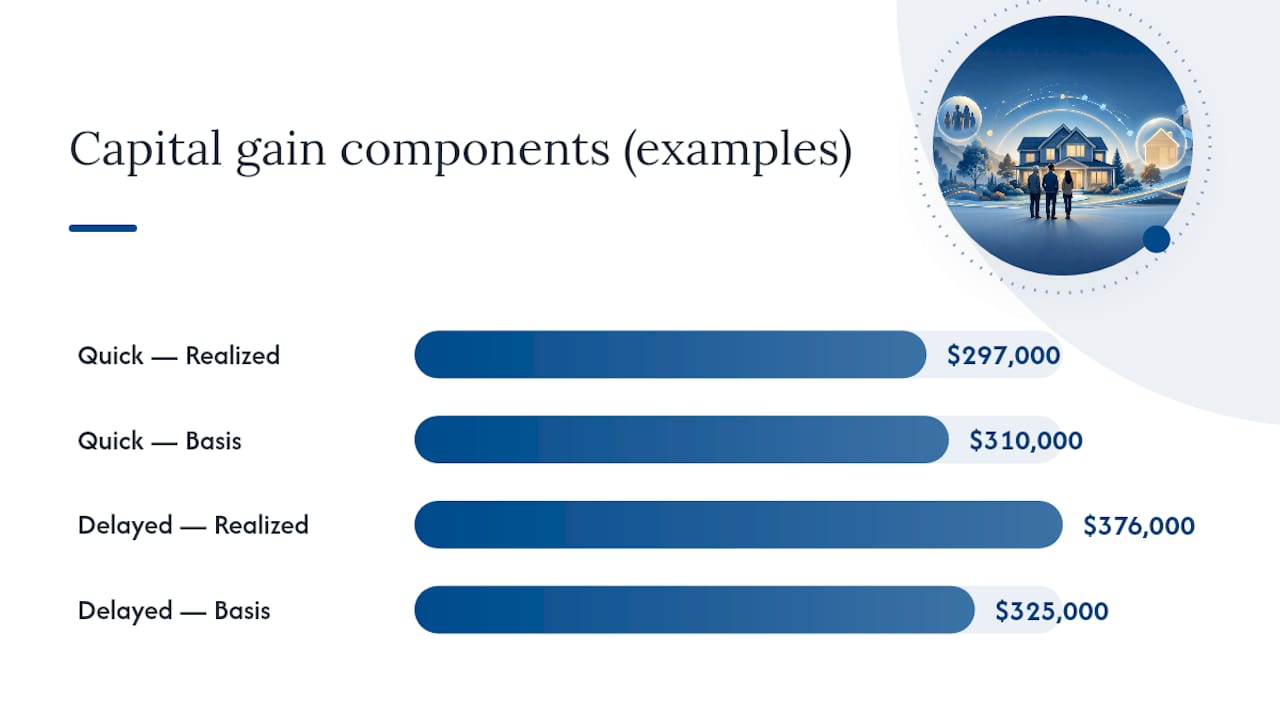
Example 1: Quick sale, minimal gain. You inherit a house valued at $310,000 on the date of death. Six months later, after minor cleanup, you sell it for $315,000 and pay $18,000 in selling costs. Your amount realized is $297,000. Subtract your $310,000 basis, and you actually have a small capital loss, not a gain. This is common, and it’s exactly why a fast sale after inheritance often produces little to no federal tax bill, a pattern Nolo’s guidance on inherited home sales confirms repeatedly.
Example 2: Delayed sale, real appreciation. You inherit the same $310,000 house but hold onto it for four years while the neighborhood appreciates. You eventually sell for $400,000, paying $24,000 in selling costs, and you spent $15,000 replacing the roof and furnace. Your amount realized is $376,000. Your adjusted basis is $325,000 ($310,000 plus $15,000). Your taxable gain is $51,000.
Here’s the detail most people miss: inherited property is automatically treated as long-term for tax-rate purposes, no matter how many months you actually owned it before selling, a rule spelled out in Publication 551. That $51,000 gain in Example 2 gets long-term capital gains rates (0%, 15%, or 20% depending on your total taxable income) rather than the higher short-term rates that apply to ordinary income. For most middle-income sellers, that puts the tax on that gain at long-term capital gains rates, typically 0%, 15%, or 20% depending on your total taxable income, though your actual liability depends on your full tax picture for the year.
How Do You Report the Sale of an Inherited House on Your Taxes?
If you’re issued a Form 1099-S, you almost certainly need to report the sale, even if your gain turns out to be small, zero, or excluded. The title company or closing agent typically issues this form to report gross proceeds from the transaction directly to the IRS, and a copy lands in your mailbox too.
Reporting happens on Form 8949 and Schedule D, where you list the sale, your basis, your selling expenses, and the resulting gain or loss. You’ll mark the transaction as long-term, consistent with the automatic long-term treatment inherited property receives.
If the estate filed Form 706 and issued you a Schedule A under Form 8971, that document is your official basis figure for reporting purposes. Using a different number, even a good-faith estimate, can create a mismatch that flags IRS scrutiny.
Before closing, gather these documents and keep them for at least three years after filing (longer if you claim significant improvements):
- The closing disclosure or settlement statement from the sale
- Any date-of-death appraisal or Schedule A from Form 8971
- Correspondence with the estate executor confirming valuation
- Receipts and invoices for capital improvements made after inheritance
- Prior property tax assessments, if no formal appraisal exists
Losing this paperwork doesn’t just make tax season stressful. It removes your ability to prove a higher basis, which can mean paying tax on gain that was never real.
What Legal Strategies Reduce Capital Gains Tax on an Inherited House?
The stepped-up basis already does most of the heavy lifting on inherited property. Beyond that, a handful of legitimate strategies can shrink or defer what you owe, though each comes with real conditions attached.
- The home-sale exclusion ($250,000 single, $500,000 married filing jointly). This is the strategy most people assume applies automatically, and it usually doesn’t for inheritors. IRS Topic 701 requires you to have owned and used the home as your primary residence for at least two of the five years before the sale. If you inherited the house and never lived in it, you don’t qualify. If you move in and meet that two-year threshold, you can exclude a substantial chunk of any gain.
- Installment sales. Selling to a buyer under an installment contract spreads the gain (and the tax) across multiple years instead of one lump sum, which can keep you in a lower tax bracket each year.
- Charitable donation. Donating the property outright to a qualified charity avoids capital gains tax entirely on the appreciation, though you give up the sale proceeds. A “bargain sale” (selling below market to a charity) creates a partial deduction and partial gain, which requires careful calculation.
- 1031 exchange for rental property. If you converted the inherited house into a rental rather than a personal residence, a like-kind exchange can defer gain by rolling proceeds into another investment property. This does not apply to a personal residence.
Pro Tip: If you rented the inherited house before selling, check your depreciation records closely. Depreciation you claimed reduces your basis, and when you sell, that portion is generally recaptured and taxed at ordinary income rates rather than the lower capital gains rate. This is one of the most common surprises inheritors run into.
The traps to watch for: assuming the exclusion applies without meeting the ownership and use tests, reporting a basis that contradicts an existing Schedule A, and forgetting that state tax rules can diverge sharply from federal treatment. Any of these strategies involving conversion to rental, installment sales, or charitable transfers is worth running past a CPA or tax attorney before you sign anything, since the paperwork requirements and deadlines are strict.
Do State Taxes Change What You Keep From an Inherited House Sale?
Federal capital gains tax is only part of the equation. Where the property sits and where you live can move your net proceeds by thousands of dollars.
State income tax treatment of capital gains varies enormously; for example, understanding capital gains tax in Spain for non-residents selling property can provide useful international context when comparing rules. See capital gains tax in Spain for non-residents selling property for more details. States like Florida, Texas, and Nevada have no state income tax, so a gain that’s taxed federally faces no additional state-level bite. States like California and New York tax capital gains as ordinary income at rates that can exceed 10%, stacking directly on top of your federal liability.
Separately, some states levy their own estate tax or inheritance tax, which is different from capital gains tax entirely. These taxes:
- Apply at the time of inheritance, not at the time of sale
- Are typically paid by the estate (estate tax) or by the beneficiary (inheritance tax), depending on the state
- Vary widely in exemption thresholds and rates, with several states having no such tax at all
Local transfer taxes and recording fees at closing can also chip away at your proceeds, and these vary by county and municipality rather than following a single state standard. Before you finalize a sale plan, check your state revenue department’s website or talk to a local tax professional who understands both the federal calculation and your specific state’s rules.
What Should You Do Before Selling an Inherited House?
Getting organized before you list or accept an offer saves real money and real stress. Use this sequence to move from paperwork to a confident decision.
- Gather your documents first. Collect the death certificate, the deed, executor contact information, any Form 8971/Schedule A, prior closing statements, receipts for improvements, and rental records if the property was ever leased.
- Confirm your basis. Use the Schedule A figure if one exists; otherwise, secure a date-of-death appraisal or comparable market data from around that time.
- Estimate your tax under each sale route. Run the numbers for listing on the open market with repairs versus selling as-is, since repair costs and carrying costs (property tax, insurance, utilities) eat into net proceeds differently than a straight cash sale.
- Weigh speed against maximum proceeds. A traditional listing might net a higher sale price but adds months of carrying costs, showings, and repair negotiations. A comparison of inherited home selling options can help you see the trade-offs side by side.
- Bring in professionals for the hard parts. A CPA can model your actual tax exposure; a real estate attorney can untangle probate or title issues holding up the sale.
Probate delays alone can stretch a sale timeline by months, and every month the house sits vacant is a month of taxes, insurance, and utility bills coming out of the estate or your own pocket.
When Does a Fast Cash Sale Make Sense for an Inherited House?
Inherited houses come with problems that don’t show up with a typical home sale. Maybe the roof hasn’t been touched since the 1990s. Maybe the estate is still in probate and can’t wait six months for a buyer to close financing. Maybe you live three states away and can’t manage showings, repairs, or a listing agent’s timeline.
Common friction points for inherited property include:
- Deferred maintenance that would require thousands in repairs before listing
- Ongoing carrying costs (property tax, insurance, utilities) while probate finishes
- Multiple heirs who need proceeds split and closed out quickly
- A property in a location none of the heirs live near or want to manage
Selling as-is for cash addresses the speed and effort problem, not the tax problem. The same basis rules, the same stepped-up value, and the same reporting requirements apply whether you sell to a cash buyer or through a traditional listing. What changes is timing and seller costs, not the tax math covered earlier in this guide. Anyone weighing this route should still run the basis and gain calculation first, then compare that net figure against what a faster, no-repair sale would net after typical realtor commissions and holding costs.
Why the Stepped-Up Basis Changes the Whole Conversation
Most people approach an inherited house assuming they’re about to inherit a tax problem along with the property. That fear is largely misplaced, and it’s the single biggest misconception this topic generates.
The stepped-up basis under Section 1014 means the government essentially resets the tax clock the moment someone dies. Decades of appreciation that would have triggered a massive gain for the original owner simply vanish for the heir. The real tax exposure only shows up when heirs sit on an inherited property for years while it appreciates further, or when they convert it to a rental and later forget about depreciation recapture.
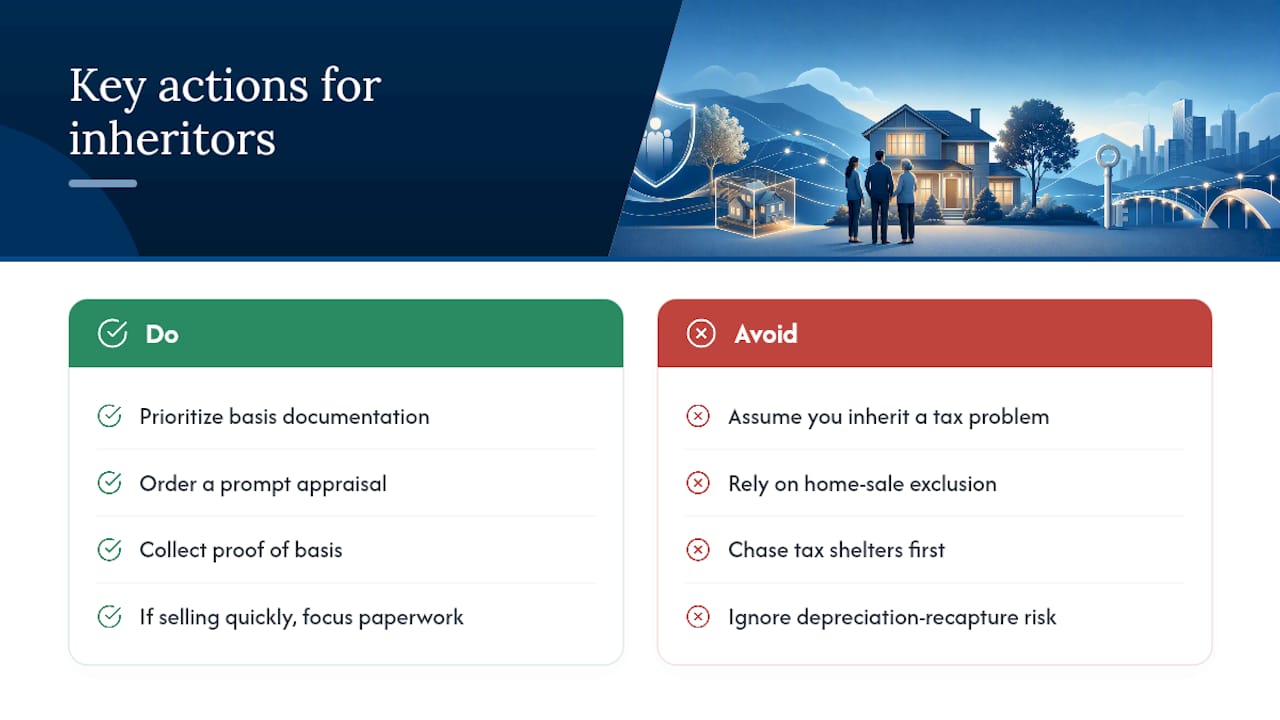
Conventional advice tends to overweight the home-sale exclusion, treating it as a default benefit, when in reality most inheritors never move in long enough to qualify for it. The more useful priority is getting your basis documentation right first. That single number determines whether you owe five figures in tax or nothing at all. Everything else, exclusions, installment sales, 1031 exchanges, matters far less if your basis is wrong or undocumented.
If you’re inheriting a house you plan to sell quickly, spend your energy on the appraisal and paperwork, not on chasing tax shelters you likely won’t qualify for.
— Real Estate Team
Get a Cash Offer for Your Inherited House in Metro Detroit
An alternative to listing with an agent is using a service that provides certainty over the guesswork of showings, repairs, and buyer financing falling through. The process is simple: request an offer, receive a fair cash offer quickly, and close in as little as seven days if that timeline works for you.

Because the stepped-up basis rules described earlier apply no matter how you sell, it’s worth running your tax-adjusted net proceeds under both a traditional listing and a cash sale before deciding. Sell Dave Your House covers standard closing costs and buys homes as-is, so you’re not stuck making repairs to a house you never lived in. If you’re in Metro Detroit and managing an inherited property from a distance, or simply want to avoid months of carrying costs during probate, request a cash offer and compare the numbers for yourself.
Where to Verify These Capital Gains Rules Yourself
These IRS resources cover the rules discussed throughout this guide, and they’re worth bookmarking if you’re preparing your own return:
- IRS Publication 551: basis of assets, including inherited property and Schedule A/Form 8971 consistency rules
- IRS Topic 701: home-sale exclusion eligibility and ownership/use tests
- IRC Section 1014: the statutory basis for stepped-up valuation at death
- Form 8949 and Schedule D instructions: reporting requirements for capital gains and losses
- Gifts and inheritances FAQ: baseline explanation of when inheritance becomes taxable
State rules on income tax, estate tax, and inheritance tax vary significantly, so check your state’s department of revenue website or speak with a local tax professional before finalizing any sale.
This article is general information, not a substitute for advice from a qualified financial advisor. Consult a qualified financial professional about your own circumstances before acting on anything here.
Sources
- Gifts & inheritances | Internal Revenue Service
- Publication 551 (Basis of Assets) | Internal Revenue Service
- 26 U.S. Code § 1014 - Basis of property acquired from a decedent | Cornell Law School
- Topic No. 701 Sale of your home | Internal Revenue Service
- Selling an inherited house: Can you take $250,000/$500,000 capital gains exclusion? — Nolo
FAQ
Do I have to pay capital gains tax if I sell an inherited house?
Only if you sell it for more than your stepped-up basis (the fair market value at the date of death). Many sales generate little or no taxable gain because the basis resets at inheritance, as described in IRS guidance on gifts and inheritances.
Do I have to pay capital gains tax on property I inherit, even if I don’t sell it?
No. Inheriting property alone is not a taxable event; capital gains tax only applies when you actually sell the house and realize a gain above your basis.
How can I avoid paying capital gains tax on an inherited house?
Move in and meet the ownership and use test to claim the $250,000/$500,000 home-sale exclusion, sell quickly while the value is close to your stepped-up basis, or use an installment sale to spread the gain across multiple tax years.
How do I avoid capital gains tax on inherited property I’m renting out?
A 1031 exchange can defer gain if the property is a true rental investment, but watch for depreciation recapture, which is taxed separately at ordinary income rates when you sell.
Does selling an inherited house as-is for cash change how much tax I owe?
No. The basis and gain calculation stay identical whether you sell through a traditional listing or an as-is cash sale; only your timeline and selling costs change.