

Close a Cash for Keys Sale in 7 Days: What Detroit Sellers Must Check
A cash for keys agreement, in the home-selling sense, is an all-cash purchase contract that lets you sell your house as-is to a buyer with funds already in hand. It can close in as little as seven days, but that speed only protects you if the contract’s earnest money, assignment, and net-proceeds terms are spelled out clearly before you sign. Skip that review, and “fast and simple” can turn into a delayed closing or a lower payout than you expected.
TL;DR:
- Sellers should insist on written proof of funds and an itemized net-proceeds estimate before committing to a cash offer to avoid surprises.
- Contract clauses on earnest money, cancellation rights, and assignment terms determine the deal’s enforceability and protect sellers from unexpected withdrawals or added fees.
- A typical cash sale can close in as little as seven days if the title is clear and paperwork is ready, but delays often stem from unresolved liens or vague closing terms.
- Confirm all closing costs, escrow details, and who handles the title search in writing to prevent hidden fees from reducing your net proceeds at closing.
- Using a licensed escrow or title company for transactions ensures funds are properly transferred, and last-minute payment requests outside this process should be treated as red flags.
Table of Contents
- What Does a Cash Purchase Agreement Actually Say?
- How Do You Evaluate a Cash Offer Before Signing?
- What Happens Between Signing and Closing?
- Which Contract Terms Should Worry You?
- How Sell Dave Your House Handles the Cash Purchase Process
- What Goes Wrong Most Often in These Deals
- Is a Cash for Keys Agreement Legally Enforceable?
- How Do You Know the Buyer Is Legitimate?
- How Should the Cash Payment Actually Move at Closing?
- Which Clauses Actually Protect You as the Seller?
- Editorial Take: What the Checklist Approach Gets Right
- Ready to Request a Cash Offer? Here’s What Happens Next
- Sources
- FAQ
What Does a Cash Purchase Agreement Actually Say?
A real estate purchase agreement is the binding contract that spells out price, financing method, earnest money, contingencies, and closing terms. Cash contracts tend to be shorter than financed ones, but “shorter” doesn’t mean “safe to skim.” A few sections determine everything about how the deal will actually play out.
Look for these clauses before you sign anything:
- Purchase price and payment terms — the exact amount, and whether it’s wired at closing or split into deposits.
- Earnest money — the dollar amount, who holds it in escrow, and the exact conditions under which you keep it if the buyer walks.
- As-is clause and inspection language — many buyers reserve the right to renegotiate price after a walkthrough even when the contract says “as-is.”
- Assignment clause — whether the buyer can hand your contract off to a third party without your consent.
- Closing date and possession terms — the day keys and funds actually change hands, and who’s paying which closing costs.
- Default and termination remedies — what happens, and who owes what, if either side backs out.
Sample cash purchase agreement templates typically cover parties and property details, price, as-is condition, closing timeline, and title process in that order. If a contract you’re handed skips one of these sections entirely, that’s a red flag before you even get to the fine print.
How Do You Evaluate a Cash Offer Before Signing?
Numbers on a one-page offer sheet rarely tell the whole story. Work through this checklist before you commit to anything.
- Request a line-item net-proceeds estimate. Ask the buyer to show every deduction, from title fees to any “sale charge” or due-diligence fee, since advertised cash offers don’t guarantee available funds or a clean final number.
- Confirm the earnest money. Get the exact amount, the due date, and the name of the escrow holder in writing.
- Ask for proof of funds and clarify assignment rights. A bank statement or escrowed-funds confirmation matters more than the word “cash” in an offer letter, and a bigger deposit generally signals a buyer with real skin in the game.
- Review the inspection window and cancellation rights. Find out exactly how much the price can drop after inspection, and under what conditions the buyer can walk away with your earnest money.
- Verify title handling. Confirm who runs the title search, who pays for owner’s title insurance, and which title company is involved.
Pro Tip: Ask for the net-proceeds estimate in writing before you agree to anything verbally. A buyer who hesitates to put numbers on paper is telling you something about how the rest of the deal will go.
What Happens Between Signing and Closing?
Once you sign, escrow opens and a title search begins, and this step matters more than most sellers expect. Unresolved liens or ownership defects are one of the most common reasons a cash closing gets pushed back, even when both sides are ready to move fast.
Timing wise, a genuine cash deal typically closes in 10 to 14 days, and sometimes in as few as seven when the title is clean and paperwork is ready on both sides. A buyer asking for more time usually has a specific reason: a pending title search, a delayed inspection, or an internal review on their end.
Have these ready to keep things moving:
- A government-issued ID for closing
- Mortgage payoff letters, if you still owe on the property
- Any required state or local property disclosures
- Keys, garage codes, and warranty documents for appliances staying with the house
Closing ends with the deed recorded and funds wired, usually the same day. If you need extra time to move out afterward, negotiate a short post-settlement occupancy with a daily fee written into the closing documents rather than assuming you can stay for free.
Which Contract Terms Should Worry You?
Some warning signs show up in the fine print long before closing day goes sideways. Watch for:
- Tiny or missing earnest money. A buyer risking little cash has little reason to follow through.
- Broad cancellation rights. Contract language that lets the buyer walk for almost any reason, at almost any point.
- Vague repair-deduction wording. Many buyers assume “as-is” locks the price, but plenty of cash-buyer contracts reserve the right to renegotiate after an inspection anyway.
- Assignment without your consent. If the buyer can sell your contract to someone else without telling you, you may end up closing with a stranger.
- Unexplained fees. “Sale charges” or “due-diligence fees” that quietly shrink your net proceeds.
Ask the buyer directly: “Can I see proof of funds?” “What’s the name of the escrow company?” “Can you give me an itemized net estimate in writing?” “What are the limits on price changes after inspection?” Straight answers to those four questions tell you almost everything you need to know about whether this deal is real.
If a buyer hesitates on any of them, or the contract’s assignment and cancellation language feels one-sided, bring in a real estate attorney or an independent title company before signing. That review typically costs far less than a bad deal.
How Sell Dave Your House Handles the Cash Purchase Process
Sell Dave Your House has worked Metro Detroit deals for more than 16 years, which means we’ve seen most of the ways a cash contract can go wrong for a seller, and we’ve built our process to close those gaps rather than exploit them. We send a fair, all-cash offer within 24 hours of hearing about your property, and we can close in as little as seven days when you need speed.
Our purchase agreements are built around what we cover for you:
- Buying the property fully as-is, with no repairs or cleanup required on your end
- Providing help with the paperwork most sellers find confusing, including disclosures and title items
- Covering standard closing costs so your net-proceeds estimate isn’t quietly reduced at the table
If you want to see the actual documents involved, our paperwork guide for a direct cash home sale walks through what you’ll sign, and our traditional vs. cash sale closing guide breaks down how our timeline compares to a financed sale.
What Goes Wrong Most Often in These Deals
The biggest risk in a cash for keys agreement isn’t fraud. It’s ambiguity. A contract that never defines “repair deduction” or leaves cancellation rights vague isn’t necessarily written by a bad actor, but it gives a buyer room to change terms after you’ve already mentally moved on.
The second most common pitfall is timeline mismatch. Sellers facing foreclosure or an inherited property with a looming deadline sometimes accept a contract with an open-ended closing date, assuming “cash” automatically means “fast.” It doesn’t. If the contract doesn’t name a firm closing date, you have no real leverage if the buyer stalls.
A third pitfall involves deposits that never actually change hands. Some contracts list an earnest money figure but never specify a deadline for the buyer to deposit it into escrow, which means that protection exists on paper only. Always confirm the deposit has actually landed with the escrow holder, not just that a number appears in the agreement.
Finally, watch for contracts that bury closing-cost allocation. If the agreement doesn’t state who pays title insurance, transfer taxes, or recording fees, you may discover those costs coming out of your proceeds at the closing table instead of before you sign.
Is a Cash for Keys Agreement Legally Enforceable?
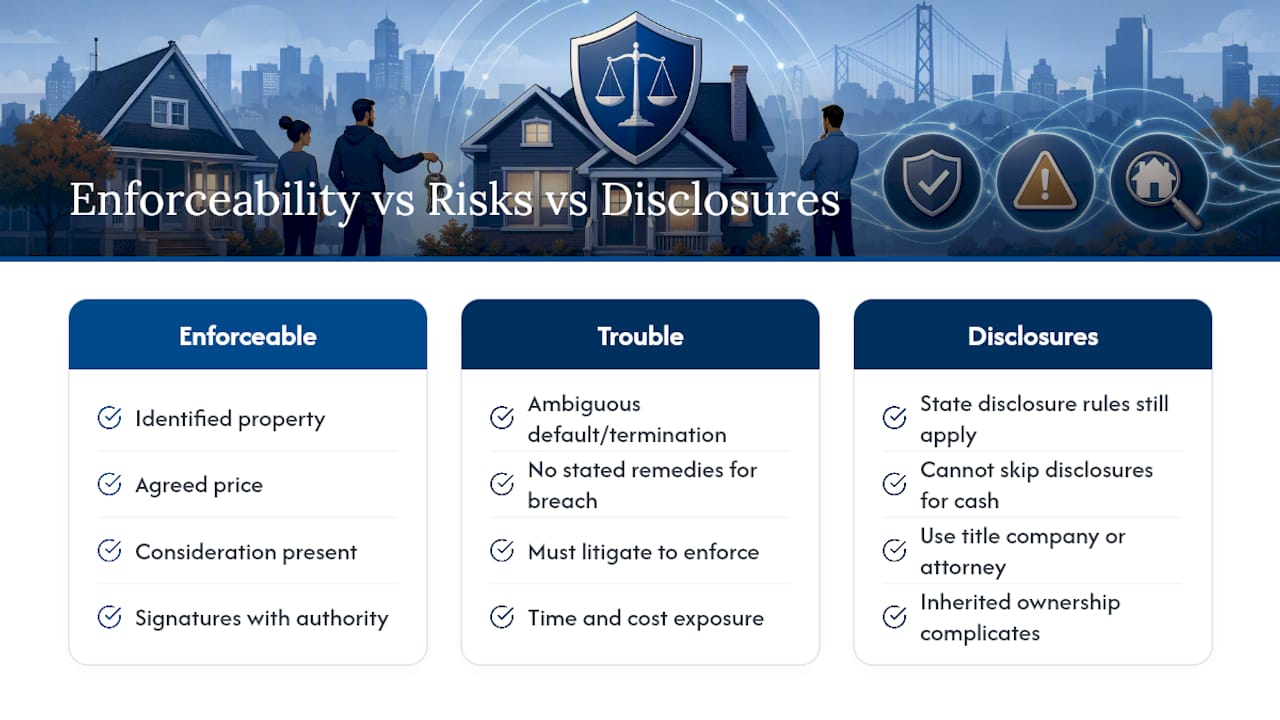
Yes, a properly executed cash purchase agreement is a legally binding contract once both parties sign it, and it holds up the same way a financed purchase agreement does. The enforceability comes from the same core elements: an identified property, an agreed price, and consideration, along with signatures from parties with legal authority to sell or buy.
Where sellers run into trouble is default and termination language. Some contracts spell out specific remedies if a buyer breaches, such as forfeiting earnest money, while others leave the seller’s recourse ambiguous. If the agreement doesn’t say what happens when a buyer fails to close on schedule, you may have grounds for a legal claim, but you’ll spend time and money establishing it that a clearer contract would have avoided.
State disclosure requirements still apply to cash sales. Skipping legally required property disclosures because the buyer is paying cash doesn’t protect you. It can expose you to a claim after closing if a defect surfaces that you should have disclosed. This is where working with a title company or attorney familiar with your state’s rules pays for itself, particularly on inherited properties where ownership and probate status can complicate an otherwise straightforward sale.
How Do You Know the Buyer Is Legitimate?
Anyone can print “cash buyer” on a business card. Verifying the person or company behind that claim takes a few concrete steps.
Start by asking how long the buyer has operated in your local market and whether they can point to closed transactions you could verify independently, such as recorded deeds at the county register. A buyer unwilling to name past closings, or one that’s newly formed with no track record, deserves more scrutiny.
Check for a real physical presence: an address, a working phone number, and a company name that appears in county or state business registries. Search the company name alongside terms like “complaint” or “lawsuit” to see what surfaces.
Most importantly, request proof of funds again at this stage, separate from any figure quoted in the offer letter itself. A neutral title company or independent escrow agent handling the transaction adds a layer of protection, since it removes the buyer’s ability to control the closing process or the documentation you rely on to confirm funds are real.
How Should the Cash Payment Actually Move at Closing?
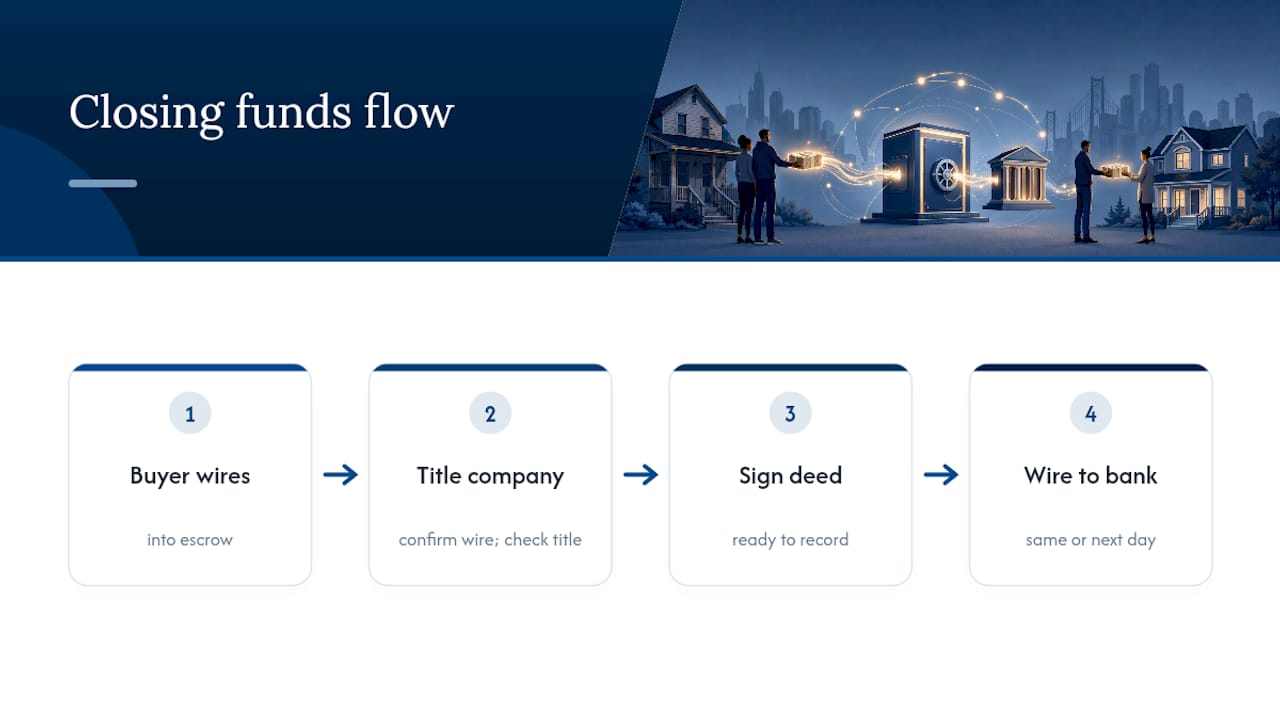
Funds should never pass directly from buyer to seller by check, wire to a personal account, or cash in an envelope. Every legitimate cash closing routes money through a licensed title company or escrow agent, who confirms the funds are cleared before releasing anything to you.
The buyer wires funds into escrow ahead of the closing date. The title company confirms the wire has cleared and there are no title defects blocking the transfer. Once the deed is signed and ready to record, the escrow agent disburses your proceeds, typically by wire to your bank account, the same day or the next business day.
Never accept a request to close outside a licensed escrow or title company “to save time,” and be wary of any last-minute request to accept a personal check or a wire to an account other than the one you designated in writing. If a buyer proposes any payment method that bypasses escrow entirely, treat it as a serious red flag rather than a convenience.
Which Clauses Actually Protect You as the Seller?
A handful of contract clauses do most of the real protective work in a cash for keys agreement.
An earnest money forfeiture clause states that if the buyer cancels outside the agreed contingency window, you keep the deposit. This is one of the strongest deterrents against a buyer tying up your property and then walking away.
A defined, capped inspection period limits how long a buyer can use “due diligence” as an excuse to delay or renegotiate. Look for language that caps price adjustments after inspection, or eliminates that right entirely once you’re past a certain point.
A no-assignment-without-consent clause keeps you from ending up in a contract with a buyer you never agreed to work with. And a firm closing date with a defined remedy for buyer delay gives you actual leverage instead of an open-ended promise.
Editorial Take: What the Checklist Approach Gets Right
Most advice on cash for keys agreements treats the paperwork like a formality to get through on the way to a fast closing. That’s backwards. The contract terms are the deal. Everything else, including how quickly a buyer promises to close, only matters if the earnest money, assignment, and net-proceeds language actually hold up.
The conventional advice oversells speed and undersells verification. Sellers facing foreclosure or an inherited property under deadline pressure are the most vulnerable to skipping the proof-of-funds request or the itemized net estimate, precisely because urgency makes shortcuts tempting. That’s exactly the wrong moment to skip them.
If you take one thing from this guide, prioritize the net-proceeds estimate and the earnest money terms before anything else. Everything downstream, closing speed, possession dates, even the buyer’s reputation, matters less than knowing what actually lands in your account and what protects you if the deal falls apart.
— Real Estate Team
Ready to Request a Cash Offer? Here’s What Happens Next
Sell Dave Your House gives Metro Detroit homeowners a direct alternative to the retrade risk and paperwork confusion this guide just walked through, one where the offer, the timeline, and the closing costs are clear from the first conversation. We look at your property, your timeline, and your situation, whether that’s foreclosure, an inheritance, or a house that needs more repairs than you can manage, and turn that into a fair, all-cash offer within 24 hours.

To get started, you just need the property address and a general sense of its condition. From there, we walk you through a written offer, a realistic closing date, and which closing costs we’re covering so you’re not calculating net proceeds on your own. If you’re ready to see a real number, request your cash offer and we’ll follow up within a day.
This article is general information, not a substitute for advice from a qualified financial advisor. Consult a qualified financial professional about your own circumstances before acting on anything here.
Sources
- How to Sell My House for Cash | Zillow
- Real estate purchase agreement: What sellers should know | Rocket Mortgage
- How to read a cash offer contract line by line | JMS Home Buyers LLC
- How to sell your house for cash: from offer to closing | LegalClarity
FAQ
Is a Cash for Keys Agreement Legal?
Yes. A properly signed all-cash purchase agreement is a legally binding contract in every state, provided it includes an identified property, an agreed price, and valid signatures from both parties.
How Fast Can a Cash Sale Actually Close?
Most cash sales close in 10 to 14 days, and some close in as little as seven days when title is clean and paperwork is ready, which is the typical window Sell Dave Your House targets for Metro Detroit sellers.
What Should I Ask For Before Signing a Cash Offer?
Request proof of funds, an itemized net-proceeds estimate, the escrow company’s name, and clear limits on any post-inspection price adjustments before you sign anything.
Does “As-Is” Mean the Price Can’t Change?
Not necessarily. Many cash-buyer contracts include inspection language that allows a price renegotiation even under an as-is clause, so read that section closely rather than assuming the headline price is final.
Who Pays Closing Costs in a Cash Sale?
It depends on the contract. Some cash buyers, including Sell Dave Your House, cover standard closing costs for the seller, but always confirm this allocation in writing before closing day.