
Get a Cash for Keys Offer in 24 to 48 Hours in Detroit
If you need to sell a Detroit house fast, a local cash buyer can give you an as-is offer within 24 to 48 hours and close in as little as 7 days. The trade-off is real: you’ll typically accept a lower price than a traditional listing might bring in exchange for speed and certainty. For homeowners facing foreclosure, an inherited property, or a house too rough to finance, that trade often makes sense.
TL;DR:
- Cash offers in Detroit are generally 10 to 20 percent below market value, but they eliminate agent commissions, repair costs, holding expenses, and the risk of financing falling through.
- Most cash sales close within 7 to 21 days after initial offer, provided there are no unresolved liens, probate delays, or tenant occupancy issues.
- Sellers facing foreclosure, probate, urgent relocations, or costly repairs should prioritize speed and certainty, making cash sales a practical option.
- Vet cash buyers by requesting proof of funds, confirming their local experience, and ensuring they use licensed Michigan title companies to avoid scams.
- The cash sale process involves quick initial contact, a streamlined offer, a brief due-diligence period, and closing with funds disbursed soon after title clearance.
Table of Contents
- What Does “Cash for Keys” Mean for a Detroit Home Seller?
- How Does the Cash Sale Process Work From Offer to Closing?
- What’s the Real Trade-Off Between a Cash Offer and a Traditional Listing?
- How Long Does It Actually Take to Close on a Cash Sale?
- How Do You Vet a Cash Buyer Without Getting Burned?
- Sell Dave Your House: 16 Years of Buying Detroit Homes As-Is
- What Costs and Fees Should You Expect in a Detroit Cash Sale?
- What Detroit-Specific Rules Apply to a Cash Home Sale?
- How Do You Spot a Reputable Cash Buyer in Detroit?
- Can You Negotiate With a Cash Buyer, or Is the Offer Final?
- Speed Sells Houses, But Only If You Understand the Trade You’re Making
- Ready for a Fast Cash Offer? Here’s What Sell Dave Your House Needs From You
- Sources
- FAQ
What Does “Cash for Keys” Mean for a Detroit Home Seller?
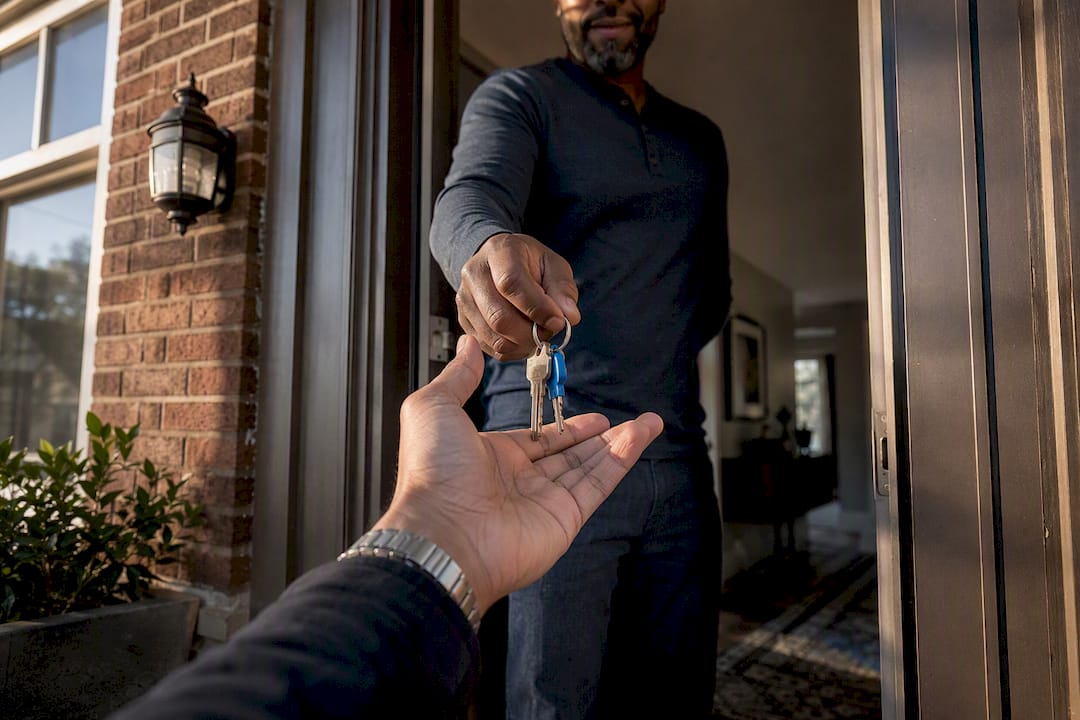
In Metro Detroit, “cash for keys” doesn’t refer to a landlord paying a tenant to move out. Here, it means selling your house directly to a local buyer who pays cash, closes fast, and takes the property as-is. You hand over the keys, the buyer hands over the money, and there’s no bank, no repairs, and no waiting for a mortgage underwriter to approve someone else’s loan.
Which Detroit Homeowners Benefit Most From a Quick Cash Sale?
A cash sale isn’t the right fit for every seller. It’s built for situations where time and certainty matter more than squeezing out the highest possible price.
- Facing foreclosure: When a sheriff’s sale date is set, a cash buyer can often close before the deadline, protecting your credit and giving you a cushion of proceeds instead of losing the home outright.
- Inherited an unwanted property: Executors juggling probate paperwork and out-of-state siblings often can’t manage months of showings and repairs. A house sold through inheritance can close before the estate even finishes settling other matters.
- Relocating on short notice: A new job, a family emergency, or a lease that’s expiring in three weeks doesn’t leave room for a 60-day listing cycle.
- Property needs work you can’t afford: A cracked foundation, a failed roof, or knob-and-tube wiring scares off financed buyers before they even schedule an inspection. Cash buyers evaluate the home as it sits, not as it should be.
- Tired landlord ready to exit: Dealing with a problem tenant or a property that’s bleeding cash every month is its own kind of urgency.
The rule of thumb is simple: if certainty and timeline outweigh maximizing your sale price, a cash sale deserves serious consideration.
How Does the Cash Sale Process Work From Offer to Closing?
The process is shorter and less paperwork heavy than a traditional sale, but it still follows a logical sequence.
- Initial information gathering. A buyer will ask for your address, some photos, your remaining mortgage balance (if any), and a general description of the home’s condition. This usually happens over a phone call or a short form.
- Offer calculation. The buyer weighs the local market baseline for your neighborhood against needed repairs, then applies their margin. This is why an offer on a home in Corktown with a bad roof looks different from a similar-sized home in Midtown that’s move-in ready.
- Contract signing. Instead of a lengthy inspection period with contingencies, most cash contracts involve a walkthrough or a short due-diligence window, not a full inspector’s report with a repair-negotiation cycle.
- Title work. A Michigan title company runs a title search, checking for liens, unpaid taxes, or ownership questions that could slow things down.
- Closing and funds disbursement. You sign the deed, the title company disburses funds, usually by wire or check, and the sale is done.
Pro Tip: Ask the buyer to keep their offer open for a set number of days even while you list the house yourself. If nothing better comes through, you still have a guaranteed floor to fall back on.
What’s the Real Trade-Off Between a Cash Offer and a Traditional Listing?
Cash offers in Southeast Michigan commonly land roughly 10 to 20 percent below what a well-marketed traditional listing would fetch. On a typical home, that discount translates to a sizable dollar amount, making the trade-off easier to evaluate. That number gets easier to stomach once you count what a cash sale lets you skip.
- No agent commission, which typically runs 5 to 6 percent of the sale price split between listing and buyer agents.
- No pre-sale repairs or staging costs, which can run into the thousands on an older Detroit home.
- No holding costs like mortgage payments, insurance, and utilities during a two- or three-month listing period.
- No risk of a financed buyer’s deal falling through during underwriting.
Building a rough net sheet helps make this concrete. Take your expected listing price, subtract commission, expected repair costs, and two to three months of holding costs, then compare that number to the cash offer on the table. Often the gap shrinks considerably once those deductions are factored in.
Benchmark: Southeast Michigan cash offers commonly run 10 to 20 percent below full market value, a range worth using as your starting expectation before you compare any specific offer.
How Long Does It Actually Take to Close on a Cash Sale?
Most Michigan cash buyers can produce an offer within 24 to 48 hours and close in as little as 7 days, though the typical range runs 7 to 21 days depending on complications. That’s a sharp contrast to the traditional market, where Detroit listings often take roughly 49 to 54 days from listing to close before you’ve even collected proceeds.
A handful of issues commonly push the timeline past that fastest-case window:
- Unresolved liens or unpaid property taxes that the title search uncovers late.
- Probate that hasn’t been finalized, which can delay the legal authority to sell.
- Tenants still occupying the property who need formal notice before vacating.
- Missing permits on additions or renovations that a title company flags before closing.
Gather your deed or title documents, mortgage payoff statement, property tax records, and (if applicable) probate paperwork before you start talking to buyers. Having these ready shaves days off the title company’s work.
How Do You Vet a Cash Buyer Without Getting Burned?
Not every “we buy houses” sign is attached to a legitimate operation. A few smart questions upfront separate the real buyers from the ones hoping to lock you into a bad deal.
- Ask for proof of funds. A legitimate buyer can show a bank statement or letter of funds availability, not just a verbal promise.
- Get the timeline in writing. How many days from signing to closing? Is that a guarantee or a guess?
- Clarify who pays closing costs. Some buyers cover them; others quietly pass them to you.
- Request a breakdown of any deductions. If the offer includes a repair allowance, ask exactly how that number was calculated.
- Confirm the title company they use. A buyer who resists using a neutral, licensed Michigan title company is a warning sign worth taking seriously.
- Check their track record. Ask for addresses of recent closings in Detroit neighborhoods and look up reviews independently, not just testimonials on their own site.
Watch for red flags like pressure to sign within hours, refusal to put the timeline in the contract, vague answers about funding sources, or requests for an upfront nonrefundable fee. Pro Tip: A buyer who’s confident in their offer won’t mind you asking for their last three closed addresses in the city. If they dodge the question, that tells you something.
Sell Dave Your House: 16 Years of Buying Detroit Homes As-Is
Sell Dave Your House has spent over 16 years buying homes throughout Metro Detroit, and that local track record shows up in the details that matter most when you’re trying to close fast. Offers typically come back within 24 hours, and closings can happen in as little as 7 days when title work is clean. Homes are purchased as-is, whether the issue is an outdated kitchen or a foundation crack that’s scared off every financed buyer, and the process is built to avoid seller fees while covering standard closing costs.
Neighborhood familiarity matters more than people expect. A team that’s already closed deals in Midtown or Corktown knows which title issues tend to surface in those areas and how to work through them without the process stalling.
What Costs and Fees Should You Expect in a Detroit Cash Sale?
A cash sale strips out some costs entirely and keeps others intact. Understanding which is which prevents surprises at the closing table.
Costs you typically avoid:
- Real estate agent commissions, usually the largest single expense in a traditional sale.
- Marketing costs like photography, staging, and listing fees.
- Buyer-requested repairs or credits that often surface after a home inspection.
Costs that usually still apply:
- Outstanding mortgage balance or liens, paid off from proceeds at closing.
- Delinquent property taxes, which the city will collect before releasing clear title.
- Title company or escrow fees, though many Detroit cash buyers, including Sell Dave Your House, cover these as part of their standard offer.
- Recording fees and any municipal transfer tax tied to the deed transfer.
The gap between a cash offer and a listing price already accounts for repairs and condition issues, so you’re not typically paying out of pocket for anything beyond what’s owed on the property itself. Always ask a prospective buyer for a written breakdown of exactly what gets deducted from your gross offer, and compare that against what’s listed above. If a fee shows up that isn’t explained, ask before you sign.
What Detroit-Specific Rules Apply to a Cash Home Sale?
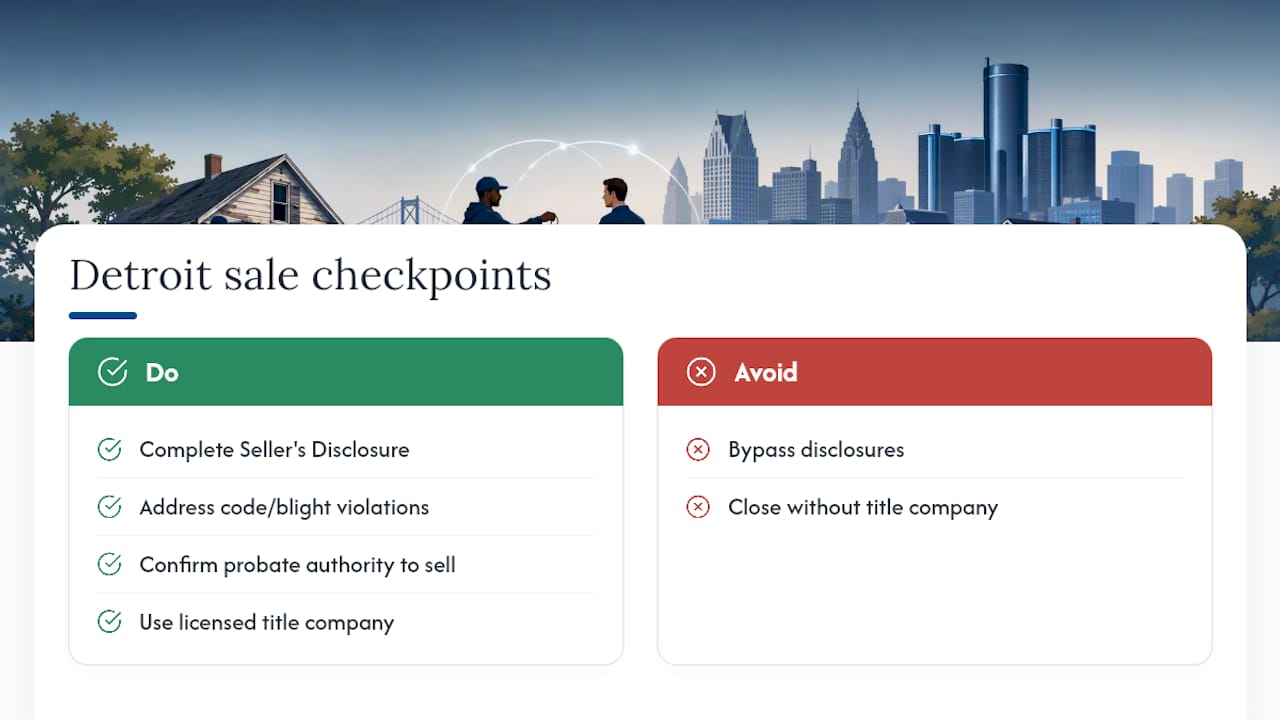
Michigan law requires sellers to complete a Seller’s Disclosure Statement disclosing known material defects, things like roof leaks, past flooding, or foundation issues, regardless of whether the buyer is paying cash or financing. Some experienced cash buyers will still ask you to complete this form even though they’re buying as-is, both to protect you legally and to confirm the condition matches what they were told.
Detroit also enforces its own layer of property compliance. If the home has open code violations, unresolved blight tickets, or unpermitted work, those records can surface during a title search and need addressing before the deed transfers cleanly. A cash buyer experienced in Detroit specifically will often know how to navigate a blight violation resolution or work with the city’s records department faster than an out-of-state buyer unfamiliar with local procedures.
If the property is going through probate, Michigan probate court requires the personal representative to have legal authority to sell before a deed can transfer, which is why inherited property sales sometimes need extra lead time even in an otherwise fast cash transaction. No legitimate Detroit cash buyer can skip these steps. Any buyer who suggests bypassing disclosure requirements or closing without a title company should be treated as a serious red flag, not a convenience.
How Do You Spot a Reputable Cash Buyer in Detroit?
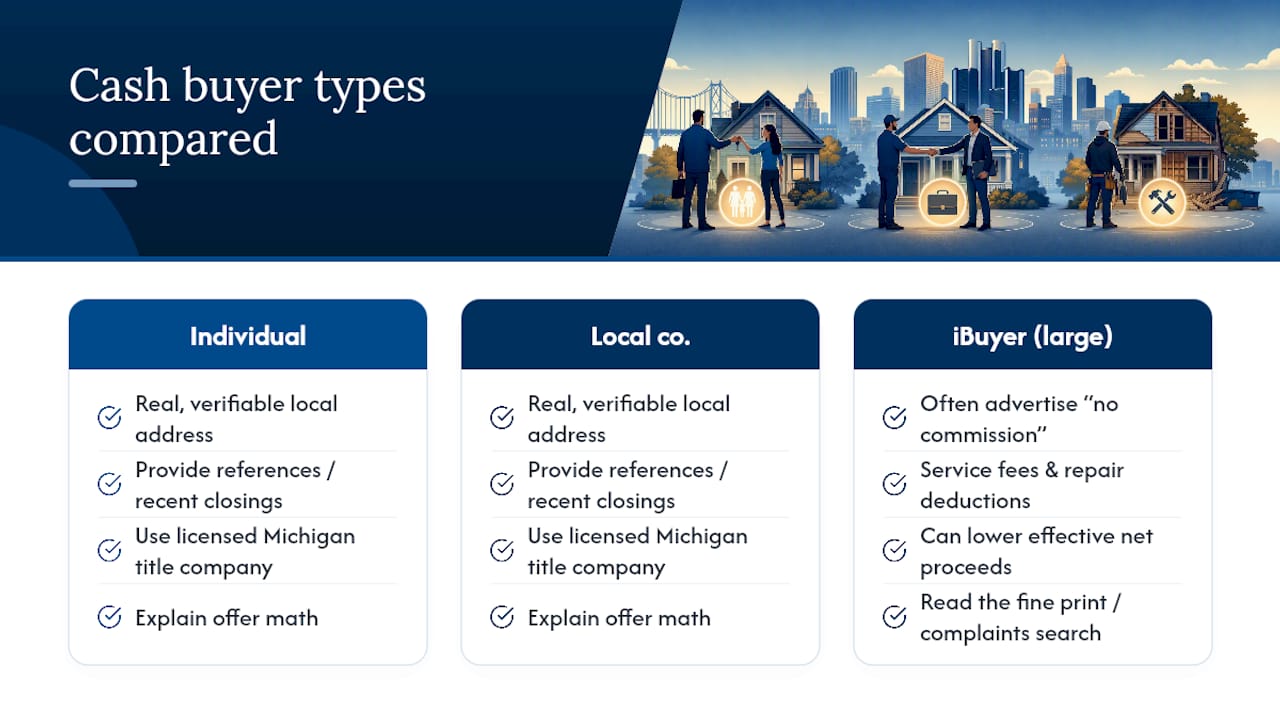
Detroit’s fast-cash market includes a mix of individual investors, small local companies, and larger regional or national cash-buying operations. Comparing options across that mix, rather than accepting the first offer you get, often reveals a meaningful spread between the highest and lowest bids on the same property.
Legitimate buyers share a few common traits. They operate from a real, verifiable local address rather than a P.O. box. They’re willing to provide references or point to specific recent closings you can independently confirm. They use a licensed Michigan title company for every transaction, and they explain their offer math instead of just handing you a number.
Larger instant-offer services, sometimes called iBuyers, often advertise a “no commission” pitch, but service fees and repair-cost deductions built into their offers frequently bring the effective net proceeds below what a traditional sale or a smaller local buyer would net. Read the fine print on any offer that sounds too clean.
Before signing anything, search the buyer’s name alongside “Detroit” and “review” or “complaint.” Confirm they’ve closed deals in your specific neighborhood, since a buyer active in Grosse Pointe may not have the same experience navigating a Brightmoor property with title complications. A general resource on fast home sale options can help you understand the broader landscape before you commit to any single buyer.
Can You Negotiate With a Cash Buyer, or Is the Offer Final?
Most sellers assume a cash offer is a take-it-or-leave-it number. That’s rarely true. Cash buyers build in a margin, and there’s often room to work within it, especially if you’re offering something valuable in return, like a faster close or flexibility on possession dates.
A few negotiation angles tend to work:
- Get multiple offers first. Even two competing cash offers give you leverage to ask either buyer to sweeten their number.
- Offer a flexible move-out date. If a buyer needs the property vacant by a specific date for their own resale plans, agreeing to that timeline sometimes earns a small price bump.
- Ask what’s driving the deduction. If the offer accounts for a new roof estimate that’s higher than what a local contractor would actually charge, push back with your own quote.
- Negotiate who covers specific closing costs. Even when the price stays fixed, shifting who pays for the title search or recording fees changes your net proceeds.
- Use the hybrid strategy some local brokers recommend: keep a firm cash offer as a fallback while briefly testing the market for two to three weeks. This gives you a safety net without fully committing to a slow traditional sale.
The buyers most willing to negotiate tend to be the ones confident in their process, not the ones rushing you to sign before you’ve had a chance to think it through.
Speed Sells Houses, But Only If You Understand the Trade You’re Making
The conventional advice on cash sales tends to split into two extremes: either “cash buyers lowball desperate sellers” or “cash sales are always the smart move for distressed properties.” Neither captures what the research actually shows. The 10 to 20 percent discount is real, but so is the 49 to 54 days a typical Detroit listing eats up before it even closes, plus commissions, repairs, and the risk of a financed deal collapsing mid-escrow.
What gets underrated is the value of comparing offers before committing to one. Too many sellers accept the first number they hear out of fear that waiting will cost them the deal entirely. It usually won’t. A serious local buyer expects you to ask questions, request proof of funds, and even shop the offer against a competitor.
If your situation involves a hard deadline, foreclosure, probate, a property no bank will finance, prioritize verifying the buyer’s legitimacy over squeezing every last dollar out of the number. Speed without trust is how sellers get hurt. Speed with a vetted, transparent buyer is how they get their life back on track faster than they thought possible.
— Real Estate Team
Ready for a Fast Cash Offer? Here’s What Sell Dave Your House Needs From You
Getting a real, usable cash offer from Sell Dave Your House starts with a short conversation, not a stack of paperwork. Send your property address, a few photos of the home’s current condition, your remaining mortgage balance if you have one, and any probate documentation if the property is part of an estate. That’s typically enough to get the process moving.

A local Metro Detroit home buyer brings extensive experience to their offers, aiming to respond quickly and close in as little as 7 days once title work is clear. Homes are purchased as-is, with no repairs, cleaning, or staging required, and the process strives to eliminate agent commissions and cover standard closing costs so the quoted amount approximates what sellers walk away with. If your situation involves foreclosure, an inherited home, or repairs you simply can’t afford to make, start by requesting a fair cash offer directly, or explore how the cash sale process works before you reach out.
Sources
- Is a Cash Offer Right for Your Situation? What Michigan Sellers Should Know | The Patrick Group
- Sell your house fast in Detroit, MI (September 2026) | Clever
FAQ
What Does “Cash for Keys” Mean in Detroit Real Estate?
It means selling your house directly to a local buyer for cash rather than the tenant-relocation payout the phrase sometimes refers to elsewhere. The buyer purchases the home as-is, often closing in as little as 7 days.
How Much Less Will I Get Selling for Cash Instead of Listing?
Southeast Michigan cash offers typically run 10 to 20 percent below what a well-marketed traditional listing might bring. That gap usually shrinks once you subtract commission, repair costs, and holding expenses from the listing number.
How Fast Can Sell Dave Your House Close on My Detroit Home?
Sell Dave Your House aims to deliver a fair cash offer within 24 hours and can close in as little as 7 days once title work is complete. Actual timing depends on factors like liens, probate status, or tenant occupancy.
Do I Need to Make Repairs Before Selling for Cash?
No. Cash buyers, including Sell Dave Your House, purchase homes as-is, which means no repairs, cleaning, or staging required before closing. The offer already accounts for the home’s current condition.
What Should I Watch Out for When Choosing a Cash Buyer?
Avoid buyers who pressure you to sign quickly, refuse to use a licensed Michigan title company, or can’t provide proof of funds. Ask for recent local closings and read independent reviews before committing to any offer.