

Avoid Losing Earnest Money: Cash Offer Contingencies U.S. Sellers Need
A cash offer usually drops the financing contingency and often waives the appraisal contingency, since there’s no lender demanding either one. Inspection, title, and HOA reviews frequently stay in place, just on a faster timeline. Fewer contingencies give sellers more certainty and a quicker path to closing, but they shift more risk onto the buyer, which is exactly why a company like Sell Dave Your House builds its own protections into every as-is Detroit purchase.
TL;DR:
- Cash offers typically waive financing and appraisal contingencies, enabling faster closings, often within 7 to 14 days, but require independent valuation and may increase buyer risk.
- Most cash transactions retain title and HOA contingencies, with inspection periods varying from strict no-repair agreements to limited-scope reviews based on buyer preference.
- Dropping contingencies shifts more risk onto buyers, meaning they may forgo protections against hidden defects or overpaying, but gives sellers increased certainty and speed.
- Clear deadlines and specific clauses like proof-of-funds and feasibility periods are essential for safeguarding both buyers and sellers during rapid cash deals.
- Actual cash offers often include customized contingencies such as proof of funds, quick title review, and acceptance of property as-is, but rarely eliminate all protections entirely.
Table of Contents
- What Cash Offer Contingencies Actually Do in a Purchase Contract
- Common Contingency Types You’ll See in a Purchase Agreement
- How a Cash Offer Reshapes These Contingencies
- Weighing the Trade-Offs: Fewer Contingencies, More Speed, More Risk
- Deadlines and Clauses That Determine Whether an Offer Actually Closes
- Negotiating, Shortening, or Waiving Contingencies the Smart Way
- What Sell Dave Your House Does Differently With Contingencies
- Legal Risks and Protections Tied to Contingencies in Cash Deals
- What Contingency Clauses Look Like in an Actual Cash Offer
- How Contingencies Shape What Happens to Your Earnest Money
- Why the “No Contingencies” Pitch Oversimplifies Cash Offers
- Skip the Contingency Guesswork, Sell Directly to Sell Dave Your House
- Sources
- FAQ
What Cash Offer Contingencies Actually Do in a Purchase Contract
A contingency is an if/then clause built into your purchase agreement. If a specific condition isn’t met by a set deadline, the buyer can walk away and keep their earnest money instead of losing it. That single mechanism is what makes contingencies valuable: they turn a risky financial commitment into a conditional one, with an exit ramp built in.
In a traditional financed sale, contingencies protect the buyer from a lender’s cold feet, a low appraisal, or a home inspection that turns up a cracked foundation. In a cash deal, some of those risks disappear because there’s no lender in the mix, but the underlying legal structure still matters.
- Contingencies create enforceable deadlines, not vague intentions. Miss the date, and you generally lose your right to cancel penalty free.
- They protect earnest money, which on a typical home sale can run 1% to 3% of the purchase price.
- Buyers, their agents, and often a real estate attorney draft the contingency language; title companies and escrow agents enforce it at closing.
Every contingency you keep is a form of insurance. Every one you drop speeds things up but removes a layer of protection you might want back later.
Common Contingency Types You’ll See in a Purchase Agreement
Before you can decide what to waive in a cash offer, you need to know what each contingency is actually protecting. The National Association of Realtors lists these as the standard set in most U.S. purchase contracts:
- Inspection contingency: Gives the buyer a window, typically 7 to 14 days, to have the home professionally inspected and negotiate repairs, credits, or a price cut based on what turns up.
- Financing contingency: Lets a buyer cancel without penalty if their mortgage falls through during underwriting. Learn more about how a mortgage contingency can protect your home purchase in the financing process by reviewing Mortgage Contingency Explained: Protect Your Home Purchase. This is different from a preapproval, which is a lender’s early estimate, not a guarantee.
- Appraisal contingency: Kicks in when a lender requires the home to appraise at or above the sale price before releasing loan funds. If it appraises low, the buyer can renegotiate or exit.
- Home-sale contingency: Lets a buyer back out if they can’t sell their current home in time. Sellers who accept one often insist on a kick-out clause, which lets them keep marketing the property and accept a better offer if one comes along.
- Title contingency: Confirms the seller can convey clear ownership, free of liens, unpaid taxes, or ownership disputes.
- HOA and insurance contingencies: Cover review of HOA rules, fees, and reserves, or confirmation that homeowners insurance is available and affordable for the property.
Each one exists to answer a specific “what if,” and each should carry its own deadline written directly into the contract.
How a Cash Offer Reshapes These Contingencies
Cash changes the math on two contingencies almost automatically and leaves the rest largely intact. Since there’s no mortgage, the financing contingency typically disappears entirely, which is a big part of why cash deals close in as little as 7 to 14 days instead of the 30 to 45 days a financed purchase often needs.
The appraisal contingency usually goes with it, since no lender is requiring a valuation to release funds. That doesn’t mean value stops mattering. A cash buyer waiving appraisal should still get an independent valuation through comps or a private appraisal, or they risk overpaying with no built-in check on price.
Inspection contingencies behave differently. Some cash buyers still request a limited-scope inspection window, while others buy strictly as-is and negotiate the price down instead of asking for repairs.
- Financing: Removed in almost every genuine cash offer.
- Appraisal: Often waived, but smart buyers replace it with their own valuation step.
- Inspection: Sometimes shortened, sometimes replaced with a flat as-is price and a credit.
- Title and HOA: These should stay. A title search protects against liens and encumbrances no cash offer can outrun, and unpaid HOA dues can attach to the property regardless of how it was purchased.
Pro Tip: If you’re evaluating a cash offer as a seller, ask specifically which contingencies the buyer is keeping, not just how much cash they’re offering. A buyer who waives everything except title is behaving very differently from one who’s also holding an open-ended inspection period.
Weighing the Trade-Offs: Fewer Contingencies, More Speed, More Risk
Dropping contingencies isn’t automatically good for either side. It reallocates risk, and who benefits depends on which side of the closing table you’re sitting on.
- Sellers gain speed and certainty. Fewer contingencies mean fewer ways a deal collapses midstream, which matters enormously if you’re facing foreclosure timelines or a job relocation.
- Sellers can lose leverage on price. A buyer asking for zero contingencies sometimes expects a discount in return, so a “clean” offer isn’t always the highest one.
- Buyers gain competitive strength. In a tight market, a buyer willing to waive inspection or appraisal contingencies often beats out financed offers on the same house.
- Buyers absorb more downside. Skipping inspection means no formal record of hidden repair costs, and skipping appraisal means no independent check against overpaying.
Deadlines and Clauses That Determine Whether an Offer Actually Closes
Every contingency is only as good as its deadline. Standard inspection periods run 7 to 14 days, while financing contingencies typically span 21 to 30 days in a financed deal. Cash offers compress these windows since financing isn’t in the equation at all.
- Kick-out clauses let a seller accept a home-sale contingent offer while still marketing the property, giving buyers a set window (often 24 to 72 hours) to remove their contingency once a better offer appears.
- Missing a deadline without written notice can forfeit a buyer’s right to cancel and keep their earnest money.
- Put every contingency deadline on a shared calendar, and notify your agent or attorney a few days ahead of each one, not the day it expires.
Negotiating, Shortening, or Waiving Contingencies the Smart Way
A full waiver isn’t the only way to make an offer competitive, and it’s often not the safest one. There’s a middle ground most buyers never explore.
- Buyers: Request a limited-scope inspection instead of skipping it entirely, or negotiate an escrowed repair holdback so funds are set aside for known issues at closing.
- Sellers: Ask any buyer, cash or financed, for proof of funds before agreeing to shortened timelines.
- Sellers accepting a contingent offer: Insist on a kick-out clause so you’re not locked in indefinitely while a buyer’s home sale drags on.
- Both sides: Loop in a title company or real estate attorney whenever timelines compress. They catch encumbrances and paperwork gaps a rushed closing can miss.
A quick pre-signing checklist: verify proof of funds, confirm the title company is engaged, and get contingency deadlines in writing before you sign anything.
Pro Tip: Sellers weighing an all-cash offer against a slightly higher financed one should calculate net proceeds after fall-through risk, not just the headline number. A shorter feasibility period that still allows a quick inspection window often protects both sides better than a blind waiver.
What Sell Dave Your House Does Differently With Contingencies
With more than 16 years buying homes across Metro Detroit, Sell Dave Your House delivers fair cash offers within 24 hours and can close in as little as seven days. Every purchase is as-is, no repairs required, and title and closing details are handled directly, so sellers aren’t left guessing what a “cash offer” actually protects them from.
Legal Risks and Protections Tied to Contingencies in Cash Deals
Dropping a contingency doesn’t erase the underlying risk, it just removes the contractual escape hatch. If a cash buyer waives inspection and then discovers a foundation issue after closing, they generally have no legal path to cancel or renegotiate, because the contract no longer gives them one. That’s the trade sellers should understand from the other side of the table too: a buyer who waived everything has fewer reasons to walk, which is exactly why their offers tend to close more reliably.

Title contingencies deserve special caution regardless of how a deal is financed. A cash purchase moves fast, but it still needs a proper title search to catch liens, unpaid property taxes, or ownership disputes that a rushed closing could otherwise miss. Skipping this step to save a few days is one of the more common legal exposures in fast cash transactions, and it’s rarely worth the time saved.
Sellers face their own legal exposure when accepting an offer with fewer contingencies. If a seller misrepresents the property’s condition in an as-is sale, waived inspection contingencies don’t automatically shield them from disclosure law claims. Most states, including Michigan, still require sellers to disclose known material defects even when a buyer waives inspection rights.
Earnest money disputes are the most common legal flashpoint. If contract language around contingency deadlines is vague, both sides can end up in a standoff over who’s entitled to the deposit. Clear, specific deadlines, put in writing and confirmed by a title company or attorney, are the cheapest insurance either party can buy in a compressed cash timeline.
What Contingency Clauses Look Like in an Actual Cash Offer
Cash offers still use contingency language, just written differently than a financed contract. A few examples of clauses that show up specifically in cash purchase agreements:
Proof-of-funds contingency: Instead of a financing contingency, many cash contracts include a clause requiring the buyer to submit bank statements or a letter from their financial institution within a short window, often 3 to 5 days, verifying funds are actually available. Sellers should treat this clause as non-negotiable protection, not paperwork.
Feasibility period clause: Rather than a full inspection contingency, some cash buyers negotiate a short “feasibility” window, often 3 to 7 days, to review basic property condition and confirm they still want to proceed, without the extended negotiation rights a traditional inspection contingency carries.
As-is acknowledgment clause: This states plainly that the buyer accepts the property in its current condition, with no right to request repairs. It’s the clause that replaces a full inspection contingency in most straightforward cash sales.
Title cure period: A clause giving the seller a defined window, commonly 10 to 15 days, to resolve any title defects the search uncovers before the buyer can cancel and reclaim earnest money.
Rapid-close clause: Specifies an accelerated closing date, sometimes seven days out, contingent only on title clearing and funds being confirmed, essentially the cash-deal replacement for the standard 30 to 45 day financed timeline.
Each of these clauses does the same job a traditional contingency does. It just does it faster and with fewer moving parts.
How Contingencies Shape What Happens to Your Earnest Money
Earnest money is the deposit that shows a buyer is serious, and contingencies are what determine whether that deposit is refundable if the deal falls apart. In a cash offer, this relationship works a little differently than in a financed one.
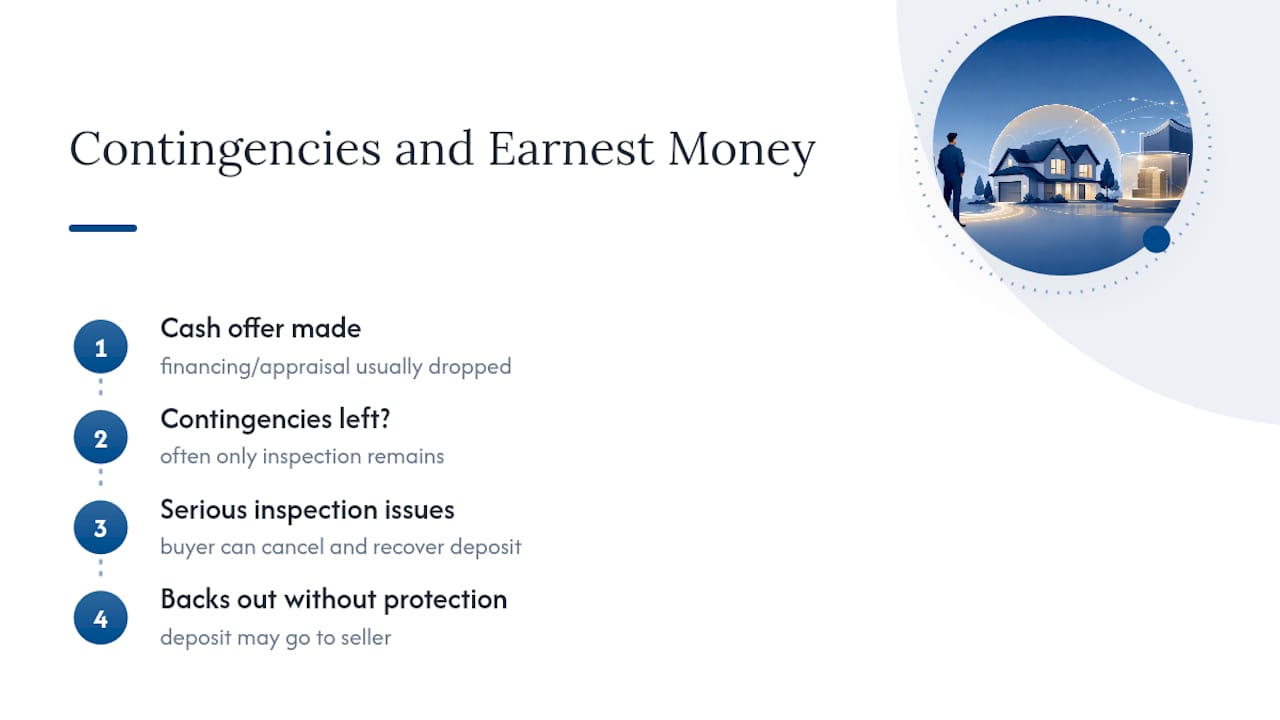
Because cash offers usually drop financing and appraisal contingencies, buyers have fewer built-in reasons to cancel and still walk away with their deposit intact. If a cash buyer backs out simply because they changed their mind, and no contingency covers that scenario, the earnest money can legally go to the seller as compensation for time and lost market exposure.
This is precisely why cash offers tend to feel more secure to sellers. Fewer contingencies mean fewer legitimate exits, and the earnest money deposit becomes a stronger commitment rather than a formality. It’s also why sellers evaluating multiple cash offers should look closely at deposit size. A buyer offering a larger, non-refundable earnest deposit alongside fewer contingencies is signaling genuine intent to close, not just a competitive number on paper.
Sellers should still confirm exactly which contingencies remain before assuming earnest money is fully protected. A cash offer that keeps an inspection contingency, for instance, still allows the buyer to cancel and recover their deposit if the inspection turns up serious issues, even without financing in the picture at all.
Why the “No Contingencies” Pitch Oversimplifies Cash Offers
The real estate industry loves the phrase “no contingencies” because it sounds clean, but it’s often more marketing than mechanism. Most legitimate cash offers still carry title contingencies and, frequently, some form of inspection or feasibility window. What actually changed is that financing and appraisal risk, the two contingencies most likely to blow up a deal in the final stretch, are gone.
Conventional advice tends to frame contingency waivers as a binary: waive everything for speed, or keep everything for safety. That framing misses the middle path, and it’s the one worth prioritizing. A shortened feasibility period, a proof-of-funds requirement, and a clean title contingency together deliver most of the speed benefit sellers actually want without asking either side to accept blind risk.
If there’s one thing sellers should take from this: judge a cash offer by which specific contingencies remain, not by whether the phrase “no contingencies” appears in the listing description. A buyer’s proof of funds, a real title search, and a fast, honest timeline matter more than a marketing label. That’s the standard worth holding every offer to, cash or otherwise.
— Real Estate Team
Skip the Contingency Guesswork, Sell Directly to Sell Dave Your House
If you’d rather not manage financing fallout, appraisal gaps, or a buyer who cancels over a contingency clause, Sell Dave Your House removes that uncertainty from the equation entirely. As a direct cash buyer serving Metro Detroit, Sell Dave Your House purchases homes as-is, no repairs, no cleaning, no realtor commissions, and delivers a fair cash offer within 24 hours with closing possible in as little as seven days.

This approach fits sellers dealing with foreclosure, an inherited property, a home in disrepair, or simply the need to move on quickly without the back-and-forth of contingency negotiations. Instead of wondering whether a buyer’s financing or appraisal will fall through at the last minute, you work directly with a company covering standard closing costs and handling title details from the start. If that certainty sounds better than another round of contingency negotiations, get a fair cash offer fast and see what your home is worth on your timeline, not a lender’s.
Sources
- What is a Contingent Offer When Buying a House
- What Is a Cash Offer On a House? | Redfin
- How to Make a Contingent Offer to Buy a Home - NerdWallet
- Consumer Guide: Real Estate Sales Contract Contingencies
FAQ
What are cash offer contingencies?
They’re the conditions still written into a cash purchase contract, most often title, inspection, or proof-of-funds clauses, even though financing and appraisal contingencies are usually removed since no lender is involved.
Is it a good idea to accept a cash offer on a house?
Often yes, especially if speed and certainty matter more to you than squeezing out the highest possible price, but you should still verify proof of funds and confirm which contingencies, if any, remain in the contract.
Why would a seller reject a cash offer?
Sellers sometimes reject cash offers that come in well below market value, lack proof of funds, or attach unusual contingencies, like an extended feasibility period, that undercut the speed cash buyers are supposed to offer.
What percentage of cash offers fall through?
There’s no single reliable national figure for this, but cash deals generally fall through less often than financed ones specifically because financing and appraisal contingencies, the most common deal killers, are usually already off the table.