

Expect 7–21 Days: Detroit Cash Sale Timeline for Sellers
Most Detroit cash sales close in 7 to 21 days once you have a signed offer, and the number depends almost entirely on your title’s condition. A clear title with verified buyer funds can wrap up in as little as 7 days. Title issues, probate, or unresolved liens push that past 21 days. Before you decide, run the math on net proceeds, because speed comes at a discount. Then start a title check and gather your closing documents. That single step often saves more time than anything else you’ll do.
TL;DR:
- Most Detroit cash sales conclude within 10 to 14 days if titles are clear and buyer funds are verified, but delays often occur with liens or probate issues.
- Title defects, unresolved liens, or probate delays can extend closing times beyond 21 days, especially when legal or administrative complications are involved.
- Preparing key documents early, requesting a preliminary title check, and being flexible with closing dates can significantly speed up the process.
- Cash buyers typically offer 5 to 15% below market value, with the discount offsetting repair costs or urgent needs for quick liquidation.
- Local experience helps identify common Detroit-specific issues, enabling faster problem diagnosis but cannot bypass legal or probate delays.
Table of Contents
- Cash Sale Timeline Detroit: The 4 Windows You’ll Fall Into
- What Happens From Offer to Closing Day, Step by Step
- What Actually Slows Down a Detroit Cash Sale
- Cash Offer vs. Listing: What Actually Lands in Your Pocket
- Getting Your Detroit Home Ready to Close in Days, Not Weeks
- How a Local Buyer Handles Detroit Timelines
- When Speed Wins and When Patience Pays Off
- Ready to Get a Fair Cash Offer in Detroit?
- Sources
- FAQ
Cash Sale Timeline Detroit: The 4 Windows You’ll Fall Into
Every Detroit cash sale lands in one of four timing brackets, and knowing which one applies to you changes how you plan the next month of your life. Sellers who assume every cash deal closes in a week are often surprised, not because the process is slow, but because they didn’t know which bracket they were in from the start.
The fastest track, 7 days, requires everything to line up: clear title, no outstanding liens, a buyer who has already verified funds, and a seller ready to sign without hesitation. This is the exception, not the rule, but it happens regularly in Detroit when the seller has owned the home outright or the mortgage payoff is straightforward.
The 10 to 14 day window is the realistic target for most straightforward deals. A routine title search takes a few days, scheduling lines up without drama, and there are no major liens to untangle. This is where a typical cash sale timeline actually lands, according to national data on cash transactions.
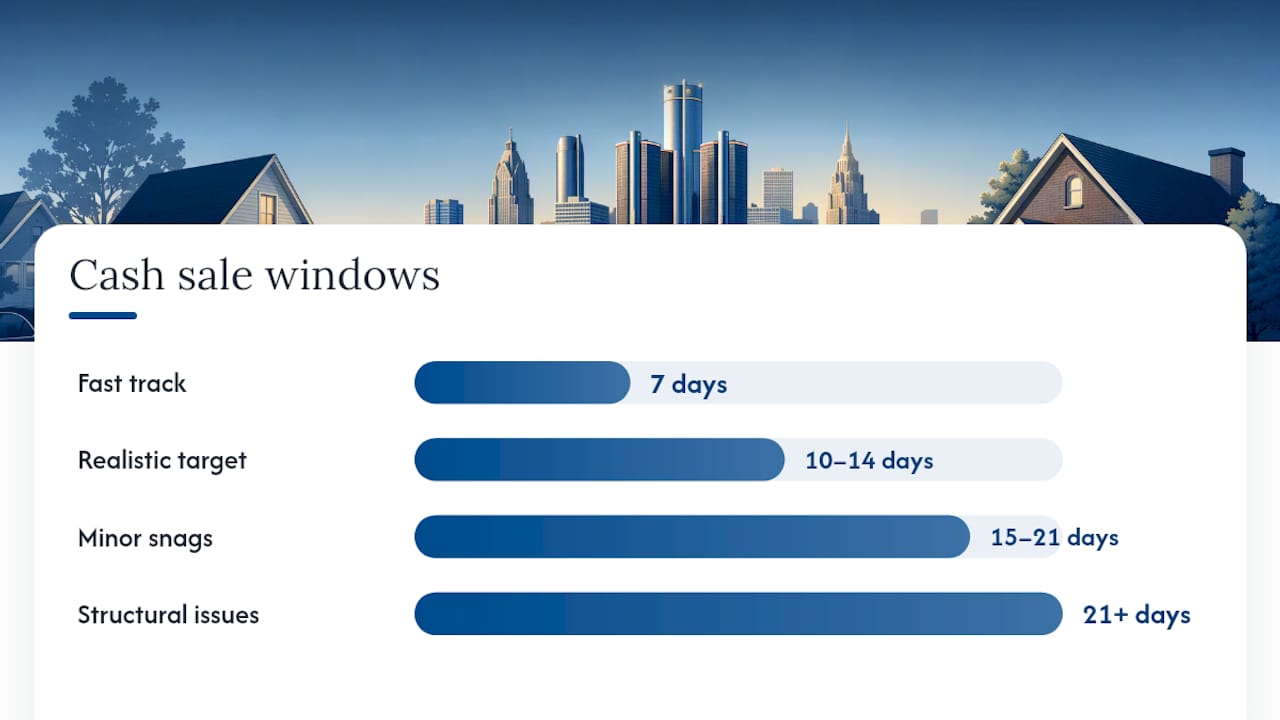
Fifteen to 21 days covers homes with minor administrative snags. Maybe a payoff statement takes longer to arrive, or a scheduling conflict pushes the closing appointment back a few days. It’s not a red flag, just friction.
Anything past 21 days usually points to something structural: probate court, a lien nobody disclosed, or a legal complication with the title itself.
| Timeline window | What it requires | Typical trigger |
|---|---|---|
| 7 days | Clear title, verified funds, seller ready to sign | Straightforward ownership, no mortgage complications |
| 10 to 14 days | Routine title search, standard scheduling | Most typical cash deals |
| 15 to 21 days | Minor title or administrative tasks | Scheduling delays, slow paperwork |
| 21+ days | Probate, liens, or legal title issues | Inherited property, unresolved debt |
- If your home has an active mortgage, request the payoff statement now. It’s one of the slowest documents to obtain.
- If you inherited the property, find out immediately whether probate has closed.
- If you’re unsure about liens, a preliminary title search will tell you before a buyer’s title company does.
What Happens From Offer to Closing Day, Step by Step
A Detroit cash sale moves through four distinct stages, and each one has its own rhythm. Understanding the sequence helps you spot delays before they cost you weeks instead of days.
- The written offer and acceptance (1 to 3 days). Once you agree to a price, the buyer typically opens escrow and provides proof of funds. This is your first checkpoint: never sign without confirming the buyer actually has the cash, whether that’s a bank statement, a letter from their financial institution, or verified funds held by a title company. A serious buyer won’t hesitate to show you this.
- Title search and payoff demands (3 to 10 days). A title company searches county records for anything attached to the property, mortgages, judgments, tax liens, or old contractor claims. If your home has an existing mortgage, the title company also requests a payoff demand from your lender, which states the exact amount needed to release the loan. This step is where most timelines either hold steady or start slipping.
- Inspections or surveys, if requested. Not every cash buyer requires an inspection, but some do, especially for properties they plan to renovate and resell. If a survey or inspection is part of the deal, expect it to add anywhere from a few days to a week, depending on scheduling and what turns up.
- Closing appointment (1 to 3 days once title is clear). This is signing day. You sign the deed, the title company or closing attorney disburses funds, and the deed gets recorded with Wayne County. Once title is clear and paperwork is in order, this final stretch moves fast.
Pro Tip: Ask your title company for a rough timeline estimate the day the search begins. They can usually tell you within 48 hours whether your title is clean or whether something will need extra attention, and that early warning lets you adjust your moving plans before you’re scrambling.
Sellers who want to compress this timeline focus on two things:
- Gather your deed, mortgage statement, and property tax records before you even accept an offer.
- Agree to a flexible closing date upfront rather than negotiating it later, since back and forth on scheduling is a common, avoidable source of lost days.
The stages you control, like paperwork readiness and flexibility on dates, matter more than people expect. The stages you don’t control, like how fast a lender processes a payoff request, are where patience pays off.
What Actually Slows Down a Detroit Cash Sale
Title defects and unreleased mortgages cause more delays than any other single factor, often adding 7 to 30 days depending on how tangled the history is. A previous owner’s unresolved lien, a name misspelled on an old deed, or a mortgage that was paid off years ago but never formally released with the county can all stall a closing that otherwise would have moved in a week.
Probate is the next biggest holdup. If you inherited the home and the estate hasn’t cleared probate, expect the timeline to stretch by weeks, sometimes months, particularly if there are multiple heirs or a missing will. An estate attorney becomes necessary in most of these cases, not optional.
Municipal liens are common in Detroit specifically. Unpaid water bills, blight violations, or delinquent property taxes attach to the property itself, not just the owner, and a buyer’s title company will find them during the search. The Wayne County recorder’s office maintains deed and mortgage records that can confirm whether something is attached to your property before a buyer’s search does.
Other common friction points:
- Seller readiness, meaning you need extra time to pack, relocate, or find your next place, which is a valid reason to negotiate a longer possession period rather than rush.
- Inspection-discovered issues that lead to repair negotiations, which happen even in cash deals, particularly when a buyer plans to resell or rent the property.
- Missing or outdated records that slow down a title company’s ability to confirm ownership cleanly.
Local market data tracking Detroit days on market shows how much timing varies property to property, reinforcing that no two sales follow an identical path. The largest single risk factor across nearly every delayed cash sale is title condition, not the buyer’s speed or willingness to close.
Cash Offer vs. Listing: What Actually Lands in Your Pocket
Speed only matters if the number at the end makes sense for you. Calculating net proceeds means subtracting every cost a traditional sale carries, agent commissions, repairs, staging, and the carrying costs of keeping the home while it sits on the market, from your expected sale price.
Selling a house the traditional way typically costs 5 to 6% in agent commissions alone, plus whatever repairs a buyer’s inspection turns up. Add in staging costs and a month or two of mortgage payments, insurance, and utilities while you wait for a buyer, and the gap between a listing price and actual net proceeds widens fast.
Cash buyers typically offer 5 to 15% below retail market value in exchange for speed and certainty. Whether that discount actually costs you money depends entirely on what your home needs.
- No repairs needed: A move-in-ready home might net more through a traditional listing, since you avoid the cash discount entirely and only pay standard commission.
- $10,000 in repairs: The gap narrows substantially. Commission plus repair costs on a listed sale can approach what a cash discount would have cost you anyway.
- $30,000 in repairs: A cash sale frequently nets close to the same amount, sometimes more, once you account for commissions, repair costs, and months of carrying costs while contractors work.
| Scenario | Listing route costs | Cash sale trade-off |
|---|---|---|
| No repairs needed | 5 to 6% commission only | 5 to 15% discount, but no repair delay |
| $10,000 repairs | Commission plus repair costs | Discount often comparable |
| $30,000 repairs | Commission, repairs, months of carrying costs | Cash sale frequently nets similar or better |
Detroit’s median days on market has run around 40 days in recent reporting, faster than many national averages but still a full month of carrying costs before you even reach closing on a financed deal. When your carrying costs are high or your repair list is long, the time value of a fast close often outweighs the sticker-price gap.
Getting Your Detroit Home Ready to Close in Days, Not Weeks
Preparation is the single biggest lever you control, and most of it takes an afternoon, not a week.
- Pull your core documents first: the deed, current mortgage statement, recent property tax records, and government-issued ID. If the property is rented, gather lease agreements too.
- Request a preliminary title report as early as possible, even before you accept an offer. This surfaces liens, judgments, or ownership questions while you still have time to address them.
- If probate applies, locate the will immediately and contact an estate attorney to estimate how long clearance will take. This is the one delay category where waiting to start costs you the most.
- Set realistic moving logistics now. Decide whether you need a delayed possession period, and say so during negotiations rather than after the contract is signed.
- Confirm who handles closing: a local title company or closing attorney, the buyer’s representative, and, if you’re pursuing a cash offer, Sell Dave Your House directly.
If you’re weighing whether repairs are even worth starting before you sell, a local contractor like One Day Doors & Closets of North Detroit can give you a quick read on minor fixes, though an as-is cash sale skips that step entirely.
Pro Tip: Call your mortgage lender for a payoff statement the same week you decide to sell, not after you accept an offer. This single document is one of the slowest to arrive and one of the easiest to request early.
How a Local Buyer Handles Detroit Timelines
Sell Dave Your House has worked Detroit’s cash sale market for over 16 years, which matters because local experience means recognizing a Wayne County title complication before it becomes a two-week surprise. The company states it can provide a fair cash offer within 24 hours of reviewing your property, with closing possible in as little as 7 days for sellers whose title is clean.
Even a local, experienced buyer cannot shortcut probate or a stubborn lien. What local experience does provide is faster diagnosis. Sixteen years of Detroit closings means recognizing patterns: which municipal liens are routine, which title issues resolve quickly, and which ones need an attorney from day one.
- Local knowledge speeds up problem identification, even when it can’t speed up the legal process itself.
- Sellers facing probate or liens get realistic timeline guidance instead of a generic “it depends.”
- The company’s stated 24 hour offer window applies regardless of your property’s condition or situation.
When Speed Wins and When Patience Pays Off
Choosing a cash sale makes sense when foreclosure deadlines are closing in, when repairs would cost more than you can front, when relocation can’t wait, or when heirs need to liquidate an estate quickly rather than manage a property from a distance. In these situations, the discount you accept buys you certainty and months of your life back.
Listing with an agent tends to win when your home is move-in ready, your local market is competitive, and you have no pressing deadline forcing your hand. If you can afford to wait 30 to 60 days and your home needs nothing, the traditional route often nets more.
The one-line test: if losing another month costs you more than the cash discount would, sell for cash. If it doesn’t, list it. For more on which situations tip the scale, Sell Dave Your House’s overview breaks down common seller scenarios in more detail.
— Real Estate Team
Ready to Get a Fair Cash Offer in Detroit?
Sell Dave Your House is the direct alternative to listing your Detroit home when repairs, probate, or a tight deadline make a traditional sale impractical.

This approach fits sellers facing foreclosure timelines, inherited properties tied up in probate, or homes that need more repair work than they want to fund out of pocket. Sell Dave Your House can close quickly once title is clear, though the team works with you through longer timelines when liens or legal issues need resolving first.
Getting started takes minutes. Visit Sell Dave Your House to request your offer, or head straight to get a cash offer for the fastest path. Expect a response within 24 hours, followed by a straightforward conversation about your timeline and next steps.
Sources
- Should I Accept a Cash Offer for My House? | Zillow
- Detroit Homes Days on Market - Dataset - DetroitData
- How much does it cost to sell a house? | Bankrate
FAQ
How Quickly Can a Cash Sale Go Through?
A cash sale can close in as little as 7 days when title is clear and buyer funds are already verified. Most straightforward Detroit cash sales take 10 to 14 days, while title issues or probate can push that past 21 days.
What Is the 3-3-3 Rule in Real Estate?
The 3-3-3 rule isn’t a standardized industry term with one fixed definition, and definitions vary by source. If you’ve seen it referenced, treat it as informal shorthand rather than an official closing standard, and rely on the actual timeline stages, offer, title search, and closing, covered in this article instead.
What Is the $25,000 Grant for Detroit Residents?
Detroit has run various homeowner assistance and grant programs over the years, but eligibility, funding amounts, and availability change frequently and aren’t something this article can confirm as current. Check directly with the City of Detroit’s housing department for the most accurate, up to date program details.
What Is the Hardest Month to Sell a House?
Winter months, particularly December and January, typically see fewer buyers and slower traditional sales nationally. This seasonal slowdown is one more reason sellers facing repairs, probate, or financial pressure often turn to a cash sale instead of waiting out a slow listing season.