

Estimate U.S. Cash Sale Closing Costs: 4 Steps, 3 Examples
Yes, cash sales still have closing costs. There’s no lender in the room, but the county recorder, the title company, and the tax authority still expect their share.
TL;DR:
- Most cash closing costs range from 1% to 3% of the purchase price, with higher costs in regions with steep transfer taxes or high recording fees.
- Title insurance, transfer taxes, recording fees, and property tax prorations are unavoidable, regardless of whether the sale is cash or financed, and can significantly vary by location.
- Expect to pay roughly $2,500 to $7,500 on a $250,000 property, $4,000 to $12,000 on a $400,000 property, and up to $22,500 on a $750,000 home, depending on local rates.
- Cash buyers avoid lender-specific fees such as origination, underwriting, and mortgage insurance, but still cover settlement, title, and transfer costs.
- Negotiating fees, timing around tax deadlines, and obtaining detailed fee breakdowns from title companies can help reduce overall cash closing expenses.
Table of Contents
- What’s the Typical Closing-Cost Range for a Cash Sale?
- The Closing-Cost Line Items Cash Buyers and Sellers Still Pay
- How to Calculate Your Total Cash-to-Close
- Where to Get a Reliable Estimate Before Closing Day
- Cash Closing Costs vs. Financed Purchase Closing Costs
- How to Lower Your Closing Costs on a Cash Deal
- How Sell Dave Your House Handles Closing Costs for Sellers
- When Paying Cash Makes Financial Sense Despite the Costs
- Ready to Skip the Closing-Cost Guesswork Entirely?
- Sources
- FAQ
What’s the Typical Closing-Cost Range for a Cash Sale?
Cash strips out the biggest closing-cost drag in real estate: lender fees. No origination charge, no underwriting fee, no lender’s title policy, no mortgage insurance premium eating into your budget. That’s why cash transactions typically land closer to 1% to 3% of the purchase price, while financed purchases often run 2% to 5%, according to Freddie Mac’s homebuyer education materials. The gap comes entirely from fees tied to the loan itself, not from the property or the sale.
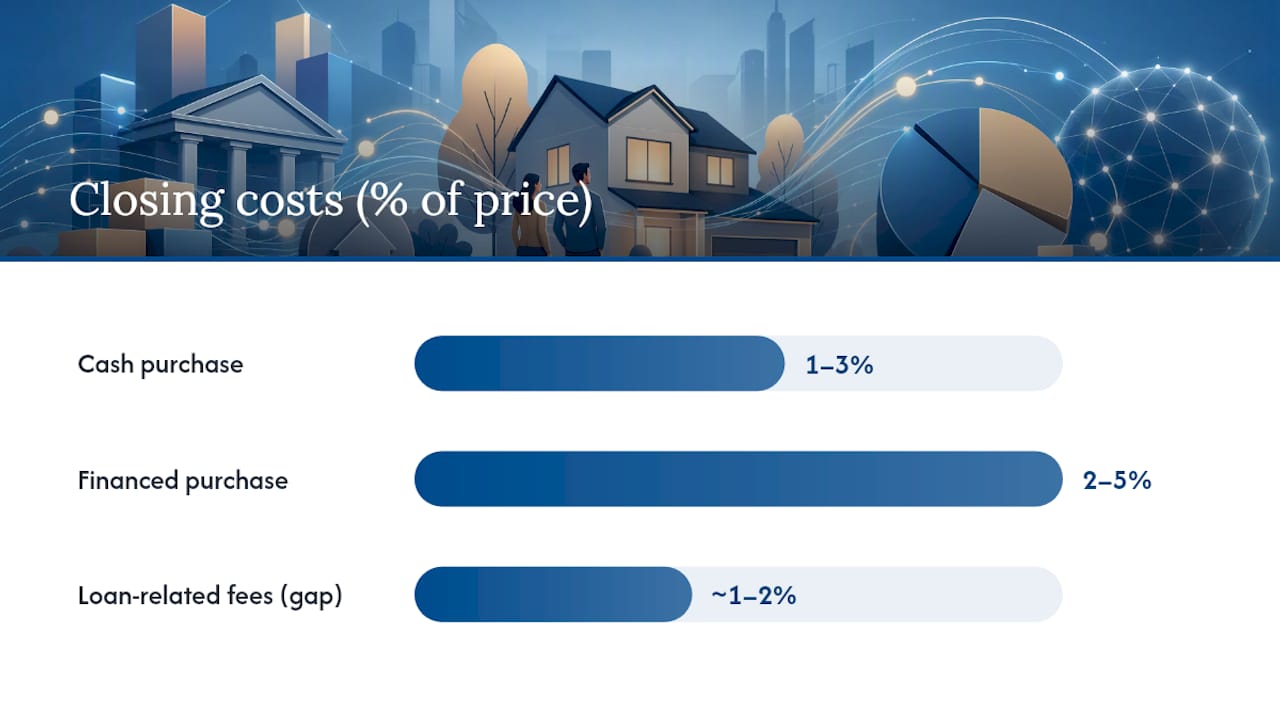
What’s left after cash strips out lender fees still needs a home. Title insurance, transfer taxes, recording fees, and prorated taxes don’t care whether you paid with a wire transfer or a 30-year mortgage. They attach to the transaction, not the financing.
Here’s what that looks like in real dollars, based on the 1% to 3% benchmark that title and settlement professionals commonly cite:
- $250,000 purchase price: Expect $2,500 to $7,500 in total closing costs. A modest condo in a low-transfer-tax state might land near the bottom; a similarly priced home in a high-transfer-tax jurisdiction could push past $7,500.
- $400,000 purchase price: Budget $4,000 to $12,000. This is the price point where local variation starts to matter a lot. A $400,000 sale in a state with a flat, low recording fee schedule might come in near $5,000. The same sale in a market with a steep transfer tax could reach $10,000 or more.
- $750,000 purchase price: Plan for $7,500 to $22,500. At this price tier, even a fractional percentage swing in transfer tax rate translates into thousands of dollars, so the range widens noticeably between low-cost and high-cost jurisdictions.
Those ranges assume a fairly standard transaction: no unusual title defects, no outstanding liens requiring extensive cleanup, and no city-specific add-on fees layered on top of state and county charges. If you’re selling in a jurisdiction with combined state-and-city transfer taxes, run the math before you assume the low end applies to you.
The Closing-Cost Line Items Cash Buyers and Sellers Still Pay
Every fee on a cash closing statement falls into one of two buckets: fixed dollar amounts or percentage-based charges. Knowing which bucket each item lives in makes the whole bill far less mysterious.
- Owner’s title insurance. This protects your equity against title defects that surface after closing, things like forged signatures on a prior deed, unrecorded liens, or heirs who show up years later claiming an ownership stake. ALTA explains that many cash buyers purchase an owner’s policy even though no lender is requiring a lender’s policy, precisely because nobody else is protecting their investment. Rates typically run 0.5% to 1% of the purchase price, and many states regulate the rate title companies can charge, so shopping around changes the service more than the price.
- Settlement or escrow fee. This covers the title or settlement company’s work coordinating the closing: preparing documents, handling the wire transfer, disbursing funds, and recording the deed. Expect somewhere between $300 and $2,000 depending on transaction complexity and region.
- Recording fees. Counties charge a flat fee to record the deed and any related documents in public records. These are usually modest, often $50 to $250, but the exact number depends entirely on your county recorder’s fee schedule.
- Transfer taxes. Calculated as a percentage or a flat rate per $1,000 of sale price, transfer taxes vary enormously by state, county, and even city. In some jurisdictions this is a rounding error. In others, it’s the single largest line on the entire settlement statement, particularly in cities that layer a municipal transfer tax on top of the state’s.
- Property tax prorations. Since property taxes are typically paid in arrears or in advance depending on your state, the seller usually owes the buyer (or vice versa) a prorated amount based on the exact closing date. If annual property tax is $4,800 and closing happens 100 days into the tax period, that’s roughly $1,315 prorated at closing.
- Inspection, survey, and attorney review. Skipping a lender doesn’t mean skipping due diligence. Cash buyers commonly pay for a home inspection and may hire a real estate attorney for contract and title review, with costs varying by location. Skipping these steps to save money exposes you to structural or boundary-line surprises that cost far more later.
- HOA transfer fees, notary fees, and mobile-notary travel charges. If the home sits in a homeowners’ association, expect a modest estoppel or transfer fee to certify dues are current. Notary fees are typically small, though mobile notary services may add extra charges.
Pro Tip: Ask your title company for a fee breakdown that separates “pass-through” government charges (recording, transfer tax) from company charges (settlement fee, title premium). Government charges are non-negotiable. Company charges often aren’t.
Roughly 1% of most cash transactions goes to title insurance alone, based on industry rate guidance, which makes it typically the single biggest line item after transfer taxes in high-tax states.
How to Calculate Your Total Cash-to-Close
Estimating your number doesn’t require a finance degree. It requires six inputs and four simple math steps.
Gather these inputs first:
- Purchase price
- Your state and local transfer tax rate (check your county recorder’s site or ask your title company)
- Estimated title insurance rate for your state
- Fixed fees: settlement fee, recording fee, notary, HOA transfer fee if applicable
- Annual property tax amount
- Planned closing date
Then run the calculation in four steps:
- Sum your fixed fees. Settlement fee, recording fee, notary charges, and HOA fee add up to a flat dollar figure regardless of price.
- Add percentage-based fees. Multiply purchase price by your title insurance rate and by your transfer tax rate, then add those two figures to your fixed-fee total.
- Calculate the proration. Divide your annual property tax by 365, then multiply by the number of days between the start of the tax period and your closing date.
- Add it all together. Fixed fees plus percentage fees plus the proration equals your total closing costs.
If the seller agrees to credit part of the transfer tax or offers a small concession toward the settlement fee, that total shifts down without changing the sale price itself, a common negotiating lever in slower markets.
Where to Get a Reliable Estimate Before Closing Day
A formula gets you in the right neighborhood. A title company gets you the exact number.
- Ask a title or settlement company for an itemized net sheet. Give them the purchase price, your city and county, and your expected closing date. They’ll return a document listing every fee specific to your transaction, not a national average.
- Check your county recorder and assessor websites directly. Recording fees and current property tax amounts are public record, and most counties post fee schedules online.
- Know when an attorney becomes necessary. Some states require attorney involvement in real estate closings by law; others don’t but benefit from a quick contract review, especially with inherited property or unclear title history.
- Understand what online calculators can and can’t do. A generic calculator can approximate percentage-based fees like title insurance reasonably well. It cannot know your city’s specific transfer tax stacking or your HOA’s exact transfer fee. Treat calculators as a starting point, never a final number.
Pro Tip: Request net sheets from two or three title companies before you sign anything. The government fees will be identical everywhere, but settlement fees and title premiums can vary enough to matter, and comparing them costs you nothing.
The CFPB’s guidance on HUD-1 settlement statements is worth reading before closing day, since a line-by-line review of that document is exactly how experienced buyers and sellers catch duplicate charges before they sign.
Cash Closing Costs vs. Financed Purchase Closing Costs
The fee categories overlap more than most people expect, but the differences are exactly where cash buyers save money.
Fees you skip entirely by paying cash:
- Loan origination and underwriting charges
- Lender’s title insurance policy (separate from your own owner’s policy)
- Appraisal fees required specifically for loan underwriting
- Lender-required escrow account setup for taxes and insurance
- Mortgage insurance premiums or upfront funding fees
Fees that stay exactly the same:
- Owner’s title insurance
- Transfer taxes
- Recording fees
- Property tax prorations
- Settlement or escrow company fees
Financed buyers sometimes negotiate seller concessions where the seller pays a portion of the buyer’s closing costs, though loan programs cap how much of the purchase price that concession can represent. Cash sales don’t face that cap, which gives sellers and buyers more room to negotiate who covers what. According to the CFPB’s overview of closing costs, settlement statements and recording charges apply in cash transactions just as they do in financed ones, even without a lender setting requirements. For a side-by-side look at how timelines and fees shift between the two paths, see this comparison of traditional versus cash sale closing.
How to Lower Your Closing Costs on a Cash Deal
You can’t eliminate closing costs, but you can trim them with a little effort upfront.
- Get net sheets from two or three title or settlement companies and compare the company-controlled fees line by line.
- Negotiate who pays the transfer tax or handles prorations. Local custom varies, but it’s rarely set in stone.
- Confirm which fees are truly fixed and ask whether mobile notary charges can be waived or bundled into the settlement fee.
- Don’t cut owner’s title insurance to save a few hundred dollars. The protection it provides against a bad title claim years down the road far outweighs the premium.
- If your closing date is flexible, timing it strategically around your local tax period can shrink the proration you owe.
Pro Tip: Ask specifically which fees are “customary for the buyer to pay” and which are “customary for the seller to pay” in your area. Custom isn’t law, and plenty of these allocations are negotiable even though agents present them as fixed.
For sellers looking to avoid negotiating any of this line by line, a direct cash sale eliminates several fee categories entirely rather than just shrinking them.
How Sell Dave Your House Handles Closing Costs for Sellers
Some cash home-buying companies provide all-cash offers quickly and can close in as little as seven days, often covering standard seller closing costs so that many typical fees do not reduce the seller’s proceeds as they might in traditional sales.
What still affects your net proceeds is the offer price itself, which reflects the home’s as-is condition, so sellers should think of this as trading some equity for speed, certainty, and zero repair obligations.
To speed up the process, have these ready before you start:
- Deed or title documentation showing current ownership
- Information on any outstanding liens or mortgages
- HOA contact information if the property belongs to an association
- Recent property tax statement
This approach fits sellers dealing with foreclosure timelines, inherited property, or homes needing repairs they can’t afford to make, situations where the traditional closing-cost negotiation described earlier in this guide simply isn’t practical.
When Paying Cash Makes Financial Sense Despite the Costs
Closing costs are real money, but they’re not the whole equation. The seller who benefits most from a cash sale isn’t chasing the highest possible number. They’re the seller who values certainty over the next 30 to 60 days more than they value squeezing out an extra few percentage points through a traditional listing, agent commissions, staging, and financing contingencies that can fall apart at the last minute.
If you’re inherited a property you’ve never lived in, facing foreclosure timelines that don’t wait for a buyer’s mortgage approval, or simply can’t afford the repairs a traditional buyer’s inspection would demand, the math tends to favor speed. The honest move is to get a net-proceeds estimate from both paths (a traditional sale and a cash offer) before deciding, since eliminating financing risk is worth more to some sellers than it is to others.
— Real Estate Team
Ready to Skip the Closing-Cost Guesswork Entirely?
Everything in this guide assumes you’re negotiating fees, comparing net sheets, and managing a traditional closing timeline. Sell Dave Your House offers a different path: a fair cash offer within 24 hours, standard seller closing costs covered as part of the deal, and a closing date as fast as seven days if that’s what you need.

There’s no need to shop three title companies or calculate prorations down to the day. You tell us about the property, we make a fair all-cash offer, and you decide if the timeline and terms work for your situation, whether that’s an inherited home, a property in disrepair, or a foreclosure deadline closing in fast. If you’re weighing whether a traditional sale or a direct cash offer makes more sense for your bottom line, the fastest way to find out is to get a fair cash offer and compare it against your own net-proceeds estimate.
Sources
FAQ
Do Cash Sales Have Closing Costs?
Yes.
How Much Are Closing Costs on a $400,000 Home Purchase?
On a $400,000 cash purchase, expect closing costs between roughly $4,000 and $12,000, depending on your state’s transfer tax rate and title insurance pricing.
How Do You Calculate Closing Costs on a Cash Sale?
Add your fixed fees (settlement, recording, notary) to your percentage-based fees (title insurance rate and transfer tax rate multiplied by purchase price), then add the prorated property tax amount for your specific closing date.
What Are the Closing Costs on a Cash Deal Compared to a Financed Deal?
Cash deals skip lender fees like origination, underwriting, and lender’s title insurance, which is why cash closing costs typically run 1% to 3% versus 2% to 5% on financed purchases, while title insurance, transfer taxes, and recording fees remain the same either way.