

What Stops Detroit Tax Foreclosure Before It’s Too Late
You can stop a Detroit tax foreclosure by paying your delinquent taxes in full, enrolling in a Wayne County payment plan before the redemption deadline, or qualifying for relief through HOPE, PAYS, and the Detroit Tax Relief Fund. The date that matters most is March 31 of the third year of delinquency. It is the final day to redeem your property before foreclosure judgment. If none of those paths are realistic on your timeline, selling the house for cash can free up money fast enough to redeem it yourself.
TL;DR:
- The March 31 deadline marks the final day to redeem a property before ownership transfers to Wayne County, with interest and fees rapidly increasing after forfeiture.
- Enrolling in Wayne County’s payment plans requires specific documents and signed approval, and missing any step or deadline can forfeit your options.
- Starting with HOPE is mandatory, followed by PAYS and the Detroit Tax Relief Fund, and applying early improves chances of overall relief rather than last-minute panic.
- Selling for cash is the fastest way to gather redemption funds, with offers within 24 hours and closings in as few as seven days, avoiding auction delays.
- Foreclosure significantly damages credit and may have tax implications, emphasizing the importance of acting before the final deadline to avoid long-term financial repercussions.
Table of Contents
- Immediate Stop-Gap Options: Pay, Payment Plans, and What Each One Requires
- How HOPE, PAYS, and the Detroit Tax Relief Fund Work Together
- How Fast Do Foreclosure Costs and Deadlines Actually Escalate?
- Can Selling for Cash Help You Avoid Foreclosure?
- Redeeming a Property After a Foreclosure Judgment
- What Happens to Your Credit and Finances After Foreclosure
- Can You Negotiate With the Wayne County Treasurer’s Office?
- Choosing a Reputable Cash Buyer Without Getting Burned
- What Sixteen Years in Detroit Real Estate Teaches You About Foreclosure
- Get a Fast, Fair Cash Offer Before Your Redemption Deadline Hits
- Sources
- FAQ
Immediate Stop-Gap Options: Pay, Payment Plans, and What Each One Requires
Wayne County gives you three payment plan options once your property taxes go delinquent, and picking the right one often comes down to how much cash you can put down today and whether you live in the home.

The Interest Reduction Step Agreement (IRSPA) is built for owner-occupants. It knocks your interest rate down substantially, sometimes cutting an 18% delinquency rate to something closer to 6%, and typically asks for around 10% down. The Step Payment Agreement (SPA) casts a wider net, covering owners who don’t qualify for IRSPA, but it comes with staged down payments that shift depending on when you file. The Distressed Owner Occupied Extension (DOOE) exists for homeowners in real financial trouble who still live in the property; it requires proof of occupancy and gives you more breathing room on the schedule.
Pro Tip: Never assume a plan is active just because you submitted paperwork. Every plan must be signed by the Wayne County Treasurer’s Office to be valid, and one missed payment after that can void it entirely.
Before you enroll, get these documents together:
- Government-issued photo ID
- Proof of occupancy (utility bill, driver’s license with matching address)
- Income documentation if applying for DOOE
- Parcel ID number from your tax bill
The Wayne County Treasurer’s property tax office handles enrollment, and its own delinquent tax notice guidance spells out filing deadlines for each plan. Call before your show cause hearing date, not after. Waiting until the hearing itself narrows your options considerably.
Roughly 18,000 property owners have used related relief support since 2020, which tells you these plans aren’t a last resort reserved for extreme cases. They’re the standard tool the county expects delinquent homeowners to use.
How HOPE, PAYS, and the Detroit Tax Relief Fund Work Together
These three programs form a sequence, not a menu you can pick from randomly. You have to start with HOPE.
- Apply for the Homeowners Property Exemption (HOPE). This exempts you from a portion of your property taxes based on income, and you must reapply every year. Detroit’s HOPE program page lists a November 6 enrollment deadline for the current cycle, and missing it can knock you out of the entire relief pipeline for a year.
- Move into PAYS once HOPE is approved. PAYS, or Pay As You Stay, restructures or reduces your county tax debt based on the exemption HOPE already established. You can’t skip to PAYS without HOPE in place first.
- Apply for the Detroit Tax Relief Fund if a balance remains. Funded through the Gilbert Family Foundation and administered by Wayne Metro, the DTRF has helped about 13,000 homeowners eliminate over $52 million in tax debt as of August 2026.
Pro Tip: Start your HOPE application weeks before the deadline, not the week of it. Homeowners who wait until the last minute often get rejected simply because they run out of time to gather income documents, and a rejected HOPE application blocks PAYS and DTRF too.
Wayne Metro and the United Community Housing Coalition (UCHC) both offer free, in-person counseling to walk you through HOPE paperwork and connect you to PAYS enrollment once approved. A completed and verified HOPE file sometimes unlocks PAYS automatically, so ask your counselor to confirm your HOPE status is finalized rather than assuming it went through.
How Fast Do Foreclosure Costs and Deadlines Actually Escalate?
Michigan runs tax foreclosure on a strict three-year statutory clock, and each stage adds cost on top of what you already owe.
Here’s the sequence: your taxes become delinquent in year one, forfeit to the county treasurer on March 1 of year two, and reach a foreclosure judgment with a final redemption deadline on March 31 of year three. Miss that March date, and ownership transfers, full stop, regardless of how close you were to paying.
Statistic: Once forfeiture hits, interest jumps to 1.5% per month, applied retroactively to the original delinquency date, plus a $175 forfeiture fee and a $30 recording fee.
That retroactive interest is the part people underestimate. A $2,000 delinquent balance that sits unpaid through forfeiture can grow by several hundred dollars in interest and fees before you even reach year three, and the meter keeps running every month after that. Speed of action matters more than finding the ideal payment plan or the perfect buyer once you’re this close to the deadline.
A few things worth knowing about the process itself:
- Landing on the public delinquent tax list is a notice, not a sale. Your home stays yours until redemption rights actually expire.
- Auctions for foreclosed properties typically happen in September or October, months after the March redemption deadline passes.
- Never attempt to enter or “inspect” a property listed as delinquent or forfeited. It’s still someone’s home and legally still theirs, and doing so can constitute trespassing.
Can Selling for Cash Help You Avoid Foreclosure?
Selling your house for cash works when the math on payment plans or relief programs doesn’t add up fast enough, and you need funds in hand before the redemption deadline closes.
A local cash buyer can typically make an offer within 24 hours of seeing your property and close in as few as seven days, buying the house as-is with no repair costs, no cleanout, and no realtor commissions eating into your proceeds. That speed is the entire point. Traditional listings take weeks to attract a buyer and months to close, timelines that rarely survive a looming foreclosure judgment.
- Weigh speed against price. A cash sale usually nets less than a fully marketed listing, but it avoids auction entirely and puts money in your hands on a schedule you control.
- Gather your paperwork early: deed, photo ID, mortgage statement (if any), and your most recent tax bill showing the delinquent balance.
- Confirm the buyer’s proof of funds and closing date in writing before you count on that money to redeem your taxes. A verbal promise doesn’t help you if the closing slips past March 31.
Pro Tip: Ask any cash buyer for a specific closing date in the purchase agreement, then work backward from the Wayne County redemption deadline to make sure the timing actually works.
If you’re weighing this route, selling a house facing foreclosure for cash gives you a way to convert equity into redemption money without waiting on a traditional sale process.
Redeeming a Property After a Foreclosure Judgment
Once a Wayne County judge enters a foreclosure judgment, your redemption window doesn’t extend past March 31 of that year. This is the moment where confusion causes the most damage, because homeowners sometimes assume a judgment gives them extra time to negotiate. It doesn’t.
To redeem before that date, you need to pay the full delinquent amount, including all forfeiture fees, the $30 recording fee, and every month of accrued interest, directly to the Wayne County Treasurer’s office. Partial payments generally don’t stop the clock. The treasurer’s office can tell you the exact payoff figure over the phone or through its online portal, and that number changes monthly as interest compounds, so get a fresh quote before you finalize any sale or loan you’re using to cover it.
Show cause and judicial foreclosure hearings happen in the weeks leading up to that deadline, and they’re your last structured opportunity to object, request a delay, or get connected with a relief program on the spot. Treasurer’s office staff at these hearings can route you toward IRSPA, SPA, DOOE, or HOPE assistance if you show up and ask. Skipping the hearing doesn’t protect you. It usually just means a judgment gets entered without your input at all.
Once the redemption deadline passes with no payment, the property proceeds toward the county’s auction process later that year, typically September or October, and ownership has already legally transferred by that point.
What Happens to Your Credit and Finances After Foreclosure
Losing your home to tax foreclosure does more damage than the loss of the property itself. It follows you financially for years.
A completed tax foreclosure shows up as a public record and can appear on credit reports, dragging down your score in a way that makes future rentals, auto loans, or mortgage applications harder to secure. Landlords and lenders both check public records during screening, and a foreclosure entry raises immediate red flags regardless of the circumstances that caused it.
There’s also a tax dimension people rarely see coming. If you had any mortgage debt forgiven or written off in connection with the foreclosure, that forgiven amount can sometimes count as taxable income in the eyes of the IRS, depending on your situation. That’s on top of losing the home itself and any equity you’d built in it, equity that doesn’t transfer to you once the county takes title.
Beyond the financial mechanics, foreclosure displaces you on a timeline you don’t control, often during the same season the county schedules its auctions. Finding new housing under that kind of pressure, with a damaged credit file working against you, is harder than most homeowners expect until they’re in it. That combination, credit damage plus a compressed relocation timeline, is exactly why acting before the March 31 deadline matters so much more than dealing with the aftermath.
Can You Negotiate With the Wayne County Treasurer’s Office?
You have more room to negotiate with the Wayne County Treasurer’s office than most homeowners assume, but it depends entirely on how early you engage.
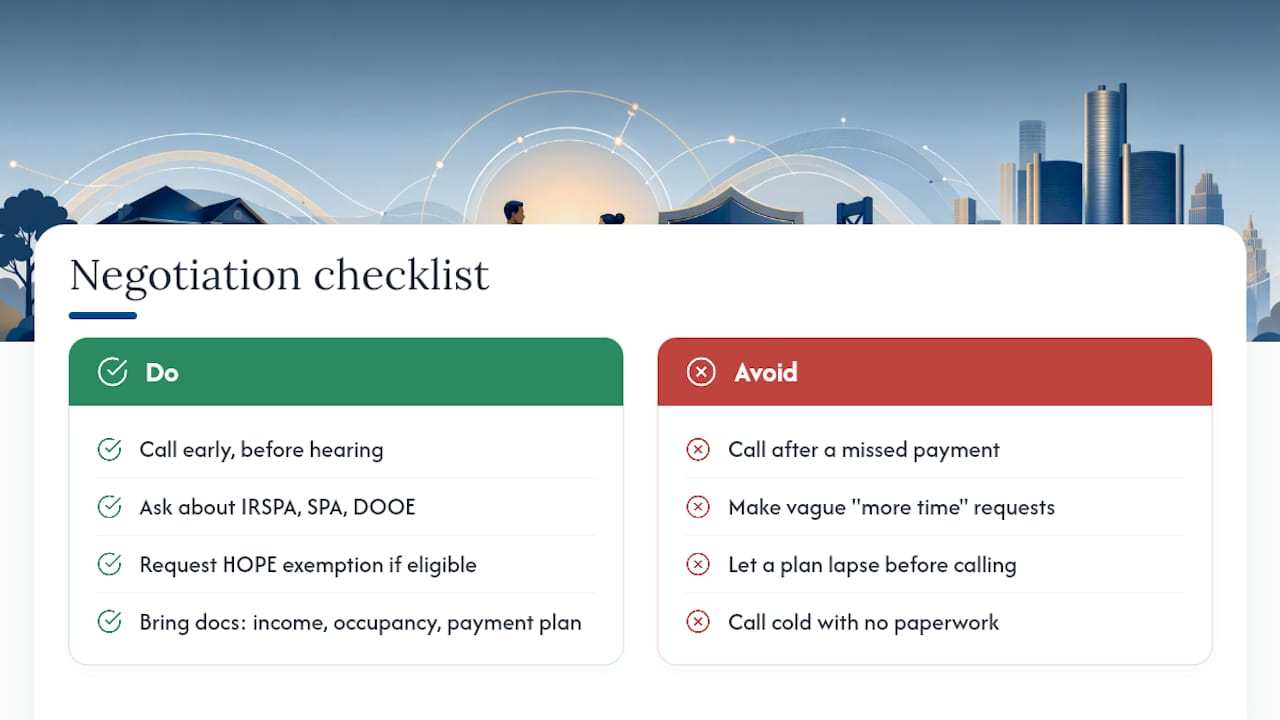
Calling before your show cause hearing, rather than after, gives staff more flexibility to route you into IRSPA, SPA, or DOOE rather than defaulting to the standard foreclosure track. If you already have a plan in place and you’re at risk of missing a payment, contact the office before the payment is due, not after it’s late. Treasurer’s staff can sometimes adjust a schedule proactively, but a plan that’s already lapsed is much harder to revive.
Bring documentation to every conversation: income statements if you’re requesting DOOE terms, proof of occupancy, and a clear number for what you can realistically pay each month. Vague requests for “more time” tend to go nowhere. Specific asks tied to a specific program get processed faster.
If your first call doesn’t get the answer you need, ask directly whether you qualify for HOPE, since that exemption can lower the total amount you owe before you even negotiate a payment structure. Community counselors at Wayne Metro or UCHC often know which Treasurer’s office staff handle which program and can help position your request more effectively than calling in cold. The office fields an enormous volume of these calls every enrollment season, and homeowners who show up prepared and early tend to get further than those who call last-minute with no paperwork.
Choosing a Reputable Cash Buyer Without Getting Burned
Not every “we buy houses” offer is what it claims to be, and a bad deal during a foreclosure crunch can cost you more than the foreclosure itself would have.
Watch for these warning signs before signing anything:
- No local address or verifiable business history. A buyer with 16 years of Metro Detroit transactions leaves a paper trail; a P.O. box and a phone number don’t.
- Pressure to sign before you’ve seen proof of funds. A legitimate buyer shows you they can close, in writing, before asking for your signature.
- Vague closing timelines. “Soon” isn’t a date. If your redemption deadline is fixed, your closing date needs to be fixed too.
- Contracts with hidden fees deducted at closing. As-is cash offers should mean no repair costs and no commissions, not a surprise deduction that shows up on the settlement statement.
Ask any buyer directly how many houses they’ve closed in your county, whether they can provide a written proof of funds letter, and what their standard closing timeline looks like from signed agreement to funds in your account. A buyer who hesitates on any of those three questions is worth walking away from, especially when your redemption deadline leaves no room for a deal that falls apart halfway through.
What Sixteen Years in Detroit Real Estate Teaches You About Foreclosure
We’ve watched enough Detroit tax foreclosure cases play out over 16-plus years to know the pattern: homeowners wait too long to explore their options, then panic when the redemption deadline is weeks away instead of months. One client, John, came to us with a redemption deadline closing in fast and no realistic path through a payment plan given his income situation. We made an offer within 24 hours and closed in seven days, giving him enough to pay off what he owed and walk away with cash left over instead of losing the property outright.
That said, a cash sale isn’t always the right first move. If you can realistically manage IRSPA or SPA payments, or if HOPE and PAYS would erase most of your debt, try those first. Selling makes the most sense when the calendar has already run out on the alternatives.
— Real Estate Team
Get a Fast, Fair Cash Offer Before Your Redemption Deadline Hits
Sell Dave Your House gives you a faster path to redemption money than any traditional listing could, because we make offers within 24 hours and close in as few as seven days, without asking you to fix a single thing or pay a realtor’s commission.

That speed matters most when the calendar is working against you. A traditional agent listing takes weeks to find a buyer and months to close, timelines that don’t survive a March 31 redemption deadline. We buy houses as-is across Metro Detroit, whether the property needs major repairs, sits vacant, or came to you through inheritance, and we cover standard closing costs so you’re not left calculating hidden deductions at the closing table.
To move quickly, have your deed, a government-issued ID, your most recent delinquent tax bill, and your mortgage statement (if applicable) ready before you call. Those documents let us build an accurate offer fast and lock in a closing date that actually lines up with your Wayne County deadline. If your redemption date is close, don’t wait on a traditional sale process to catch up. Get a fair cash offer fast in Detroit and find out within a day what your house is worth.
Sources
- Property Tax Information - Wayne County, Michigan
- Homeowners Property Exemption (HOPE) - City of Detroit
- Are you behind on your property taxes? A Wayne County relief program is back. — BridgeDetroit
FAQ
What is the deadline to stop a Detroit tax foreclosure?
Redemption typically ends March 31 of the third year of delinquency, after which the foreclosure judgment becomes final and ownership transfers to the county.
Do I need HOPE before I can apply for PAYS or the Detroit Tax Relief Fund?
Yes, HOPE is the required first step, and you must reapply for it annually before PAYS or Detroit Tax Relief Fund assistance can apply to your account.
How fast can I sell my Detroit house for cash to avoid foreclosure?
Sell Dave Your House typically makes an offer within 24 hours and can close in as few as seven days, which can free up funds before the March 31 redemption deadline.
Will tax foreclosure show up on my credit report?
A completed tax foreclosure is a public record that can affect your credit profile and complicate future rental or loan applications, on top of any tax consequences from forgiven mortgage debt.