

Eliminate Inspection Contingency Home Sale: Fast Cash Guide
Yes, you can lawfully eliminate the inspection contingency from a home sale in Metro Detroit. The fastest, most reliable way to do it is to sell to a cash buyer who explicitly waives inspection rights in the purchase agreement. Selling “as-is” alone is not enough. An “as-is” label does not remove a buyer’s contractual right to inspect; only explicit waiver language in the signed agreement does. Michigan seller disclosure laws still apply regardless of how the contract is written, so transparency about known defects is not optional.
Three things to do right now:
- Confirm the buyer’s proof of funds and escrow readiness before signing anything.
- Add explicit inspection-waiver language to the purchase agreement (see contract options below).
- Prepare and deliver your Michigan Seller’s Disclosure Statement in writing, attached to the contract.
Sell Dave Your House handles all three of these steps for Metro Detroit sellers, with cash offers delivered within 24 hours and closings in as little as seven days.
Table of Contents
- How do you legally remove the inspection contingency for an as-is cash sale?
- What does an inspection contingency actually protect, and what changes when you waive it?
- What legal disclosures can you not skip when selling as-is in Michigan?
- What contract clause options let you limit or remove the inspection contingency?
- How do cash buyers and investors typically handle inspections?
- What does a typical as-is cash sale cost and how long does it take?
- What questions should you ask a cash buyer before waiving inspection rights?
- What is the recommended approach for Metro Detroit homeowners?
- Key Takeaways
- A local seller’s perspective on as-is cash sales in Metro Detroit
- Sell Dave Your House makes it straightforward to close fast
- Useful sources and where to get formal help
- FAQ
How do you legally remove the inspection contingency for an as-is cash sale?
Follow these steps in order. Skipping any one of them creates legal or financial exposure.
- Verify buyer funding first. Request a proof-of-funds letter from a bank or financial institution, not just a verbal assurance. Confirm the title company or closing attorney is already engaged.
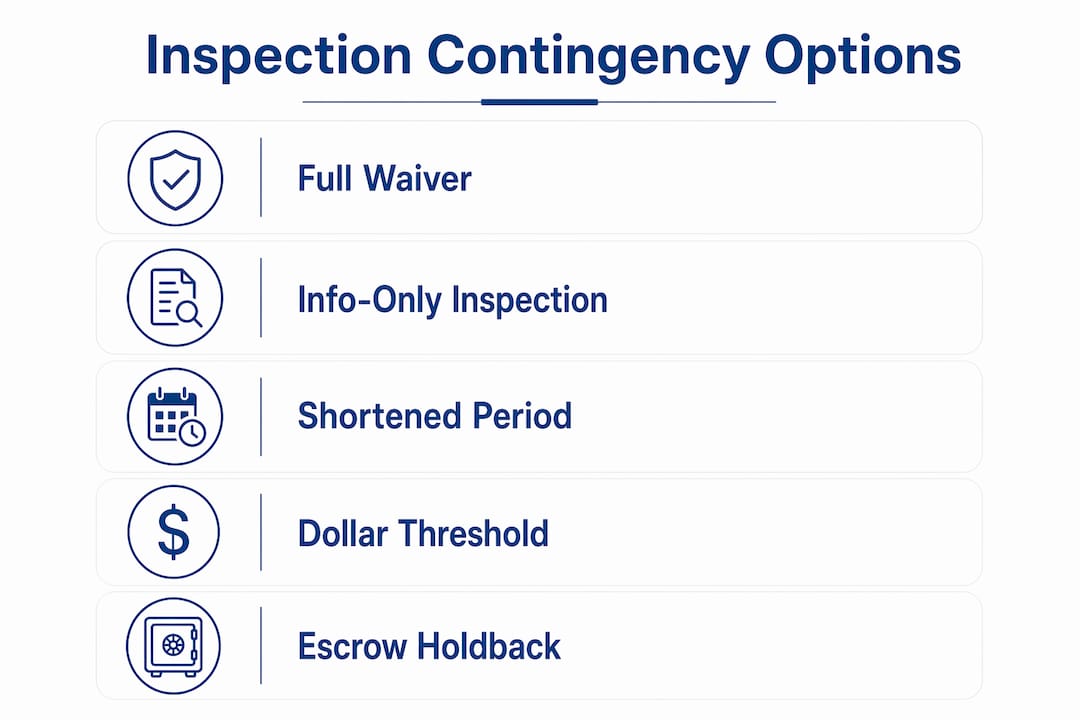
- Choose your contractual route. Four options exist: a full inspection waiver, a shortened inspection window (3–5 business days), an inspection-for-information-only clause, or a limited-dollar-threshold contingency. Each is covered with sample language in the contract section below.
- Disclose known material defects in writing. Attach your completed Michigan Seller’s Disclosure Statement to the purchase agreement. Do not rely on “as-is” as a legal shield; it is not one.
- Consider an escrow holdback if the buyer wants partial protection. Escrowed funds for a specific identified issue can replace a full contingency and keep the deal moving.
- Set firm deadlines with the title company. Contingency windows run from the contract’s effective date. Coordinate with your title company so every deadline is calendared and enforced.
Pro Tip: If you want to make a contingency waiver easier for buyers to accept, order a pre-listing inspection yourself or share any recent inspection reports you have. Sellers who provide recent reports reduce renegotiation risk and give buyers the confidence to waive the contingency without hesitation.

What does an inspection contingency actually protect, and what changes when you waive it?
The inspection contingency gives a buyer the right to hire a licensed inspector, review findings, and then request repairs, negotiate a price reduction, or walk away with their deposit returned. Typical contingency windows run 7–15 days from the contract’s effective date and can cover specialty inspections for radon, termite, septic systems, and HVAC.
When a buyer waives that contingency, they accept the property in its current condition and lose deposit protection if they try to terminate based on condition later. For sellers, that is the upside: fewer renegotiations, no repair demands, and a faster path to closing.
Waive vs. keep at a glance:
- Waive: Faster close, no repair negotiations, buyer absorbs condition risk, earnest money is non-refundable on condition grounds.
- Keep: Buyer retains right to terminate with deposit returned, seller faces potential repair requests or price reductions, timeline extends by 7–15 days.
As-is buyers commonly expect a price reduction to offset the risk they are absorbing. Industry estimates place that discount in the 10–30% below market value range depending on the home’s condition. That range is wide because condition varies so much, but it is the realistic starting point for any Metro Detroit seller pricing an as-is cash deal.
What legal disclosures can you not skip when selling as-is in Michigan?
Michigan law requires sellers to complete a formal Seller’s Disclosure Statement covering foundation, roof, plumbing, electrical, environmental hazards, and other material conditions. The form must be delivered to the buyer before or at the time of the purchase agreement. Common legally material defects include foundation cracks, roof deterioration, major plumbing or electrical failures, water intrusion, and environmental hazards such as lead paint or mold.
If you discover mold or other environmental hazards, disclose them and consult a specialist. Specialized remediation guidance exists for sellers navigating those situations, and your disclosure obligation extends to what you know, not just what an inspector finds.
Pro Tip: Keep signed copies of every disclosure form. If a dispute arises after closing, your paper trail is your primary defense. A real estate attorney is worth consulting for any defect that is unusual, expensive, or not clearly covered by the standard form.
For contract language guidance, ReviewMyContract is a practical resource for reviewing clause options and red flags before you sign.
What contract clause options let you limit or remove the inspection contingency?
Each option below trades some buyer protection for speed and seller certainty. Choose based on how motivated your buyer is and how much risk they are willing to absorb.
Full inspection waiver: The purchase agreement states the buyer accepts the property in its current condition and expressly waives the inspection contingency. Sample language: “Buyer acknowledges the property is being purchased in its present condition and hereby waives any and all inspection contingencies.” Fastest option; works best with experienced cash buyers or investors.
Inspection-for-information-only: The buyer may inspect but agrees not to request repairs or terminate based on findings, except for defined material defects exceeding a stated threshold. Keeps the deal alive while giving the buyer some peace of mind.
Shortened inspection period: Reduce the standard 7–15 day window to 3–5 business days. Information-only inspections and shortened windows are commonly used middle paths that preserve competitiveness while managing buyer risk.
Limited-dollar-threshold contingency: Buyer may terminate only if repair estimates exceed an agreed dollar amount (for example, $10,000). Sample language: “Buyer may terminate this agreement only if licensed contractor estimates for repairs identified during inspection exceed $10,000 in aggregate.”
Escrow holdback: Funds for a specific known issue are held in escrow at closing and released upon completion of agreed work. Useful when one defect is the sticking point but both parties want to close.
| Clause type | Closing speed | Seller certainty | Buyer risk | Legal exposure |
|---|---|---|---|---|
| Full waiver | Fastest | Highest | Highest | Low if disclosed |
| Shortened window | Fast | High | Moderate | Low if disclosed |
| Info-only inspection | Moderate | High | Moderate | Low if disclosed |
| Dollar-threshold | Moderate | Moderate | Lower | Moderate |
| Escrow holdback | Moderate | Moderate | Lower | Low if structured correctly |
How do cash buyers and investors typically handle inspections?
Most experienced cash buyers and investors skip the formal inspection process entirely or conduct a rapid walk-through to price risk into their offer. They are not looking for a reason to renegotiate; they are calculating their repair budget before they make the offer. That is why cash buyers and investors are the most reliable path to a contingency-free sale.
What a realistic cash-sale timeline looks like:
- Day 1: Submit property details, receive a cash offer within 24 hours.
- Days 2–3: Review and sign the purchase agreement; buyer provides proof of funds.
- Days 3–7: Title search, closing paperwork prepared by title company.
- Day 7 (or sooner): Close, receive funds.
Sell Dave Your House follows this exact process for Metro Detroit homeowners, covering standard closing costs and requiring no repairs or cleaning before closing. Learn more about how cash offers bypass repair contingencies and what sellers can realistically expect.
What does a typical as-is cash sale cost and how long does it take?
| Milestone | Realistic timeline (cash buyer) |
|---|---|
| Cash offer received | Within 24 hours of inquiry |
| Purchase agreement signed | Days 1–2 |
| Title search completed | Days 2–5 |
| Closing | As early as Day 7 |
Typical seller costs and savings with a cash buyer:
- Realtor commissions: $0 (no agent required).
- Standard closing costs: Often covered by the buyer.
- Repairs or cleaning: $0 when selling as-is.
- Price concession: Expect 10–30% below retail market value depending on condition.
The speed-versus-price tradeoff is real. A faster close with a cash buyer almost always means accepting a lower price than you would get after repairs and a full market listing. For sellers facing foreclosure, managing an inherited property, or simply needing certainty, that tradeoff is often the right one. Selling a house in disrepair in Detroit follows the same process and timeline.
What questions should you ask a cash buyer before waiving inspection rights?
Vetting a cash buyer takes less than 30 minutes and protects you from stalled closings or outright fraud.
Ask these questions before signing:
- Can you provide a proof-of-funds letter from your bank or financial institution today?
- Which title company or closing attorney will you use?
- Can I see a draft purchase agreement before we proceed?
- Have you closed similar transactions in Metro Detroit? Can you provide references?
- Is your business registered, and can you provide company formation documents?
Red flags that should stop the conversation:
- Buyer refuses to provide proof of funds or delays repeatedly.
- Buyer asks you to wire money or pay any upfront fee.
- Contract terms are unusual, vague, or heavily one-sided.
- Buyer insists on cash outside of escrow or pressures you to skip the title company.
Pro Tip: Always require escrowed earnest money with a release condition tied to confirmed funding. This gives you a financial backstop if the buyer fails to close.
What is the recommended approach for Metro Detroit homeowners?
The clearest path is this: verify buyer funding first, use explicit waiver or shortened-window language in the contract, fully disclose every known defect on your Michigan Seller’s Disclosure Statement, and work with a reputable local cash buyer who will coordinate title and closing. That combination gives you speed without legal exposure.
- Verify proof of funds before signing any agreement.
- Use explicit inspection-waiver or short-window contract language.
- Complete and attach your Michigan Seller’s Disclosure Statement.
- Confirm the title company is engaged and closing costs are defined.
- Choose a buyer with a documented local track record.
Sell Dave Your House meets every item on that list. With over 16 years of experience buying homes across Metro Detroit, the team provides proof of funds, a straightforward purchase agreement, and the ability to close in as little as seven days, with no repair negotiations and no agent commissions.
Key Takeaways
Selling as-is for cash is the fastest legal path to remove an inspection contingency, but it only works when you verify buyer funding, use explicit contract language, and fully disclose known defects.
| Point | Details |
|---|---|
| Waiver requires explicit language | “As-is” alone does not remove the inspection contingency; the purchase agreement must state it explicitly. |
| Disclosure is non-negotiable | Michigan law requires a completed Seller’s Disclosure Statement; concealment can lead to post-closing litigation. |
| Cash buyers close in 7 days | Reputable cash buyers provide proof of funds and can close in as little as seven days with no repairs required. |
| Expect a price concession | As-is cash buyers typically offer 10–30% below retail market value to account for condition risk. |
| Sell Dave Your House | Provides 24-hour cash offers, covers standard closing costs, and closes in as little as seven days for Metro Detroit sellers. |
A local seller’s perspective on as-is cash sales in Metro Detroit
The part most sellers underestimate is how much the contract language actually matters. Saying “I’m selling as-is” in conversation is not the same as having a signed purchase agreement with an explicit inspection waiver. Sellers who skip that step often find themselves back at the negotiating table after a buyer’s inspector turns up a leaky basement or an aging furnace.
The other thing worth saying plainly: disclosure protects you. Sellers who are thorough and honest about known defects almost never face post-closing disputes. The ones who try to hide something, even something minor, are the ones who end up in mediation. In Metro Detroit’s market, where older housing stock is the norm, buyers expect imperfections. What they do not forgive is being misled.
If you are under time pressure, whether from foreclosure, an inherited property, or a life change, the fastest and safest move is to work with a buyer who already knows how to handle these transactions. Get everything in writing, keep copies of your disclosures, and use a licensed title company for closing.
Sell Dave Your House makes it straightforward to close fast
If you need to close quickly without repair negotiations, Sell Dave Your House is built for exactly that situation. Metro Detroit homeowners receive a fair cash offer within 24 hours, with no repairs, no cleaning, and no agent commissions. Sell Dave Your House verifies proof of funds upfront, provides a clear purchase agreement with explicit inspection-waiver language, and coordinates the title company so closing can happen in as little as seven days.

Whether you are dealing with an inherited property, facing foreclosure, or simply ready to move on without the delays of a traditional listing, the process is straightforward. Have your deed, a recent mortgage statement, and a list of any known defects ready, and Sell Dave Your House handles the rest. Request a cash offer today, or visit the Harper Woods cash offer page if you are in that area.
This article is general information, not legal advice. Confirm current Michigan disclosure requirements and contract obligations with a licensed real estate attorney or your title company before closing.
Useful sources and where to get formal help
- Real Estate Contract Guide: Clauses, Red Flags & Negotiation | ReviewMyContract — Practical breakdown of inspection contingency language, red flags, and clause options.
- How to Sell a House As-Is | AskDoss — Covers what “as-is” does and does not do contractually, including disclosure obligations.
- Can You Sell a House Without an Inspection? | Zillow — Overview of seller options and buyer behavior around inspection waivers.
- Pros and Cons of Waiving the Home Inspection | Home Buying Hub — Covers alternative middle-path options including shortened windows and information-only inspections.
- Mold Discovery When Selling Your Home | The Mold Genius — Specialist guidance on environmental hazard disclosure and remediation referrals.
For formal help: Consult a Michigan-licensed real estate attorney for unusual defects or complex contract terms. Use a licensed title company for all closings. If environmental hazards such as mold are present, engage a certified remediation specialist before closing.
| Resource type | Who to contact |
|---|---|
| Contract review | Michigan real estate attorney or ReviewMyContract |
| Closing and title | Licensed Michigan title company |
| Environmental hazards | Certified mold or environmental remediation specialist |
| Fast cash sale | Sell Dave Your House (Metro Detroit) |
FAQ
What does it mean to eliminate an inspection contingency?
Eliminating the inspection contingency means the buyer agrees in writing to purchase the property without the right to request repairs or terminate based on inspection findings. It requires explicit contract language, not just an “as-is” label.
Can a seller in Michigan legally require buyers to waive inspection?
Yes. A seller can request or require an inspection waiver as a condition of accepting an offer. Buyers are not obligated to agree, but cash buyers and investors routinely accept this term.
Does waiving inspection mean the buyer cannot inspect at all?
Not necessarily. Buyers can still conduct an informational inspection, but without the contingency they lose the contractual right to demand repairs or terminate without risking their earnest money deposit.
How fast can Sell Dave Your House close on a Metro Detroit home?
Sell Dave Your House provides cash offers within 24 hours and can close in as little as seven days, covering standard closing costs with no repairs or agent commissions required.
What happens if I forget to disclose a known defect on an as-is sale?
Failing to disclose a known material defect can expose you to post-closing litigation or contract rescission, even when the purchase agreement includes an as-is clause. Michigan law requires a completed Seller’s Disclosure Statement regardless of sale terms.