

Your Foreclosure Prevention Seller Checklist for 2026
The fastest way to preserve your options right now is to call your mortgage servicer today and tell them you are experiencing a hardship. That single call, backed by a complete loss-mitigation application, can pause many foreclosure actions while your case is reviewed. According to the Consumer Financial Protection Bureau, contacting your servicer as soon as you know you will miss a payment opens the door to forbearance, repayment plans, and loan modifications that may not be available once the process advances.
Your priority document list to gather promptly includes:
- Most recent mortgage statement (account number, servicer contact)
- Last 8 weeks of paystubs (or a notarized self-employment income affidavit)
- Last 2 months of bank statements (all accounts)
- Most recent two years of federal tax returns
- Government-issued photo ID
- Hardship letter (one page explaining what changed and whether it is temporary or permanent)
- HOA statements, if applicable
Call script you can read verbatim: “My name is [your name], my loan number is [number]. I am calling because I am experiencing a financial hardship and I want to discuss loss-mitigation options before I miss a payment. Can you connect me with your loss-mitigation department?”
After that call, contact a HUD-approved housing counselor for free guidance. Counselors help you prepare your application and negotiate with servicers at little or no cost to you.
Key Takeaways
Calling your mortgage servicer within 48 hours, submitting a complete loss-mitigation application, and verifying any cash buyer’s proof of funds are the three actions most likely to preserve your options and stop foreclosure.
| Point | Details |
|---|---|
| Call your servicer first | Contact the loss-mitigation department within 48 hours; servicers cannot start foreclosure until you are more than 120 days delinquent. |
| Submit a complete application | A complete loss-mitigation packet pauses certain foreclosure actions while your servicer reviews your case. |
| Use free HUD counseling | HUD-approved housing counselors are free or low-cost and help you prepare documents and negotiate with your servicer. |
| Know your sale options | Traditional sale, short sale, and fast cash sale are all viable in preforeclosure; the right choice depends on your equity and timeline. |
| Sell Dave Your House | Provides written cash offers within 24 hours and can close in as few as 7 days for Metro Detroit homeowners facing foreclosure. |
Official resources and intake checklists
Use these verified sources to download document checklists, find counselors, and access state assistance programs:
- HUD foreclosure avoidance guidance: Usa — state HAF links, counselor referrals, and program overviews
- CFPB loss-mitigation guidance: Consumerfinance — servicer timelines, your rights, and how to file a complaint
- CFPB housing counselor directory: Consumerfinance — search by ZIP code for a HUD-approved counselor near you
- FTC consumer protections: Consumer — scam red flags and your legal rights
- SHIP intake document checklist (Lake County, FL example): SHIP Foreclosure Prevention Required Documents PDF — practical template for your application packet
- IHCDA Loss Mitigation Checklist (Indiana): In — another state-level template useful for verifying packet completeness
- Evaluating private lending proposals: Checklist for evaluating hard money loan proposals — useful if you are considering a bridge loan to reinstate your mortgage before selling
- Stop a foreclosure sale fast: Selldaveyourhouse — publisher-specific guidance on urgent steps when an auction date is imminent
This article provides general information about foreclosure prevention options and is not a substitute for legal or financial advice. Consult a HUD-approved housing counselor, a licensed attorney, or a qualified financial professional to review your specific situation before making decisions.
Table of Contents
- How does the foreclosure process work, and what timelines protect you?
- What should you do first, second, and third to stop foreclosure?
- What documents do you need for a loss-mitigation or sale application?
- What are your loss-mitigation options, and which one fits your situation?
- How do you prepare and submit a complete loss-mitigation application?
- Which selling option is right for you: traditional sale, short sale, or fast cash?
- How do you spot foreclosure-rescue scams and get free legitimate help?
- Sell Dave Your House offers a fast cash path when selling is the right move
- Sources
- FAQ
How does the foreclosure process work, and what timelines protect you?
Foreclosure does not happen overnight. Understanding the stages gives you a clear picture of which options remain open at each point.
Stage 1: Delinquency. You miss one or more payments. Your servicer will begin sending notices and attempting contact. This is the best time to act because every option is still on the table.
Stage 2: Notice of Default or Notice to Accelerate. Your servicer formally notifies you that the loan is in default. Under federal rules, servicers generally cannot start foreclosure until a borrower is more than 120 days delinquent. That 120-day window is your most protected period.
Stage 3: Preforeclosure. The servicer has filed or is preparing to file with the court (judicial foreclosure states) or issued a notice of trustee sale (non-judicial states). A short sale or traditional sale is still possible here. Submitting a complete loss-mitigation application during this stage can pause certain foreclosure actions while the servicer evaluates your case.
Stage 4: Foreclosure Sale or Auction. The property is sold at public auction. After this point, your options narrow sharply. Redemption rights vary by state, and most sale-based solutions are no longer available.
Stage 5: Post-Foreclosure Eviction. If the property sells and you remain, the new owner can begin eviction proceedings.
| Stage | Approximate Timing | Options Still Available |
|---|---|---|
| Delinquency (1–3 months) | Days 1–90 | All options: forbearance, modification, reinstatement, sale |
| Notice of Default | Day 90–120 | Repayment plan, modification, short sale, traditional sale |
| Preforeclosure | Day 120+ | Short sale, deed in lieu, fast cash sale, reinstatement |
| Foreclosure Sale | Auction date | Very limited; state redemption rights only |
The most critical protection to know: once you submit a complete loss-mitigation application, your servicer is generally required to evaluate it before proceeding with a foreclosure sale. That review period is your breathing room.
What should you do first, second, and third to stop foreclosure?
Sequencing matters. Doing the right things in the wrong order wastes time you may not have.
48-hour actions
- Call your mortgage servicer. Use the script above. Ask specifically for the loss-mitigation department. Write down the date, time, representative’s name, and a summary of what was said.
- Call a HUD-approved housing counselor. Find one through the CFPB counselor directory or by calling 800-569-4287 (HUD’s national hotline). This call is free.
- Gather your minimum document set. Pull together the seven items listed in the opening section. Scan or photograph them clearly and save them in a single folder on your phone or computer.
- Note every contact detail. Start a simple log: date, time, who you spoke to, what they said, and any reference numbers given.
1-week actions
- Submit your complete application packet. Use your servicer’s online portal if one exists. If not, send by certified mail with return receipt requested. Keep a timestamped digital copy of everything you send.
- Notify your servicer in writing if you are listing the home. If selling is your plan, put it in writing and send it certified mail. This documents your good-faith effort.
- Follow up on any missing documents. Your servicer may request additional items. Respond within 48 hours of any request to keep your application active.
30-day actions
- Evaluate the servicer’s response. They must acknowledge receipt of a complete application and provide a written decision. If you have not heard back within 30 days, escalate through your HUD-approved counselor.
- Weigh your sale options. If loss mitigation is not viable, assess whether a traditional sale, short sale, or fast cash sale fits your timeline and equity position.
- Secure professional appointments. Book a follow-up with your housing counselor and, if needed, a HUD-referred legal aid attorney to review any documents before you sign.
What documents do you need for a loss-mitigation or sale application?
State and county SHIP intake checklists converge on a consistent set of required documents across programs. Gather everything below before you make your first submission, because an incomplete packet can delay your review and, in some cases, allow foreclosure proceedings to continue.
Documents for loss-mitigation applications
Documents for selling (traditional sale or short sale)
- Payoff quote (request a fresh one within 30 days of listing)
- Title documents or deed
- Utility receipts (last 2–3 months)
- Proof of occupancy or vacancy
- Short sale approval letter from lender (required before closing a short sale)
- MLS listing agreement or buyer purchase agreement
Format notes: PDF scans are accepted by most servicers. Redact your full Social Security number on any copy you share with third parties, keeping only the last four digits visible. The IHCDA Loss Mitigation Checklist is a practical template you can use to verify your packet is complete before submission.
What are your loss-mitigation options, and which one fits your situation?
Loss mitigation is the umbrella term for any arrangement between you and your servicer that avoids a formal foreclosure sale. The right option depends on whether your hardship is temporary or permanent and how much equity you have.

Reinstatement: You pay all missed payments, fees, and interest in a single lump sum to bring the loan current. Best for homeowners who receive a windfall (tax refund, insurance payout, family help) and whose hardship has already resolved. No credit impact beyond the missed payments already reported.
Forbearance: Your servicer temporarily reduces or pauses your payments for a set period (typically 3–12 months). Payments are not forgiven; they are deferred. Best for a temporary hardship like a job loss or medical event. Fannie Mae guidance notes that servicers may offer forbearance depending on borrower eligibility and loan type.
Repayment plan: You resume regular payments plus a portion of the missed amount each month until the arrears are cleared. Works when your income has stabilized and you can afford slightly higher payments for 6–24 months.
Loan modification: The servicer permanently changes one or more loan terms, such as the interest rate, loan term, or principal balance, to make payments affordable long-term. Best for a permanent income reduction. Approval takes longer and requires full documentation. Credit impact is moderate.
Short sale: You sell the home for less than the outstanding loan balance, and the lender agrees to accept the proceeds as full or partial satisfaction. Requires lender approval and typically takes 60–120 days. Avoids a formal foreclosure on your record, though credit impact is still significant.
Deed in lieu of foreclosure: You voluntarily transfer the title to the lender in exchange for release from the mortgage obligation. Faster than a short sale and avoids the auction, but the lender must agree and the home must typically be free of other liens.
| Option | Best For | Credit Impact | Typical Timeline | Deficiency Risk |
|---|---|---|---|---|
| Reinstatement | Temporary hardship, lump sum available | Low (missed payments only) | Immediate | None |
| Forbearance | Temporary hardship, no lump sum | Low to moderate | 3–12 months | None |
| Repayment plan | Stabilized income, moderate arrears | Moderate | 6–24 months | None |
| Loan modification | Permanent income reduction | Moderate | 30–90 days review | None |
| Short sale | Negative equity, lender approval obtained | Significant | 60–120 days | Possible (state-dependent) |
| Deed in lieu | Clean break, no other liens | Significant | 30–90 days | Possible (state-dependent) |
A simple rule of thumb: if your hardship is temporary and you expect income to recover, start with forbearance or a repayment plan. If your income has permanently changed and the payment is no longer affordable, pursue a loan modification or, if equity is negative, a short sale or deed in lieu.
How do you prepare and submit a complete loss-mitigation application?
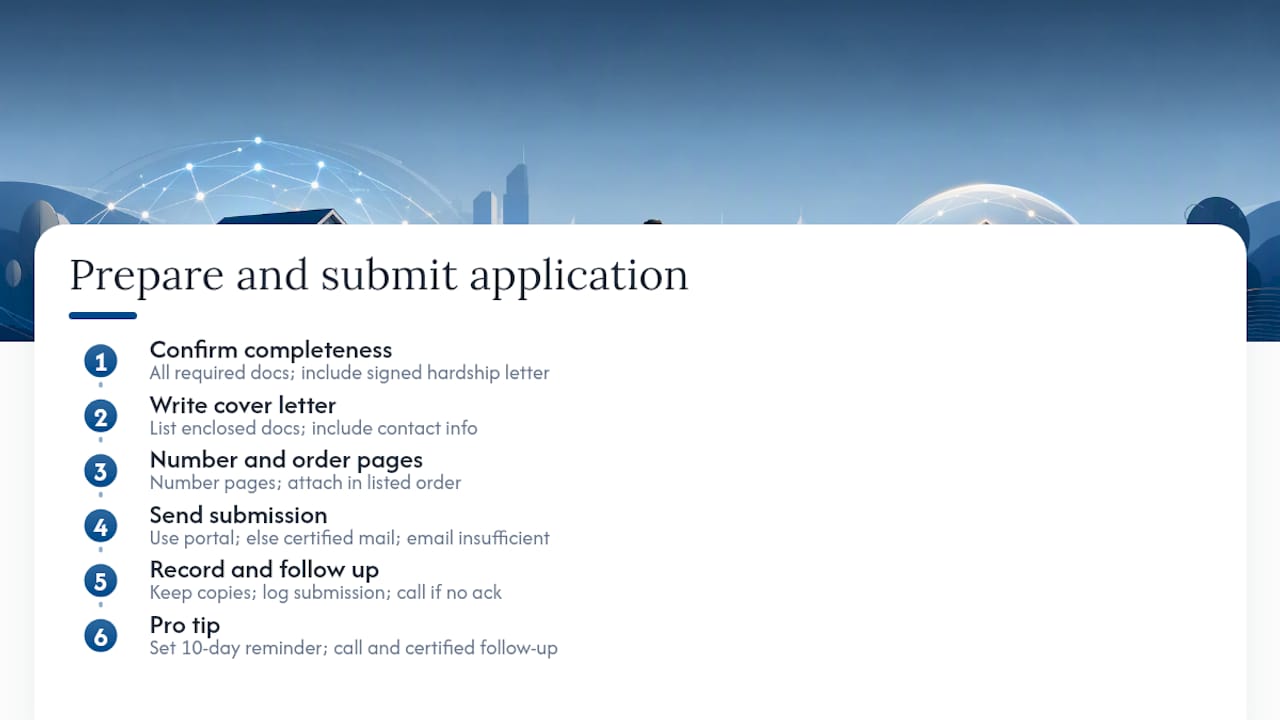
A “complete application” is one that includes every document your servicer requires with no missing pages, no expired statements, and a signed hardship letter. Completeness is not just a formality. Under federal rules, a complete application triggers the servicer’s obligation to evaluate your options before advancing foreclosure.
Packaging your application:
Write a short cover letter that lists every enclosed document by name. Put your name, loan number, and phone number in the header of the cover letter and on every page of the packet. Number the pages (e.g., “Page 3 of 22”) so the servicer can confirm nothing is missing. Attach documents in the same order as your cover letter list.
Sample cover letter opening you can adapt: “Dear Loss Mitigation Department: Enclosed please find my complete loss-mitigation application for loan number [XXXX]. I am requesting consideration for [forbearance / loan modification / short sale — choose one]. Documents included: [list each item]. Please contact me at [phone] or [email] with any questions.”
Delivery:
Use your servicer’s online portal when one is available; it timestamps your submission automatically. If no portal exists, send by certified mail with return receipt requested and keep the green card when it comes back. Email alone is not sufficient for most servicers.
After submission:
Keep a digital copy of everything you sent, including the cover letter, with the date in the file name. Log the submission in your communication record. Your servicer should acknowledge receipt within a few business days. If you do not hear back within two weeks, call and reference your submission date and certified mail tracking number.
Pro Tip: Set a calendar reminder for 10 days after submission. If you have not received written acknowledgment by then, call the loss-mitigation department and send a follow-up letter by certified mail referencing your original submission date and tracking number. Servicers are required to acknowledge a complete application, and a paper trail protects you if you need to escalate.
Which selling option is right for you: traditional sale, short sale, or fast cash?
Selling your home before foreclosure is a legitimate and often smart path, particularly when you have little or no equity and loss mitigation is not viable. Selling in the preforeclosure stage can let you avoid a formal foreclosure sale and reduce the long-term damage to your credit.
Traditional sale works best when you have equity above the payoff amount and enough time (typically 60–90 days) to list, market, and close. You pay off the mortgage at closing and keep any remaining proceeds. The downside is that a traditional sale requires repairs, showings, and a buyer who can secure financing, all of which take time you may not have. Review the traditional home selling timeline before committing to this route if your auction date is approaching.
Short sale is the right path when your home is worth less than you owe and your lender agrees to accept less than the full payoff. It avoids a foreclosure on your record, but lender approval is required and the process typically takes 60–120 days. You will need a short sale approval letter before closing, and some lenders may pursue a deficiency judgment for the remaining balance depending on your state.
Fast cash sale to an investor is the fastest option when time is the primary constraint. A reputable cash buyer can provide a written offer within 24 hours, requires no repairs or cleaning, and can close in as few as 7 days. The trade-off is that the offer will typically be below full market value. For many homeowners facing an imminent auction date, the speed and certainty of a cash sale outweigh the price difference. Read more about how a cash sale stops foreclosure before auction to understand the mechanics.
Questions to ask any cash buyer before signing
- Can you provide written proof of funds today?
- What is your exact closing timeline, and is it guaranteed in the contract?
- Are there any fees, commissions, or out-of-pocket costs to me as the seller?
- Do you require an inspection contingency, and if so, how long?
- Will you cover standard closing costs?
- Can you provide references from recent sellers in this market?
A legitimate cash buyer answers all of these questions in writing before you sign anything. If a buyer pressures you to sign quickly without providing proof of funds or a written offer with clear terms, walk away.
How do you spot foreclosure-rescue scams and get free legitimate help?
Foreclosure is one of the most heavily targeted situations for financial scams. The FTC warns homeowners not to pay upfront fees to any company promising to stop foreclosure and to watch for these red flags:
- Guaranteed results. No legitimate counselor or attorney can guarantee your servicer will approve a modification or short sale.
- Upfront fees. Legitimate HUD-approved housing counselors provide free or low-cost help. Any company demanding payment before delivering results is a warning sign.
- Requests to sign over your title. Some scammers use “lease-back” or “equity-stripping” schemes where you sign over ownership and pay rent, often losing the home entirely.
- Instructions to stop communicating with your servicer. A legitimate counselor helps you communicate better with your servicer, not less.
- Payments redirected to a third party. Never send mortgage payments to anyone other than your servicer unless a court or your servicer has directed you to do so in writing.
Where to get free or low-cost legitimate help
USAGov’s foreclosure avoidance resources and the following organizations provide verified, free assistance:
- HUD-approved housing counselors: Call 800-569-4287 or search the CFPB counselor directory. Free or low-cost, available in most states.
- Consumer Financial Protection Bureau (CFPB): cfpb.gov provides written guidance on loss-mitigation rights and a complaint portal if your servicer is not responding.
- Homeowner Assistance Fund (HAF): A federally funded program administered by states. Find your state’s program at consumerfinance.gov or usa.gov. Funds can cover mortgage arrears, property taxes, and utility bills in qualifying cases.
- HOPE NOW Alliance: A nonprofit coalition of mortgage servicers and counselors. Call 888-995-4673 for referrals.
- Legal aid organizations: If you believe your servicer has violated your rights or you are facing a judicial foreclosure, a HUD-referred legal aid attorney can review your case at no cost.
To verify a counselor’s legitimacy, look them up in the HUD counselor database at hud.gov or the CFPB directory. Any agency listed there has met HUD’s training and certification standards.
Prepare before you call: a practical tip from HUD and CFPB counseling practice
Servicer calls go better when you walk in organized. Counselors consistently recommend treating the call like a short business conversation: know your numbers, know your hardship type, and have a one-page financial snapshot ready before you dial.
Pro Tip: Before calling your servicer or counselor, fill in this one-page snapshot: (1) monthly gross income from all sources, (2) monthly mortgage payment (principal, interest, taxes, insurance), (3) the dollar shortfall between what you earn and what the mortgage costs, (4) your three largest essential monthly expenses (utilities, food, transportation), and (5) one sentence describing whether your hardship is temporary (job loss, medical event) or permanent (income reduction, disability). Servicers are more likely to offer workable options to homeowners who can clearly explain their situation and demonstrate good-faith effort.
Having this snapshot ready also helps your HUD-approved counselor assess your options faster and advocate for you more effectively. It takes about 15 minutes to complete and can meaningfully change the tone of the conversation.
A note from the Sell Dave Your House team
We have worked with Metro Detroit homeowners in foreclosure for over 16 years, and the pattern we see most often is this: homeowners wait too long, then feel like they have no options left. You almost always have more options than you think, but only if you act before the auction date.
When selling is the right path, a fast cash offer is one of the most direct ways to stop foreclosure. We buy homes as-is, with no repairs required, and can provide a written offer within 24 hours. Closing in 7 days is possible when the timeline is tight. That said, we always encourage homeowners to consult a HUD-approved housing counselor and, where appropriate, a legal aid attorney before making any decision. Those resources are free, independent, and exist specifically to protect you.
Sell Dave Your House offers a fast cash path when selling is the right move
If you have worked through the checklist above and selling is the clearest way to stop foreclosure, Sell Dave Your House provides a direct, low-friction option for Metro Detroit homeowners. The process starts with a free property valuation, a written cash offer within 24 hours, and a closing timeline as short as 7 days. No repairs, no cleaning, no realtor commissions, and no hidden fees.

To request your offer, you will need your current mortgage statement, a government-issued photo ID, and a payoff quote if you have one. Sell Dave Your House covers standard closing costs, so the offer you receive is close to what you walk away with. Before signing anything with any cash buyer, confirm proof of funds in writing, verify there are no upfront fees, and make sure the closing timeline is stated clearly in the contract. Those are the same standards we hold ourselves to.
Ready to find out what your home is worth in cash? Request a free cash offer today, or visit the sell your house fast page to learn more about why Metro Detroit homeowners choose this route when time is short.
Sources
- If I can’t pay my mortgage loan, what are my options? | Consumer Financial Protection Bureau
- How to avoid foreclosure | Consumer Financial Protection Bureau
- Avoid foreclosure | USAGov
- Trouble paying your mortgage or facing foreclosure | FTC
- SHIP Foreclosure Prevention List of Required Documents
FAQ
What is the first step to avoid foreclosure?
Call your mortgage servicer’s loss-mitigation department as soon as you know you will miss a payment. Early contact opens options like forbearance and loan modification that may not be available once foreclosure proceedings begin.
Can you sell your house to prevent foreclosure?
Yes. Selling in the preforeclosure stage, whether through a traditional sale, short sale, or fast cash sale, can pay off the mortgage and stop the foreclosure process. A short sale requires lender approval and typically takes 60–120 days; a cash sale can close in as few as 7 days.
How long do you have before a servicer can start foreclosure?
Under federal rules, servicers generally cannot initiate foreclosure until a borrower is more than 120 days delinquent. Submitting a complete loss-mitigation application during that window can pause certain foreclosure actions while the servicer evaluates your case.
What documents do you need for a loss-mitigation application?
Most servicers require your current mortgage statement, last 8 weeks of paystubs, last 2 months of bank statements, last two years of tax returns, a government-issued photo ID, and a signed hardship letter. State SHIP intake checklists confirm this as the standard document set.
How do you know if a foreclosure-rescue company is a scam?
The FTC identifies the clearest red flags as upfront fee demands, guaranteed results, and requests to sign over your title. Legitimate help from HUD-approved housing counselors is free or low-cost and never requires you to stop communicating with your servicer.