
Hidden Fees in a Traditional Home Sale, Explained
Sellers typically lose a significant portion of their sale price to combined fees and closing costs, and the biggest surprises rarely come from the number they expect. Seller closing costs alone (excluding commission) commonly run about 2% of the sale price, but stack in commissions, brokerage admin charges, transfer taxes, title and escrow fees, mortgage payoff costs, and prorations, and that number climbs fast.
The categories that quietly drain the most money from your check at closing include:
- Real estate agent commissions
- Brokerage admin or “junk” fees
- Title insurance, escrow, and recording charges
- Transfer taxes, which vary widely by state and county
- Mortgage payoff costs, including possible prepayment penalties
- Repairs, staging, and seller-paid buyer concessions
Pro Tip: Pull your most recent mortgage statement and your listing agreement before you go any further. You’ll need both to spot the fees explained below on your own Closing Disclosure once an offer comes in.
Key Takeaways
Hidden fees in a traditional home sale typically consume between 6% and 10% of the sale price, driven mainly by commissions, admin charges, and mortgage payoff costs.
| Point | Details |
|---|---|
| Expect 6% to 10% in total deductions | Commissions plus closing costs, repairs, and prorations combine to reduce most sellers’ net proceeds by this range. |
| Watch for admin fees | Brokerage transaction fees of $400 to $600, sometimes over $1,000, often surface only at closing. |
| Confirm mortgage payoff early | Prepayment penalties can inflate your payoff beyond remaining principal, so check with your lender in advance. |
| Transfer taxes vary by location | State and county rates range from zero to several percent, so verify your local figure before estimating proceeds. |
| Consider a cash sale for distressed properties | Sell Dave Your House buys homes as-is for cash, eliminating staging, most repairs, and realtor commissions entirely. |
Table of Contents
- Hidden Fees Traditional Home Sale Explained, Line by Line
- How to Reduce Hidden Fees Before You List or Close
- What a Real Net-Proceeds Calculation Looks Like
- Sources
- FAQ
Hidden Fees Traditional Home Sale Explained, Line by Line
Every fee on your closing statement has a name, a typical range, and usually a way to question it. Here’s what actually shows up.
Real estate commissions remain the largest single deduction. Total commission has historically run around 5 to 6 percent of sale price, split between the listing agent and the buyer’s agent, though this is negotiable and increasingly unbundled since the 2024 industry settlements changed how buyer-agent compensation gets offered. Ask your agent directly what percentage goes to each side and whether a reduced or flat-fee listing structure is available for your home. If your local market is competitive and your home needs little marketing, you have more leverage than most sellers realize.
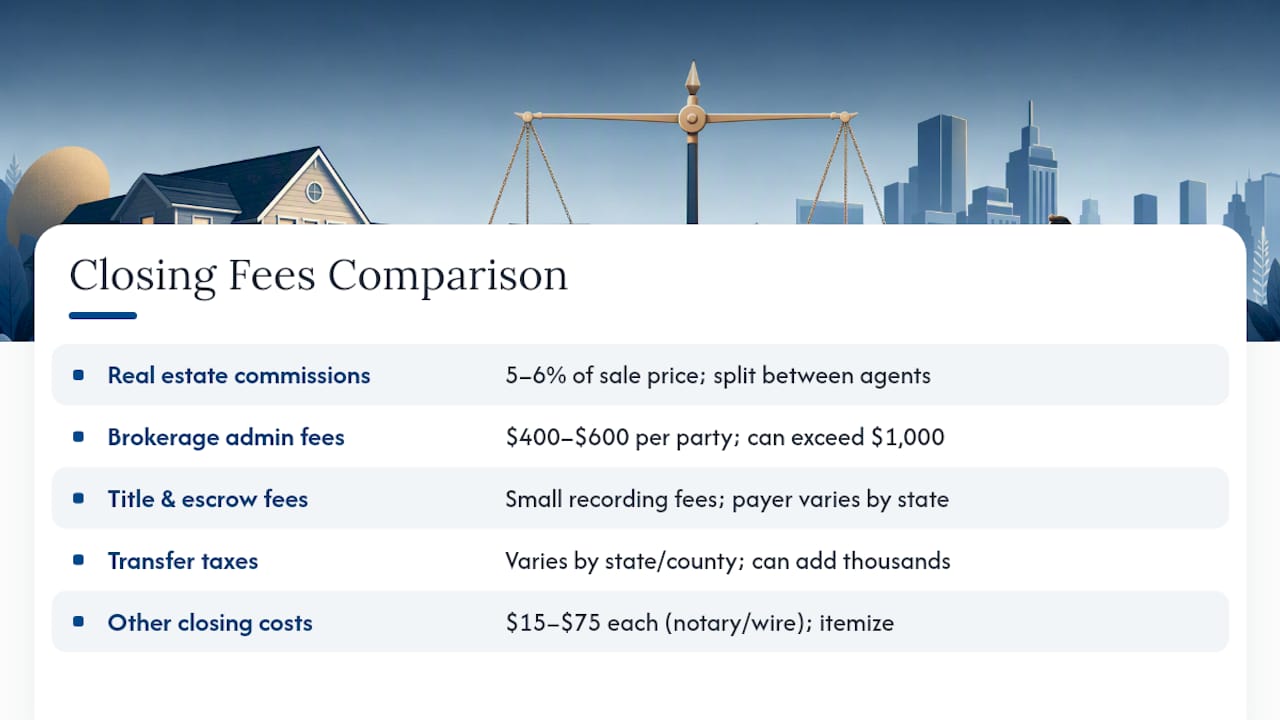
Brokerage admin fees are the ones nobody warns you about. These “transaction fees” or “compliance fees” typically run $400 to $600 per party and can exceed $1,000 in some markets. They’re often tacked onto the closing statement without ever appearing in your listing agreement, and industry reporting suggests this practice could cost consumers close to $2 billion annually if it continues unchecked. Because these are flat-dollar charges, they hit sellers of lower-priced homes hardest as a percentage of proceeds.
Title insurance, escrow, and recording fees cover the cost of confirming clear ownership and processing the paperwork. Who pays the owner’s title policy versus the lender’s policy depends heavily on local custom. Some states default to seller-paid title insurance, others split it, and recording fees for the deed itself are usually small but non-negotiable government charges.
Transfer taxes vary more than almost any other line item. Some states charge nothing. Others charge a percentage of sale price that adds thousands of dollars, and county-level add-ons can push the total higher still. Check your state and county rate before you assume a number.
Notary, courier, and wire fees are small individually, usually $15 to $75 each, but they add up and are worth asking your title company to itemize or waive.
Mortgage payoff is where sellers get blindsided most often. Your payoff includes the remaining principal, prorated interest through the closing date, and in some cases a prepayment penalty. The CFPB confirms some mortgages still carry these penalties, so check your loan documents or call your lender well before you set a closing date.

Prorations for property taxes, HOA dues, and utilities show up as automatic ledger entries rather than negotiated line items, which is exactly why they’re easy to miss. Verify the math on your Closing Disclosure rather than trusting the total.
Pre-listing repairs and staging run anywhere from a few hundred dollars for minor touch-ups to several thousand for larger projects, while a pre-listing inspection typically costs $300 to $600 and can prevent a much larger concession request later.
Seller concessions, where you agree to cover part of the buyer’s closing costs, are capped by loan type. FHA and conventional loans set specific percentage limits, and agreeing to concessions too early in negotiations can cost you more than holding firm on price.
Moving costs and vacancy expenses, including a mortgage payment or utilities on a home you’ve already left, are the fees sellers forget to budget for entirely.
For a deeper look at how these add up in a conventional listing, our breakdown of hidden realtor costs walks through a real case study.
How to Reduce Hidden Fees Before You List or Close
- Put every fee in writing. Require your listing agreement to disclose any brokerage admin fee as a line item, not a closing-day surprise, and refuse late additions.
- Negotiate commission structure. Ask about flat-fee or limited-service listings, and compare that against selling without an agent entirely or working with a discount agent model.
- Shop title and escrow providers. Get itemized estimates from at least two companies before you lock one in.
- Review your Closing Disclosure line by line. Question anything that wasn’t in your original agreement.
- Limit concessions strategically. Know your buyer’s loan-type limits before you agree to cover their costs.
- Fix what actually moves price. Use a pre-listing inspection to decide which repairs matter and which can be left to the buyer.
- Confirm your mortgage payoff early. Request a payoff statement from your lender weeks before closing, not days.
Pro Tip: Ask your lender for a written payoff quote the same week you sign a listing agreement. This one call resolves prepayment penalty questions before they become closing-day math problems.
What a Real Net-Proceeds Calculation Looks Like
Here’s a worked example on a $350,000 sale, using typical figures. Your numbers will shift with your state, loan, and negotiation outcomes.
Non-negotiable items, transfer tax, mortgage payoff, and prorations are set by your loan and local government. Everything else on this list has room to move if you ask early. For a more detailed template you can adapt, see how net proceeds are calculated.
What the Data and Regulators Actually Say
Brokerage admin fees of $400 to $600 per party, sometimes exceeding $1,000, are frequently disclosed only at closing rather than in the original listing agreement, a pattern regulators and industry reporters have flagged as a consumer transparency problem.
The IRS’s guidance on home sales confirms most sellers of a primary residence can exclude up to $250,000 in capital gains ($500,000 if married filing jointly), which matters when you’re estimating your true take-home. LodeStar’s closing-cost data, drawn from over 620,000 purchase quotes, confirms just how much state and county variation drives your final number. Your Closing Disclosure remains the one document with your exact figures.
When a Cash, As-Is Sale Changes the Math
A direct cash sale removes several fees from the equation entirely. Staging costs disappear. Most repairs become the buyer’s problem, not yours. Many closing third-party costs get absorbed by the buyer, not deducted from your check. What typically remains are mortgage payoff and any recording or transfer taxes required by law.
This route tends to make the most sense for sellers facing foreclosure, an inherited property they can’t maintain, or a home that needs more repair work than they can afford before listing. Sell Dave Your House has spent over 16 years buying homes across Metro Detroit this way, with cash offers delivered within 24 hours and closings possible in as little as seven days.
— Real Estate Team
A Faster Alternative When the Fee Math Doesn’t Work in Your Favor
If the commissions, admin fees, and repair costs above sound like more than your situation can absorb, Sell Dave Your House buys homes in Metro Detroit as-is, for cash, with no realtor commissions and no repair list to complete first.

You get a fair cash offer within 24 hours and can close in as little as seven days, with standard closing costs covered on our end, whether your home is inherited, in disrepair, facing foreclosure, or you simply want to skip the months of showings and negotiation. This works especially well for sellers dealing with financial hardship or a property that would need thousands in repairs before a traditional buyer would even consider it. Visit our cash offer request page to see what your home could sell for, or check where we currently buy houses for cash to confirm we cover your area.
Sources
- Brokerage transaction fees could cost consumers $2 billion (HousingWire)
- How much does it cost to sell a house? (Bankrate)
- 2025 purchase mortgage closing cost data report (LodeStar)
- IRS Topic No. 409 Selling Your Home
- What is a prepayment penalty? (CFPB)
FAQ
How Do I Avoid Hidden Fees When Selling My House?
Require every fee, including brokerage admin charges, to be disclosed in writing in your listing agreement, then review your Closing Disclosure line by line before signing.
What Is the Hardest Month to Sell a House?
Winter months, particularly December and January, typically see the slowest buyer activity in most markets, which can extend your carrying costs like utilities, insurance, and mortgage payments.
What Are Some Examples of Hidden Fees in a Home Sale?
Brokerage admin fees, notary and courier charges, prorated HOA dues, and mortgage prepayment penalties are among the most commonly overlooked costs.
How Do Hidden Fees Work on a Closing Statement?
Many hidden fees are added as flat-dollar line items late in the transaction rather than disclosed upfront, which is why comparing your final Closing Disclosure against your original agreement matters.
Does Selling for Cash Avoid These Fees?
A cash, as-is sale through a buyer like Sell Dave Your House typically eliminates staging costs, most repair expenses, and realtor commissions, leaving mainly mortgage payoff and legally required taxes.