

TL;DR
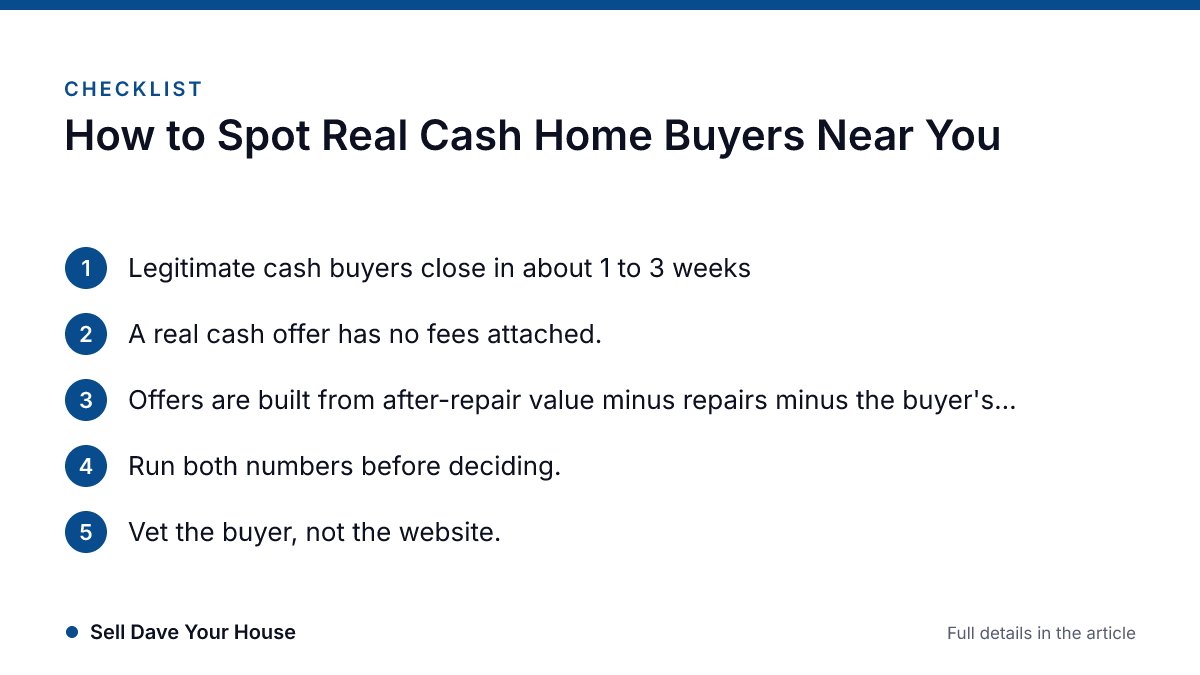
- Legitimate cash buyers close in about 1 to 3 weeks, charge you no commission, and buy as-is. In exchange, their offer lands well below what a fixed-up version of your house would fetch on the open market.
- A real cash offer has no fees attached. No agent commission, no seller closing costs, no repair credits clawed back after the walkthrough.
- Offers are built from after-repair value minus repairs minus the buyer's margin. Once you know the formula, you can tell a fair offer from a fishing expedition in about two minutes.
- Run both numbers before deciding. In the worked example below, a traditional as-is listing nets about $25,800 more but takes roughly three and a half extra months. That's the trade, stated plainly.
- Vet the buyer, not the website. Physical address, closed deals in Wayne, Oakland, or Macomb County, and a contract they'll let you read overnight.
Searching "cash home buyers near me" usually means one of two things. Either you need to sell fast and don't know who to trust, or you already got an offer that felt low and you want to know if that's normal. Both are fair. The honest answer is that this business has careful local operators and outright predators running nearly identical websites, and you can't tell them apart from the homepage. You tell them apart by how they explain their number, what they charge, and whether they'll commit to a closing date.
Table of Contents
- Is selling your house for cash a good idea?
- How do cash home buyers determine their offer price?
- What's the typical timeline from offer to closing?
- What costs or fees should you expect with a cash sale?
- Are companies that buy houses for cash legitimate?
- What are the pros and cons of a cash offer on a house?
- How do you find the best cash home buyers near you?
- What's your next step?
- Frequently asked questions
Is selling your house for cash a good idea?
Sometimes. A cash sale makes sense when speed, certainty, or skipping repairs is worth more to you than the last chunk of sale price.
That describes a lot of Metro Detroit sellers. The out-of-state heir who inherited a house on the east side and has no interest in managing a rehab from Arizona. The Warren landlord who has chased rent for eleven months and just wants out. The Pontiac homeowner with a sheriff's sale date that isn't going to move because a buyer's underwriter wants one more pay stub. The Royal Oak retiree who doesn't want strangers walking through the house every Saturday for two months.
Where it's a bad idea: your house is in good shape, it's in a neighborhood buyers fight over, and nothing is forcing your hand. List it. An agent will almost certainly net you more. Cash buyers profit by buying under market. That isn't a scam, it's the entire business model. The scam is pretending otherwise.
How do cash home buyers determine their offer price?
Almost every real buyer uses a version of the same formula: offer = after-repair value (ARV) × a percentage, minus estimated repair costs. In our experience that percentage usually sits somewhere in the 65% to 85% range, and it covers holding costs, the buyer's own closing costs, agent fees when they resell, and profit. It isn't a number pulled out of the air. It's what has to be left over for the deal to work.
Here's a full example you can re-run with your own figures.
- After-repair value (ARV): comps for a fully renovated 3-bedroom in your neighborhood support $220,000.
- Repair estimate: roof, kitchen, furnace, and electrical, call it $45,000.
- Buyer's percentage: this buyer works at 70% of ARV.
The math: $220,000 × 0.70 = $154,000. Subtract repairs: $154,000 − $45,000 = $109,000 cash offer.
That's about half the fixed-up value, which sounds brutal until you price out the alternative on the same house.
Say you list it as-is instead at $160,000 and it sells there:
- Agent commission at 6%: $9,600
- Seller-side closing costs and title fees at roughly 2%: $3,200
- Repair credit the financed buyer negotiates after inspection: $8,000
- Holding costs at about $1,100/month (taxes, insurance, utilities, mortgage) for four months: $4,400
$160,000 − $9,600 − $3,200 − $8,000 − $4,400 = $134,800 net, roughly three and a half months later.
So the listing wins by about $25,800. Divide that by the extra time and you're being paid roughly $7,400 a month to wait, carry the house, keep it showable, and accept the risk that the buyer's loan dies at week six. If you can do that, do it. If you're staring at a foreclosure date or paying for a house you don't live in, that math flips fast.
Pro tip: ask any buyer to show you their comps and their repair estimate line by line. Someone legitimate will walk you through both without flinching. "That's our best offer," with no explanation behind it, tells you exactly who you're dealing with. Our guide on red flags to spot in we buy houses offers breaks down the specific tactics.
What's the typical timeline from offer to closing?
Most of our Metro Detroit closings run 7 to 21 days from the first phone call to funds in your account. The stages are predictable.
- Initial contact and property details (same day). You describe the house, the condition, and why you're selling. Nobody needs to come out yet.
- Walkthrough or virtual assessment (1 to 3 days). Someone sees the property in person, or by photos and video if you're out of state.
- Written offer (usually same day as the walkthrough). A specific number, no financing contingency.
- Acceptance and title work (3 to 10 days). The title company searches for liens, unpaid water bills, old judgments, and heirship issues. This is where deals actually slow down, not the money.
- Closing (as soon as 7 days, or whenever you're ready to move). You sign, funds are wired or cut as a check.
A traditional sale stacks listing prep, showings, an accepted offer, underwriting, appraisal, and the buyer's final loan approval on top of each other, which is why it commonly runs a couple of months even when nothing goes wrong. Bankrate's guide to selling a house lays out those steps if you want to see the full sequence.
Pro tip: in Michigan, the thing most likely to blow your 10-day timeline is title, not the buyer. Unpaid city water bills attach to the property in some municipalities. A probate sale needs Letters of Authority in hand. If a sibling's name is still on the deed from 1998, the title company will find it. Tell your buyer about anything like that on day one and it gets solved during the search instead of on closing day.
What costs or fees should you expect with a cash sale?
With a real cash buyer, none. No commission, no seller closing costs, no repair credits deducted after the fact. That's the actual appeal, and it's where the comparison against a listing gets interesting.
Here's how the two paths compare on an illustrative $150,000 house, using the fee ranges we see on Metro Detroit closings:
| Cost factor | Traditional sale | Cash sale (as-is) |
|---|---|---|
| Agent commission | About 5–6%, roughly $7,500–$9,000 | $0 |
| Seller-side closing costs | About 1–3%, roughly $1,500–$4,500 | $0, buyer pays |
| Repairs before listing | Often $5,000 to $30,000+ | $0, sold as-is |
| Post-inspection concessions | Common, negotiated after you're under contract | None |
| Holding costs while waiting | 2 to 3 months of taxes, insurance, utilities | 1 to 3 weeks |
| Financing fall-through risk | Real, the loan can be denied at week six | None, no lender involved |
The trade is the price itself. You skip every fee in that left column and accept a number below retail. Whether that's a good deal for you depends almost entirely on how much repair and carrying cost you'd be eating otherwise. Kris Lindahl's breakdown of cash offer benefits covers the same tradeoff from a different angle.
Are companies that buy houses for cash legitimate?
Most are. The industry also has a genuine problem with unlicensed wholesalers and out-of-state operators who push sellers into contracts with no exit. The good ones are local, have an address you can drive to, have closed deals in your county, and will answer specific questions without changing the subject.
Warning signs worth stopping over:
- No verifiable local presence. A P.O. box, or a "local" buyer whose phone rings in another time zone.
- Pressure to sign today. No time to read the contract, no time to call an attorney. Anyone who won't let you sleep on it is counting on you not reading it.
- A number that moves after you sign. Usually blamed on a "new inspection finding." Real buyers price the risk upfront.
- No past sellers who'll talk. A company with closings in Wayne, Oakland, or Macomb County can name a few.
- An assignment clause buried in the contract. That means they can hand your deal to someone else. It isn't always illegal, but you deserve to know whether the person across the table is actually buying your house.
Pro tip: search the company name plus "reviews," then again plus "lawsuit." Five minutes of that has saved more sellers than any contract clause ever will.
What are the pros and cons of a cash offer on a house?
Pros: speed, certainty, no repairs, no showings, no lender, no commission. Cons: a lower price, and one buyer instead of a room full of them bidding.
It tips in your favor when:
- You need weeks, not months. Foreclosure dates, job relocations, and probate deadlines don't care about underwriting.
- The house has a condition problem a lender won't touch. Active roof leak, knob-and-tube wiring, a caved basement wall, missing furnace. FHA and conventional buyers get disqualified on those before the appraisal is dry.
- You're managing it from out of state. Flying in twice for contractor estimates costs more than most people expect.
- There are tenants or heirs involved. A month-to-month tenant who won't leave, or four siblings who have to agree on everything, makes a traditional listing painful.
It tips against you when:
- The house is move-in ready in a neighborhood people want. In parts of Troy and Royal Oak, a clean, updated three-bedroom draws competing offers in a weekend. No single cash offer beats that.
- You have time and nothing forcing your hand. Time is the one thing that lets you hold out for retail.
How do you find the best cash home buyers near you?
Start local. Search "cash home buyers near Troy, MI" or "cash home buyers near Detroit, MI" rather than a national brand, because a local buyer already knows what a 1950s brick ranch off Big Beaver trades for and doesn't have to route your file through a call center three states away to find out.
We work directly with sellers across Troy, Detroit, Warren, Dearborn, Livonia, Royal Oak, and dozens of surrounding Wayne, Oakland, and Macomb County communities, including smaller cities like Ferndale, Clawson, and Romulus that national buyers skip because the volume bores them.
If you'd rather try selling on your own first, fair enough. Just know that selling a home by owner in Michigan still means a purchase agreement, a title company, the state seller disclosure statement, and either an attorney or a lot of reading. Skipping the agent doesn't skip the paperwork.
What's your next step?
Get an actual number, then put it next to what an agent says you'd net after commission, repairs, concessions, and three months of carrying the house. Not the list price. The net. That single comparison answers the question faster than any amount of research.
You can request a free, no-obligation cash offer through our home page, or call 586-500-7161 and talk it through, whether it's an inherited property, a rental with a tenant still in it, or a house that simply needs to be gone. No cost for the number, and no pressure to take it.
Frequently asked questions
Do I need to clean out or repair the house before selling for cash?
No. Legitimate cash buyers take houses in current condition, including ones still full of a previous owner's or tenant's belongings. Leave the furniture, the garage full of paint cans, all of it. Cleanout is already priced into the offer.
What happens if my house has tenants living in it?
The sale can still close. The buyer either steps in as the new landlord or negotiates a move-out timeline as part of the deal. Say so on the first call, and bring the lease. A tenant discovered at the walkthrough changes the number. A tenant disclosed upfront usually doesn't.
Will a cash buyer still require an inspection?
Most do a walkthrough, but it's for their own pricing, not to renegotiate. There's no lender demanding repairs. A straight buyer's number shouldn't drop afterward unless the condition was materially different from what you described.