

Close in 7 Days If You Can’t Clear Belongings: Seller Checklist
The purchase contract, not assumptions, decides which belongings stay with a house. List everything you mean to include or exclude in writing, because if it isn’t on paper, both sides are guessing. Fixtures usually transfer with the home unless the contract excludes them, while movable personal items go with you unless the contract says otherwise. When something goes wrong, the final walk-through is where you catch it and fix it, through removal, a credit, or an escrow holdback.
TL;DR:
- Fixtures like built-in lighting and plumbing usually transfer with the house unless explicitly excluded in the contract.
- Movable personal items, including clothing and freestanding furniture, generally go with the seller unless specified otherwise.
- Gray-area items such as appliances, curtains, and wall mounts should be named individually in the contract to avoid disputes.
- The final walk-through confirms that included items are present, functional, and that excluded items are removed without damage; issues should be documented immediately.
- Post-closing leftovers generally transfer to the buyer unless a specific arrangement or escrow holdback is in place, and hazardous or perishable items must be properly disposed of beforehand.
Table of Contents
- What Typically Stays vs. What Typically Goes When Leaving Belongings
- Legal and Contract Rules That Control What Transfers
- Final Walk-Through: What to Check and How to Fix Problems
- What Happens if You Leave Items Behind After Closing
- Seller’s Checklist to Avoid Disputes Over Belongings
- How Local Laws and HOA Rules Affect Leaving Belongings
- A Seller’s Responsibility for Hazardous or Perishable Items
- What Sellers Consistently Get Wrong About Belongings
- A Faster Path When You Can’t Clear the House in Time
- Primary Sources and Further Reading
- Sources
- FAQ
What Typically Stays vs. What Typically Goes When Leaving Belongings
Most disputes over abandoned items when selling a house come down to the same handful of categories. If you know where the lines usually fall, you can head off arguments before they start.
Items that usually stay with the house because they’re legally considered fixtures:
- Built-in lighting fixtures and ceiling fans
- Permanently mounted plumbing fixtures, like a wall-mounted towel bar or a bathtub
- Kitchen cabinets, countertops, and anything bolted or plumbed into the structure
- In-ground landscaping, mailboxes, and attached storage sheds
Items sellers can typically take with them:
- Clothing, freestanding furniture, and area rugs
- Wall art, decorative mirrors, and freestanding décor
- Electronics that aren’t wired into the wall, including standalone speakers or freestanding lamps
Then there’s the gray zone, and this is where most disagreements happen: kitchen appliances, curtains and rods, TV wall mounts, and outdoor garden pots. A refrigerator might be a fixture in one deal and a seller’s personal property in the next. California’s real estate guidance treats permanently attached items as fixtures by default, but the safest move for any of these gray-area items is simple: name them individually in the contract. Don’t rely on a category label to settle it for you.
Legal and Contract Rules That Control What Transfers
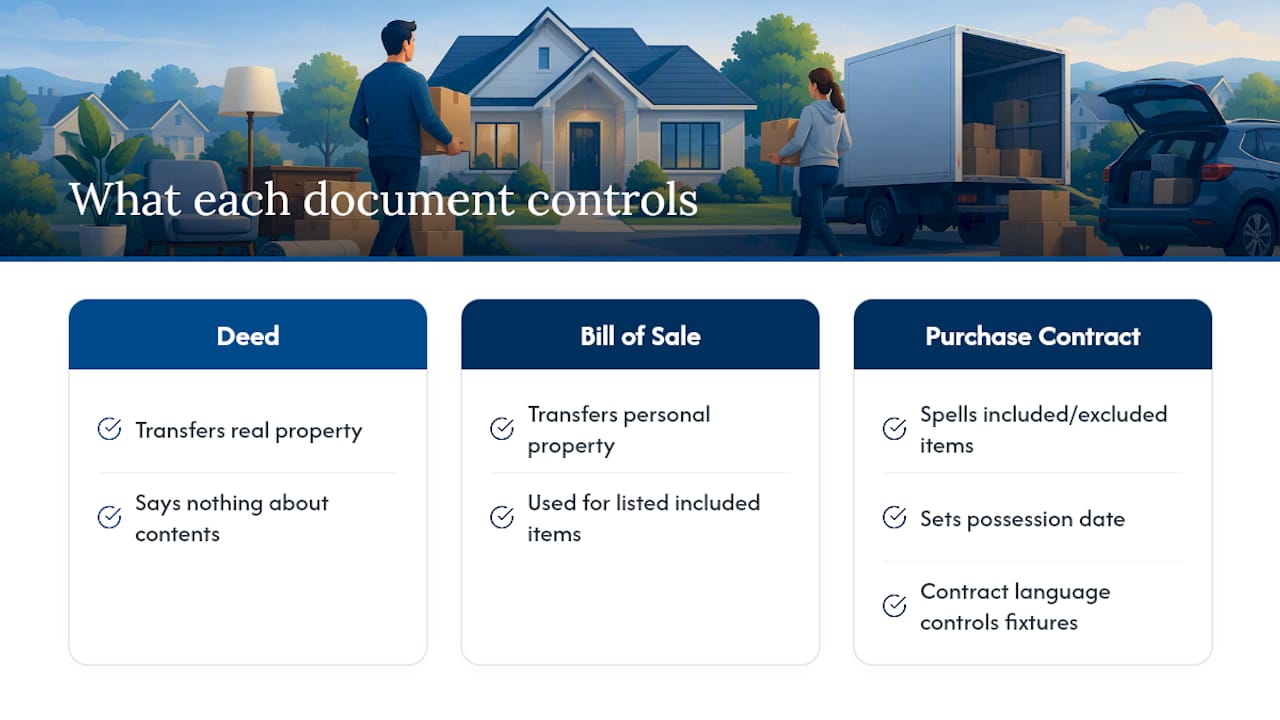
Two documents do the heavy lifting at closing. The deed transfers the real property itself, and a bill of sale transfers ownership of any personal property you’ve agreed to include, like a washer and dryer or a shed full of tools. The American Bar Association’s guidance on purchase contracts is direct about this: the contract itself must spell out included and excluded items, along with the possession date, because a deed alone says nothing about what’s inside the house.
This is also why formal transactions so often attach a schedule or exhibit listing personal property item by item. Even large commercial purchase agreements filed with the SEC use this same structure: a schedule of included property plus a bill of sale, rather than leaving anything to a general fixture test.
Speaking of the fixture test, it’s a useful starting point, not a legal guarantee. Courts and real estate professionals commonly ask whether an item is permanently attached, whether it was customized for the space, and whether removing it would damage the property. But state law varies, and your contract’s specific language beats any general assumption every time. If your agreement lists an item as excluded, that language controls, even if the item would normally count as a fixture. Write it down. Don’t leave it to interpretation.
Final Walk-Through: What to Check and How to Fix Problems
The final walk-through exists for one reason: to confirm the house matches what the contract promised, right before you hand over the keys. Treat it as your last real chance to catch a problem before it becomes a legal headache.
During the walk-through, check for:
- Every item listed as included is actually present and in working condition.
- No unexpected items, junk, or abandoned belongings from selling the house are cluttering rooms, garages, or yards.
- Excluded items were removed cleanly, without damaged walls, exposed wiring, or gaps left behind.
If something’s off, document it immediately with photos and a written note, then contact the closing agent or real estate attorney before signing anything. The ABA’s guidance on the purchase contract recommends converting any walk-through problem into a written remedy rather than a verbal promise. Typical remedies include the seller removing items before possession, a buyer credit at closing, an escrow holdback until the issue is resolved, or daily rent charged if possession is delayed.
Pro Tip: Never accept “I’ll take care of it after closing” as a solution. Once you’ve signed and the keys change hands, your leverage disappears. Get the fix in writing before you close, not after.
What Happens if You Leave Items Behind After Closing
Once possession transfers, ownership of whatever’s left in the house generally transfers with it, unless the contract says otherwise. That means a buyer who finds furniture, tools, or boxes in the garage after closing usually has the legal right to keep, sell, donate, or dispose of it as they see fit.
For buyers dealing with leftover items to discard before selling changed hands, the realistic options are:
- Donate usable furniture or appliances to a local charity
- Sell higher-value pieces individually or as a lot
- Hire a hauling service for anything not worth keeping
- Use escrow to fund a scheduled removal if the seller agreed to handle it post-closing
Costs vary by volume and location, but hauling services commonly start around the low hundreds of dollars for a single load, climbing from there depending on how much needs to go. Hazardous items, like old paint, chemicals, or propane tanks, need separate disposal through a local hazardous waste program, never a standard hauler. Whoever pays for removal should keep receipts, since those costs can sometimes be offset against an escrow holdback or a negotiated credit.
Seller’s Checklist to Avoid Disputes Over Belongings
A little paperwork now saves a lot of arguing later. Here’s the sequence that keeps most sellers out of trouble:
- Walk every room and create an itemized inclusion and exclusion list, attaching photos of anything unusual, like a custom light fixture or a built-in shelving unit.
- Attach that list to the contract as a signed addendum, not a verbal side agreement.
- Secure cash, jewelry, and important documents before every showing, and use an electronic lockbox so there’s a record of who accessed the property and when.
- Schedule your full move-out before the final walk-through whenever possible.
- If you truly can’t remove everything in time, negotiate a written post-possession agreement with a firm deadline, defined daily rent, and clear terms for how you’ll access the property to finish removal.
Pro Tip: Photograph every room the same day you sign the listing agreement, before staging or showings begin. That photo record becomes your proof of condition if a dispute ever surfaces at closing.
If you and the buyer agree to a post-possession arrangement, spell out exactly how that agreement should work so removal timelines and consequences are unambiguous on both sides.
How Local Laws and HOA Rules Affect Leaving Belongings
City ordinances and homeowners association rules can add another layer on top of your contract, and ignoring them gets expensive fast. Many municipalities classify furniture or debris left on a curb or in a yard past a certain point as illegal dumping, which can trigger fines against whoever holds title at the time.
HOAs often go further. Plenty of governing documents restrict how long items can sit in a driveway, garage, or shared area, and some require written notice before any large item removal, especially in condo buildings with shared hauling schedules or loading dock access. If your community has an HOA, check the covenants before you assume you can simply leave excess belongings for the next owner to sort out. A violation notice landing after closing can still name you if it was issued while you held title.
State and local rules also affect what counts as abandoned property and how long a new owner must wait before disposing of it. Some states require a written notice period before a buyer can treat leftover belongings as abandoned, particularly if the previous owner left behind something identifiable, like mail addressed to them or personal documents. When in doubt, both sides benefit from a quick call to a real estate attorney rather than guessing at local rules that vary block by block.
A Seller’s Responsibility for Hazardous or Perishable Items
Certain categories of leftover belongings carry legal weight that ordinary furniture doesn’t. Hazardous materials, propane tanks, old paint cans, motor oil, pesticides, or car batteries, cannot simply be left in a garage for the next owner to deal with. Most states require these to go through a hazardous waste facility, and leaving them behind can expose a seller to cleanup liability even after closing, especially if a fire or environmental issue traces back to improper disposal.

Perishable items deserve the same seriousness, just for different reasons. A freezer full of food, left behind during a rushed move, can create mold, pest infestations, and odors that damage flooring or drywall within days. That’s not just unpleasant for the new owner. It can also become a health and safety issue that delays possession or triggers a credit dispute at the walk-through.
The safest approach is straightforward: empty refrigerators and freezers completely before your final walk-through, and never leave chemicals, fuel, or anything flammable in a garage or shed you’re vacating. If you’re managing an estate or an out-of-state property and can’t handle this in person, coordinating the cleanout from a distance needs to happen before the keys change hands, not after.
What Sellers Consistently Get Wrong About Belongings
Sellers underestimate the gray items every single time. Nobody thinks twice about a curtain rod until the buyer assumes it’s included and you’ve already sold it at a yard sale. The habit that solves this is simple: photograph it, list it, attach it to the contract. That three-step routine catches more disputes before closing than any amount of good faith or verbal reassurance.
Sellers facing foreclosure, an inherited property full of a relative’s belongings, or a timeline too tight to coordinate a full cleanout often benefit from working with an as-is or fast-cash buyer, since that route can remove the pressure to empty a house on a rigid schedule. Even then, the signed agreement still needs to state a possession date and what’s included. When a walk-through reveals a real problem, involve a title company or real estate attorney immediately. Waiting until after signing to raise it costs you the leverage you need to fix it.
— Real Estate Team
A Faster Path When You Can’t Clear the House in Time
If emptying a house before closing feels impossible, whether it’s a hoarding situation, an inherited property full of decades of belongings, or a foreclosure timeline that leaves no room to schedule a cleanout, Sell Dave Your House offers a way through it. Sell Dave Your House buys homes in Metro Detroit as-is, which means you don’t need to remove furniture, haul junk, or stage a single room before you sell.

That matters most for sellers dealing with financial hardship, an inherited home they can’t manage from out of state, or a house in disrepair that traditional buyers would walk away from. Sell Dave Your House provides fair cash offers within 24 hours and can close in as little as seven days, without realtor commissions or fees eating into what you walk away with. If leftover belongings, a tight timeline, or a property that needs work are standing between you and a sale, get a cash offer and see what a no-cleanout closing actually looks like.
Primary Sources and Further Reading
For the legal framework behind purchase contracts and closing documents, the ABA’s guide to buying a home and its purchase contract breakdown are worth bookmarking. For showing-day security, see the NAR seller checklist, and for extra guidance on protecting valuables during a move, review this security-focused resource on transporting expensive items safely.
Sources
FAQ
What Happens if You Leave Stuff Behind When You Sell Your House?
Once possession transfers at closing, the buyer generally becomes the owner of whatever’s left behind, unless your contract states otherwise. Buyers typically respond by donating, selling, or hauling away leftover items, and hauling services often start around the low hundreds of dollars depending on volume.
How Long Can Someone Leave Their Belongings in Your House?
There’s no universal timeline. It depends entirely on what your purchase contract or any post-possession agreement specifies for a removal deadline. If no written deadline exists, the buyer can generally treat leftover items as abandoned once they hold title and possession.
Do I Have to Leave My Curtains When I Sell My House?
Not necessarily. Curtains and rods fall into the gray-area category, meaning they aren’t automatically included unless your contract or an attached addendum says so. If you want to take them, exclude them explicitly in writing before you list the house.
Do I Have to Leave My Appliances When I Sell My House?
It depends on how your contract defines them. Built-in appliances like a dishwasher usually count as fixtures and stay by default, while freestanding appliances like a washer or dryer typically don’t transfer unless the contract lists them as included.