

Lifestyle Change Home Sale Preparation: A Fast-Sale Guide
If you need to sell fast because of a lifestyle change, your best move is simple: accept a vetted all-cash as-is offer that matches your timeline. Financing contingencies are a major reason traditional deals collapse, and a verified cash buyer removes that risk entirely. That certainty usually comes with a trade-off. You may net less than a financed buyer would eventually pay, but you skip the months of showings, repairs, and appraisal delays that lifestyle-change sellers rarely have time for.
Your next move should be immediate:
- Request proof of funds (a bank letter or evidence of escrowed money) from any buyer, including Sell Dave Your House.
- Get the offer in writing, with a stated purchase price and closing date.
- Confirm which title or escrow company will handle the transaction before you sign anything.
Pro Tip: Ask for proof of funds before you even discuss price. A buyer who hesitates on that request usually isn’t ready to close.
Key Takeaways
A vetted all-cash, as-is offer with confirmed proof of funds and a named title partner is the fastest reliable path to closing during a lifestyle change.
| Point | Details |
|---|---|
| Verify before you sign | Always request proof of funds and a named title/escrow company before accepting any offer. |
| Expect a speed-for-price trade-off | Cash buyers close faster but often pay less than a financed buyer chasing top market value. |
| Use a weighted rubric | Score offers on net proceeds (40%), speed (30%), certainty (20%), and fees (10%). |
| Watch closing bottlenecks | Unpaid liens and probate issues on inherited homes are the top causes of closing delays. |
| Sell Dave Your House option | Buys homes as-is across Metro Detroit, offers within 24 hours, and can close in as little as 7 days. |
Table of Contents
- Why Sellers Choose Cash Offers for Lifestyle Changes
- How Do You Get a Fast As-Is Cash Sale Started?
- What Should You Expect From a Cash Offer?
- How Do You Verify a Cash Buyer Is Legitimate?
- What Paperwork and Timeline Should You Expect?
- How Do You Compare Multiple Cash Offers?
- What Happens Between Accepting the Offer and Moving Day?
- How Sell Dave Your House Makes a Fast Sale Simple
- Sources
- FAQ
Why Sellers Choose Cash Offers for Lifestyle Changes
Speed is the entire point. Whether you’re downsizing into retirement, relocating for a job, managing a foreclosure deadline, or settling an inherited estate, a traditional listing timeline of two to four months rarely fits your situation. Cash offers remove mortgage contingencies and typically close faster, which is exactly what a deadline-driven seller needs.
The trade-off is real, and you should walk in with eyes open. Cash buyers skip staging, showings, and lender appraisal delays, but they often pay less than a financed buyer chasing full market value. For someone facing foreclosure or an urgent relocation to a new city, that gap in price is frequently worth the certainty of a closing date you can actually plan around.
How Do You Get a Fast As-Is Cash Sale Started?
Getting from “I need to sell” to a signed agreement takes five steps, and most sellers move through all of them in under two weeks.
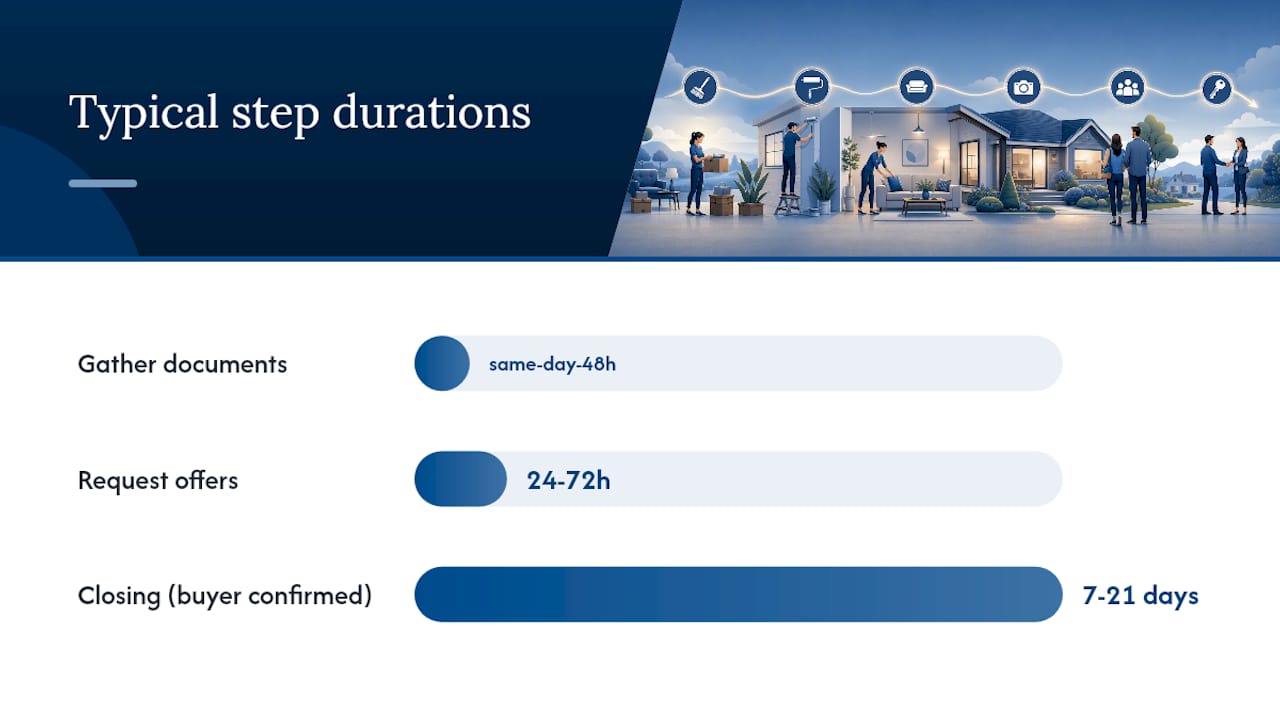
- Gather your documents. Pull your deed, mortgage payoff statement, recent tax records, and utility bills, then snap a few basic photos of the property. This takes same-day to 48 hours.
- Request offers from vetted cash buyers. Ask each one for proof of funds and a specific closing date. Expect responses within 24 to 72 hours.
- Compare offers using a simple rubric. Weigh net proceeds, closing date, contingencies, and the title or escrow partner named on the offer.
- Accept an offer and confirm the closing team. Sign the purchase and sale agreement once you know who’s handling title work.
- Prepare for closing and moving day. Confirm payoff amounts, plan the final walk-through, and line up your moving logistics.
Cash transactions can close in about two weeks once a buyer is confirmed, though many close within a 7 to 21 day window depending on title complexity.
Pro Tip: Never sign a purchase agreement until you have proof of funds and a named title/escrow company in writing. Verbal promises don’t hold up when moving day gets close.
What Should You Expect From a Cash Offer?
Not every cash buyer operates the same way, and knowing the differences helps you avoid disappointment. Three types dominate this market:
- Individual cash buyers using home equity or savings, often the most flexible on terms.
- Investors and house flippers, who factor renovation costs into their offer and move fast on distressed properties.
- Institutional iBuyers, which use automated pricing models and may add service fees.
Selling as-is generally trades a lower price for speed and zero repair obligations, making it one of the easiest ways to upgrade your home’s value with low-effort improvements. Cash buyers commonly promise to skip repairs and showings entirely, which matters if your home has deferred maintenance you don’t have time or money to fix. Some investors offer between 70% and 85% of fair market value depending on condition and location, since they’re absorbing renovation and resale risk themselves.
Watch these terms closely on any offer: the as-is price adjustment, whether an inspection contingency exists, the proposed closing date, which fees the seller covers, and whether the buyer picks up standard closing costs. To estimate your net proceeds quickly, subtract your mortgage payoff, closing costs, and any seller-covered fees from the offer price. That number, not the headline offer, is what actually matters.
How Do You Verify a Cash Buyer Is Legitimate?
A rushed timeline is exactly when scammers and unreliable buyers try to take advantage of sellers. Before you sign anything, verify the basics.
Your vetting checklist:
- Proof of funds (bank letter or evidence of escrowed money)
- Buyer identification and, for investors, business license or LLC verification
- A named title or escrow partner handling the transaction
- References or evidence of past closed transactions
Ask these questions directly before signing:
- “Can you provide proof of funds?”
- “Who is handling closing, and which title or escrow company are you using?”
- “Are you buying as an investor or as an owner-occupant?”
- “What contingencies, if any, are included in this offer?”
Red flags include a buyer who won’t produce proof of funds, requests for large nonrefundable deposits paid outside escrow, no named title company, or pressure to skip legal review entirely. A clear proof-of-funds document paired with a named escrow partner is the fastest signal that an offer is real and closable on a short timeline. Legitimate buyers, including Sell Dave Your House, expect these questions and answer them without hesitation.
What Paperwork and Timeline Should You Expect?
Once you accept an offer, the process follows a predictable sequence. Here’s what a typical as-is cash sale looks like from acceptance to funds in your account:
You’ll need these documents ready: your deed, mortgage payoff statement, property tax records, recent utility receipts, any legally required disclosure forms, and valid ID.
Your title or escrow company runs the title search, processes any outstanding liens, and prepares the closing statement where you’ll review your final net proceeds. Unpaid liens and probate complications on inherited properties are the two most common things that slow down an otherwise fast closing, so raise them with your buyer early rather than at the closing table.
How Do You Compare Multiple Cash Offers?
When you have more than one offer on the table, score each with a simple weighted rubric: 40% net proceeds, 30% closing speed, 20% certainty (contingencies and buyer vetting), and 10% fees and terms.
Here’s why this matters more than the sticker price. A $180,000 offer with no seller-paid closing costs and a confirmed title partner can net you more than a $190,000 offer that requires you to cover $8,000 in closing costs and carries a vague 45-day timeline.
- If you’re facing foreclosure or an immediate move, weight speed and certainty higher than price.
- If your timeline has flexibility, you can afford to hold out for a stronger net number.
- Before finalizing any choice, confirm proof of funds, the named title partner, and a closing date that actually matches your moving plan.
What Happens Between Accepting the Offer and Moving Day?
The final stretch is where small oversights cause the biggest headaches, so keep this checklist close.
- Verify the closing statement and confirm your mortgage payoff amount matches what you expect.
- Ensure title documents are properly recorded before you hand over keys.
- Confirm funds have transferred before releasing possession.
- Arrange short-term storage if your new place isn’t ready, and transfer utilities and mail forwarding right away.
- For inherited or vacant properties, coordinate remote signing if you’re out of state, and spell out in the contract who clears any remaining personal belongings.
Pro Tip: Book your moving truck only after the closing date is confirmed in writing. Locking in logistics too early, before title work clears, is how sellers end up paying for a truck they can’t use.
How Sell Dave Your House Makes a Fast Sale Simple
If everything above sounds like a lot to manage on your own timeline, that’s exactly the gap Sell Dave Your House was built to close. We buy homes across Metro Detroit as-is, no repairs, no cleaning, and no realtor commissions eating into your proceeds. You get a fair cash offer within 24 hours of reaching out, and we can close in as little as 7 days when your situation calls for it.

Requesting an offer is straightforward. Have your basic property details ready, reach out online or by phone, and expect a real, written offer within 24 to 72 hours, backed by proof of funds and a named title/escrow partner from the start. We’ve spent over 16 years helping homeowners across Detroit navigate foreclosure, inherited property, and downsizing moves, including clients like John, who moved from a stressful, drawn-out situation to a closed sale without ever lifting a hammer. We also cover standard closing costs, so the number we offer is close to the number you actually walk away with.
If you’re in Harper Woods or elsewhere in Metro Detroit and need to move on your own schedule, get a fair cash offer now and see your numbers before you commit to anything.
A Note From Buyers Who Handle These Sales Every Day
Most sellers worry we’ll lowball them or drag out closing. In practice, the sellers who move fastest are the ones who ask hard questions up front. One recent inherited-home sale closed in 10 days, from first contact to keys handed over, because the heirs asked for proof of funds immediately and never had to wonder if the deal was real.
Sources
- Are Cash Offers Better for Sellers? - NerdWallet
- Should I Accept a Cash Offer for My House? | Zillow
- Best Way to Sell Inherited Property: 5 Options Compared | Inherited Property Match
FAQ
How Fast Can an As-Is Cash Sale Close?
Most cash sales close within 7 to 21 days after the offer is accepted, and some inherited-property sales close in as little as 7 to 30 days depending on title and probate complexity.

Do Cash Buyers Always Offer Less Than Market Value?
Not always, but investors and iBuyers typically factor in repair and resale risk, so offers often land below what a financed buyer might eventually pay. Sell Dave Your House offsets some of that gap by covering standard closing costs and eliminating realtor commissions.
What Documents Do I Need to Sell My House for Cash?
You’ll need your deed, mortgage payoff statement, property tax records, recent utility bills, any required disclosure forms, and valid ID.
How Do I Know a Cash Buyer Isn’t a Scam?
Ask for proof of funds, confirm a named title or escrow company, and be wary of anyone demanding a large nonrefundable deposit outside of escrow.
Can I Sell an Inherited House As-Is Without Making Repairs?
Yes. Cash buyers purchase inherited properties in their current condition, which avoids the repair costs and delays that come with listing traditionally through an inherited-property sale.