

Michigan Foreclosure Timeline: 4–6 Months, 120 Day Rule, Redemption
Most Michigan mortgage foreclosures run about four to six months from the first missed payment to the sheriff’s sale, and homeowners typically get another six months after that to redeem the home. Some cases stretch to 12 months of redemption, and a smaller group of abandoned properties get only 30 days. Your exact deadline lives on the certificate of sale at your county Register of Deeds, so call your servicer or a HUD-approved housing counselor today to confirm where you stand.
TL;DR:
- Foreclosure in Michigan typically takes four to six months from missed payment to sheriff’s sale, with redemption periods ranging from 30 days to 12 months.
- The 120-day rule prevents most servicers from initiating foreclosure until the homeowner is more than 120 days delinquent, allowing time for loss mitigation applications.
- Homeowners should verify their specific redemption deadline by contacting the county Register of Deeds, as courthouse notices can vary and override generic estimates.
- Early action such as applying for a loan modification or selling for cash offers the best chance to avoid foreclosure once the 120-day delinquency threshold is reached.
- Missing the redemption deadline results in title passing to the buyer, with the possibility of eviction proceedings starting shortly after, emphasizing the importance of prompt responses.
Table of Contents
- How Does the Michigan Foreclosure Timeline Actually Unfold?
- What Does the 120-Day Servicer Rule Mean for You?
- How Does a Sheriff’s Sale Notice and Auction Actually Work?
- How Long Do You Have to Redeem Your Home in Michigan?
- What Happens When the Redemption Period Ends?
- What Can You Do Before the Sheriff’s Sale Happens?
- Our Perspective on Timing After 16 Years in Metro Detroit
- Ready for a Fast, Fair Cash Offer in Metro Detroit?
- Where to Verify Your Exact Foreclosure Dates
- Sources
- FAQ
How Does the Michigan Foreclosure Timeline Actually Unfold?
You have more time than you probably think, and knowing the sequence helps you use it. Here is how a typical Michigan mortgage foreclosure moves, step by step.
- Day 1: Payment due. Nothing happens yet, but the clock starts here.
- Day 2: Delinquency begins. Late fees accrue, and your loan is reported as past due.
- Days 2 through 36: Early servicer contact. Under MSHDA’s stages-of-foreclosure guidance, servicers are expected to attempt live contact and explain your options during this window.
- By Day 45: Your servicer must send a written delinquency notice, assign you a single point of contact, and include information about loss mitigation.
- Days 45 to 120: Loss-mitigation window. This is your best chance to submit a complete application for a loan modification, repayment plan, or forbearance.
- Not before Day 120: For most covered loans, federal rules bar the servicer from referring your file to foreclosure before this point.
- Sheriff’s sale scheduling: Once foreclosure by advertisement begins, notice runs in a local newspaper once a week for four consecutive weeks, with a copy posted on the property in the required window.
Pro Tip: Mark Day 45 and Day 120 on your calendar the moment you miss a payment. Those two dates control whether you get a real shot at loss mitigation before a sale is ever scheduled.
What Does the 120-Day Servicer Rule Mean for You?
A servicer generally cannot start the formal foreclosure process until you are more than 120 days past due, under 12 C.F.R. § 1024.41. That window exists so you can apply for help before the process turns adversarial.
The rule has exceptions, though, and they matter:
- Reverse mortgages and most HELOCs are not covered.
- Small servicers and certain qualified lenders may follow different timing.
- Some property types fall outside the standard coverage entirely.
If you submit a complete loss-mitigation packet, your servicer must acknowledge it within five days and generally must decide within 30 days, with added protections once a sale is scheduled within 37 days. Submitting early, and responding fast to a servicer that reaches out, is one of the most consistently effective ways homeowners avoid a scheduled sale reaching the courthouse steps at all, according to CFPB guidance. Keep copies of everything you send, ask for a named point of contact, and loop in a HUD-approved counselor if the servicer stalls.
How Does a Sheriff’s Sale Notice and Auction Actually Work?
Michigan’s foreclosure by advertisement statute requires specific public notice before your home can be sold, and the requirements are strict enough that missing one can delay a sale.
- Notice must run in a newspaper in the county where the property sits, once a week for four consecutive weeks.
- A copy of the notice must also be posted on the property itself within the statutory window, per the Michigan courts benchbook.
- The county sheriff conducts the sale, typically at the courthouse, and the winning bidder receives a certificate of sale.
- That certificate, filed at the county Register of Deeds, is the document that spells out your exact redemption deadline.
Call your county Register of Deeds directly if you cannot find the notice yourself. They can confirm the sale date, the buyer, and the certificate details faster than piecing it together from published legal notices.
How Long Do You Have to Redeem Your Home in Michigan?
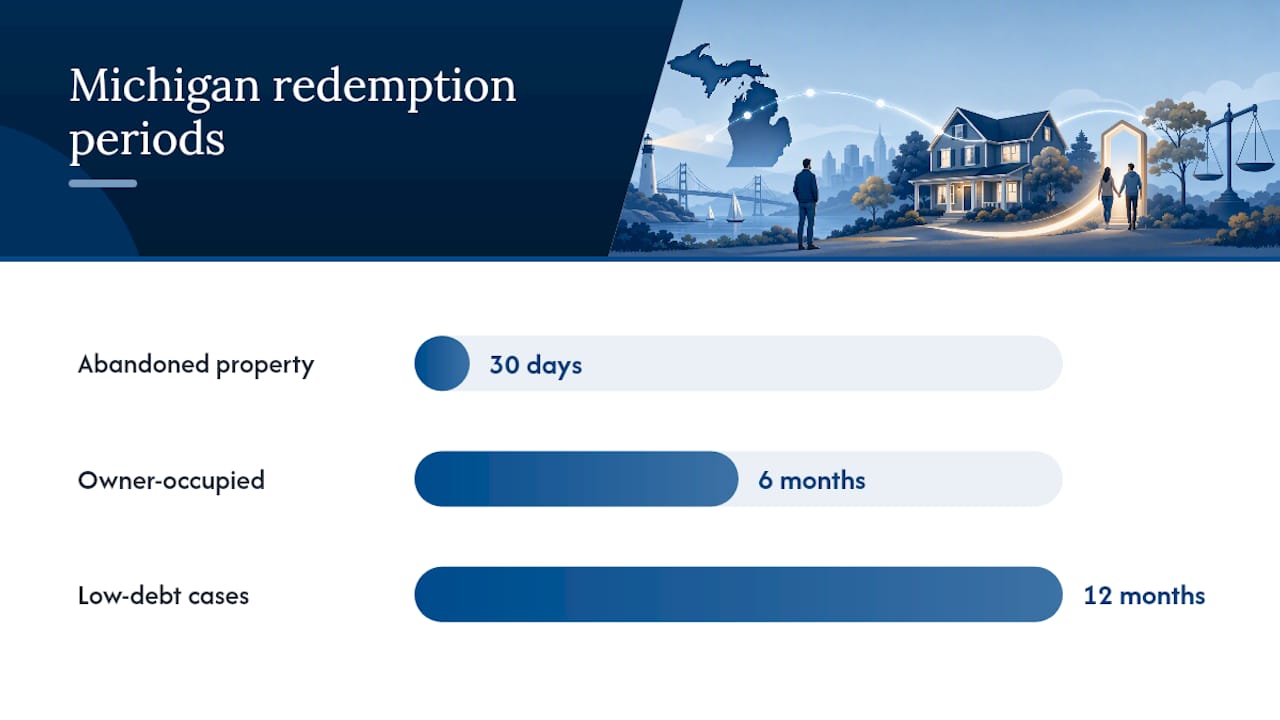
Redemption periods in Michigan fall into three common bands, and which one applies to you depends on the type of property and how much you still owe.
- Thirty days typically applies to properties that have been abandoned.
- Six months is the most common outcome for owner-occupied residential homes, according to MSHDA.
- Up to 12 months applies in narrower circumstances, such as when the amount owed is less than two-thirds of the original loan balance.
The clock starts on the date of the sheriff’s sale, not when the deed gets recorded. To redeem, you pay the purchase price plus interest and reasonable post-sale costs, which can include property insurance, taxes, or HOA dues paid by the purchaser during that stretch, according to Nolo’s summary of Michigan redemption rules. You can pay the purchaser directly or route the payment through the Register of Deeds, depending on local practice.
Pro Tip: Request a written, itemized payoff figure from the purchaser before you show up with funds. Verbal estimates during redemption tend to run low, and you do not want to discover a shortfall on the deadline itself.
You may keep living in the home during redemption, but purchasers generally have limited inspection rights, often with 72 hours’ notice before entering, so keep the property maintained and insured in the meantime, per Michigan Legal Help.
What Happens When the Redemption Period Ends?
If you do not redeem by the deadline on your certificate of sale, the sheriff’s deed becomes operative and title passes to the purchaser, according to Michigan’s judicial foreclosure benchbook. Recording that deed within 20 days is a statutory requirement for the purchaser, but a late recording does not extend your redemption clock or give you extra time.
- The new owner generally must file an eviction action in court rather than removing you directly.
- After a judgment, you may have as little as 10 days to move out, though courts sometimes grant limited extra time on request.
- Read any summons or eviction paperwork the moment it arrives and contact a housing attorney or Michigan Legal Help immediately.
Waiting to respond to eviction paperwork is the single costliest mistake homeowners make at this stage.
What Can You Do Before the Sheriff’s Sale Happens?
You have real options between missed payment and sale day, and the earlier you act, the more of them stay open.
- Loss mitigation first. Apply for a loan modification, repayment plan, or forbearance as soon as you know you will miss payments, and gather pay stubs, bank statements, and a hardship letter before you call.
- Short sale or deed-in-lieu. Both require lender approval and typically take weeks to negotiate, but either can stop foreclosure and limit damage to your credit compared to letting a sale happen.
- Sell for cash. When keeping the home is not realistic, a fast cash sale before foreclosure lets you close on your own timeline, skip repairs, and walk away with funds instead of a foreclosure on your record. The trade-off is a lower price than a fully marketed sale might bring.
Pro Tip: Never pay an upfront fee to a stranger who promises to “save your home.” MSHDA and HUD-approved counselors provide this kind of guidance for free, and any company demanding cash before doing anything is a foreclosure rescue scam.
Our Perspective on Timing After 16 Years in Metro Detroit
Some experienced local real estate professionals observe that the people who fare best are the ones who decide early, not the ones who wait for a sale date to force their hand. A fast, all-cash, as-is offer within 24 hours and a closing in as little as seven days is not the right move for everyone, but it is often the clearest path when keeping the home is no longer realistic and the redemption clock is already running. Use HUD-approved counseling alongside any offer you get, and reach out when you are ready to talk through your specific dates.
— Real Estate Team
Ready for a Fast, Fair Cash Offer in Metro Detroit?
If your redemption clock is ticking and keeping the house is not the goal, Sell Dave Your House gives Metro Detroit homeowners a faster exit than listing with an agent while a foreclosure timeline runs in the background. Request an offer, and you will typically hear back with a fair, all-cash number within 24 hours, no repairs, no showings, and no commission eating into what you walk away with.

The process stays simple: you tell us about the property, we send a written cash offer, and if it works for you, we handle standard closing costs and close in as little as seven days. That speed matters when a sheriff’s sale date is already on the calendar or when redemption is about to expire. We work with homeowners across the region, including through dedicated local pages for Roseville and Madison Heights, and if your situation involves a rental you inherited along with the property, our rental property page covers that scenario too. Get your cash offer started here and see the number before you decide anything.
Where to Verify Your Exact Foreclosure Dates
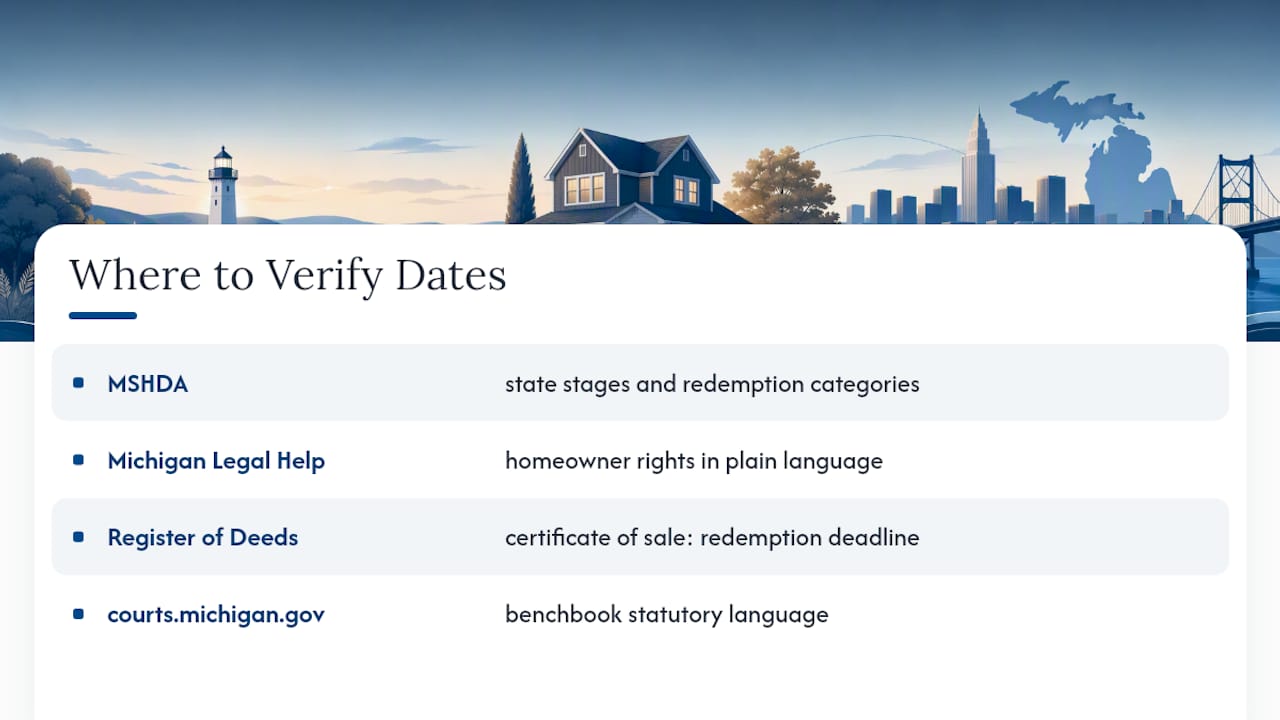
Confirm your specific timeline with primary sources rather than general rules. MSHDA’s stages-of-foreclosure page explains state-level stages and redemption categories. Michigan Legal Help covers homeowner rights in plain language. Your county Register of Deeds holds the certificate of sale with your actual redemption deadline, and courts.michigan.gov publishes the statutory benchbook language courts rely on.
This article is general information, not a substitute for advice from a qualified financial advisor. Consult a qualified financial professional about your own circumstances before acting on anything here.
Sources
- How long will it take before I’ll face foreclosure if I can’t make my mortgage payments? What is the foreclosure timeline? | CFPB
- Stages of Foreclosure | MSHDA
- Foreclosure and Eviction for Homeowners | Michigan Legal Help
- Mortgage foreclosures by advertisement | Michigan courts benchbook
- If I lose my home in foreclosure in Michigan, can I get it back? | Nolo
FAQ
How long does a foreclosure take in Michigan?
Most Michigan mortgage foreclosures take about four to six months from the first missed payment to the sheriff’s sale, followed by a separate redemption period that runs another 30 days to 12 months depending on your circumstances.
What is the typical redemption period for a foreclosure in Michigan?
Six months is the most common redemption period for owner-occupied residential foreclosures in Michigan, though abandoned properties often get only 30 days and certain low-balance cases can extend to 12 months, according to MSHDA.
What state has the quickest foreclosure process?
Foreclosure speed varies widely by state depending on whether the process is judicial or nonjudicial and how long each state’s notice and redemption rules run; Michigan’s nonjudicial process with a defined redemption period runs slower than states with no post-sale redemption at all.
What is the 120-day rule for foreclosure?
Under 12 C.F.R. § 1024.41, most mortgage servicers cannot refer a covered loan to formal foreclosure until the borrower is more than 120 days delinquent, giving homeowners time to apply for loss mitigation first.
Where can I find my exact redemption deadline?
Your county Register of Deeds holds the certificate of sale, which lists the specific date your redemption period ends, and that document overrides any general estimate you find online.