

Paperwork for a Direct Cash Home Sale: Seller’s Guide
TL;DR:
- A cash home sale involves thorough legal and administrative processes akin to financed deals, including proof of funds verification and title clearance. Proper documentation such as purchase agreements, disclosures, and notarized deeds are essential, with title searches ensuring a clear transfer of ownership. Verifying proof of funds through official bank letters and using independent confirmation methods helps prevent fraud, while the process typically completes within one to three weeks when title is clear.
To close a direct cash sale, you must verify proof of funds, sign a written purchase agreement with required seller disclosures, complete a title search and lien payoff, sign and notarize the deed at closing, and record the deed with the county recorder. The settlement agent will also file Form 1099-S to report gross proceeds to the IRS. No lender is involved, but the legal duties are identical to a financed sale.
TL;DR: Cash sales close faster, but the paperwork checklist is just as real. Gather these items before you accept any offer:
- Signed written purchase agreement (price, closing date, deed type, contingencies)
- Proof of funds: bank letter on institutional letterhead
- Required state seller disclosures (lead paint, material defects, HOA)
- Title search results and lien payoff statements
- Deed (signed, notarized, and ready for county recording)
- ALTA settlement statement or Closing Disclosure
- County recording confirmation
- IRS Form 1099-S (filed by settlement agent; keep your copy)
Table of Contents
- What does the paperwork for a direct cash home sale look like, step by step?
- How do you verify a cash buyer before accepting their offer?
- What purchase agreement clauses and seller disclosures do you need?
- Why does title work still matter when there’s no lender?
- What does “as-is” actually mean for your paperwork obligations?
- What do you sign at closing, and how do funds transfer safely?
- How long does a cash sale take, and what will it cost you?
- What scams and red flags should you watch for in cash offers?
- Your pre-closing paperwork checklist: what to have ready
- How Sell Dave Your House handles the paperwork for you
- Key Takeaways
- What selling for cash actually feels like as a seller
- Sell Dave Your House: get a documented cash offer and paperwork support
- Useful sources and further reading
- FAQ
What does the paperwork for a direct cash home sale look like, step by step?
The sequence runs like this: accept the offer, verify proof of funds, open escrow or title, complete any inspections, clear liens and obtain payoffs, sign closing documents, transfer funds, and record the deed. Cash closings typically take a few weeks when title is clear, compared with about a month for mortgage-backed purchases.
Here is how the steps break down in practice:
- Accept the offer (Day 1): You and the buyer sign the purchase agreement. The earnest money deposit goes into escrow, usually within 1–3 business days.
- Verify proof of funds (Day 1–2): Request a bank letter on official letterhead before countersigning anything. This is your first line of protection.
- Open escrow or title (Day 1–3): Either you or the buyer contacts a licensed title or escrow company. They order the title search immediately.
- Title search and lien clearance (Days 3–10): The title company examines the ownership chain, identifies liens, judgments, and easements, and issues a preliminary title report.
- Inspections, if any (Days 3–10): Cash buyers may waive inspections or schedule them during the option period. Any inspection reports go to the title or escrow file.
- Obtain lien payoffs (Days 5–12): Your mortgage servicer, HOA, or any lien holder provides a payoff demand. These figures appear on the settlement statement.
- Sign closing documents (Days 7–21): You sign the deed, settlement statement, transfer tax forms, and any required affidavits. A notary witnesses the deed signing.
- Fund transfer and deed recording (Closing day): Funds arrive by wire or cashier’s check. The title company disburses proceeds and records the deed with the county recorder.
Who does what at closing?
| Party | Primary responsibility |
|---|---|
| Seller | Signs deed, disclosures, affidavits, and settlement statement; provides lien payoff authorization |
| Buyer | Delivers verified funds; signs purchase agreement and any buyer-side closing documents |
| Title/escrow agent | Orders title search, prepares ALTA settlement statement, disburses funds, records deed |
| Notary | Witnesses and notarizes the deed and any power-of-attorney documents at signing |
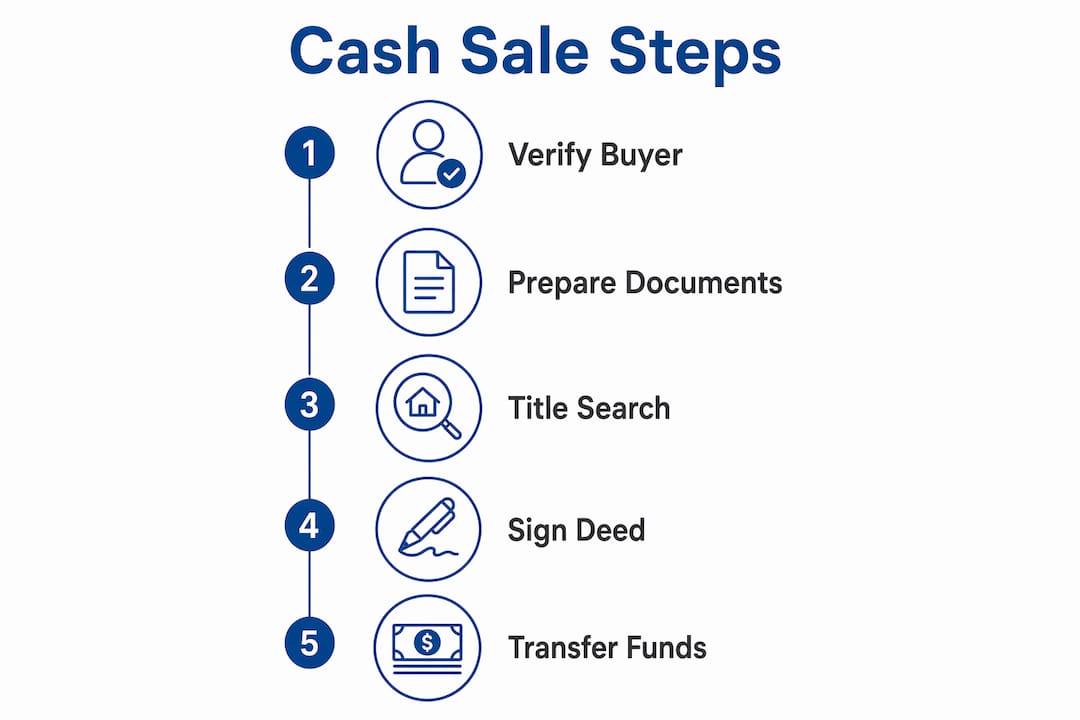
The title/escrow agent is the neutral hub: they consolidate all financials on the settlement statement, confirm funds are received, and send the deed to the county recorder. You should expect to see the ALTA settlement statement or Closing Disclosure at least one business day before closing so you can review every line item.
How do you verify a cash buyer before accepting their offer?
Demand a bank letter on official letterhead as your primary proof of funds. It is harder to fabricate than a screenshot or a copy-pasted statement, and title companies treat it as the standard verification document.
Acceptable proof-of-funds documents:
- Bank letter signed by an officer, on institutional letterhead, dated within 30 days
- Recent bank statements (last 2–3 months) showing sufficient liquid funds
- Third-party escrow confirmation from a licensed escrow company
- Brokerage account statements for liquid, non-retirement assets
What to check on any POF document:
- Bank name, address, and direct phone number
- Account type (checking, savings, or money market — not a line of credit)
- Current balance that meets or exceeds the purchase price
- Officer’s signature and date
Red flags to watch for:
- Buyer refuses to provide POF or delays repeatedly
- POF document has no bank contact information you can independently verify
- Last-minute changes to wiring instructions (a classic wire-fraud signal)
- Buyer pressures you to skip the title company and close “off-record”
- Unusually complex LLC buyer structure with no identifiable principals
Pro Tip: Call the bank directly using a number you find independently — not the number printed on the POF letter itself. Confirm the account exists and the balance is sufficient. This two-minute call can prevent a devastating fraud.
What purchase agreement clauses and seller disclosures do you need?
The sale must be governed by a signed written purchase agreement that spells out price, closing date, deed type, possession date, contingencies, and who pays which closing costs. Without a written contract, you have no enforceable terms and no clear record of what was agreed.
Key clauses to review before signing:
- Deed type: Warranty deed (full title guarantee) vs. quitclaim deed (no guarantee). Most buyers expect a general warranty deed; a quitclaim is appropriate only in specific situations like estate transfers.
- As-is language: Confirms the buyer accepts the property’s current condition, but does not eliminate your disclosure obligations.
- Inspection period: Even cash buyers sometimes include a short option period (typically 5–10 days). Know whether this is included and what triggers termination rights.
- Earnest money: Amount, who holds it (escrow), and what happens if either party defaults.
- Closing cost allocation: Who pays title insurance, recording fees, and transfer taxes varies by state and negotiation.
- Unpaid property taxes: Specify whether taxes are prorated at closing or paid in full by the seller.
Seller disclosures you will likely need:
- Lead-based paint disclosure (federal requirement for homes built before 1978)
- Seller’s property condition disclosure (material defects, water intrusion, structural issues)
- HOA documents: CC&Rs, bylaws, current dues, and any pending assessments
- Natural hazard disclosures (required in many states, including California)
- Any known environmental issues (underground storage tanks, mold, etc.)
State requirements vary significantly. Check your state’s real estate commission website for the specific forms required in your market.
Pro Tip: Upload every signed disclosure to the title company’s escrow portal at least five business days before closing. Last-minute disclosure delivery is one of the top reasons cash closings get pushed back a day or two.
Why does title work still matter when there’s no lender?
A title search and clear title are mandatory to transfer ownership cleanly. Without a lender’s underwriting, the responsibility to discover and resolve title defects falls entirely on the parties and the title company. Title defects, undischarged liens, and chain-of-title issues are the most common problems that delay or derail cash closings.
A title search examines the public record for liens (mortgage, tax, mechanic’s), judgments, easements, ownership gaps, and heirship issues. If defects appear, the title company will require a title cure, a payoff at closing, or an escrow holdback before recording.
What documents does the title company need from you?

| Document | Purpose |
|---|---|
| Government-issued photo ID | Identity verification for all signers |
| Current deed or prior title policy | Confirms ownership chain |
| Mortgage payoff statement | Calculates lien payoff amount for settlement statement |
| HOA payoff or estoppel letter | Confirms dues and any outstanding assessments |
| Any existing survey | Identifies boundary or easement issues |
Key terms you will encounter:
- Title insurance: A one-time premium policy protecting against undiscovered title defects. Owner’s title insurance is optional for buyers in a cash sale, but most title professionals recommend it.
- Lien: A legal claim against the property by a creditor. Must be paid off or released before the deed records cleanly.
- Affidavit of title: A sworn statement by the seller confirming no undisclosed liens, legal actions, or ownership disputes.
- Payoff demand: A formal statement from a lender or lien holder showing the exact amount needed to satisfy the debt.
You can opt out of purchasing owner’s title insurance, but doing so leaves you exposed if a defect surfaces after closing. In most U.S. markets, the seller pays for the owner’s title insurance policy as a customary closing cost, though this is negotiable.
What does “as-is” actually mean for your paperwork obligations?
“As-is” means you are not contractually required to make repairs, but it does not release you from disclosing known defects. Required condition disclosures still apply under state law regardless of what the purchase agreement says about repairs.
Typical inspection-related documents and timelines:
- Inspection contingency clause in the purchase agreement (buyer’s right to inspect, usually 5–10 days)
- Written inspection report delivered to the buyer and copied to the title/escrow file
- Buyer’s written waiver or acceptance of inspection results before the option period expires
- Any repair addendum (rare in true as-is cash deals, but possible if negotiated)
A standard as-is clause reads something like: “Buyer accepts the property in its present condition. Seller makes no representations or warranties regarding the condition of the property.” That language protects you from repair demands, but it does not protect you from a misrepresentation claim if you knew about a leaking roof and said nothing.
Cash buyers who waive repair contingencies still have the right to receive accurate disclosures. The practical takeaway: disclose everything you know, document it in writing, and let the buyer decide.
What do you sign at closing, and how do funds transfer safely?
At closing, you will sign the deed, the ALTA settlement statement, an affidavit of title, transfer tax forms, and any payoff authorizations. Funds typically arrive by wire transfer, and the title company records the deed after confirming receipt.
Typical closing document checklist:
- Deed (warranty or quitclaim, notarized): the instrument that transfers ownership
- ALTA settlement statement or Closing Disclosure: itemizes every dollar in and out
- Affidavit of title: your sworn statement of no undisclosed liens or disputes
- Transfer tax forms: required by most states and many counties
- Lien payoff authorization: directs the title company to pay off your mortgage or other liens from proceeds
- Power of attorney (if applicable): allows a designated person to sign on your behalf
Wire transfers are the most common method for moving large closing funds. Most title companies prefer wires over cashier’s checks for amounts over $50,000. Safe wire practices matter because wire-fraud spoofing is a real and frequent threat.
Safe wire transfer steps:
- Call the title company using a phone number you find independently (not from an email)
- Verbally confirm the wiring instructions before initiating any transfer
- Send a small test wire if the title company allows it for large transactions
- Confirm receipt with the title company after the wire is sent
- Never act on last-minute wiring instruction changes sent by email alone
The notary’s role at closing is to verify your identity and witness your signature on the deed. Some states require additional witnesses. Remote online notarization (RON) is now accepted in many states, which can speed up the process if you cannot appear in person.
Pro Tip: Ask the title company about your state’s “good funds” law before closing day. Some states require wired funds to fully clear before the deed can record, which can push same-day recording to the following business day.

How long does a cash sale take, and what will it cost you?
Cash sales typically close in 1–3 weeks when title is clear. The actual timeline depends on how quickly the title search is completed, whether liens need to be paid off, and how fast funds transfer. A traditional financed sale typically takes 30–45 days by comparison.
Common seller costs in a cash closing:
| Cost item | Typical range / notes |
|---|---|
| Title/escrow fees | Varies by state and transaction size; often $500–$1,500 |
| Owner’s title insurance | Customarily paid by seller in many markets; amount varies by sale price |
| Recording fees | Usually $10–$50 per document; set by county |
| Transfer taxes | Vary widely by state and county; some states have none |
| Prorated property taxes | Calculated to closing date; appears as a debit on settlement statement |
| Mortgage payoff | Full outstanding balance plus per-diem interest to closing date |
| Seller credits (if negotiated) | Any agreed repair credits or concessions |
Unpaid liens and back taxes can significantly reduce your net proceeds if payoffs are required at settlement. Review the preliminary title report carefully and ask the title company to walk you through every debit on the settlement statement before signing.
What scams and red flags should you watch for in cash offers?
Insist on verifiable proof of funds and use independent verification of wiring instructions. Wire fraud is the top operational risk in cash deals, and fake POF letters are more common than most sellers expect.
Red flags in cash offers:
- Buyer refuses to provide a bank letter or delays POF repeatedly
- POF document has no verifiable bank contact information
- Buyer is an LLC but refuses to identify principals or provide formation documents
- Pressure to close without a title company or “off-record”
- Last-minute changes to wiring instructions via email
- Offer price dramatically above market with no explanation
If you suspect fraud, take these steps immediately:
- Stop any pending wire transfer by calling your bank directly.
- Contact the title company by phone (using a number you verified independently) to report the issue.
- Notify your bank’s fraud department and request a wire recall if funds have already moved.
- Contact local law enforcement and file a report.
- Report the incident to the FBI’s Internet Crime Complaint Center (IC3) at ic3.gov.
One additional note: if the buyer is a non-natural entity such as an LLC, the settlement agent may be required to collect and report detailed ownership information under AML/FinCEN rules using standardized ALTA FinCEN collection forms. This is a federal compliance requirement, not a red flag in itself, but it is worth knowing so you are not surprised when the title company asks for it.
Your pre-closing paperwork checklist: what to have ready
Have these items ready and uploaded to your escrow or title portal at least three business days before closing. Arriving organized prevents last-minute delays that push your closing date.
Documents and items to gather:
- Government-issued photo ID (driver’s license or passport) for all sellers
- Recorded deed copy (if you have it; title company can obtain it if not)
- Mortgage payoff statement from your lender (request 10–14 days before closing)
- HOA documents: estoppel letter, current dues statement, CC&Rs
- Completed seller disclosure forms (all state-required forms, signed)
- Property tax bills (current and any outstanding)
- Keys, garage door openers, mailbox keys, and any access codes
- Utility account information (account numbers and provider contacts)
- Contact details for all parties (buyer, buyer’s representative, title company, your attorney if applicable)
- Any existing survey, permits, or warranties for recent work
Most title companies have a secure online portal where you can upload documents directly. Ask for the portal link when you open escrow and submit everything digitally rather than waiting to hand over paper at the closing table. If you are selling an inherited property, you may also need probate documentation or letters testamentary before the title company can clear the chain of title.
How Sell Dave Your House handles the paperwork for you
Sell Dave Your House manages proof-of-funds verification, coordinates title and escrow, prepares required seller disclosures, obtains lien payoffs, and handles deed notarization and county recording. The goal is a documented, fast closing with as little seller burden as possible.
The Sell Dave Your House process:
| Stage | What happens | Typical timing |
|---|---|---|
| Offer | Fair all-cash offer delivered after property review | Within 24 hours |
| Verification | POF confirmed; purchase agreement signed | Day 1–2 |
| Escrow/title opened | Title search ordered; disclosures prepared | Day 1–3 |
| Title search | Liens identified; payoffs obtained | Days 3–10 |
| Closing | Deed signed, notarized, funds wired, deed recorded | As few as 7 days |
What sets this process apart:
- No agent commissions or hidden fees that reduce your net proceeds
- As-is purchases mean no repair demands or contractor negotiations
- 16+ years of experience handling cash closings in the Detroit market
- Offers within 24 hours; most closings complete in 1–3 weeks when title is clear
- Full coordination of title, escrow, notarization, and county recording
If you want to understand how a direct cash sale saves fees compared with a traditional listing, the difference in net proceeds is often more significant than sellers expect once agent commissions, repair costs, and carrying costs are removed from the equation.
Key Takeaways
A direct cash home sale requires the same core legal documents as any real estate transaction: verified proof of funds, a signed purchase agreement, required seller disclosures, clear title, a notarized deed, and a settlement statement, plus IRS Form 1099-S reporting.
| Point | Details |
|---|---|
| Proof of funds first | Demand a signed bank letter on institutional letterhead before accepting any cash offer. |
| Title work is non-optional | A title search and lien clearance are required in every cash sale, regardless of whether a lender is involved. |
| Disclose everything | “As-is” language does not eliminate your legal duty to disclose known material defects under state law. |
| Verify wires by phone | Always confirm wiring instructions by calling the title company at an independently verified number before transferring funds. |
| Sell Dave Your House | Handles POF verification, title coordination, disclosures, and deed recording for Detroit-area sellers, closing in 1–3 weeks when title is clear. |
This article is general information, not legal or tax advice. Confirm current requirements with a licensed real estate attorney or tax professional for your specific situation.
What selling for cash actually feels like as a seller
Selling for cash speeds the timetable considerably, but it does not remove your legal duties. You still must provide required disclosures, ensure title is clear, and sign the same core documents you would in any sale. What changes is the absence of a lender’s underwriting timeline, which is what compresses the closing to 1–3 weeks.
A few practical questions sellers often raise:
- Possession timing: The purchase agreement sets the possession date. Cash buyers sometimes request immediate possession at closing; you can negotiate a post-closing occupancy period if you need more time.
- Left-behind items: Specify in the purchase agreement what stays and what goes. Anything not addressed in writing can become a dispute.
- Power of attorney: If you cannot attend closing in person, a properly drafted and notarized power of attorney allows a trusted person to sign on your behalf. Confirm the title company will accept it before closing day.
The protections that matter most in a cash sale are the ones you build into the process: a licensed title or escrow company overseeing the transaction, a written purchase agreement with clear terms, and a recorded deed that creates the public record of ownership transfer. Those three elements together give you the same legal standing as any other real estate closing.
Sell Dave Your House: get a documented cash offer and paperwork support
If you want a documented cash offer and help with the paperwork from start to finish, Sell Dave Your House verifies proof of funds, coordinates title and escrow, and closes quickly, with no agent commissions and no repair requirements. For Detroit-area homeowners facing financial hardship, foreclosure, an inherited property, or simply a need to move fast, that combination of speed and full paperwork support is a genuine relief.

What to have ready when you reach out:
- Your property address and a brief description of the home’s condition
- Any known liens or outstanding mortgage balance
- Your preferred closing timeline
- Contact information for follow-up
Sell Dave Your House delivers a fair cash offer within 24 hours and can close in 1–3 weeks when title is clear. To get a cash offer or learn more about how the process works for your situation, reach out today. Detroit homeowners can also visit the Detroit cash homebuyers page for local service details.
Useful sources and further reading
These primary sources back the key claims in this article and are worth bookmarking for your own reference:
- IRS Form 1099-S Instructions: The official IRS instructions explaining who must file, what counts as gross proceeds (including digital asset payments), and how settlement agents report real estate sales.
- IRS: Tax reminders for home sellers: Explains the $250,000/$500,000 capital gains exclusion, ownership-and-use tests, and when Form 1099-S triggers reporting obligations even if you qualify for the exclusion.
- ALTA FinCEN Seller Collection Form v1.0: The standardized form settlement agents use to collect ownership information when the buyer is a non-natural entity (LLC, trust, corporation) under federal AML/FinCEN rules.
- LegalClarity: What happens at closing when paying cash: Practical overview of cash closing mechanics, title agent roles, and fund transfer methods.
- Seller closing process step-by-step guide: A detailed workflow for sellers covering each stage of the closing process from contract to recording.
FAQ
Is selling your house for cash a good idea?
For sellers who need speed, certainty, or want to avoid repairs, a cash sale is often the right choice. You trade some negotiating leverage on price for a faster, simpler closing with fewer contingencies.
Does buying a house for cash get reported to the IRS?
Yes. The settlement agent is generally required to file Form 1099-S reporting gross proceeds to the IRS, even if you qualify for the capital gains exclusion.
How much are closing costs on a cash offer?
Seller closing costs on a cash deal typically include title and escrow fees, recording fees, transfer taxes, and prorated property taxes. Agent commissions are eliminated in a direct cash sale, which can meaningfully increase your net proceeds.
What is the safest way to receive funds in a cash home sale?
Wire transfer is the standard method for large real estate transactions. Always verify wiring instructions by calling the title company at an independently verified phone number before initiating any transfer, and confirm receipt after the wire is sent.
Can you sell a house for cash without a title company?
Technically possible in some states, but bypassing a licensed title company exposes you to undischarged liens, title defects, and improper recording that can create competing ownership claims after closing. Using a title or escrow company is strongly recommended.