

Close in 7 Days: Cash Exit vs. Post Possession Agreement in Detroit
A post-possession agreement is a written contract letting the seller stay in the home for a set period after closing, paying the buyer an occupancy fee while the buyer legally owns the property. Buyers should never accept an informal handshake version. Insist on a signed use-and-occupancy agreement with a fixed move-out date, an escrow holdback, and confirmation from your lender, insurer, and title company before you agree to it.
TL;DR:
- Short-term rent-backs under 30 days are easiest to enforce and manage, reducing legal and lender risks associated with longer stays.
- The occupancy fee should be based on the buyer’s PITI divided by 30, with clear daily rate and payment terms specified in the agreement.
- A well-structured agreement must include a fixed move-out date, a monetary holdback, and clear conditions for damage and overstay penalties to prevent disputes.
- Lenders’ owner-occupancy requirements and insurance policies may restrict or complicate rent-back arrangements if the seller overstays or if coverage isn’t updated.
- Selling for cash with a quick closing is often a preferable alternative to rent-back, especially for distressed or time-sensitive sellers, eliminating legal and logistical complications.
Table of Contents
- Post-Closing Occupancy Template: The Clauses You Need
- What Legal and Financial Risks Come with Seller Rent-Back Deals?
- How Do You Write Post-Possession Terms That Actually Hold Up?
- Closing-Day Checklist for a Smooth Handoff
- Why a Fast Cash Sale Can Sidestep Rent-Back Headaches Entirely
- Sample Post-Possession Agreement: What to Copy
- Who Covers Utilities, Taxes, and Insurance During the Rent-Back?
- What Happens if the Seller Won’t Leave on Time?
- Why Do Sellers Actually Ask for a Post-Possession Agreement?
- Rent-Back vs. Leaseback vs. Bridge Housing: What’s the Difference?
- How to Negotiate Rent-Back Terms Without Losing Leverage
- Real Disputes: How Rent-Back Conflicts Actually Get Resolved
- Do State Laws Change How Post-Possession Agreements Work?
- The Real Lesson Buyers and Sellers Both Miss
- A Simpler Option Than Negotiating a Rent-Back
- Sources
- FAQ
Post-Closing Occupancy Template: The Clauses You Need
A post-closing occupancy agreement, also called a seller rent-back agreement, only works if it spells out money, dates, and consequences in plain language. Vague terms are where these deals fall apart. One law firm’s guidance is blunt about this: phrases like “approximately one week” are not enforceable substitutes for exact calendar dates.
Here’s what belongs in the document, clause by clause:
- Parties and premises. Full legal names of buyer and seller, plus the property’s legal description, not just the street address.
- Term. A specific calendar move-out date and time, not a range or estimate.
- Occupancy fee. A daily rate, usually calculated from the buyer’s principal, interest, taxes, and insurance (PITI), divided by 30.
- Security deposit or escrow holdback. A dollar amount held by the title company or attorney, with clear release conditions tied to a satisfactory final walkthrough.
- Utilities and maintenance. Who pays what, and who is responsible for lawn care, snow removal, and normal upkeep during the rent-back window.
- Condition at surrender. The exact state the home must be in when the seller leaves, ideally referencing the closing-day inspection photos.
- Insurance requirements. Proof the seller carries renter’s or occupant’s insurance for the possession period.
- Access and inspection rights. The buyer’s right to inspect with reasonable notice before move-out.
- Holdover penalty. A daily charge that increases sharply if the seller overstays.
- Governing law and signatures. The state whose law controls, plus notarized signatures from both parties.
Treat this list as a drafting checklist for your attorney, not a fill-in-the-blank form you copy without review.
What Legal and Financial Risks Come with Seller Rent-Back Deals?
Closing transfers legal title to the buyer, but a rent-back means the buyer doesn’t get physical possession right away. That gap creates real exposure on both sides, and it’s the reason most legal guidance on the topic treats a handshake rent-back as a liability, not a favor.
One in five deals hits a snag here. Loan programs often carry owner-occupancy requirements, and some lenders expect the buyer to occupy the home within 30 to 60 days of closing. A rent-back that stretches past that window can violate the loan agreement itself, not just annoy the buyer.
Insurance is the other blind spot. A standard homeowner policy assumes the owner lives in the house. If the seller is still occupying it, the insurer may deny a claim filed during that window unless the policy was updated to reflect non-owner occupancy.
Then there’s the landlord-tenant trap. Depending on the state, an occupant who pays rent and stays long enough can pick up tenant protections, meaning:
- The buyer may need to file a formal eviction or detainer action instead of simply asking the seller to leave
- Removal timelines stretch from days to weeks or months
- Local notice requirements apply even when the seller is clearly in the wrong
This is why attorneys consistently push for occupancy periods measured in days, not months.
How Do You Write Post-Possession Terms That Actually Hold Up?
Enforceability starts with structure, not just intent. The safest post-possession agreements share the same bones, no matter which attorney drafts them.
- Keep the term short. Rent-backs under 30 days are far easier to manage; once occupancy stretches longer, lender scrutiny and tenant-law complications increase sharply.
- Base the daily fee on PITI. Take the buyer’s monthly principal, interest, taxes, and insurance, divide by 30, and use that as the daily occupancy rate. It’s a number both sides can verify.
- Size the escrow holdback deliberately. A pure rent escrow can get drained down to zero with no money left to cover damage or a holdover. Attorneys often recommend structuring the holdback as a penalty amount layered on top of daily fees, not a substitute for them.
- Use license language, not lease language. Calling the seller a “licensee” rather than a “tenant” is a deliberate legal choice attorneys make to limit tenant-law protections and preserve faster remedies if things go sideways.
- Get paperwork lenders expect. A signed agreement, written escrow instructions, and a letter confirming the buyer’s insurer is aware of the rent-back period. Skipping this step is how enforcement disputes happen later.
Pro Tip: Ask your title company to hold the escrow, not the real estate agent’s brokerage. Title companies have clear fiduciary rules for releasing funds, which removes a layer of “he said, she said” if a dispute comes up.
Closing-Day Checklist for a Smooth Handoff
Print this and take it with you. A rent-back succeeds or fails based on what happens in the 48 hours around closing.
- Before closing: Notify your lender and insurer of the planned occupancy period in writing, and confirm the move-out date matches the agreement exactly.
- At closing: Take dated photos of every room, verify the escrow deposit lands with the title company, and get the use-and-occupancy agreement signed by everyone before you hand over keys.
- During occupancy: Schedule at least one mid-term inspection, keep utility bills documented, and request proof of the seller’s renter’s insurance.
- At move-out: Do a final walkthrough against your closing-day photos, confirm the escrow release conditions are met, and put any damage disputes in writing within a set number of days.
Why a Fast Cash Sale Can Sidestep Rent-Back Headaches Entirely
Some sellers only want a rent-back because they’re racing a moving timeline, not because they love the paperwork. If you’re the one selling and the whole process sounds like more legal exposure than it’s worth, a fast cash sale skips the escrow math, the insurance calls, and the lender occupancy clock altogether. Some cash home buyers purchase homes as-is in the Detroit area, make cash offers quickly, and can close in as little as seven days, which often eliminates the need for a rent-back in the first place.
Sample Post-Possession Agreement: What to Copy
A usable template follows the same clause order every time, which is exactly why courts and title companies expect it. Structure your document with these headings, in this sequence:
1. Recitals — states the closing date, property address, and that title has passed to the buyer.
2. Grant of Occupancy License — the sentence establishing that the seller occupies the home as a licensee, not a tenant, for a stated number of days.
3. Occupancy Fee and Payment Schedule — the daily rate, when it’s due (often prepaid at closing), and where payments go.
4. Security Deposit and Escrow Holdback — the dollar figure, who holds it, and exactly what triggers its release.
5. Utilities and Maintenance — a short table assigning each utility and yard task to a party.
6. Insurance — a requirement that the seller carry occupant’s insurance and provide proof before keys change hands.
7. Condition at Surrender — reference to closing-day photos as the baseline condition.
8. Access for Inspection — notice period the buyer must give before entering.
9. Default and Holdover Remedies — the escalating daily penalty and the buyer’s right to pursue removal.
10. Governing Law and Signatures
Real estate attorneys and title companies both keep boilerplate versions of this structure. Ask your closing attorney for their standard form rather than pulling a generic template off the internet, since state-specific language on tenant rights varies enough to matter.
Who Covers Utilities, Taxes, and Insurance During the Rent-Back?
The buyer owns the home the moment title transfers, which means property tax liability and the mortgage payment are the buyer’s responsibility from day one, rent-back or not. What’s negotiable is everything else.
Utilities typically stay in the seller’s name and get paid by the seller for the duration of the occupancy, since they’re the one using the gas, water, and electricity. Some agreements have the seller reimburse the buyer if accounts already switched at closing. Either way, the agreement should say so explicitly, because “figure it out later” is how disputes start.
Insurance splits differently than most people expect. The buyer’s homeowner policy covers the structure, but that policy may not extend to claims tied to a non-owner occupant unless the insurer signs off in advance. The seller, meanwhile, should carry a renter’s or occupant’s policy covering their own belongings and liability while they’re inside a house they no longer own.
Routine maintenance, lawn care, and minor repairs during the rent-back period are usually the seller’s job, since they’re the one living there. Anything structural or system-related (a failing water heater, a roof leak) should default to the buyer as the owner, with the agreement stating who calls the repair company and who pays for it.
What Happens if the Seller Won’t Leave on Time?
The occupancy agreement’s whole job is to make overstaying expensive and fast to resolve, not to leave the buyer negotiating from scratch after the deadline passes.
The first remedy is financial. A properly drafted agreement includes a holdover fee that jumps well above the daily occupancy rate the moment the deadline passes, often two to three times the original rate. That penalty gets deducted automatically from the escrow holdback the title company is holding, which is why sizing that escrow correctly at signing matters so much.
If the seller still won’t leave after the escrow is drawn down, the buyer’s next step depends on how the agreement was worded. A document that clearly identifies the seller as a licensee, not a tenant, gives the buyer a faster path: a licensee who overstays can typically be treated as a trespasser, which allows for quicker removal than a formal eviction. If the agreement was vague or the seller has been paying rent long enough to acquire tenant status under state law, the buyer may need to file a formal eviction or detainer action, a process that can take weeks or months depending on the local court calendar. That gap in speed is the single biggest argument for careful license-vs-lease drafting up front.
Why Do Sellers Actually Ask for a Post-Possession Agreement?
Most rent-back requests come down to one of a handful of predictable situations, and recognizing which one you’re dealing with helps you negotiate smarter terms.
The most common is a timing mismatch. The seller sold their house but their new home isn’t ready to close, so they need a bridge of a few days or weeks between the two transactions. This is often the easiest scenario to accommodate because the timeline is usually short and well defined.
Cross-state or long-distance moves create a second common pattern. A seller relocating for a job or family reason may need extra time to coordinate movers, school transitions, or a spouse’s start date. These rent-backs run longer, which means they deserve more scrutiny, not less.
A third scenario involves buyer preference, not seller need. Some buyers, particularly investors or those buying a second home, actually prefer the seller stay for a month so the buyer isn’t paying two mortgages or juggling their own move at the same time.
Finally, financial timing issues show up when a seller is using the sale proceeds to fund their next purchase and needs the closing to happen before their new place is ready. This scenario carries the most risk for buyers, since a seller under financial strain has more incentive to stretch a deadline than one who is simply waiting on a moving truck.
Rent-Back vs. Leaseback vs. Bridge Housing: What’s the Difference?
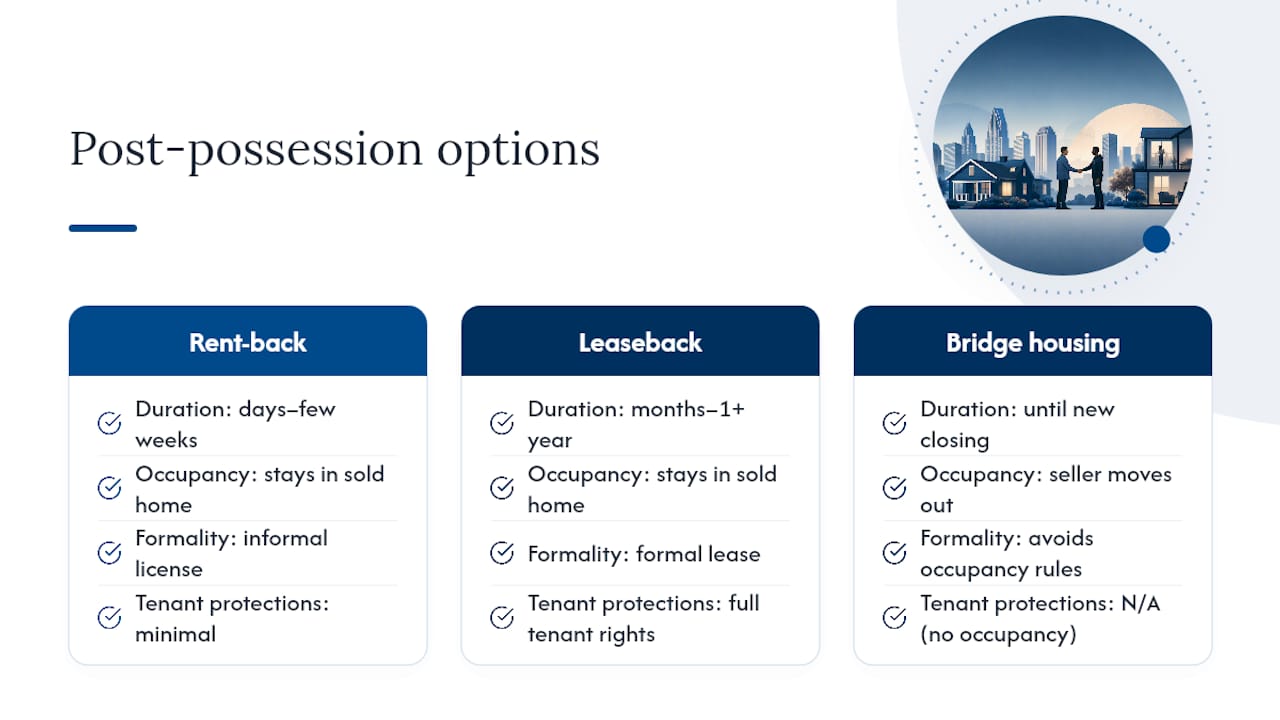
A post-possession agreement, a formal leaseback, and bridge housing solve the same underlying problem (a timing gap between two closings) but they carry different legal weight and different levels of complexity.
A standard rent-back is the short, informal version: days to a few weeks, structured as a license with a daily fee and an escrow holdback. This is what most residential closings use because it’s fast to draft and easy for a title company to administer.
A formal leaseback is a longer, more heavily negotiated version, sometimes lasting several months to over a year, common in commercial deals or situations where a seller needs significant time before relocating. These typically read like an actual lease, with monthly rent, a security deposit, and full landlord-tenant protections attaching to the seller. That extra formality means more tenant rights for the seller and a slower removal process for the buyer if things go wrong.
Bridge housing arrangements skip the whole possession question by removing the timing conflict entirely. Instead of staying in the sold house, the seller moves into temporary housing (a short-term rental, a relative’s place, an extended-stay hotel) while their new home finishes closing. This avoids every legal complication tied to occupancy of a home you no longer own, but it costs the seller money out of pocket and requires more logistical coordination upfront.
For most residential sellers facing a short gap, the standard rent-back remains the simplest option. It’s only when the timeline stretches past 30 days that a formal leaseback or bridge housing becomes the safer call.
How to Negotiate Rent-Back Terms Without Losing Leverage
Negotiation works best when both sides treat the rent-back as its own mini-transaction, not an afterthought bolted onto the purchase agreement.
Buyers should lead with the daily rate, not the move-out date. Anchoring on a PITI-based formula gives you a number the seller can’t easily argue with, since it’s tied to your actual carrying cost rather than an arbitrary figure. Once the rate is set, negotiate the escrow amount as a separate line, sized to cover a realistic holdover scenario plus potential damage, not just a token deposit.
Sellers, meanwhile, have the most leverage before the purchase agreement is signed, not after. If you know you’ll need extra time, raise it during the offer stage so it’s baked into the deal rather than negotiated under pressure close to closing, when the buyer has far less incentive to be generous.
Both sides benefit from involving their respective agents and attorneys early rather than trying to hash out terms verbally and formalize them later. A rent-back negotiated in the final 48 hours before closing tends to produce the vaguest, least protective language, exactly the kind of “approximately one week” phrasing that causes disputes down the line.
Real Disputes: How Rent-Back Conflicts Actually Get Resolved
Most rent-back disputes fall into one of three buckets, and each has a fairly predictable resolution path when the underlying agreement was written well.
Overstay disputes are the most common. A seller’s moving truck gets delayed, or their new home’s closing slips, and they’re still in the house past the deadline. When the agreement includes a clear holdover penalty and escrow holdback, this typically resolves through a simple financial deduction. When it doesn’t, the buyer is left negotiating informally or filing for eviction, which stretches the timeline and often damages the relationship between both parties.
Condition disputes happen at move-out, when the buyer claims the seller left the home in worse shape than the closing-day photos showed. Agreements with a documented condition-at-surrender clause and timestamped photos resolve these quickly, usually through a straightforward escrow deduction. Without that documentation, it becomes a dispute over memory and opinion, sometimes ending up in small claims court.

Insurance and liability disputes arise less often but hit hardest when they do, typically after an incident (a fire, a water leak, an injury) during the occupancy period. If neither party updated their insurance to reflect the rent-back, both sides can find themselves without coverage exactly when they need it most. This is the scenario attorneys point to most often when explaining why insurer notification isn’t optional.
Do State Laws Change How Post-Possession Agreements Work?
Landlord-tenant law is set at the state level, and that single fact drives most of the variation you’ll see in post-possession agreements around the country. Some states apply tenant protections quickly once money changes hands for occupancy, even for a short rent-back. Others give more weight to a clearly drafted license agreement, allowing faster removal if a seller overstays.
This is also why the license-versus-lease distinction matters so much in drafting. A term that reads as clearly enforceable in one state’s courts might get reinterpreted as a de facto tenancy in another, depending on how that state’s courts have ruled on similar short-term occupancy arrangements.
If you’re closing in Michigan, ask your closing attorney specifically about local post-closing occupancy practices, since Michigan’s landlord-tenant statutes and local court procedures for detainer actions differ from neighboring states in ways that affect how fast a buyer can act if a seller refuses to leave. There is no substitute here for a real estate attorney licensed in the state where the property sits. Generic templates and out-of-state advice are the fastest way to end up with an agreement that doesn’t hold up in your local court.
The Real Lesson Buyers and Sellers Both Miss
Most advice on post-possession agreements focuses on the paperwork, and that’s not wrong, but it misses the bigger point: the agreement is only as good as the two people signing it. A perfectly drafted escrow holdback and license clause won’t save a buyer from months of frustration if the seller is genuinely unable to move out on time because their own purchase fell through.
The conventional wisdom treats a rent-back like a routine formality, something you sign because your agent said it’s normal. It’s not routine. It’s a temporary landlord-tenant relationship layered on top of a completed sale, with real money and real legal exposure on both sides, and it deserves the same scrutiny you’d give the purchase agreement itself.
What the research actually supports is narrower and more useful than most guides admit: keep the term short, base the fee on real numbers, size the escrow to actually matter, and get your lender and insurer involved before you sign anything. If any of those pieces feel shaky, or if the seller’s timeline sounds more like a hope than a plan, that’s the moment to ask whether a rent-back is even the right tool, or whether a faster, cleaner sale solves the actual problem underneath it.
— Real Estate Team
A Simpler Option Than Negotiating a Rent-Back
If you’re a seller weighing all of this against your own timeline, there’s a version of this transaction with none of the escrow math, insurance calls, or holdover clauses: sell for cash and skip the rent-back conversation entirely. Some cash buyers purchase homes as-is, with no repairs or cleaning required, and cover standard closing costs.

Offers can come quickly, and closing can happen in as little as seven days, fast enough that many sellers who would have needed a rent-back simply don’t need one anymore. That speed matters most for people facing foreclosure, juggling an inherited property, or coordinating a cross-state move where every extra week of occupancy paperwork is one more thing that can go wrong. Instead of drafting a use-and-occupancy agreement, sizing an escrow holdback, and hoping your insurer signs off in time, you get a cash number, a closing date, and a straightforward exit.
If your situation sounds like any of the scenarios above, get a fair cash offer and see what closing without a rent-back actually looks like.
Sources
- The Hidden Legal Dangers of Letting a Seller Stay Past the Closing Date
- United States post-closing possession raises deal risk • United States Real Estate Investor®
- Should You Agree to a Seller Rent-Back? What Buyers and Sellers Need to Know About Post-Closing Possession Agreements - Auricchio Law Offices
- Pre and post closing possession agreements in real estate contracts - Kansas City Real Estate Lawyer
FAQ
How Long Are You Liable for a House After You Sell It?
Once title transfers at closing, you’re no longer the legal owner, but under a rent-back you remain responsible for your own conduct and belongings during the occupancy period, and your liability insurance should reflect that you’re now an occupant, not a homeowner.
How Does Post-Closing Possession Work?
The seller signs a use-and-occupancy agreement before or at closing, pays a daily fee usually based on the buyer’s PITI, and vacates by a fixed date, with an escrow holdback securing the buyer against damage or a holdover.
Can a Seller Back Out of a Letter of Intent?
A letter of intent is generally non-binding, so a seller can typically walk away before signing the actual post-possession agreement or purchase contract, though specific language in the letter can create limited exceptions.
Who Pays the Seller After Closing?
Nobody pays the seller after closing in a rent-back; it works the other direction. The seller pays the buyer a daily occupancy fee for the right to remain in a home the buyer now legally owns.