

30 Day Cash Buyer Proof of Funds, Detroit Tested for U.S. Sellers
Require verifiable proof of funds before you take your home off the market. The strongest documentation is a recent bank statement or a signed bank letter showing liquid funds at or above your offer price, dated within the last 30 days. Pair it with a meaningful earnest money deposit sent to a neutral title company or closing attorney, not to the buyer directly. Skip either step, and you risk pulling your listing for an offer that quietly falls apart weeks later.
TL;DR:
- Verifiable proof of funds must be recent, ideally within 30 days, and primarily include liquid accounts like checking or savings statements showing balances at or above the offer price.
- Authentic proof of funds documents should be verified by calling the issuing bank through independent contact information and confirmed with the escrow or title company before proceeding.
- Red flags indicating a buyer may not be able to close include resistance to verification, inconsistent or suspicious documentation, delays, or offers from unverified LLCs with no formation records.
- Buyers should provide a substantial earnest money deposit to go along with proof of funds, sent to a licensed title company or attorney, to further secure intent to close.
- Including specific contract contingencies for proof of funds delivery, escrow timing, and verification rights can protect sellers and prevent delays or failed closings.
Table of Contents
- What Counts as Proof of Funds for a Cash Buyer?
- How Do You Verify a Proof of Funds Letter Is Real?
- Red Flags That a Cash Buyer Can’t Actually Close
- Why You Need a Buffer Above the Offer Price
- Escrow and Earnest Money as Your Second Layer of Protection
- What to Add to Your Contract Before You Sign
- Cash Buyer Proof of Funds vs. Financed Buyer Approval
- When Sellers Typically Ask for Proof of Funds
- Does Proof of Funds Give You Real Negotiating Leverage?
- Sell Dave Your House’s Perspective on Verified Cash Closings
- Get a Verified Cash Offer Without the Guesswork
- Primary Sources and Further Reading
- Sources
- FAQ
What Counts as Proof of Funds for a Cash Buyer?
A proof of funds cash buyer document is any bank-issued record showing the buyer already has enough liquid cash sitting in an account to cover the deal. Not every financial document qualifies, and knowing the difference saves you from accepting paperwork that looks official but proves nothing.
Documents you should accept:
- Recent checking, savings, or money market account statements showing an available balance at or above the offer
- A formal bank letter on official letterhead, signed by a bank officer, listing that officer’s name and direct phone number
- Verified brokerage or investment account statements, but only when the funds are fully liquid and immediately accessible, not tied up in a settlement period
Documents that don’t hold up:
- Retirement account balances (401(k), IRA), because early withdrawal penalties and processing time make them unreliable for a fast close
- Home equity lines of credit that haven’t been drawn yet
- Life insurance cash values, which often require weeks to access
- Screenshots with no visible bank name, account holder, or date
Ask the buyer to redact account numbers and Social Security numbers before sending anything, but insist that the buyer’s name, the institution’s name and logo, the balance, and the statement date all stay visible. Liquid capital in checking, savings, or money market accounts is the universally accepted form of proof of funds; retirement accounts and life insurance typically don’t qualify because they aren’t immediately liquid.
How Do You Verify a Proof of Funds Letter Is Real?
Forged bank letters are common enough that skipping this step is a genuine risk to your sale. Work through this order before you agree to anything:
- Match the name on the document to the contract. The buyer name on the proof of funds letter, the purchase agreement, and any LLC paperwork should be identical. A mismatch is your first warning sign.
- Call the bank yourself. Look up the branch’s number independently through the bank’s official website, never the number printed on the letter. Ask to confirm the letter was issued and that the account is active.
- Loop in your title company or closing attorney. Most title companies will verify funds and manage the earnest money deposit as part of their normal closing process, giving you a second set of eyes beyond your own.
- Check the date and the balance type. Documentation dated within 30 days carries the most weight with agents, and you want an available balance, not a total account value that includes pending holds.
Pro Tip: If a buyer resists you calling their bank directly, treat that resistance itself as information. A legitimate buyer with real funds has nothing to lose by letting you verify.
Red Flags That a Cash Buyer Can’t Actually Close
Some warning signs show up before you ever open a bank statement. Watch for these patterns:
- The buyer pushes you to skip escrow entirely or asks to wire funds directly to you instead of through a title company
- The proof of funds document has a phone number that goes straight to voicemail, a logo that looks slightly off, or formatting inconsistent with the bank’s real letters
- The buyer delays repeatedly when asked for documentation, or claims “confidentiality” as a reason to withhold basic verification
- The offer comes from an LLC with no formation paperwork available, or one registered only days before the offer was made
Scammers often supply forged bank statements or pressure sellers to bypass escrow because it’s the fastest way to look credible without actually having the money. Any one of these signs on its own is worth a pause. Two or more together should end the conversation until the buyer produces real verification.
Why You Need a Buffer Above the Offer Price
Closing costs typically add 1% to 3% on top of the sale price, so a proof of funds letter that shows the exact offer amount and nothing more leaves no room for error. Ask for documentation showing balance headroom beyond the purchase price.
Stick with paperwork dated within 30 days when possible. Some sellers and title companies will accept 60 days, but only with a fresh verification call to the bank. If a buyer plans to pay with physical currency or a stack of cashier’s checks rather than a wire, know that large cash transactions can trigger IRS Form 8300 reporting for the receiving party. This is rare in residential deals, but worth knowing before it surprises anyone at the closing table.
Escrow and Earnest Money as Your Second Layer of Protection
Proof of funds tells you a buyer can close. Earnest money in escrow tells you a buyer intends to close, and the two protections work together, not as substitutes for each other.
- Insist the earnest money deposit goes to a licensed title company or closing attorney, never to you or the buyer directly
- A meaningful deposit, generally 1% to 5% of the purchase price depending on your local market, gives the buyer real financial skin in the game
- Title and escrow companies independently verify wire instructions and confirm funds actually landed before they let anyone move toward closing
A partner resource on escrow and settlement basics from Best Price Homebuyers covers how licensed settlement providers structure this process if you want a deeper look at how neutral escrow actually functions.
What to Add to Your Contract Before You Sign
A few contract lines protect you far more than a verbal promise ever will. Ask your agent or attorney to include:
- A proof of funds delivery deadline, commonly 48 to 72 hours after you accept the offer, with a verification contingency attached
- A clear earnest money deposit timeline naming the exact escrow holder
- Your right to keep the property on the market, or to cancel, until verification is complete
- If the buyer is an entity, a requirement for entity formation documents and proof the signer actually has authority to bind the LLC
Structuring these cash offer contingencies correctly is often the difference between losing weeks to a buyer who can’t close and moving straight to a real closing date.
Cash Buyer Proof of Funds vs. Financed Buyer Approval
A financed buyer hands you a mortgage pre-approval letter from a lender, which confirms the lender is willing to lend, not that the deal will actually fund. Underwriting can still kill the loan over an appraisal gap, a job change, or a credit issue discovered late in the process, and that risk lingers all the way to closing day.
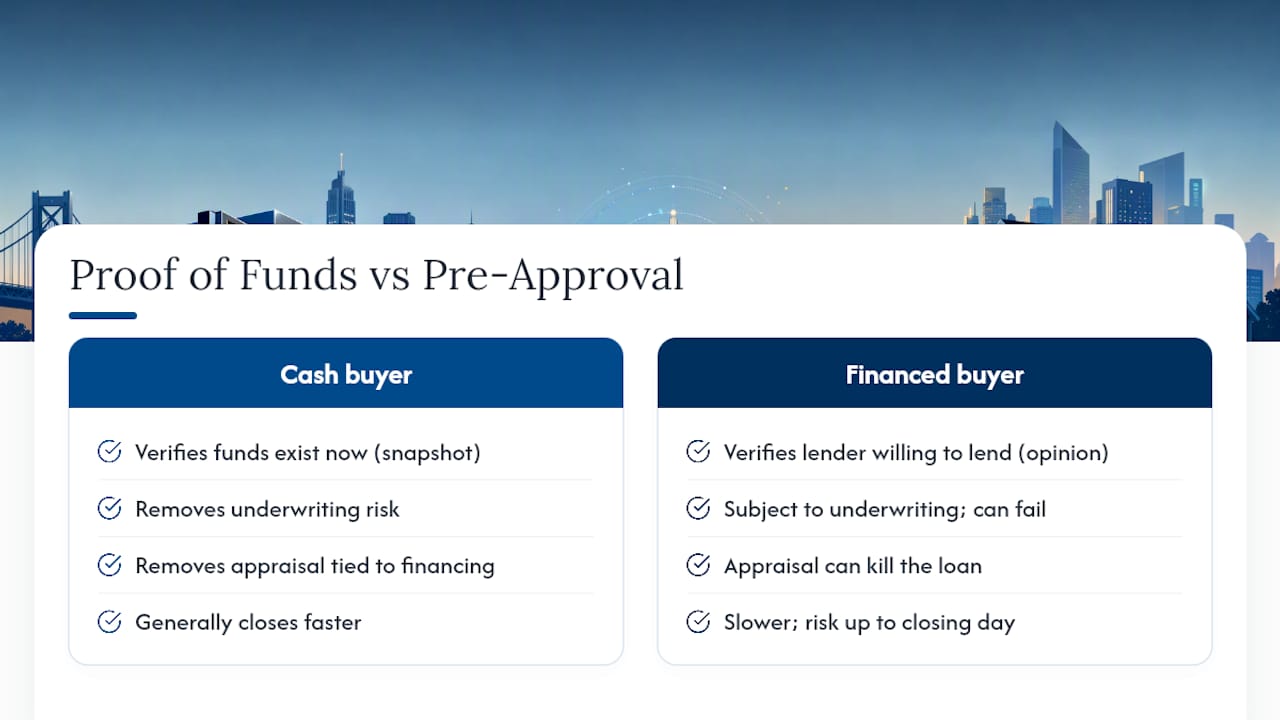
Cash buyer proof of funds works differently. It documents money the buyer already has in hand right now, which removes lender approval, appraisal contingencies tied to financing, and underwriting delays from the equation entirely. That’s a meaningful trade-off: a cash deal generally closes faster and with fewer ways to collapse, but it puts more weight on you, the seller, to confirm the funds are real before you take the house off the market. A pre-approval letter is a bank’s opinion about a future loan. A proof of funds letter is a snapshot of money that already exists.
When Sellers Typically Ask for Proof of Funds
Proof of funds requests show up at a few predictable points in a transaction, and knowing when to expect them helps you plan the timeline.
Most sellers or their agents ask for it immediately after receiving a cash offer, before signing anything, to confirm the offer is worth taking seriously. It comes up again during multiple-offer situations, where proof of funds becomes a tiebreaker between two similar bids. Investors and iBuyers request it routinely as part of standard due diligence. It also surfaces in probate and estate sales, where personal representatives face extra scrutiny and want documented certainty before recommending a buyer to the court or other heirs. Foreclosure and short sale transactions add another layer, since lenders reviewing the sale often want their own proof of funds check before approving the transaction.
In each case, the underlying question is the same: does this buyer actually have the money, right now, to complete this purchase? A seller who asks for proof of funds early in any of these scenarios sets a tone of seriousness that tends to filter out buyers who were never really ready to close.
Does Proof of Funds Give You Real Negotiating Leverage?
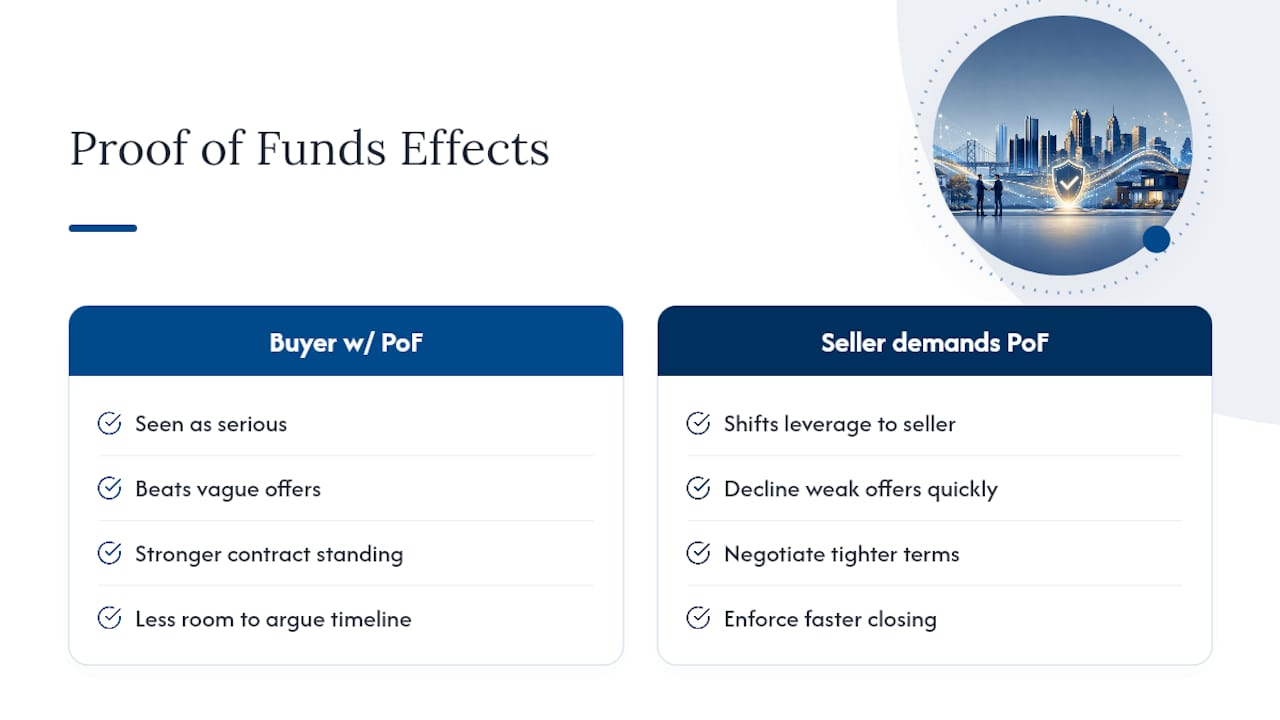
Yes, and it works in both directions. A buyer who produces clean, verifiable proof of funds without hesitation gains leverage of their own. That buyer looks more serious than a competing offer with vague or missing documentation, which can matter in a multiple-offer scenario where you’re weighing price against certainty of closing.
For you as the seller, requiring proof of funds up front shifts leverage back in your favor. It lets you decline weak offers before you’ve taken your home off the market and lost momentum with other interested buyers. It also gives you standing to negotiate contract terms, since a buyer with verified funds and a strong earnest money deposit has less room to argue against a tight closing timeline or a verification contingency.
Confidence matters here too. Sellers who understand what real proof of funds documentation looks like negotiate from a stronger position because they can spot a weak offer immediately instead of discovering the problem three weeks into escrow. That confidence is worth as much as any single contract clause, because it changes how you respond the moment an offer that doesn’t add up lands in your inbox.
Sell Dave Your House’s Perspective on Verified Cash Closings
With over 16 years buying houses for cash across Metro Detroit, we’ve built our process around the same verification standards this article recommends: a bank letter you can independently confirm, an escrow arrangement handled by a neutral title company, and coordination that keeps you informed at every step. We don’t ask sellers to take our word for it. We provide documentation your title company can verify directly, because a cash buyer that eliminates financing risk should be able to prove it, not just claim it.
— Real Estate Team
Get a Verified Cash Offer Without the Guesswork
Sell Dave Your House gives Metro Detroit homeowners a way to skip the verification headaches altogether: fair, all-cash offers within 24 hours, backed by documentation you or your title company can confirm before you sign anything.

The process typically involves coordinating with a licensed title company for closing, depositing earnest money into neutral escrow, and can close quickly once funds are verified. That means no waiting on a bank letter that turns out to be unreachable, and no chasing a buyer who stalls at document requests. If your home needs repairs, sits in probate, or is heading toward foreclosure, our cash sale process is built to move fast without cutting corners on verification. Ready to see what a verified cash offer looks like for your property? Request your cash offer today and get a number within 24 hours.
Primary Sources and Further Reading
- Investopedia’s overview of proof of funds documentation explains which account types qualify as genuinely liquid.
- LegalClarity’s guide to showing proof of funds covers bank letter standards and IRS Form 8300 considerations.
- Rocket Mortgage’s proof of funds resource details acceptable formats and redaction practices.
- Sell Dave Your House’s breakdown of cash sale closing costs explains the buffer sellers should look for above the offer price.
This article is general information, not a substitute for advice from a qualified financial advisor. Consult a qualified financial professional about your own circumstances before acting on anything here.
Sources
- Proof of Funds (POF): What It Is, Qualifying Documents, and How to Obtain - Investopedia
- How to show proof of funds to buy a house with cash - LegalClarity
- Proof of Funds (POF) - Rocket Mortgage
FAQ
What Is a Proof of Funds Letter in Real Estate?
It’s a bank-issued document, typically on letterhead, confirming a buyer has enough liquid cash in an account to complete a purchase without financing.
How Recent Should Proof of Funds Documentation Be?
Most agents and title companies prefer documentation dated within 30 days, though some accept up to 60 days if the buyer provides a fresh verification call to the bank.
Can a Seller Verify Proof of Funds Independently?
Yes. Call the issuing bank using a phone number you find on your own, not one printed on the document, and ask your title company or closing attorney to confirm funds as part of the closing process.
Does Sell Dave Your House Provide Proof of Funds?
Sell Dave Your House routinely provides bank letters and coordinates with title companies so Metro Detroit sellers can verify funds directly before closing. Current offer details are available through a free cash offer request.
What Happens if a Cash Buyer Can’t Produce Proof of Funds?
Treat repeated delays or refusal as a red flag and consider keeping your home on the market until the buyer supplies verifiable documentation and a meaningful earnest money deposit.