

Should You Sell Your Home to Fund Retirement?
Yes, selling your home can fund a secure retirement if you need a large amount of cash now or plan to move somewhere cheaper to live. The math gets less favorable if you love where you are, the local market is soft, or you have no clear plan for the proceeds once they land in your bank account. The biggest trade-off is simple: you trade owned housing and future appreciation for liquidity and lower monthly overhead, and which side wins depends heavily on your health outlook, your portfolio’s staying power, and where you plan to land next.
Three types of retirees tend to benefit most from this move:
- Downsizers — you want a smaller, cheaper home and a lump sum to strengthen your retirement income without leaving your area entirely.
- Relocators — you’re moving from a high-cost market to a lower-cost one, which can multiply your net proceeds far beyond what you’d see staying put.
- Full exits — you’re funding assisted living, moving near family, or simplifying life completely, and you need the entire equity position converted to cash.
If none of those describe you, an alternative like a reverse mortgage or renting out a portion of your home might serve you better than an outright sale. Keep reading to figure out which category you fall into.
Key Takeaways
Selling your home to fund retirement works best for relocators and full exits chasing maximum liquidity, while a HECM or rental strategy often serves homeowners who want to stay in place.
| Point | Details |
|---|---|
| Know your exclusion | Up to $250,000 (single) or $500,000 (married) in capital gains can be excluded under Section 121 if you pass the ownership and use tests. |
| Calculate net, not gross | Subtract commissions, closing costs, repairs, and mortgage payoff before assuming what you’ll actually pocket. |
| Keep liquidity after selling | Hold 6 to 12 months of expenses in cash before annuitizing or investing the rest of your proceeds. |
| Match the option to your goal | Choose selling for liquidity and relocation; choose a HECM or rental strategy to stay in place. |
| Consider a fast cash sale for speed | Sell Dave Your House provides all-cash offers within 24 hours and closings in as little as 7 days for sellers who need speed over top-dollar price. |
Table of Contents
- How Selling Your Home to Fund Your Retirement Plan Actually Works
- What Are the Pros and Cons of Selling to Fund Retirement?
- What Are the Tax Rules When You Sell Your Home for Retirement?
- What Are the Alternatives to Selling Your Home Outright?
- When Is the Right Time to Sell Your House for Retirement?
- What Should You Do After Deciding to Sell?
- How Does a Fast Cash Sale Work in Practice?
- An Adviser’s Perspective: Modeling Sell vs. Stay
- Need Cash Fast? Here’s a Simpler Path to Fund Your Retirement
- Sources
- FAQ
How Selling Your Home to Fund Your Retirement Plan Actually Works
A home sale converts an illiquid asset (your house) into liquid cash you can draw on for living expenses, medical costs, or investments. The tricky part is understanding how much of that “equity” you actually see in your bank account, because gross sale price and net proceeds are two very different numbers.
The formula is straightforward: gross sale price, minus mortgage payoff, minus agent commissions, minus closing costs, minus repair or staging costs, equals net proceeds. Commissions commonly run 5–6% of the sale price, and once you add closing costs, staging, and any repairs a buyer’s inspection turns up, sellers often lose more than they expect. On a $500,000 traditional sale, typical costs bring net proceeds into a $425,000 to $465,000 range, depending on how much work the home needs and what commission rate you negotiate.
Here’s what that looks like on a $400,000 sale with an outstanding mortgage balance:
Before you run your own numbers, gather these documents and figures:
- Your current mortgage payoff amount (call your lender for an exact quote, not just your statement balance).
- Your tax basis in the home (original purchase price plus qualifying capital improvements).
- A recent comparative market analysis or appraisal for a realistic sale price.
- Records of any home improvements that raise your basis and reduce taxable gain.
Pro Tip: Most sellers forget about the 1099-S form. If your title company or closing agent issues one, the IRS gets a copy too, so your reported sale price needs to match what shows up on your tax return, even if the entire gain is excluded. A mismatch is one of the more common reasons sellers get an unexpected IRS notice years after closing.
What Are the Pros and Cons of Selling to Fund Retirement?
Selling solves a liquidity problem. It also creates a housing problem you have to solve next, and the balance between those two forces should drive your decision more than anything else.
Advantages of selling:
- You unlock nearly all of your home equity in one transaction, rather than accessing it piecemeal.
- Ongoing costs drop immediately: no more property taxes, homeowner’s insurance, or maintenance reserve on the old house.
- You gain the flexibility to relocate to a lower cost-of-living area, which can meaningfully stretch your retirement dollars.
- A lump sum makes it far easier to fund assisted living or a continuing-care community, since most facilities require substantial entrance fees.
Disadvantages of selling:
- You give up owned housing, meaning you’ll likely take on rent or a new mortgage payment somewhere else.
- Selling and moving costs (movers, temporary housing, new furnishings) eat into your proceeds fast.
- You lose future appreciation on a property you may have held for decades.
- Estate planning gets more complicated once a home becomes cash sitting in investment accounts instead of a clearly designated asset for heirs.
Relocators and full exits tend to come out ahead financially. If you’re emotionally attached to your neighborhood and your carrying costs are manageable, a reverse mortgage or partial-rental strategy might preserve more of what matters to you.
What Are the Tax Rules When You Sell Your Home for Retirement?
Here’s the number that matters most: homeowners who meet the ownership and use tests can exclude up to $250,000 of capital gain if single, or up to $500,000 if married filing jointly, under Internal Revenue Code Section 121. For most retirees selling a longtime primary residence, this exclusion wipes out the entire tax bill.
To qualify, you need to clear a few specific hurdles, all detailed in IRS Publication 523:
- Ownership test: you owned the home for at least 2 of the 5 years before the sale.
- Use test: you lived in it as your primary residence for at least 2 of those same 5 years.
- Frequency rule: you generally can’t claim the exclusion if you used it on another home sale within the past 2 years.
- Partial exclusion exceptions: if you sell early because of a health issue, a job change, or another unforeseen circumstance, you may still qualify for a reduced exclusion even without meeting the full 2-year requirement.
One detail retirees often miss: time spent living in a licensed care facility can sometimes count toward the 2-year use requirement under Section 121 of the tax code, which matters if health issues forced an earlier-than-planned move.
For most sellers, the math works like this: take your sale price, subtract your basis and selling costs, and compare the result to your exclusion limit. A married couple selling a home for $600,000 with a $200,000 basis and $40,000 in selling costs has a $360,000 gain, comfortably under the $500,000 exclusion, meaning zero federal capital gains tax. Gains above the exclusion, or losses on the sale, get different treatment: losses on a personal residence aren’t deductible, and any taxable gain gets reported using Form 8949 and Schedule D, often triggered by a Form 1099-S from your closing agent.
What Are the Alternatives to Selling Your Home Outright?
An outright sale isn’t the only path to unlocking home equity in retirement. Each alternative fits a different profile, and understanding the trade-offs can save you from a decision you can’t easily reverse.
A HECM (Home Equity Conversion Mortgage), the FHA-insured version of a reverse mortgage, lets homeowners aged 62 and older borrow against their equity without monthly payments, as long as they keep up with property taxes, insurance, and maintenance. Experts generally agree it suits homeowners who want to stay in their home and only need partial access to their equity, not a full cash-out. You can learn more about how a reverse mortgage supports retirement income from a HECM specialist if this path interests you.

Renting out your home generates ongoing income without giving up ownership, but it also makes you a landlord, with all the maintenance calls and tenant management that entails.
A cash-out refinance gives you a lump sum while keeping the home, though it adds a new monthly payment, which can strain a fixed retirement income if you’re not careful.
A home equity loan or line of credit offers flexible access to a portion of your equity, useful for bridging a gap rather than fully funding retirement.
| Option | Best For | Liquidity | Ongoing Costs | Tax Consequences | Complexity |
|---|---|---|---|---|---|
| Outright sale | Relocators, full exits, maximum liquidity | Highest, nearly all net equity upfront | New rent or mortgage elsewhere | Section 121 exclusion may apply | Moderate, one transaction |
| HECM/reverse mortgage | Staying in place, partial equity access | Partial, ongoing draws | Property tax, insurance, maintenance continue | Loan proceeds generally not taxable | Higher, ongoing loan management |
| Cash-out refinance | Time-sensitive cash, staying in place | Partial, lump sum | New monthly mortgage payment | Not taxable, but interest may be deductible only for qualified use | Moderate |
| Renting out the home | Income generation, keeping the asset | Low upfront, recurring income | Landlord responsibilities and repairs | Rental income is taxable | Higher, ongoing management |
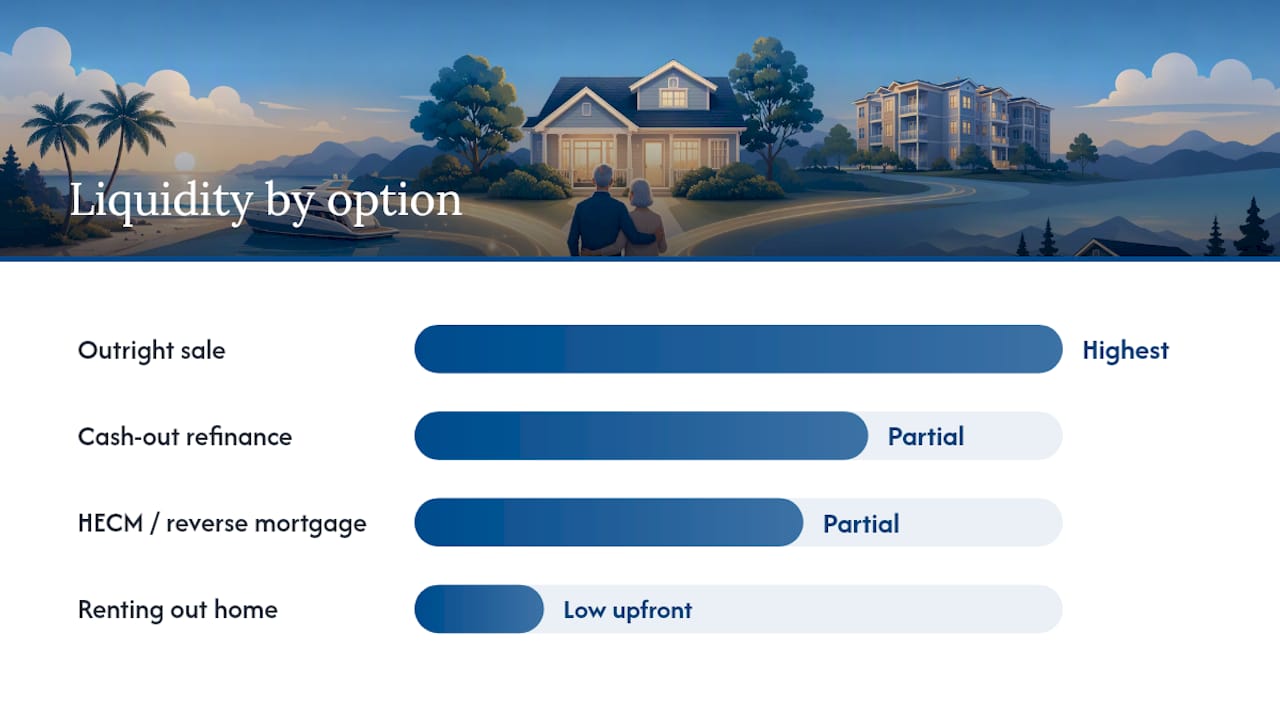
A few cautions worth flagging before you choose: a HECM requires you to stay current on property taxes and insurance, or you risk default. Renting shifts landlord duties onto you at a stage of life when you may want fewer obligations, not more. A cash-out refinance adds debt back onto a home you may have spent decades paying off.
When Is the Right Time to Sell Your House for Retirement?
Timing your sale correctly can be worth tens of thousands of dollars, and the decision comes down to a handful of concrete questions rather than gut feeling.
Ask yourself:
- Is your local market strong right now, or has it cooled? Selling into a weak market can reduce your usable cash substantially compared to selling in a strong one.
- What will replacement housing cost in your target location, and does it undercut your current carrying costs?
- What’s your realistic health and mobility outlook over the next 5 to 10 years?
- How long will your portfolio last if you add these proceeds to your retirement income?
Run a simple sell-versus-stay scenario using these steps:
- Estimate your net proceeds using the calculation from earlier in this guide, adjusted for your actual mortgage balance and expected repair costs.
- Model your replacement housing cost, whether that’s rent, a smaller mortgage, or a facility fee, and compare it to what you currently spend on your existing home.
- Run a basic portfolio longevity projection that adds the freed-up cash to your retirement accounts and see how many additional years of income it buys you.
If your local market is hot and you’re eyeing a move to a lower cost-of-living region, that arbitrage often produces a real surplus that staying put simply can’t match. If the market is soft where you live and strong where you’re moving, the case for waiting gets stronger.
What Should You Do After Deciding to Sell?
Once you’ve decided selling makes sense, the process moves faster than most retirees expect, but a little preparation prevents costly mistakes.
- Get your mortgage payoff quote and tax basis documented so you know your true starting numbers.
- Get a market price estimate, either through a licensed appraiser or a comparative market analysis from a local agent.
- Choose your sale path. A traditional listing typically nets more before costs but takes weeks or months and often requires repairs; an as-is cash sale trades some top-line price for speed, certainty, and zero repair obligations.
- Plan your moving window around your replacement housing timeline so you’re not paying for two places at once, or scrambling for temporary housing.
Once proceeds hit your account, resist the urge to leave it all sitting in a checking account or to lock it all away at once. A common allocation approach splits the money into layers:
- Emergency reserve (roughly 10–15%): covers moving costs, unexpected repairs at your new place, and short-term cash needs.
- Partial annuitization (roughly 25–40%) through a single premium immediate annuity or multi-year guaranteed annuity: creates a guaranteed income floor.
- Medium-term guaranteed layer (roughly 20–30%): bonds or CDs timed to cover known future expenses.
- Liquid growth allocation (remaining balance): invested for longer-term growth and inflation protection.
Pro Tip: Don’t annuitize all of your proceeds just because a guaranteed income stream sounds appealing. Keep at least 6 to 12 months of expenses in cash or near-cash accounts, since moving and settling into a new home almost always produces surprise costs nobody budgets for.
How Does a Fast Cash Sale Work in Practice?
Consider a retiree, we’ll call her the seller, who owns a paid-off home in Metro Detroit that needs a new roof, updated plumbing, and cosmetic work throughout. She wants to downsize into a senior living community within a few weeks and doesn’t have the time, money, or energy to manage repairs and staging before listing traditionally.
Working with a cash buyer like Sell Dave Your House illustrates how this path typically unfolds:
- The seller requests a cash offer and provides basic property details.
- She receives a fair, all-cash offer within 24 hours, with no obligation to accept.
- She accepts the offer as-is, with no repairs, no cleaning, and no staging required.
- The buyer covers standard closing costs, which would otherwise come out of her proceeds.
- She closes in as little as 7 days, walking away with cash in hand and no ongoing carrying costs on a house she no longer wants to manage.
The rough timeline looks like this:
- Day 1: Submit property information and request an offer.
- Day 1–2: Receive a fair cash offer, review terms.
- Day 3–7: Complete closing paperwork and finalize the sale.
- Day 7: Funds are wired or delivered at closing, ready to allocate toward the next chapter of retirement.
Compared to a traditional sale, where repairs alone can take weeks and a buyer’s financing contingency can add another 30 to 45 days, this path trades some top-line sale price for speed and zero repair costs, a fair trade for a seller who values certainty over maximizing every last dollar.
An Adviser’s Perspective: Modeling Sell vs. Stay
Most people treat “should I sell my house” as an emotional question when it’s really a modeling problem. A certified financial planner’s job in this scenario isn’t to tell you whether to sell. It’s to stress-test the assumptions underneath your gut instinct, because the instinct is usually right for the wrong reasons.
The three assumptions that quietly wreck these calculations are inflation, longevity, and Social Security timing. People assume their current spending will stay flat, but healthcare costs alone tend to rise faster than general inflation as retirees age. People also underestimate how long they’ll live, which means a home sale that looks like plenty of cushion at age 68 can look thin at age 88. And the decision to sell often gets made independently of when you’re claiming Social Security, even though the two interact directly: a bigger cash cushion from a home sale can sometimes justify delaying benefits to lock in a larger monthly check later.
Once proceeds are spent on rent or a facility, that capital generally can’t be re-leveraged the way home equity can, since you can’t take out a second mortgage on money you’ve already spent. That’s the real argument for modeling this decision carefully instead of deciding based on how you feel about your neighborhood this month.
A few concrete actions worth taking before you sign anything:
- Run a basic 30-year income projection, or a Monte Carlo simulation if your planner offers one, using your actual expected proceeds and spending.
- Talk to a CPA about the timing of your sale, particularly if you’re close to a tax bracket threshold or considering a mid-year move.
- Visit two or three replacement housing options in person before you commit, since photos and floor plans rarely capture whether a place will actually feel like home.
Need Cash Fast? Here’s a Simpler Path to Fund Your Retirement
If you’ve read this far and repairs, showings, and months of uncertainty sound like the last thing you want during a major life transition, Sell Dave Your House offers a different route to the same goal: cash in your hand without the traditional selling grind. Instead of preparing your home for the market, negotiating commissions, and waiting on buyer financing, you get a fair cash offer within 24 hours and can close in as little as 7 days, with no repairs, no cleaning, and no realtor fees eating into your proceeds.

This approach tends to work best for a few specific situations: downsizers who need funds quickly to secure a new home or senior living arrangement, executors handling an inherited property they don’t want to manage or repair, and homeowners facing urgent financial pressure like foreclosure or mounting bills. If you own a rental property you’re ready to liquidate as part of your retirement plan, the same as-is cash-sale process applies there too.
Before you decide, still run the tax and financial checklist from earlier in this guide, since the exclusion rules and portfolio math matter regardless of which sale path you choose. When you’re ready to see what your home is worth, request a fair cash offer and get a real number within 24 hours.
Sources
This article is general information, not a substitute for advice from a qualified financial advisor. Consult a qualified financial professional about your own circumstances before acting on anything here.
FAQ
What happens if I sell my home after I’ve already retired?
Selling after retirement works the same way tax-wise as selling before it: you still qualify for the Section 121 exclusion as long as you meet the ownership and use tests. Retirement status itself doesn’t change your tax treatment, though a fixed income makes planning where the proceeds go even more important.
How do I access cash from my home if I don’t want to sell?
Options include a HECM (reverse mortgage), which lets you borrow against equity without monthly payments, a cash-out refinance, or a home equity loan. Reverse mortgages tend to suit homeowners who want to stay in place and need only partial access to their equity.
What’s the best time of year to sell a home for retirement?
There’s no single best month that applies everywhere, since local market conditions matter more than the calendar. A strong local market generally produces better net proceeds than a weak one regardless of season, so check regional trends before timing your sale around a specific month.
How much retirement income can $250,000 in home sale proceeds generate?
The answer depends entirely on how you allocate it, your age, and prevailing interest rates for annuity products. Common strategies split proceeds between guaranteed income products and liquid investments rather than converting the full amount into one income stream, so there’s no single fixed monthly figure that applies to everyone.
Can I sell my home fast without making repairs first?
Yes. Cash buyers like Sell Dave Your House purchase homes as-is, meaning you skip repairs, cleaning, and staging entirely, and can close in as little as 7 days instead of the weeks or months a traditional listing typically requires.