

Close in 7 Days: Sell Your Detroit Home During Eviction
If you need a fast, all-cash sale during eviction in Detroit, selling your house as-is to a trusted local cash buyer is the practical quickest option. You can often close in 7 to 21 days instead of waiting the 49 to 54 days a typical agent listing takes. Some local cash buyers can extend a cash offer within 24 hours and close in as little as seven days. Start by pulling together your mortgage payoff statement and deed. That paperwork is what lets any serious buyer move fast.
TL;DR:
- Cash sales in Detroit typically close within 7 to 21 days, significantly faster than the 49 to 54 days for traditional agent listings.
- As-is properties generally sell for 15% to 25% less than move-in-ready homes, but speed can outweigh the price discount during an eviction.
- Sellers should have mortgage payoff statements, deeds, and identification ready to secure quick, accurate offers from local cash buyers.
- Disclosing property defects remains legally required under Michigan law, but buyers familiar with distressed homes expect and accept some deferred maintenance.
- Active evictions lower financing options for traditional buyers, making cash offers the most practical route for urgency and certainty.
Table of Contents
- What Does an As-Is Cash Sale Mean During an Eviction in Detroit?
- Should You Sell for Cash Now or Try Another Route First?
- How to Get a Fast, All-Cash Offer and Close in Detroit
- What Will You Actually Net From an As-Is Cash Sale?
- How Do You Verify a Cash Buyer Is Legitimate?
- Do You Still Have to Disclose Problems With the House If You’re Being Evicted?
- Does an Active Eviction Affect Buyer Interest or Financing?
- Can You Still Raise Your Sale Price Despite the Eviction?
- Will Selling During Eviction Create Tax or Lien Problems?
- Why Work With an Investor Who Specializes in Pre-Eviction Sales?
- What Sellers in This Situation Usually Get Wrong
- How Sell Dave Your House Can Help You Right Now
- Sources
- FAQ
What Does an As-Is Cash Sale Mean During an Eviction in Detroit?
An as-is cash sale means you sell your home in its current condition, no repairs, no cleaning, no staging, to a buyer who pays with cash instead of a mortgage. In Detroit, these buyers usually fall into a few categories: local real estate investors, small buy-and-hold landlords, and owner-occupants with cash on hand who want to skip financing delays. None of them requires you to fix a leaking roof or replace flooring before closing.
The trade-off is price. As-is properties typically sell for 15% to 25% below comparable move-in-ready homes, with the exact discount depending on how competitive the local market is and how much work the house needs. That gap narrows when demand is high and widens when a property needs major structural repairs.
Speed is where the math changes in your favor. Detroit’s median agent-listed sale takes roughly 49 to 54 days from listing to closing, and that’s before you factor in the weeks it can take to prep a house for market. Cash buyers routinely close in 7 to 21 days. When an eviction date is set, those extra weeks aren’t a luxury you have.
What this actually saves you:
- Repair costs you’d otherwise pay out of pocket before listing
- Mortgage, insurance, and tax payments that keep accruing while a traditional sale drags on
- The uncertainty of a buyer’s financing falling through mid-contract
Should You Sell for Cash Now or Try Another Route First?
Not every situation calls for the fastest exit. A cash sale usually makes the most sense when:
- You have a hard deadline, an eviction hearing, a sheriff’s sale date, or a mortgage acceleration notice
- The property needs major work you can’t afford or don’t have time to complete
- You inherited the house and don’t have the bandwidth to manage repairs or showings
- You’re underwater on the mortgage and need certainty over top dollar
An open-market listing can still be worth considering if you have real equity and enough runway, typically several weeks to a couple of months, to make strategic repairs and market the home properly. Selling on the open market usually nets more money than a direct investor sale, but only if time is genuinely on your side.
Here’s a rough rule of thumb: if the expected net gain from repairs, after paying for materials, labor, and the months of carrying costs it takes to finish and sell, exceeds $5,000 to $10,000, repairs might pay off. If it doesn’t clear that bar, selling as-is almost always leaves you better off financially and mentally.
Pro Tip: Add up your monthly mortgage, insurance, and property tax payments and multiply by how many months a traditional sale would realistically take. That number alone often makes the decision for you.
How to Get a Fast, All-Cash Offer and Close in Detroit
Getting from “I need to sell” to “I have cash in hand” follows a predictable sequence, and knowing it ahead of time keeps you from feeling rushed or caught off guard.
Before you contact a buyer, gather:
- Your mortgage payoff statement (call your lender or check your online portal)
- The property deed
- A government-issued photo ID
- Recent property tax and homeowner’s insurance information
- Tenant lease details, if the property is currently rented
Requesting and comparing offers:
- Reach out to at least one local cash buyer and request a written offer, not just a verbal number
- Ask specifically for the purchase price, proposed closing date, which party pays closing costs, and whether the offer has contingencies
- Check whether the contract includes an assignment clause, which allows the buyer to sell your contract to a third party before closing
- Compare that offer against at least one other source; sellers who get a second opinion often spot lowball numbers they’d have otherwise accepted
What happens during closing:
Most cash sales still involve a basic inspection, even on as-is deals, and a title company runs a title search to confirm there are no surprise liens. Your mortgage payoff gets sent directly from the closing proceeds, and you receive whatever remains after that and any agreed closing costs.
Timelines vary by buyer type. A direct investor sale often closes in 7 to 14 days. A cash owner-occupant purchase typically takes 14 to 21 days because of the added inspection and title steps. If you’re comparing an iBuyer-style offer, expect timing and terms to vary more, so read the fine print closely.
What Will You Actually Net From an As-Is Cash Sale?
The discount range on as-is sales, again, roughly 15% to 25% below move-in-ready comps, depends heavily on two things: how hot the local market is right now and how much repair work the house needs. A cosmetically dated kitchen costs you less in negotiating leverage than a failing foundation or roof.
By the numbers: As-is properties typically sell 15% to 25% below comparable move-in-ready homes, and seller-side transaction costs, even in cash deals, still commonly run 6% to 10% of the sale price when commissions, title fees, and transfer taxes are factored in.
Even with a cash buyer covering standard closing costs, as many local investors do, you should budget for the possibility of some fees depending on how your contract is written. A simple way to estimate your net proceeds: take your expected sale price, subtract your mortgage payoff, subtract any transaction costs your contract doesn’t cover, and subtract the carrying costs you avoid by closing fast instead of slow.
That last part matters more than most sellers realize. A prolonged sale timeline, three to six months on the open market, can quietly cost you $5,000 to $15,000 in mortgage payments, insurance, taxes, and utilities you’d otherwise skip by closing in two or three weeks. When you’re facing eviction, every month you carry the property is a month working against you financially, not just emotionally.
How Do You Verify a Cash Buyer Is Legitimate?
Not every “we buy houses” offer is what it claims to be, and verifying a buyer before you sign anything protects you from wasted time or worse.
- Ask for proof of funds, a bank statement or letter from their financial institution showing they can actually cover the purchase
- Confirm which title company or closing attorney will handle the transaction, and call that company directly to verify
- Get the offer in writing with specific terms, not just a verbal number over the phone
- Look for a real local presence: an address, a working phone number, and if possible, references or reviews from past Detroit sellers
Before you sign, read the contract closely for a few specific items: assignment rights (can the buyer flip your contract to someone else?), the inspection window, earnest money terms, and exactly who pays which closing fees.
Watch for these red flags:
- Pressure to sign within hours or same-day, with no time to review terms
- Refusal to close through a licensed title company
- Any request for you to pay money upfront before closing
Pro Tip: A legitimate buyer never asks you to pay them anything before closing. Money should flow to you at the closing table, never from you to the buyer beforehand.
Do You Still Have to Disclose Problems With the House If You’re Being Evicted?
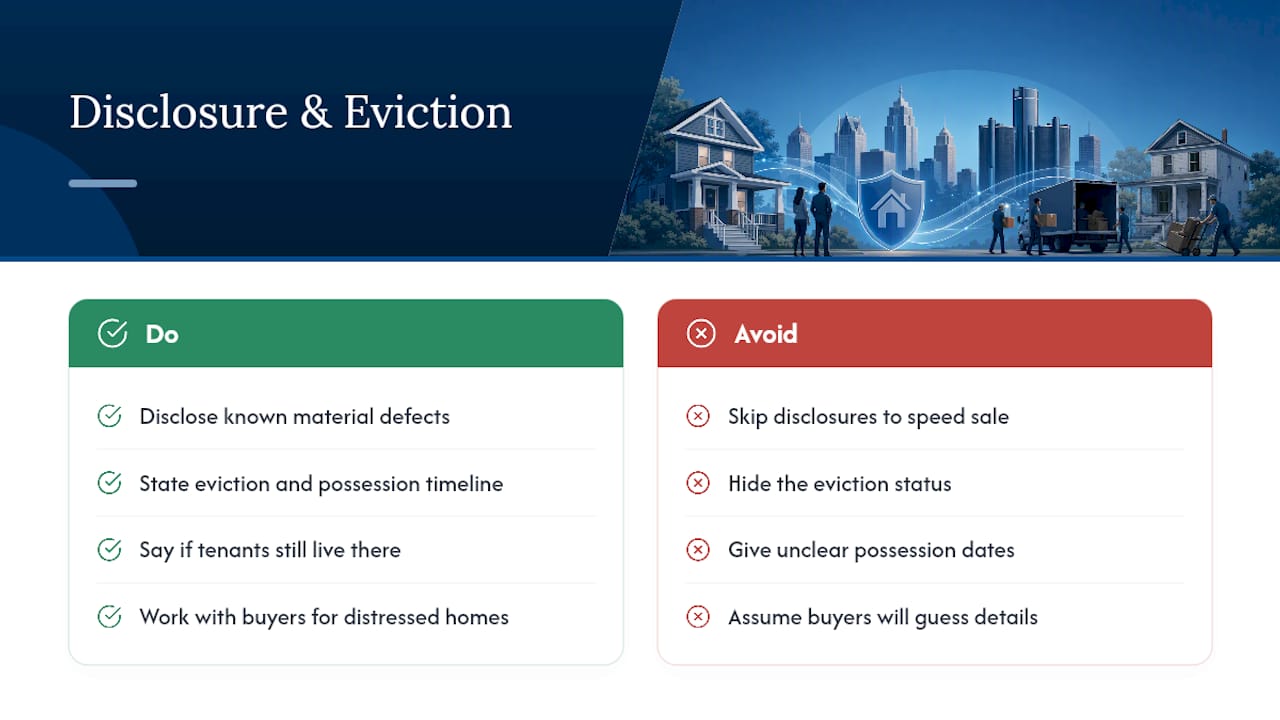
Facing eviction doesn’t change your legal disclosure obligations as a seller. Michigan law generally requires sellers to disclose known material defects, roof issues, foundation problems, past water damage, regardless of your personal financial situation or timeline pressure. Skipping disclosures to speed things along can create legal exposure later, even after the sale closes.
That said, an eviction situation does shift the negotiation dynamic in a practical way. Buyers who specialize in as-is purchases already expect some level of deferred maintenance and build that into their offer. You’re not negotiating from a position where every flaw needs to be hidden or minimized, because the buyer’s whole model assumes the house isn’t perfect.
Where eviction status does matter is timing transparency. If tenants are currently living in the home, or if the eviction involves the property’s previous occupant, buyers will want clarity on who has legal possession and when. A cash buyer experienced with distressed properties will ask direct questions about the eviction timeline early, not because it disqualifies the sale, but because it affects when they can take possession and start any work.
Being upfront about the eviction context from the first conversation tends to move things faster, not slower. Buyers who work regularly with hardship sellers aren’t put off by the situation. They’ve seen it before, and clear information lets them structure a fair offer instead of guessing.
Does an Active Eviction Affect Buyer Interest or Financing?
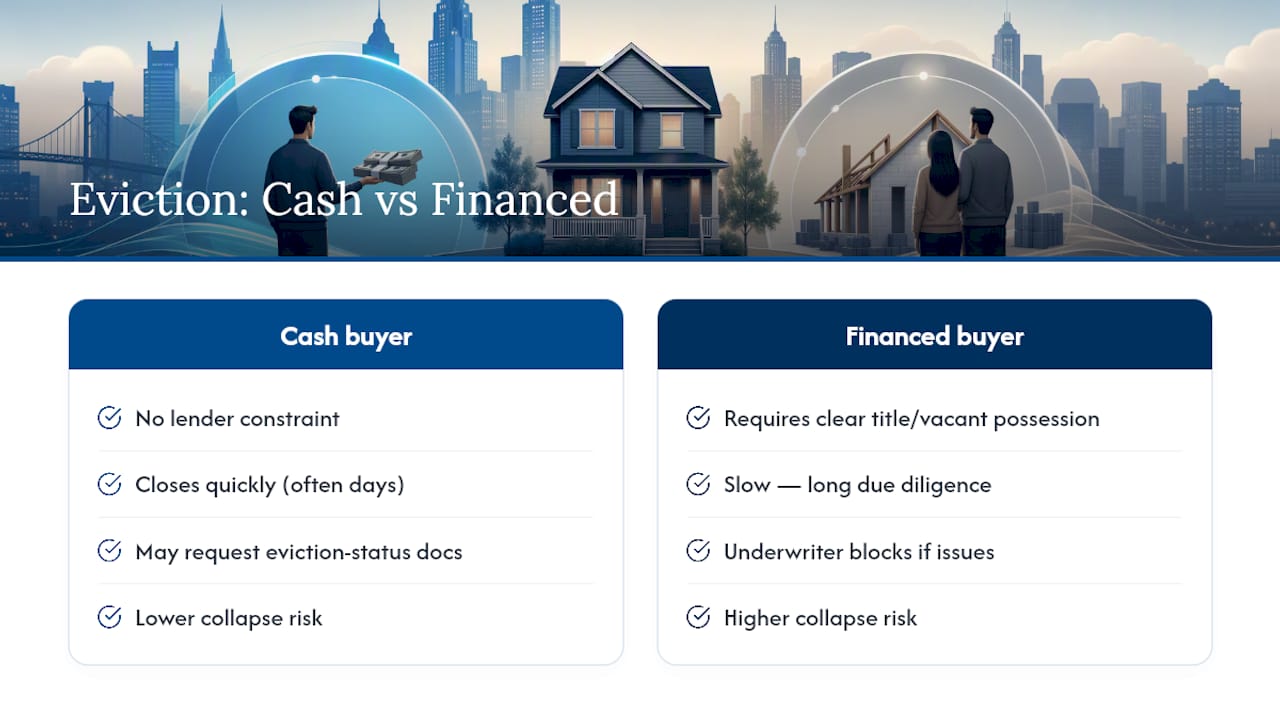
An active eviction can make traditional, financed buyers hesitant, and that’s one of the practical reasons cash sales dominate this segment of the market. Mortgage lenders often require clear title and vacant possession before funding a purchase, and an unresolved eviction introduces uncertainty a bank underwriter doesn’t want to carry.
Cash buyers don’t face that constraint. Because there’s no lender involved, no appraisal contingency tied to occupancy status, and no underwriting committee weighing in, a cash buyer can move forward even while eviction proceedings are still active or recently resolved. This is a big part of why cash offers close in a fraction of the time traditional financed offers do.
That flexibility doesn’t mean every cash buyer treats an eviction the same way. Some will want documentation showing the eviction’s current status, whether a judgment has been entered, whether the property is currently vacant, or whether occupants are still present. Buyers use this information to plan their own timeline for taking possession, not to penalize you as the seller.
If financing-dependent buyers do show interest despite the eviction, expect a longer due diligence period and a real chance the deal falls through if title or possession issues surface during underwriting. That risk is exactly what pushes most sellers in this situation toward cash buyers instead. Fewer moving parts means fewer ways for the deal to collapse right when you need certainty most.
Can You Still Raise Your Sale Price Despite the Eviction?
Yes, though your options look different than a standard listing. Full renovations rarely make sense here. Renovation timelines typically add two to four months you likely don’t have, plus upfront costs you may never recoup before your eviction deadline.
Smaller moves can still help. Clearing out clutter and personal belongings, even without a full staging setup, lets buyers see the property’s actual layout and condition more clearly, which can reduce lowball anchoring during negotiations. A thorough cleaning costs little and removes one common excuse buyers use to justify a steeper discount.
Simple, cheap fixes sometimes pay for themselves: replacing a broken window, fixing a running toilet, or patching an obvious drywall hole can prevent a buyer from mentally stacking up a long list of “problems” that inflates their perceived discount beyond what the actual repair would cost. The goal isn’t to make the house market-ready. It’s to prevent small, fixable issues from being used as leverage for a bigger price cut than they warrant.
The single biggest price lever you control is comparison. Getting more than one cash offer, even just a second opinion, gives you a benchmark to know whether the first number you received reflects the property’s real value or an aggressive lowball. Sellers who skip this step have no way to know if they left money on the table.
Will Selling During Eviction Create Tax or Lien Problems?
An eviction itself doesn’t create a lien or a special tax obligation. But eviction situations often surface alongside other financial pressures, unpaid property taxes, a second mortgage, a contractor’s lien, or an HOA balance, that need to be resolved before or at closing.
Any outstanding liens against the property get paid out of your sale proceeds at closing, before you receive your net amount. That’s why the pre-close paperwork matters so much: a title search will surface these liens, and it’s far better to know about them before you accept an offer than to be surprised at the closing table.
On the tax side, selling your primary residence may qualify you for capital gains exclusions under IRS rules, but that depends on your specific ownership history and how the property has been used. If back property taxes are part of what’s driving the eviction, those unpaid taxes typically get deducted from your proceeds as part of the closing process rather than following you afterward. A title company or closing attorney will identify these amounts during their standard title search.
Because every situation involves different lien amounts, tax history, and ownership structures, this is one area where a quick conversation with a tax professional or the title company handling your closing is worth the extra half hour. It won’t slow down a cash sale, but it prevents surprises in your final payout.
Why Work With an Investor Who Specializes in Pre-Eviction Sales?
General “we buy houses” companies exist all over the country, but not all of them understand the specific pressure points of a Detroit eviction timeline: court dates, sheriff’s sale schedules, and how quickly a title company needs to move to beat a deadline. A buyer with real experience in hardship and pre-eviction sales has already built a process around exactly this kind of urgency.
That experience shows up in practical ways. They know which paperwork to request first, how to structure a closing date that actually beats your court deadline, and how to talk you through what happens to your credit and your record once the sale closes. They’ve also typically seen enough inherited properties, foreclosure cases, and disrepair situations that nothing about your house surprises them into lowballing out of caution.
Speed matters more than squeezing out the last dollar when an auction date is close, and the earlier you start the conversation, the more options stay open to you. Waiting until days before a hearing narrows your choices dramatically. An investor who specializes in this exact situation can often move faster than a generalist buyer simply because they’ve done it before.
What Sellers in This Situation Usually Get Wrong
Most homeowners facing eviction assume they have fewer options than they actually do, and that assumption costs them money and time. The biggest mistake we see isn’t picking a cash sale over listing. It’s waiting too long to start the conversation, sometimes until days before a court date, when a week or two of extra lead time would have opened up better offers and more breathing room.
The second mistake is treating every cash offer as equivalent. Sellers in urgent situations sometimes accept the first number they hear out of relief, without asking for a written offer or comparing it against anything else. That’s understandable when you’re stressed, but it’s exactly when a second opinion matters most.
Over 16 years working with Detroit homeowners in situations like inherited properties, urgent foreclosure timelines, and houses needing extensive repair, we’ve found that most sellers just want a straight answer and a realistic timeline, not pressure. The homeowners who come out of this best are the ones who start the process early and ask direct questions from the first phone call.
— Real Estate Team
How Sell Dave Your House Can Help You Right Now
Sell Dave Your House buys homes as-is in Metro Detroit, no repairs, no cleaning, no realtor commissions, so you can move on your timeline instead of a buyer’s. We say we can extend a fair cash offer within 24 hours and close in as little as seven days, and we cover standard closing costs for sellers dealing with foreclosure, inherited property, or homes in serious disrepair.

Before you reach out, have your mortgage payoff statement, deed, and a few photos of the property ready. That’s usually enough for us to put a real number in front of you fast, not a placeholder estimate. We work directly with Detroit homeowners, not out-of-state call centers, which means someone local is actually looking at your situation. If you’re weighing whether a fast sale makes sense for your circumstances, that page walks through common scenarios we see. When you’re ready to move forward, request your fair cash offer and we’ll get back to you with next steps.
This article is general information, not a substitute for advice from a qualified financial advisor. Consult a qualified financial professional about your own circumstances before acting on anything here.
Sources
- Is Selling Your House As-Is Worth It? Repair ROI vs. As-Is Discounts | EffectiveAgents®
- Sell your house fast in Detroit, MI (September 2026)
- Cost of Renovating vs. Selling As-Is: What Homeowners Need to Know - Home Briefings
FAQ
How Fast Can I Sell My House During an Eviction in Detroit?
Cash buyers in Detroit typically close in 7 to 21 days, compared to a median of 49 to 54 days for a traditional agent-listed sale. Sell Dave Your House states it can make a cash offer within 24 hours and close in as little as seven days.
How Much Less Will I Get Selling My House As-Is?
As-is homes typically sell 15% to 25% below comparable move-in-ready properties, with the exact gap depending on market conditions and how much repair work the house needs. Selling as-is still often nets more than paying for renovations you can’t afford or don’t have time to complete before an eviction deadline.
Do I Still Need to Disclose Property Defects If I’m Being Evicted?
Yes, Michigan disclosure laws apply regardless of your eviction status or timeline pressure. Cash buyers who specialize in as-is purchases generally expect some deferred maintenance and build it into their offer, so disclosure doesn’t typically derail a fast sale.
What Does It Cost to Sell My House to Sell Dave Your House?
Sell Dave Your House does not charge commissions or fees, and covers standard closing costs for sellers, though a specific price depends on your property and is provided directly after a home evaluation. You can request a cash offer to get a fair, no-obligation number.
What Documents Do I Need Before Contacting a Cash Buyer?
Gather your mortgage payoff statement, the property deed, a government-issued photo ID, and recent property tax and insurance information. If the property is currently rented, tenant lease details also help speed up the offer and closing process.