

Selling a House Full of Furniture and Belongings in Metro Detroit
You can sell a house that is still full of furniture, boxes and leftover belongings, but how you sell decides who has to clear it out. In a traditional listing, the contents are usually your job and your bill before closing. With a cash buyer who purchases as-is, you can skip that step. At Sell Dave Your House, we buy Metro Detroit homes as-is with no repairs or cleaning required, so the house does not have to be emptied before you get an offer.
This guide explains what a standard sale expects from you, what clearing a house costs around Detroit, and how to sell without doing the work yourself.
TL;DR
- “As-is” describes the condition of the house, not its contents. In a standard sale, the purchase agreement decides what stays, and most expect the home to be left empty and broom-clean.
- Leftover belongings can cost you money at closing if the contract does not address them in writing.
- Clearing a house yourself means sorting, hauling, donating and paying disposal fees, often on a deadline.
- We buy houses as-is across Metro Detroit, with a cash offer within 24 hours and closing in as little as 7 days, with no repairs or cleaning required.
Table of Contents
- Why a full house complicates a traditional sale
- What the contract says about furniture and fixtures
- What happens if belongings are still there at closing
- Your options for clearing a house in Metro Detroit
- What a cleanout really costs you
- When the house is inherited, in probate, or a rental
- Selling without clearing the house first
- Who this helps most
- Our view: the house is the problem to solve, not the stuff
- Get a cash offer on a house full of belongings
- FAQ
- Sources
Why a full house complicates a traditional sale
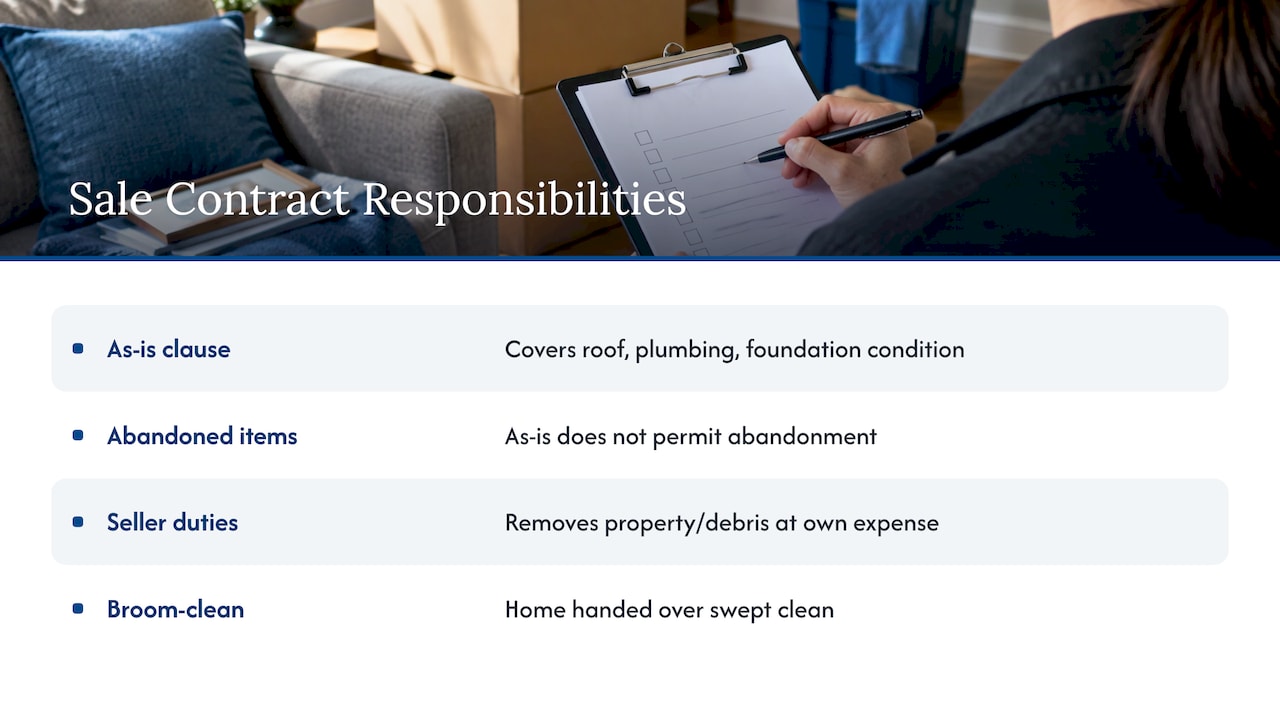
Most sellers assume that selling “as-is” means the buyer takes everything. It does not. An as-is clause covers the physical condition of the property, such as the roof, the plumbing or the foundation. LegalClarity explains that the label does not give a seller permission to abandon furniture, trash or personal belongings, and that the purchase agreement controls what stays and what goes.
Those agreements usually lean one way. Standard U.S. contracts commonly require the seller to remove personal property and debris at their own expense and to hand over the home swept clean, a condition known as “broom-clean.” Some state realtor contracts are explicit: under Virginia REALTORS®’ standard contract, furniture that is not part of the sale must be removed unless it is made part of the deal. Michigan transactions use their own forms, so read the one you are given, but the principle is the same everywhere: if the contract says the house is delivered empty, it has to be empty.
For a seller with a packed house, that turns into a long list of jobs before a listing can even be photographed.
What the contract says about furniture and fixtures
Before you decide what to do with the contents, it helps to know what the buyer is entitled to expect.
- Movable furniture is generally personal property. It leaves with you unless the contract says otherwise, according to Redfin’s guide to what stays and what goes.
- Fixtures are items attached to the house, such as built-in shelving or light fixtures. They are generally expected to stay unless excluded in writing.
- Gray areas are where closing disputes tend to start: wall-mounted TVs, custom window treatments, built-in refrigerators, and freestanding shelving that looks built in. LegalClarity recommends listing every such item in a signed addendum, since anything left ambiguous invites an argument at the final walkthrough.
If you want a buyer to keep a sofa or a washer and dryer, write it into the agreement. If you do not, assume it needs to go.
What happens if belongings are still there at closing
Leaving things behind without an agreement can cost you. Realtor.com reports that experts advise putting removal terms in writing, with the items named, a specific deadline and a remedy such as a holdback, which is money held back from the seller’s proceeds to cover removal if the items are not gone. When nothing addresses it, hauling costs can end up with the homeowner.
A Deeds.com article adds that many local contracts require a broom-clean home at possession, that the parties can agree in writing for certain items to remain, and that a pre-closing walkthrough and written terms for cleanup credits protect both sides.
The practical result: on a traditional sale, a full house is a deadline. If the closing date arrives and the house is not clear, you are negotiating credits from a weak position.
Your options for clearing a house in Metro Detroit
If you choose to clear the house yourself before a traditional sale, there are four main routes. Each one costs either time or money, and often both.
Donate what is still in good shape
Furniture Bank of Metro Detroit runs a paid pickup service: its services page lists $100 per item for older or worn furniture and items such as bookshelves, sectionals and TV stands, and $125 for armoires, china cabinets, entertainment centers and treadmills. Charities also set condition rules, so stained, ripped or damaged pieces and used mattresses are often declined. Donation works best for a few good pieces, not for a house where every room is full.
Use municipal bulk pickup or a transfer station
Cities handle bulky waste differently, and the limits matter. Orion Township’s 2025 waste collection guidelines show how tight the rules can be: one curbside bulk item per week, scheduled at least 48 hours ahead, with refrigerators accepted only after the doors are removed and Freon drained, and tires, batteries and hazardous waste not accepted at all. Check your own city or township’s public works page before you plan around curbside pickup, because a house with two dozen large items could take months this way.
Driving loads to a transfer station is cheaper per item but costs you a truck, a weekend and your back. In Wayne County, the City of Taylor’s transfer station posts a $10 fee per heavy or loose debris item, such as furniture, with the same $10 for carpet from a 12-by-12 room. Multiply that by every piece in a full house, then add the trips.
Hire a junk removal service
A junk removal company clears the house and may dump, donate or resell what it takes. It is the fastest of the do-it-yourself routes, though you pay for the labor and the disposal. One Phoenix operator quoted by Realtor.com describes the split this way: junk removal simply clears the house, while an estate sale company appraises, photographs, advertises and runs a sale.
Hold an estate sale
An estate sale can recover money when the contents have real resale value. The same Realtor.com piece says estate sale companies typically take a 25% to 45% commission. It also takes weeks to organize, and whatever does not sell still has to be removed.
If you are weighing whether valuable contents are worth selling before a sale, the guide to preparing a house for sale covers how to plan that stage.
Rent a dumpster
For a full cleanout you handle yourself, a dumpster is the usual choice. A Michigan waste guide puts a 20-yard dumpster in Metro Detroit at roughly $440 to $600 per week, with disposal fees of $55 to $75 per ton on top, so a heavy load of furniture and water-damaged items raises the bill. You still have to fill it, and you need a place to put it.
What a cleanout really costs you
Here is a realistic way to add it up for a three-bedroom house with a basement and garage full of belongings:
| Cost or burden | What it involves |
|---|---|
| Your time | Sorting every room, deciding what is kept, sold, donated or thrown away |
| Hauling | Dumpster rental, truck trips or a removal crew |
| Disposal | Per-ton or per-item fees at transfer stations and landfills |
| Carrying costs | Taxes, utilities and insurance while the house is being cleared |
| Deadline pressure | Closing dates that do not move when the cleanout runs long |
The fees quoted above are only the visible part. The larger cost is usually the weeks the house sits unlisted while you work through it, especially if you live out of state, are grieving, or are managing a move at the same time.
When the house is inherited, in probate, or a rental
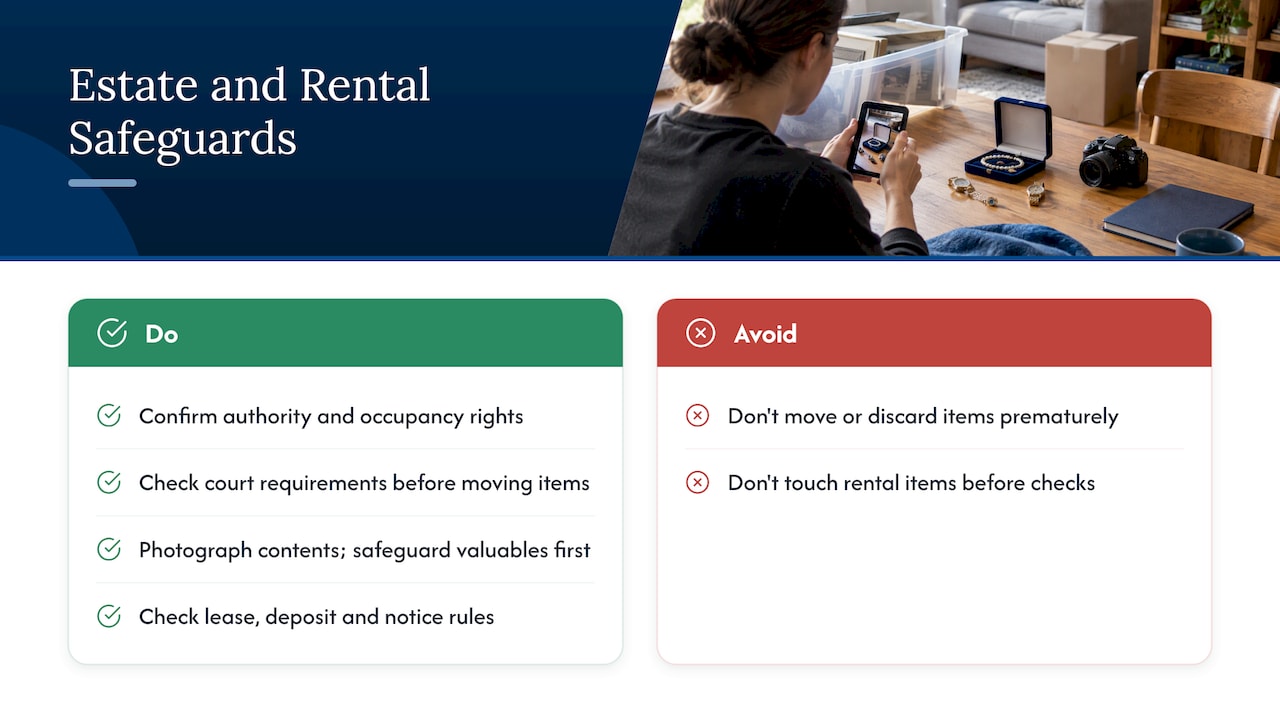
Some full houses carry extra responsibilities. If you inherited the property or are handling an estate, sorting belongings is more than a cleanup task. Contents can include valuables, sensitive records, photographs or property that belongs to other people. Probate guidance advises confirming the representative’s authority, occupancy rights and any court requirements before moving or discarding anything, and photographing contents and safeguarding valuables first. Talk to the probate attorney handling the estate before you dispose of anything, since the court process decides who may act.
If a tenant has left belongings in a rental, or tenants still live there, check the lease, deposit and notice requirements before touching anything, and speak with an attorney about the legal process. The same goes for a vacant house where the previous owner’s things remain.
We work with these situations regularly: see how we handle an inherited house, a house in probate, a rental property or a vacant house. If the estate is being settled from another state, our guide to closing an estate sale out of state fast walks through the steps.
Selling without clearing the house first
The simplest way to avoid the cleanout is to sell to a buyer who purchases the house as-is, with no repairs or cleaning required. That is how we work. You get a written cash offer within 24 hours, and you pick a closing date, which can be as soon as 7 days. There are no showings, no agent commissions and no hidden fees, and we cover standard closing costs.
What that means for a house full of furniture:
- You do not have to stage or deep clean. There are no photos, open houses or buyer walk-throughs to prepare for.
- You do not have to rush a cleanout to hit a closing date. You choose the timeline that fits your situation.
- You stay in control of what you take. Pull out the photographs, papers, heirlooms and valuables you want, and tell us about the rest when you ask for the offer.
- Everything is in writing. Put the terms of the sale, including the condition the house will be in at handover, into the purchase agreement, which is the same advice experts give for any sale.
Our checklist, closing in 7 days if you can’t clear belongings, explains the details step by step.
Who this helps most
- Heirs who live far away or cannot face sorting a parent’s home.
- Landlords with a rental that tenants left full of items.
- Downsizers moving to a smaller place who do not want to manage a house-wide sale. Our retirement and downsizing page covers that case.
- Owners facing foreclosure or divorce who need to close quickly and cannot spend weeks on a cleanout. See our pages on foreclosure and divorce.
- Owners of houses in disrepair, where the contents and the condition are both part of the problem. Our as-is sales page explains how that works.
Our view: the house is the problem to solve, not the stuff
We hear the same worry from sellers across Wayne, Oakland and Macomb Counties: “I can’t sell until I clear it out.” That belief keeps people stuck for months, paying taxes and utilities on a house they cannot face.
We have bought homes in Southeast Michigan for 16+ years, and our approach is simple. We buy the house directly, as-is, with a written cash offer in 24 hours and a closing date you choose, often 7 days. You skip repairs, realtor fees and open houses.
A full house is not a character flaw. It usually means life got busy, someone passed away, or a tenant left in a hurry. You should not have to rent a dumpster and give up your weekends to move forward.
Real Estate Team
Get a cash offer on a house full of belongings
If you want to know what your house is worth to us as it stands, ask for a cash offer in 24 hours. We are a local cash buyer, owned by Dave Joseph, not a national franchise or a lead marketplace, with 80+ five-star reviews from Metro Detroit homeowners.

Tell us the address and a little about what is inside. We will come back with a written offer, and you decide whether it works for you. If you want the full picture of how a cash sale works, see how to sell your house for cash.
FAQ
Do I have to empty my house before selling it as-is?
In a traditional sale, usually yes. The as-is label covers the house’s condition, and most contracts expect personal property to be removed and the home left broom-clean unless the agreement says otherwise. With us, no repairs or cleaning are required, so you do not need to empty the house to get an offer.
Can I leave furniture for the buyer?
Only if the agreement says so. Name each item in writing, especially gray-area ones like wall-mounted TVs, built-in appliances and shelving, so nothing is disputed at the walkthrough.
What if I inherited a house full of someone else’s belongings?
Confirm who has legal authority to sell and dispose of the contents before you touch anything, and speak with the estate’s probate attorney. Photograph the contents, and set aside valuables, papers and photographs. After that, we can discuss buying the house as-is.
How long does it take to sell a house that is full of belongings?
With a traditional listing, the cleanout often comes first, then listing, showings and closing. When you sell to us, you receive a cash offer within 24 hours and can close in as little as 7 days, or on a later date you choose.
Sources
- Is leaving furniture behind a breach of contract when the buyer doesn’t want it? (Virginia REALTORS®)
- Selling a House? Learn What Stays and What Goes (Redfin)
- Can You Leave Stuff Behind When You Sell Your House As Is? (LegalClarity)
- What To Do When Sellers Leave Their Junk Behind (Realtor.com)
- Ready to Close, But the Home Isn’t Empty (Deeds.com)
- Furniture Bank of Metro Detroit: Services
- 2025 Annual Waste Collection Service Guidelines (Orion Township)
- Landfill & Dump Prices in Michigan: Posted Fees by Facility
- Why Estate Sales Can Outperform Simple Junk Removal (Realtor.com)
- Michigan Waste Management Guide 2025
- The Sacramento Seller Guide for Probate & Inherited Property
- Preparing a House for Sale: A Step-by-Step Plan