

How to Sell Your Home Fast When Relocating to a New City
When you need to sell quickly and relocate to another city, the two fastest realistic routes are a vetted cash offer (closing in 7–14 days) or an expedited MLS listing priced for speed with a rent-back clause (30–60 days). Cash transactions can close in as few as 7–14 days, while a traditional sale typically takes 30–60 days from listing to close. Your single next step: get one cash offer and one agent comparative market analysis (CMA) within 48 hours, then compare net proceeds side by side.
Here is a quick snapshot of your fastest options:
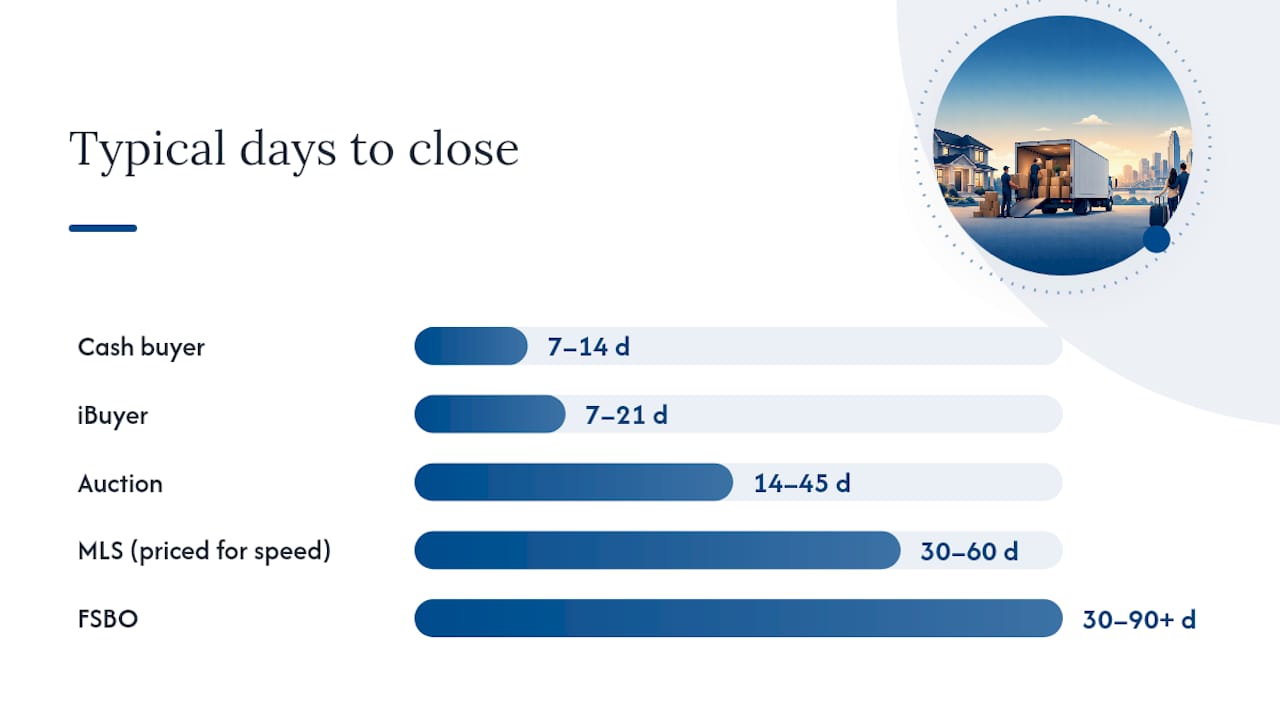
- Cash buyer (7–14 days): Highest certainty, lowest seller effort, price typically below full market value but carrying costs are eliminated
- iBuyer (7–21 days): Convenient, online-driven process, service fees typically 5–8% of sale price, availability limited to select metros
- Auction (14–45 days): Fast but unpredictable final price; works best for unique or distressed properties
- Expedited MLS listing (30–60+ days): Highest potential net proceeds, but timeline risk is real if your job start date is firm
Pro Tip: Get at least one no-obligation cash offer as a baseline before you commit to any route. It costs nothing and gives you a concrete number to measure every other option against.
Key Takeaways
When you need to sell quickly and relocate to another city, a vetted cash offer is the most reliable path for sellers with firm deadlines, while an expedited MLS listing priced for speed remains viable when you have 45 or more days and a financial cushion.
| Point | Details |
|---|---|
| Cash sale is fastest | Cash buyers close in 7–14 days with high certainty and no repairs or commissions required. |
| MLS nets more but takes longer | A traditional listing takes 30–60 days; carrying costs can close the net-proceeds gap with a cash offer. |
| Get both offers within 48 hours | Request one cash offer and one agent CMA immediately to compare real net numbers before deciding. |
| Relocation packages can offset costs | Employer packages range from roughly $24,000 to $97,000+; ask HR about bridge loans and temporary housing. |
| Sell Dave Your House | Metro Detroit sellers can get a fair written cash offer within 24 hours and close in as few as 7 days, as-is. |
Table of Contents
- What are the fastest ways to sell quickly when relocating to another city?
- Should you sell first, buy first, or close both at the same time?
- How do you prepare your house to sell fast on a tight timeline?
- What will selling fast actually cost you?
- How do you negotiate the best relocation package from your employer?
- What legal and logistical items should you confirm before you move?
- How do you choose between an agent, a cash buyer, and a relocation company?
- How does Sell Dave Your House work as a fast, local cash option?
- What would I do if I had to move in 30 days?
- Metro Detroit homeowners: get a fair cash offer in 24 hours
- Sources
- FAQ
What are the fastest ways to sell quickly when relocating to another city?
When speed is the priority, you have four realistic routes. Each one trades something different, and knowing those trade-offs upfront saves you from a costly mistake.
Cash buyers
A direct cash buyer purchases your home as-is, skips the appraisal and mortgage underwriting process, and can close in as few as 7–14 days. You will likely accept a price below full market value, but you eliminate agent commissions, repair costs, and the carrying costs of holding a vacant property for weeks. For a homeowner with a firm job start date, that certainty has real financial value.

Not all cash offers are unconditional, though. Some individual buyers still include inspection contingencies or financing clauses that can delay closing. Always verify the contract language and request written proof of funds before signing.
iBuyers
iBuyers like Opendoor operate in select markets and make algorithmic offers within 24–48 hours. Closing windows typically run 7–21 days, and the process is largely digital. The trade-off is a service fee (often 5–8%) on top of an offer that may already reflect a market discount. Check availability in your specific metro before counting on this route.
Auctions
Real estate auctions can close in 14–45 days, but the final price is unpredictable. This route works best for distressed properties or unique homes that are hard to price on the open market. For a standard suburban home, an expedited MLS listing usually produces a better outcome.
Traditional MLS listing (priced for speed)
Pricing 3–5% below comparable sales and offering a competitive buyer’s agent commission can generate multiple offers within days. Add a rent-back clause and you can close quickly while staying in the home for an agreed period, typically 30–60 days, to coordinate your move. A CMA from a local agent helps you find the price point that balances speed and net proceeds.
FSBO (For Sale By Owner)
FSBO eliminates the listing agent’s commission (typically 2.5–3%), but it adds significant effort: pricing, marketing, showings, negotiations, and paperwork all fall on you. On a tight relocation timeline, most homeowners find that the time cost outweighs the commission savings.
| Route | Typical days to close | Net proceeds | Seller effort | Certainty |
|---|---|---|---|---|
| Cash buyer | 7–14 days | Below market | Very low | High |
| iBuyer | 7–21 days | Near market (minus fees) | Low | High |
| Auction | 14–45 days | Unpredictable | Low | Medium |
| MLS (priced for speed) | 30–60 days | Highest potential | Medium-high | Medium |
| FSBO | 30–90+ days | Moderate (no listing commission) | Very high | Low |
Should you sell first, buy first, or close both at the same time?
There are four main sequencing strategies for relocating homeowners: sell-first, buy-first, simultaneous (contingent offer), and sell to a cash buyer. The right choice depends on your financial cushion, your employer’s flexibility, and how competitive the destination market is.
Sell-first
This is the lower-risk path for most people. You close on your current home, pocket the equity, and rent temporarily in your new city while you shop for a home without pressure. The downside: you may be paying rent and a mortgage simultaneously for a short window, and you will need to move twice if temporary housing is involved.
Best for: Tight timelines, limited cash reserves, or sellers who cannot afford to carry two mortgages.
Buy-first
You purchase in the new city before your current home sells. This avoids double moves and lets you take your time finding the right property. The risk is significant: if your current home sits on the market longer than expected, you carry two mortgages. Bridge financing can cover the gap, but it adds cost and complexity.
Best for: Sellers with strong equity, a solid relocation package, or a destination market where inventory is scarce and waiting is costly.
Simultaneous (contingent offer)
You make an offer on a new home contingent on selling your current one. In a hot seller’s market, contingent offers are less competitive and sellers in desirable areas often reject them outright. This route works better in balanced or buyer-friendly markets.
Sell to a cash buyer
A direct cash sale sidesteps the sequencing problem almost entirely. You get a guaranteed close date, which lets you coordinate your move with precision. A short rent-back negotiated after an immediate sale can solve the timing mismatch if you need a few extra weeks to vacate.
Pro Tip: Before you choose a sequence, collect four facts: your relocation benefit details, your mortgage payoff amount, a pre-approval for your destination purchase, and the average days-on-market in both cities. Those four numbers will tell you which path carries the least risk.
Decision checklist:
- What is your job start date, and how many days do you have?
- Do you have enough cash reserves to carry two mortgages for 60–90 days if needed?
- Does your employer offer bridge financing, temporary housing, or a home-sale buyout?
- How fast is the destination market? Are homes going under contract in days or weeks?
- What is your current home’s equity position after payoff and estimated closing costs?
How do you prepare your house to sell fast on a tight timeline?
Speed and presentation are not opposites. A few targeted actions in the first 48 hours can meaningfully shorten your time on market without expensive renovations.
What to do in the first 48 hours
- Set the right price. Request a CMA from a local agent immediately. Overpricing is the single biggest reason homes sit. Price at or slightly below comparable sales to generate early momentum.
- Declutter every room. Rent a storage unit or use a portable container. Buyers need to see the space, not your belongings.
- Deep clean. Hire a professional cleaning service. A clean home photographs better and signals to buyers that the property has been maintained.
- Fix the obvious. Patch holes in drywall, replace burned-out bulbs, tighten loose fixtures, and touch up scuffed paint. These repairs cost under $500 and remove buyer objections before they form.
What to do in the first week
- Hire a professional photographer. Listings with professional photos sell faster and for more money. This is not optional on a tight timeline.
- Stage the main rooms. Focus on the living room, primary bedroom, and kitchen. You do not need a full staging service; removing excess furniture and adding a few neutral accents is enough.
- Consider a pre-listing inspection. A pre-inspection ($300–$500) surfaces issues before buyers find them, which reduces the chance of a renegotiation or deal falling apart after you are already under contract.
When to skip the prep and go as-is
If your home needs significant repairs (roof, HVAC, foundation), the math often favors skipping the renovation entirely and accepting a cash offer. Selling remotely increases complexity, and managing contractors from another city adds stress and timeline risk. An as-is cash sale eliminates that problem.

Pro Tip: Listing local-sale items on online marketplaces before you move reduces what you need to transport and can offset some moving costs. Decluttering and selling simultaneously is one of the most efficient uses of your pre-move time.
What will selling fast actually cost you?
Understanding the full cost picture before you choose a route is the difference between a confident decision and a regrettable one. Here is what to expect across the main scenarios.
Timeline and cost summary by route:
- Cash buyer (7–14 days): No agent commission, minimal or no repair costs, closing costs often covered by the buyer. Net proceeds are lower than a full-market MLS sale, but carrying costs are zero.
- iBuyer (7–21 days): Service fee typically 5–8%, plus standard closing costs. No repair costs in most cases, but the offer price may already reflect a discount.
- Auction (14–45 days): Auctioneer fees vary (typically 5–10% of sale price). Final price is uncertain.
- MLS listing (30–60+ days): Agent commissions typically 5–6% of sale price, plus closing costs of 1–3%, plus any repairs or staging. Carrying costs accumulate for every week the home is on market.
Carrying costs are where most sellers get surprised. If your home sits on the market for 60 days while you have already moved, you are paying a mortgage, property taxes, insurance, and utilities on a vacant property. On a $250,000 home with a $1,400/month mortgage, that is roughly $2,800 in mortgage payments alone, before taxes and insurance. Run a net-proceeds comparison that includes estimated carrying costs for each additional week on market. That calculation often shifts the decision toward a faster, lower-gross-price route.
For a practical timeline guide on fast home sale steps, external resources can help you map out each stage against your move date.
A cash sale that avoids three months of carrying costs can net similar or better proceeds than a slow MLS sale once all expenses are included. (Wedgewood Homes)
How do you negotiate the best relocation package from your employer?
Corporate relocation packages commonly range from roughly $24,000 to $97,000+ depending on whether you rent or own and the scope of the package. Most homeowners leave money on the table simply by not asking the right questions.
Benefits worth requesting:
- Moving allowance (lump sum or reimbursement)
- Temporary housing in the destination city (30–90 days)
- Home-sale assistance or a guaranteed buyout program
- Bridge loan support to cover carrying costs during a gap between closings
- Extended closing date flexibility so your start date does not force a distressed sale
Questions to ask HR directly:
- Does the company offer a home-sale buyout program, and what are the eligibility requirements?
- Is temporary housing provided, and for how long?
- Can the start date be extended by 30–60 days to allow a proper sale process?
- Is there a lump-sum option instead of reimbursement, and which covers more of my actual costs?
- Does the package include bridge financing if I close on a new home before my current one sells?
When to push for a buyout vs. using benefits to bridge a buy-first plan:
A relocation buyout (where the employer purchases your home at an appraised value through a third-party relocation company) removes all market risk. If your employer offers one, it is worth comparing that guaranteed price against what a cash buyer or MLS sale would net. If the buyout price is within 5–8% of your CMA estimate, the certainty often makes it the better choice. If the gap is larger, a fast cash sale or expedited MLS listing may produce a better outcome.
What legal and logistical items should you confirm before you move?
Interstate relocations add a layer of complexity that purely local moves do not. A few checkpoints handled early prevent expensive surprises at closing.
Remote closings and RON:
Remote Online Notarization (RON) and remote closings are now available in 45+ states, which means you can sign closing documents from your new city without flying back. Confirm with your title company or closing attorney that RON is available in your state and that your lender accepts it. Not every lender does, and finding out the week before closing creates unnecessary stress.
Tax and legal items to confirm:
- Capital gains timing: If you have lived in the home for at least 2 of the last 5 years, you may qualify for the federal capital gains exclusion ($250,000 for single filers, $500,000 for married filing jointly). Confirm your eligibility with a tax professional before you close, especially if your timeline is tight.
- State transfer taxes: These vary by state and county. Your title company will calculate them, but knowing the estimate in advance helps with net-proceeds planning.
- HOA documents: If your home is in an HOA, you will need to provide governing documents, current dues statements, and any pending assessments to the buyer. Request these early; some HOA management companies take 2–3 weeks to respond.
- Mortgage payoff statement: Request a 30-day payoff quote from your lender as soon as you have a target close date. The figure changes daily due to interest accrual.
Pro Tip: Hire a real-estate attorney in your home state, not just a title company, if your sale involves an estate, a trust, or any title complications. Attorney fees ($500–$1,500) are modest compared to the cost of a delayed or failed closing.
How do you choose between an agent, a cash buyer, and a relocation company?
The right help depends on your timeline, your home’s condition, and how much uncertainty you can absorb. Here is a practical framework for vetting each type quickly.
Vetting an agent
- Ask specifically about experience with interstate relocations and seller-side timelines
- Request a CMA within 24 hours of your first conversation; an agent who cannot deliver that quickly is not the right fit for a fast sale
- Ask how they handle showings and negotiations if you have already moved
- Request two or three references from sellers who had firm move-out deadlines
Vetting a cash buyer
- Request written proof of funds before you spend time on their process
- Ask for a guaranteed close date in writing, not an estimate
- Review the contract for inspection contingencies or financing clauses that could delay or kill the deal
- Ask what closing costs they cover and get that in writing
Asking for a written timeline and proof of funds is a simple, high-leverage step that filters out weak offers quickly. A professional direct-acquisition firm provides standardized paperwork and a guaranteed closing date; an inexperienced individual buyer may include hidden contingencies that surface only after you are under contract.
Vetting a relocation company
- Confirm whether they are a third-party relocation management company (handling logistics) or a home-buyout program (purchasing your home directly)
- Ask how their appraised value is determined and whether you can negotiate
- Clarify the timeline from appraisal to offer to close
Red flags to watch for (any provider):
- No written timeline or close date
- Pressure to sign before you have reviewed the contract
- Unverifiable or verbal-only proof of funds
- Contingencies buried in contract language that allow the buyer to exit without penalty
- Fees or deductions that were not disclosed in the initial offer
Pro Tip: Send a short email to every agent or cash buyer you are considering: “Can you provide a written offer or CMA, a guaranteed close date, and proof of funds by [date]?” The responses you get back, and how fast you get them, tell you almost everything you need to know.
How does Sell Dave Your House work as a fast, local cash option?
For Metro Detroit homeowners who need to sell quickly and relocate, Sell Dave Your House offers a direct, as-is cash purchase with a process built around your timeline.
How the process works:
- Request an offer. Contact Sell Dave Your House and provide basic property details. No obligation, no pressure.
- Property assessment. The team conducts an in-person or virtual walkthrough, typically within 24–48 hours of your request.
- Written cash offer within 24 hours. You receive a fair, written cash offer. No repairs, no cleaning, no staging required.
- Close in as few as 7 days. If you accept, closing can happen on your schedule, as quickly as 7 days or on a date that fits your relocation timeline.
What to verify before you accept:
- Request written proof of funds
- Confirm the exact closing date in the purchase agreement
- Ask which closing costs are covered (Sell Dave Your House covers standard closing costs for sellers)
- Ask for a reference or a brief account of a comparable seller situation
One realistic scenario: a Metro Detroit homeowner receives a job offer with a 30-day start date. Their home needs roof repairs they cannot afford to complete before listing. A traditional MLS sale would require 2–3 weeks of prep plus 30–60 days on market. A cash offer from Sell Dave Your House closes in 7 days, as-is, with no repair costs and no commission, giving the seller a clean exit and the certainty to commit to their new city.
Pro Tip: Even if you plan to list on the MLS, getting a cash offer from a vetted local buyer first gives you a floor price and a backup plan. If your MLS listing stalls, you already have a guaranteed exit.
What would I do if I had to move in 30 days?
The honest answer is that most homeowners overthink the options and underestimate the timeline. Here is the decision process I would run through immediately.
Step 1: Get a cash offer within 24 hours. Before anything else, I want a concrete number. It takes 15 minutes to request one and it anchors every other decision.
Step 2: Request a CMA from a local agent. I want to know what a realistic MLS sale would net after commissions, repairs, and 45 days of carrying costs. Not the gross sale price, the net number.
Step 3: Check my relocation benefits. If my employer offers temporary housing or a bridge loan, that changes the math on a buy-first strategy. If they offer a home buyout, I compare that price to my cash offer and CMA.
Step 4: Apply the heuristic. If my start date is fewer than 45 days away and I have no bridge financing available, I prioritize the cash offer or an iBuyer. The certainty is worth more than the marginal price difference. If I have more than 60 days and a financial cushion to carry two properties, an expedited MLS listing becomes viable.
A practical example: your start date is 28 days out, you have $15,000 in savings, and your home needs a new water heater. The cash offer comes in at $185,000. The CMA suggests $205,000 on the MLS, but that assumes 45 days on market, $3,000 in repairs, and $12,000 in commissions and closing costs. Net MLS proceeds: roughly $190,000, with timeline risk. Net cash proceeds: $185,000, guaranteed, in 7 days. The $5,000 difference is not worth the risk of missing your start date.
The fast closing benefits of a cash sale are not just about speed. They are about removing the single biggest variable in a relocation: an uncertain close date.
Metro Detroit homeowners: get a fair cash offer in 24 hours
If you are a Metro Detroit homeowner who needs to sell quickly and move to a new city, Sell Dave Your House offers exactly what a tight relocation timeline demands: a fair all-cash offer within 24 hours, closing in as few as 7 days, no repairs required, no commissions, and standard closing costs covered.

The service covers Metro Detroit, including Detroit, Waterford, Hazel Park, Pontiac, Madison Heights, Dearborn, and surrounding communities. To get an immediate offer, have these items ready: your property address, a rough sense of the home’s condition, your target move-out date, and your mortgage payoff amount if you have it.
You do not need to clean, repair, or stage anything. Sell Dave Your House buys homes as-is, which means you can focus entirely on your move instead of managing contractors and showings from a distance.
Request your cash offer today and have a written number in hand within 24 hours. For sellers in specific Metro Detroit communities, the Detroit cash homebuyers page has local coverage details.
Sources
The following resources were used in preparing this article and can help you verify timelines, RON availability, and relocation guidance:
- How to Buy and Sell a Home When Relocating for Work | EffectiveAgents®
- Selling Your House for a Job Relocation: A Complete Guide - Redfin
- Options for Selling Your House for Job Relocation | Zillow
- Selling Your House for a Job Relocation: Risks to Avoid | Wedgewood Homes
- Are cash offers better for sellers? | NerdWallet
- Selling to a Cash Buyer vs. Listing with a Realtor: An Honest Comparison | Distressed Property Solutions Blog
This article provides general information about home-selling strategies and is not a substitute for professional legal, tax, or real estate advice. Confirm current rules, tax implications, and closing requirements with a qualified professional in your state.
FAQ
How fast can you sell a house when relocating for a job?
A cash buyer can close in as few as 7–14 days, while a traditional MLS listing typically takes 30–60 days. If your job start date is fewer than 45 days away, a cash sale is the most reliable option.
What is the hardest month to sell a home?
January and February are historically the slowest months for home sales in most U.S. markets, with lower buyer demand and fewer listings going under contract. If your relocation falls in winter, pricing aggressively or pursuing a cash buyer becomes even more important.
How do you sell your belongings quickly when moving to a new city?
List furniture and household items on Facebook Marketplace, Craigslist, or OfferUp for fast local sales. For higher-value items, eBay or specialty resale platforms can reach a broader buyer pool and often yield better prices.
Will cities pay you to relocate there?
Some cities and states do offer relocation incentives, including cash grants, student loan repayment assistance, or tax credits, to attract remote workers and new residents. Programs vary widely by location and eligibility requirements, so check directly with the economic development office of your destination city.
Can you close on a home sale after you have already moved?
Yes. Remote Online Notarization (RON) is available in 45+ states, allowing you to sign closing documents digitally from your new city. Confirm RON availability with your title company and verify that your lender accepts remote closings before you move.