

US Rental Owners: Tax on a Sale, Forms, and a Detroit Cash Option
When you sell a U.S. State taxes can add more depending on where you live. Your first move should be calculating your adjusted basis and separating out the depreciation you’ve claimed since that number drives everything else. One catch trips up a lot of sellers: depreciation you were entitled to take but never claimed still reduces your basis and gets recaptured anyway.
TL;DR:
- Depreciation that was never claimed reduces your basis and can still be recaptured at a maximum federal rate of 25%, even if overlooked during ownership.
- Your adjusted basis includes the original purchase price, capital improvements, and the depreciation allowed or allowable over the years.
- State taxes can significantly increase your total tax burden, with some states taxing capital gains as ordinary income and others having no income tax at all.
- Proper documentation, such as depreciation schedules and improvement receipts, helps accurately calculate your gain and avoid surprises at tax time.
- Using strategies like a 1031 exchange or filing an installment sale can delay or reduce your total tax liability, but each has strict deadlines and rules to follow.
Table of Contents
- Sell Rental Property Taxes: Quick Checklist Of What Applies
- How To Calculate Taxable Gain On A Rental Sale, Step By Step
- Depreciation Recapture: The Mechanics And The Traps
- Reporting The Sale: Form 4797, Form 8949, Schedule D, And Form 8824
- Ways To Reduce Or Delay What You Owe
- NIIT And State Tax: Model Your Full Combined Bill
- Your Pre-Sale Checklist: What To Gather Now
- What Happens To Suspended Passive Losses When You Sell
- Transferring Rental Property Before A Sale: Estate Planning Angles
- Does AMT Still Matter For Rental Property Sales?
- Common Mistakes Sellers Make And When Speed Beats Maximizing Price
- If Speed And Certainty Matter More Than Maximizing Every Dollar
- Where To Verify These Rules Yourself
- Sources
- FAQ
Sell Rental Property Taxes: Quick Checklist Of What Applies
Before you list the property or sign a purchase agreement, confirm which of these apply to your situation. Every rental sale touches at least a few of them.
- Depreciation recapture (unrecaptured Section 1250): taxed at a federal rate up to 25% on the portion of gain tied to prior depreciation.
- Capital gains tax: long-term rates (0%, 15%, or 20%) apply if you’ve owned the property more than a year; short-term gains are taxed as ordinary income.
- Net Investment Income Tax: an additional 3.8% if your modified adjusted gross income clears certain thresholds.
- State income tax: varies widely, and some states tax capital gains as ordinary income with no special rate at all.
- Forms you’ll likely need: Form 4797, Form 8949, Schedule D (Form 1040), Form 8824 if you’re doing a 1031 exchange, and Form 6252 for installment sales.
How To Calculate Taxable Gain On A Rental Sale, Step By Step
Getting a reliable estimate before you talk to a CPA takes three steps and a little arithmetic. None of it is complicated, but skipping a step is how sellers end up surprised at tax time.
- Find your adjusted basis. Take your original purchase price, add capital improvements (a new roof, an addition, major system replacements), then subtract cumulative depreciation, whether or not you actually claimed it on your returns.
- Calculate amount realized. Subtract selling expenses (agent commissions, title fees, transfer taxes) from your final sale price.
- Subtract adjusted basis from amount realized. That’s your taxable gain. Split it into two buckets: the depreciation recapture portion, and everything above that, which gets long-term capital gains treatment.
Worked example: Say you bought a rental for $250,000, put $30,000 into capital improvements, and claimed $70,000 in depreciation over the years. Your adjusted basis is $210,000. You sell for $400,000 and pay $24,000 in selling costs, leaving an amount realized of $376,000. Taxable gain: $166,000. Of that, $70,000 is taxed as depreciation recapture at up to 25%, or $17,500. Rough federal total: roughly $38,200, before any state tax.
Depreciation Recapture: The Mechanics And The Traps
Unrecaptured Section 1250 gain is the IRS’s name for the portion of your profit that comes from depreciation you deducted on a residential rental.
The rule that catches people off guard: the IRS calculates recapture using depreciation “allowed or allowable,” not just what you claimed. If you owned a rental for a decade and never deducted depreciation on your returns, either through an oversight or bad advice, you still owe recapture tax on the amount you should have deducted. Skipping the depreciation deduction doesn’t skip the tax bill; it just means you paid more in prior years for nothing.
Cost segregation studies complicate this further. If a previous cost segregation study reclassified parts of your property (carpeting, certain fixtures, land improvements) as Section 1245 personal property, those components get recaptured at ordinary income rates instead of the capped 25%, which can meaningfully raise your near-term bill.
- Keep every closing statement, improvement receipt, and depreciation schedule you’ve ever generated for the property.
- If you or a prior owner ran a cost segregation study, get a copy before you sell. It changes your recapture math.
Pro Tip: Pull your last three years of depreciation schedules from your tax preparer now, not after you’ve accepted an offer. Reconstructing years of missed or misfiled depreciation under deadline pressure is one of the most common reasons rental sellers miss their own closing date.
Reporting The Sale: Form 4797, Form 8949, Schedule D, And Form 8824
Where the sale lands on your return depends on how the IRS classifies the activity. Rental property sales generally get reported on Form 4797 if the property was used in a trade or business, with the capital gain portion flowing through to Schedule D. If your rental activity is treated more like an investment, Form 8949 feeds into Schedule D instead.
- Form 4797: reports the sale of business property, including depreciation recapture calculations.
- Form 8949 and Schedule D (Form 1040): capture the capital gain or loss detail and summary totals.
- Form 8824: required for like-kind exchanges under Section 1031, and it has strict timing documentation built into the form itself.
- Form 6252: used if you’re financing the sale through an installment agreement, spreading gain recognition across payment years.
NIIT doesn’t get its own form line item tied to the sale. It’s calculated on Form 8960 using your total net investment income for the year, gain included.
Ways To Reduce Or Delay What You Owe
You have more control over the tax bill than most sellers realize, but each option comes with its own deadline pressure or tradeoff.
- 1031 exchange. Defers both capital gains and depreciation recapture if you identify a replacement property within 45 days and close within 180 days, using a qualified intermediary to hold the funds. Miss either deadline and the whole exchange collapses into a fully taxable sale.
- Installment sale. Spreads capital gain recognition across the years you receive payments, which can help smooth your tax bracket. Depreciation recapture, though, is still taxed in full in the year of sale regardless of when you get paid.
- Section 121 primary residence conversion. If you move into the rental and live there two of the last five years before selling, you can exclude up to $250,000 ($500,000 married filing jointly) of gain. Depreciation recapture still applies in full, and nonqualified use rules reduce the exclusion for years the property sat as a rental.
- Tax-loss harvesting or Qualified Opportunity Funds. Offsetting gains with realized losses elsewhere, or rolling gain into a Qualified Opportunity Fund, can reduce or defer the bill, though QOFs carry their own multi-year holding requirements.
Pro Tip: A failed 1031 exchange is one of the most expensive mistakes in real estate tax planning. If you’re even considering one, line up your qualified intermediary before you list the property, not after you get an offer.
NIIT And State Tax: Model Your Full Combined Bill
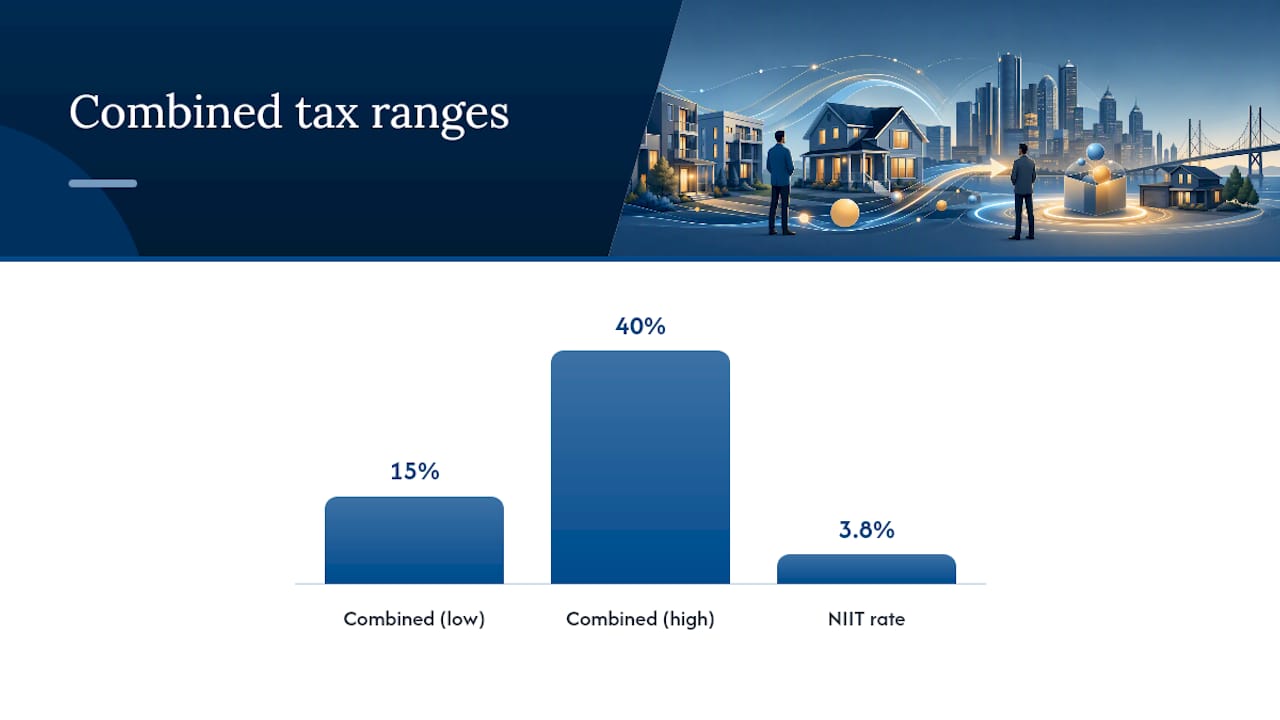
The 3.8% Net Investment Income Tax applies once your modified adjusted gross income exceeds $200,000 for single filers or $250,000 for married couples filing jointly, and it stacks on top of federal capital gains and recapture, not instead of them.
State tax is where sellers most often underestimate their final number. States with no income tax, like Texas or Florida, leave your federal calculation untouched. High-tax states can push your combined burden much higher.
- Some models show combined federal and state tax on a rental sale, ranging from roughly 15% to 40%, depending on your state and NIIT exposure.
- Run your numbers with your actual state’s rate, not a national average, before you commit to a listing price.
Your Pre-Sale Checklist: What To Gather Now
A little paperwork now saves real money later. Work through this before you sign anything.
- Pull your original purchase closing statement and every receipt for capital improvements made since.
- Locate your full depreciation schedule from your tax preparer or software, covering every year you owned the property.
- Get a current appraisal or broker price opinion so you can estimate selling costs accurately.
- Decide now whether a 1031 exchange fits your plans, and if so, contact a qualified intermediary before closing, not after.
- Book time with a CPA or tax attorney to model your expected bill using real numbers, not estimates.
For a fuller look at how selling costs shrink your final payout, see this guide on what counts as net proceeds from a home sale.
What Happens To Suspended Passive Losses When You Sell
If you’ve owned a rental for years and your income was too high to deduct losses against other income, those losses didn’t disappear. They accumulated as suspended passive activity losses, sitting on your return waiting for an event that “frees” them.
Selling the property in a fully taxable transaction is that event. In the year of sale, any suspended passive losses tied to that property become fully deductible against your other income, not just against passive income like they were before. That’s a meaningful offset if you’ve been renting the property at a loss for multiple years, since those losses can directly reduce the gain and recapture you’re now facing.
The catch is that this only works for a fully taxable disposition. A 1031 exchange doesn’t trigger the release of suspended losses the same way, since you’re deferring the gain rather than recognizing it. If you’re weighing an exchange against an outright sale, factor in how many years of suspended losses you’re sitting on. In some cases, releasing a large bank of suspended losses through an outright sale offsets enough gain that deferring through a 1031 becomes less attractive than it first appears.
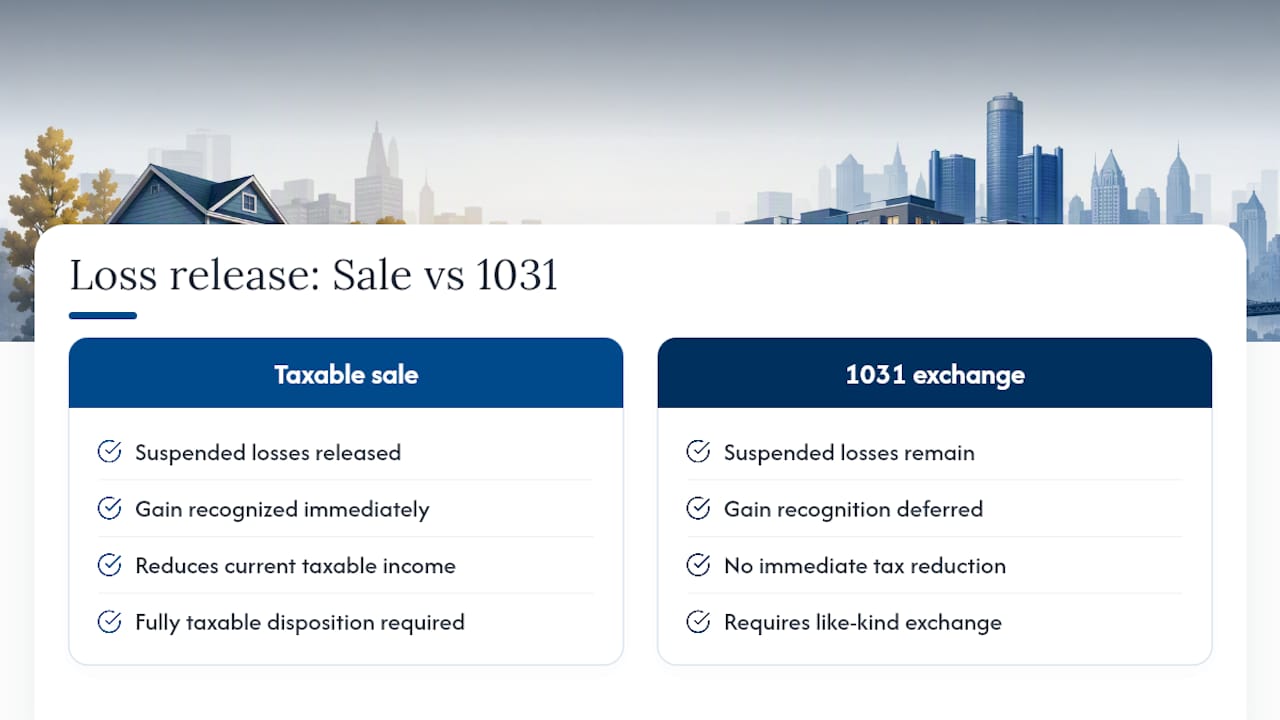
Check your prior returns, specifically Form 8582, to see exactly how much suspended loss you’re carrying forward. It’s easy to forget this number exists until a preparer points it out at tax time, and by then you’ve already priced your sale without factoring it in.
Transferring Rental Property Before A Sale: Estate Planning Angles
If your rental property is part of a larger estate plan, the timing of a sale versus a transfer changes the tax outcome dramatically. Selling the property yourself during your lifetime triggers depreciation recapture and capital gains exactly as described throughout this guide. Transferring the property to heirs at death works very differently.
Property passed through an estate generally receives a step-up in basis to its fair market value at the date of death. That step-up can erase most or all of the built-in gain and depreciation recapture that would have applied had you sold it yourself. Heirs who later sell the inherited property typically owe tax only on appreciation that occurs after they inherit it, not on the gain that accrued during your ownership.
This creates a real tension for aging rental owners. Selling now to simplify your finances or fund retirement means paying recapture and capital gains today. Holding the property until death, if that fits your broader estate and cash-flow needs, can shift a substantial tax bill onto nobody, since the step-up largely erases it. Gifting the property to heirs during your lifetime is different again. Lifetime gifts generally carry over your existing basis rather than stepping up, so the recipient inherits your tax exposure along with the property.
None of these choices are purely tax decisions. Liquidity needs, family dynamics, and how badly the property needs ongoing management all factor in. If you’re weighing a sale against a transfer, an estate planning attorney and a CPA should be in the same conversation, since the tax mechanics and the estate mechanics interact directly. If you’re handling an inherited property yourself, this guide to inherited home selling options walks through how the step-up affects your own sale.
Does AMT Still Matter For Rental Property Sales?
Alternative Minimum Tax used to be a real concern for rental property sellers, particularly those with large depreciation deductions or significant state and local tax deductions. The Tax Cuts and Jobs Act changed that calculus substantially by raising AMT exemption amounts and phase-out thresholds, which pulled a large share of taxpayers out of AMT exposure entirely.
For most rental property sellers today, AMT is a background consideration rather than a primary risk. The capital gain and depreciation recapture from a rental sale are treated similarly under both the regular tax system and AMT, so the sale itself rarely creates a large AMT adjustment on its own. Where AMT can still surface is for sellers with other significant preference items in the same tax year, like exercising incentive stock options, claiming large state and local tax deductions in a high-tax state, or generating substantial private activity bond interest.
If your rental sale coincides with one of those other events in the same year, it’s worth running an AMT calculation alongside your regular tax estimate before you finalize your plans. A CPA can run both calculations in parallel using tax software in a matter of minutes, and it’s far better to know ahead of the sale than to be surprised by it in April. For the vast majority of straightforward rental property sales, though, AMT will not change your bottom line materially compared to your regular tax calculation.
Common Mistakes Sellers Make And When Speed Beats Maximizing Price
Most rental sellers underestimate their tax bill in the same three places: they forget depreciation recapture applies even on unclaimed depreciation, they don’t model NIIT until their accountant flags it in March, and they ignore state tax until the closing statement is final. Add a cash-flow crunch, a job relocation, or an inherited property nobody wants to manage, and the math around a traditional listing changes fast.
Some owners rationally accept lower net proceeds in exchange for a certain, fast closing and zero listing costs. For Metro Detroit sellers in that position, Sell Dave Your House offers a cash alternative worth weighing against a traditional sale.
— Real Estate Team
If Speed And Certainty Matter More Than Maximizing Every Dollar
If the tax math above left you wondering whether a traditional listing is worth the wait, there’s a more direct route outlined in The complete guide to selling an investment property that can help clarify the process. Sell Dave Your House buys rental properties across Metro Detroit in as-is condition, no repairs, no cleaning, no realtor commissions eating into your proceeds. You get a fair cash offer within 24 hours and can close in as little as seven days, which matters when depreciation recapture, capital gains, and NIIT are already going to take a bite out of your check.

The tradeoff is straightforward: a cash offer typically comes in below what a fully marketed, repaired, and staged listing might fetch on the open market. For sellers facing foreclosure, managing an inherited property from out of state, or simply done being a landlord, that tradeoff is often worth it once you factor in avoided repair costs, months of carrying costs, and the certainty of a set closing date. If your rental property is in Metro Detroit and you’d rather skip the listing process entirely, get a fair cash offer fast and see what your property is worth on your timeline, not a buyer’s.
Where To Verify These Rules Yourself
For form-specific instructions and the underlying rules, go straight to the source: Form 4797 guidance, Publication 527 for rental property basis and depreciation rules, and Form 8824 instructions for 1031 exchange timing. For calculation walkthroughs, Lofty’s capital gains breakdown and TurboTax’s recapture explainer are solid practical references.
This article is general information, not a substitute for advice from a qualified financial advisor. Consult a qualified financial professional about your own circumstances before acting on anything here.
Sources
- Depreciation Recapture: Definition, Calculation, and Examples - TurboTax
- Capital Gains Tax on Rental Property: Calculate What You Owe at Sale | Lofty
FAQ
How do you avoid paying capital gains tax when selling a rental property?
A 1031 exchange defers capital gains and depreciation recapture if you meet strict identification and closing deadlines, while converting the property to a primary residence for at least two years can qualify part of the gain for the Section 121 exclusion.
How much capital gains tax will I pay on $300,000?
Run your specific adjusted basis and income numbers rather than relying on a flat percentage of the sale price.
What is the 50% rule in rental property?
It isn’t a tax rule and has no bearing on capital gains, depreciation recapture, or how you calculate taxable gain at sale.
Do I owe tax on a rental property sale if I sell at a loss?
You generally won’t owe capital gains tax if your amount realized is below your adjusted basis, but depreciation recapture rules still apply to any depreciation you claimed or should have claimed over the years, so consult Publication 527 and a tax professional to confirm your specific position.