

Seller Closing Costs in Detroit: What You’ll Actually Pay
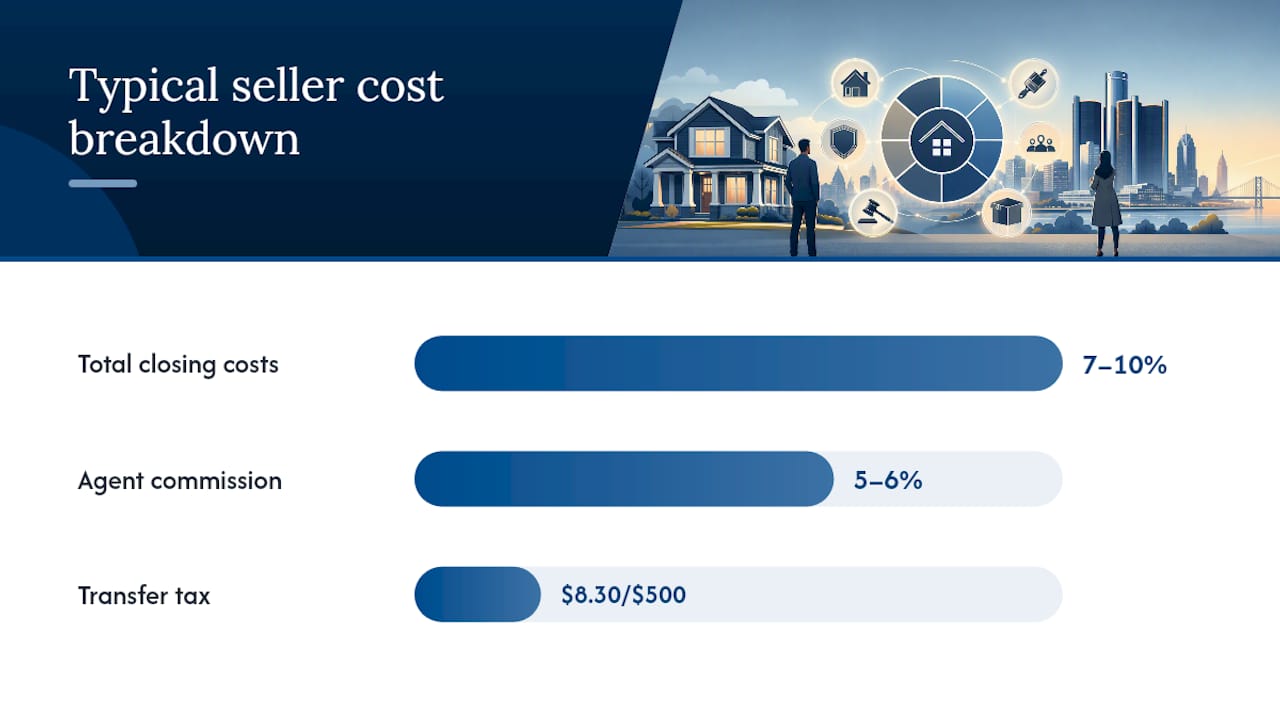
Detroit sellers typically pay between 7% and 10% of their sale price in closing costs, which lands somewhere between $17,500 and $40,000 on a $250,000 to $400,000 home once you count agent commissions, transfer tax, and title fees. The three costs that eat the biggest share of your proceeds:
- Agent commission: usually 5% to 6% of the sale price, split between listing and buyer’s agents.
- Michigan transfer tax: a combined state and county rate of $8.30 per $1,000 of sale price, paid by the seller.
- Title and closing fees: typically $800 to $2,000 depending on your policy type and settlement company.
Pro Tip: Ask your title company for a draft settlement statement before closing week, and if your timeline is tight, get a no-obligation cash offer to see how the math compares.
Key Takeaways
| Point | Details |
|---|---|
| Typical cost range | Expect 7% to 10% of your sale price in total closing costs, per regional cost estimates. |
| Transfer tax is fixed | Michigan’s combined state and county transfer tax runs $8.30 per $500 and applies regardless of how you sell. |
| Commission is negotiable | Agent commission (5% to 6%) is the largest cost you can actually influence through negotiation. |
| Verify prorations early | Request a draft ALTA settlement statement to catch tax proration and payoff errors before signing. |
| Cash sale alternative | Sell Dave Your House eliminates commission costs and closes in as little as seven days, though transfer tax still applies. |
Table of Contents
- Seller Closing Costs Detroit Homeowners Should Expect, Line by Line
- Sample Net Proceeds for Common Detroit Sale Prices
- Who Pays What and When Money Actually Changes Hands
- What Detroit and Wayne County Sellers Need to Verify
- How to Lower Your Closing Costs Before You Sign Anything
- How a Cash Sale Changes Your Closing-Cost Math
- A Detroit Team’s View on What Actually Trips Sellers Up
- Selling for Cash With Sell Dave Your House
- Sources
- FAQ
Seller Closing Costs Detroit Homeowners Should Expect, Line by Line
Every seller’s closing statement in Detroit tells roughly the same story, even if the dollar amounts shift. Here’s what typically shows up on the settlement sheet, and why.
On a $300,000 sale, that’s $15,000 to $18,000 gone before you touch any other line item. Commission is negotiable, and it’s the single biggest lever you have for reducing your total costs.
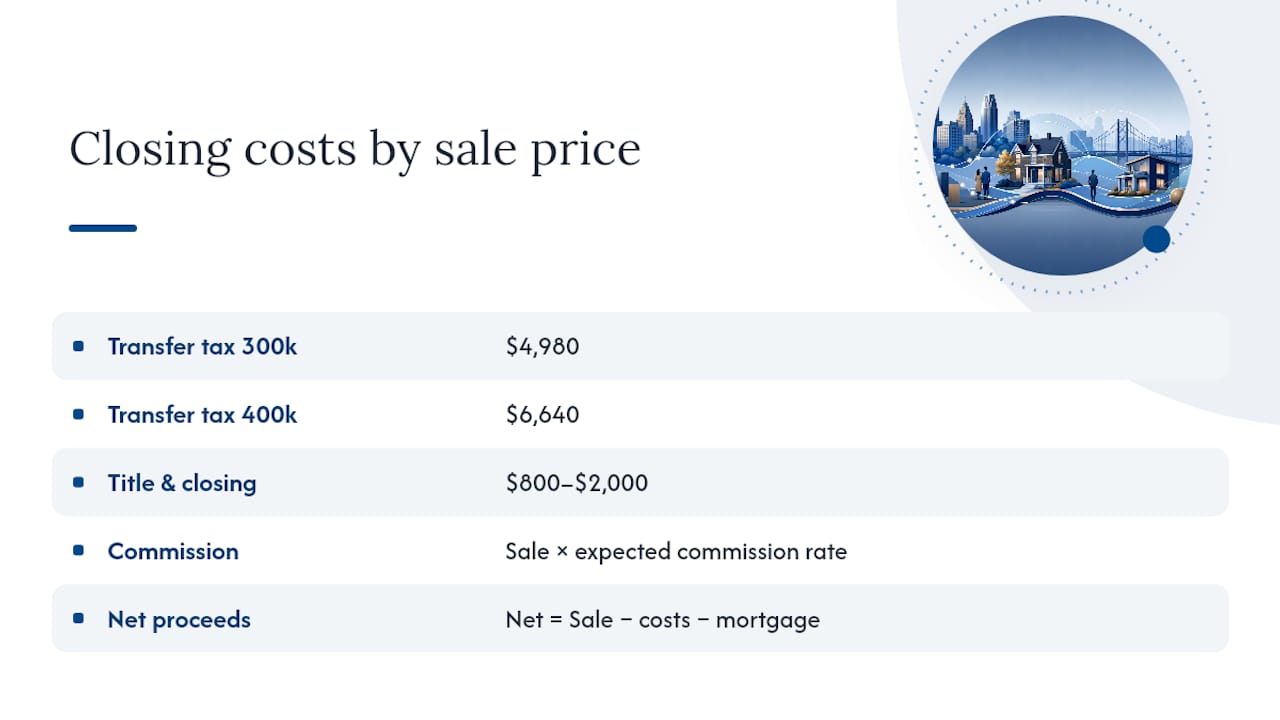
Michigan transfer tax is where a lot of sellers get surprised. The state charges $3.75 per $500 of sale price, and counties commonly tack on another $0.55 per $500, for a combined $8.30 per $500 (or $16.60 per $1,000). Use the Michigan Treasury rate tables to confirm your exact figure, since some sellers qualify for exemptions tied to the Principal Residence Exemption. Sellers customarily pay this tax in Michigan, and it’s rarely negotiable.
Title insurance and settlement fees typically run $800 to $2,000. In Michigan, it’s customary for the seller to pay the owner’s title policy, though federal RESPA gives the buyer the right to pick the title company even when the seller foots the bill. That distinction matters when your purchase agreement calls for an Expanded or Eagle policy, which offers broader coverage than a standard owner’s policy but usually costs a few hundred dollars more.
Round out the list with prorated property taxes (Michigan taxes are paid in arrears, so this shows up as a credit or debit depending on timing), recording fees, any buyer credits or concessions you agreed to, your mortgage payoff, and occasionally a smaller attorney or municipal fee.
Sellers who skip a line-by-line review of their draft ALTA settlement statement are the ones most likely to get blindsided at the closing table. A five-minute read can save you from an arithmetic error that costs real money.
Sample Net Proceeds for Common Detroit Sale Prices
Numbers make this easier to plan around.
These figures assume no outstanding mortgage payoff and no buyer concessions, so treat them as a starting point rather than a final answer. To run your own numbers: multiply your sale price by your expected commission rate, multiply the price by $0.0166 for transfer tax, add a title/closing estimate of $800 to $2,000, then subtract your remaining mortgage balance.
Who Pays What and When Money Actually Changes Hands
Michigan custom puts transfer tax and the owner’s title policy on the seller’s side of the ledger, while the buyer usually covers the lender’s title policy. Nearly everything here is negotiable if both sides agree, but these are the defaults you’ll see on a standard purchase agreement.
- Sellers pay: transfer tax, owner’s title policy, prorated property taxes owed through closing, and their own mortgage payoff.
- Buyers pay: lender’s title policy, recording fees for the deed and mortgage, and their own loan-related costs.
- Because Michigan property taxes are billed in arrears, you’ll either credit the buyer for taxes accrued during your ownership or receive a credit if you’ve prepaid, depending on your closing date.
- Order your mortgage payoff statement early. Payoff amounts include per-diem interest, so an inaccurate date can leave money on the table or create a shortfall at the closing table.
Most Detroit closings run 30 to 45 days from accepted offer to keys-in-hand, though that stretches if financing contingencies or inspection repairs come into play.
What Detroit and Wayne County Sellers Need to Verify
Local details change your bottom line more than most sellers expect. Before you sign a purchase agreement, confirm a few things specific to your address.
- Verify your combined transfer tax calculation with Wayne County, since recording fees and local surcharges can vary slightly by municipality within the county.
- Check for unpaid special assessments, municipal liens, or delinquent water bills attached to the property. Detroit has a history of transferring these obligations at closing if they aren’t cleared first.
- Contact the Wayne County treasurer’s office and your city assessor directly to confirm exact prorations rather than relying on estimates from an agent or online calculator.
- Ask your title company for the most current payoff and lien figures, since these change daily as interest accrues.
Pro Tip: If your closing lands close to Michigan’s summer or winter tax due dates, ask your title company to recalculate prorations twice, once early in escrow and again right before closing. A shift of even a few days near those dates can move your credit by several hundred dollars.
How to Lower Your Closing Costs Before You Sign Anything
You have more room to negotiate than most sellers realize. A few conversations early in the process can meaningfully shrink your total cost.
- Talk to your agent about commission structure before you sign a listing agreement. A simple ask like “what would a reduced commission look like if I bring my own buyer” opens the door without burning the relationship.
- Review the title policy clause in your purchase agreement. If a buyer’s lender requires an Expanded or Eagle owner’s policy instead of standard coverage, that upgrade is usually negotiable, and pushing back can save a few hundred dollars.
- Consider offering a repair credit instead of making the fix yourself, and weigh a cash-sale option if your home needs work you don’t want to fund upfront.
Pro Tip: Credits often beat price reductions because a credit doesn’t get run through your agent’s commission calculation the same way a lower sale price does. Ask your agent to confirm before you decide which route to take.
How a Cash Sale Changes Your Closing-Cost Math
Selling directly to a cash buyer removes some line items entirely and leaves others untouched. Here’s the honest breakdown.
- Disappears: agent commission, since there’s no listing agent involved when you sell directly.
- Shrinks or speeds up: mortgage payoff interest, because a faster close means fewer days of accrued interest.
- Still applies: Michigan transfer tax and recording fees, since those are tied to the deed transfer itself, not the buyer type.
A seven-day closing timeline compresses prorations into a much smaller window, which means less guesswork about tax credits and fewer days of interest eating into your payoff.
Always confirm exact fee handling with your specific buyer and title company in writing before you sign, since practices can vary.
A Detroit Team’s View on What Actually Trips Sellers Up
Most Detroit sellers underestimate transfer tax and overestimate how fixed commission really is. We’ve seen both mistakes cost people real money at the closing table.
Get your numbers verified with a title company before you commit to anything, and if your timeline or your home’s condition has you worried, reach out for a straightforward cash offer to compare.
Selling for Cash With Sell Dave Your House
If the commission and repair math above has you rethinking a traditional listing, Sell Dave Your House offers a different route: a fair cash offer within 24 hours, no repairs required, and a close in as little as seven days.

When you sell directly, here’s what changes:
- No agent commission, since there’s no listing agent in the transaction.
- No repair punch list. Sell Dave Your House buys homes as-is, including inherited properties and homes in disrepair.
- A faster close, which shrinks the window for prorated taxes and mortgage interest.
- Help navigating paperwork, especially useful if you’re dealing with foreclosure or a rental property you’d rather not manage from a distance.
You’ll still pay Michigan transfer tax, since that’s tied to the deed transfer itself, but everything tied to a traditional listing disappears. Learn how the cash-sale process works or check out the Detroit-specific offer page to see what your home could net you this week.
Sources
- Total Rates Reports (Michigan Treasury)
- Real Estate Closing Process For Home Sellers In Metro Detroit
- Does Michigan’s Borrower‑Pays Rule for Lender’s Title Insurance Impact You? (Blue Pointe Title)
This article is general information, not a substitute for advice from a qualified financial advisor. Consult a qualified financial professional about your own circumstances before acting on anything here.
FAQ
What closing costs do sellers pay in Michigan?
Michigan sellers typically pay transfer tax and other closing costs ($8.30 per $500 combined state and county), the owner’s title insurance policy, agent commission if using an agent, and prorated property taxes.
How much are closing costs on a $400,000 house?
On a $400,000 Detroit sale, expect total closing costs to range between 7% and 10% of the sale price, which includes commission, transfer tax, title fees, and prorations, based on typical regional rates.
What are normal closing costs for a seller?
How much are typical closing costs on a $300,000 house?
A $300,000 sale in Detroit typically incurs combined commission, transfer tax, and title fees that generally fall between $15,000 and $18,000, resulting in net proceeds around $282,000 before mortgage payoff.
Does selling to a cash buyer eliminate closing costs?
A cash sale through a company like Sell Dave Your House removes agent commission entirely, but Michigan transfer tax and recording fees still apply since they’re tied to the deed transfer.