

TL;DR
- A specialist cash buyer works one region (like Metro Detroit) and prices off real street-level comps. A generalist operates across many states and leans on automated models and regional averages.
- Specialists usually land closer on Troy homes because they know a house near Sylvan Glen or Emerald Lakes doesn't price like the Oakland County average. Generalists miss that premium and either lowball or overpromise, then trim the offer after inspection.
- Neither label guarantees anything. A generalist with a strong local partner can perform like a specialist, and a thinly capitalized local buyer can still blow a closing date.
- The real test: can they show you three recent comps within a mile, have they closed in your zip code, and is the written offer free of a financing contingency?
- Before you sign, run the offer through our 7 Red Flags to Spot in We Buy Houses Offers checklist. It catches the moves both types sometimes pull.
Ask a specialist and a generalist to price the same Troy house and you'll often get numbers tens of thousands apart. Not because one is a scam. Because one of them has stood in that neighborhood and the other is reading a spreadsheet from three states away.
That gap is wider in Troy than in most cities, because Troy isn't one market. It's a dozen of them stacked inside the same city limits.
Table of Contents
- What's the actual difference between a specialist and a generalist cash buyer?
- Does a specialist always pay more than a generalist buyer?
- Is a generalist buyer riskier because they don't know the local market?
- Do specialist buyers only work with certain situations, like inherited homes or foreclosure?
- How do you compare offers when one buyer is a specialist and one isn't?
- Which type of buyer should you actually call first?
- What should you do next?
- Frequently asked questions
What's the actual difference between a specialist and a generalist cash buyer?
A specialist buys almost exclusively inside one metro. For us that's Wayne, Oakland, and Macomb Counties, and it means knowing which side of a mile road carries a premium. A generalist is typically a larger operation, sometimes a national brand, sometimes an investor juggling five states, pricing off automated valuation models and regional averages, then correcting after an inspection.
Both are legitimate paths to a cash offer for home sales. The inputs are what separate them. A buyer walking a house near Troy's Big Beaver corridor knows the office towers there prop up rents and resale in a way a house ten minutes north doesn't get. An algorithm scoring "Troy, MI 48084" often doesn't weight it at all.
Pro tip: Ask any buyer to name three comparable sales within a mile from the last 90 days. If they can't produce them while you're on the phone, they're estimating. Treat the number as an opening bid, not an offer.
Does a specialist always pay more than a generalist buyer?
Not always. More often than homeowners expect, though.
The formula almost every cash buyer uses is roughly identical: take the after-repair value, apply a discount covering renovation risk and profit (commonly somewhere in the 15–25% range), subtract estimated repair costs. Written out: (ARV × (1 − discount)) − repairs = offer.
The formula isn't where buyers diverge. The two inputs are.
Here's an illustrative scenario, not a quote. Say you own a dated but structurally sound three-bedroom in Sylvan Glen. It needs roughly $30,000 of work: roof, kitchen, some flooring. Renovated homes on nearby streets have been selling around $440,000, which tracks with what we see in Troy generally, where solid single-family homes move in the low-to-mid $400s and don't sit long (local market snapshots tell a similar story).
| Step | Specialist buyer (local comps) | Generalist buyer (regional average) |
|---|---|---|
| Estimated ARV | $440,000, matching actual Sylvan Glen sales | $400,000, county-wide average, misses the neighborhood premium |
| Discount applied | 20% | 20% |
| Value after discount | $352,000 | $320,000 |
| Repair estimate | $30,000, from an in-person walkthrough | $45,000, padded for an unseen house |
| Final offer | $322,000 | $275,000 |
Run it yourself: $440,000 × 0.80 = $352,000, minus $30,000 = $322,000. Then $400,000 × 0.80 = $320,000, minus $45,000 = $275,000. A $47,000 spread with the same profit margin on both sides.
Here's the rule of thumb worth memorizing: at a 20% discount, every $10,000 a buyer misses on ARV costs you about $8,000 on the offer, and every dollar they pad the repair estimate costs you a dollar straight off the top. That's why an accurate walkthrough beats a generous-sounding phone number.
Pro tip: If two offers are far apart, don't assume the higher one is real. Ask the high bidder to walk you through their comps and their repair line items. A number that outruns the market usually shrinks after their inspection, which is a pattern we break down in our red flags guide.
Is a generalist buyer riskier because they don't know the local market?
They carry a different risk, not automatically a bigger one. A generalist's exposure is mispricing. They overestimate and renegotiate down at the table, or underestimate and lose the deal to someone better informed. A specialist's exposure is scale. A smaller operator working one metro can have a thin month, so confirm they can close on their own funds with no financing contingency, however local they sound.
Local knowledge shows up in places that have nothing to do with price. Troy handles its own building permits, zoning, and inspections, and in our experience the Metro Detroit cities vary a lot in what they require before a property changes hands. Some want a pre-sale inspection or a certificate of occupancy signed off before transfer. Some don't. A few will flag an unpermitted deck or a finished basement nobody pulled a permit for, and suddenly your closing slides two weeks while the file gets corrected.
We've hit those snags in Troy, in Warren, and in Royal Oak. A buyer who's been through them schedules around them. A buyer reviewing your file remotely finds out the week of closing.
Do specialist buyers only work with certain situations, like inherited homes or foreclosure?
No. That's a marketing artifact, not a capability limit.
Most specialist cash buyers covering Metro Detroit handle the whole range: inherited property, tenant-occupied rentals, houses in rough shape, sellers under financial pressure, retirees downsizing. The myth sticks because buyer websites build separate pages around one keyword at a time, so homeowners assume the ad headline describes the whole business.
The situations that actually walk through the door are pretty consistent across the metro:
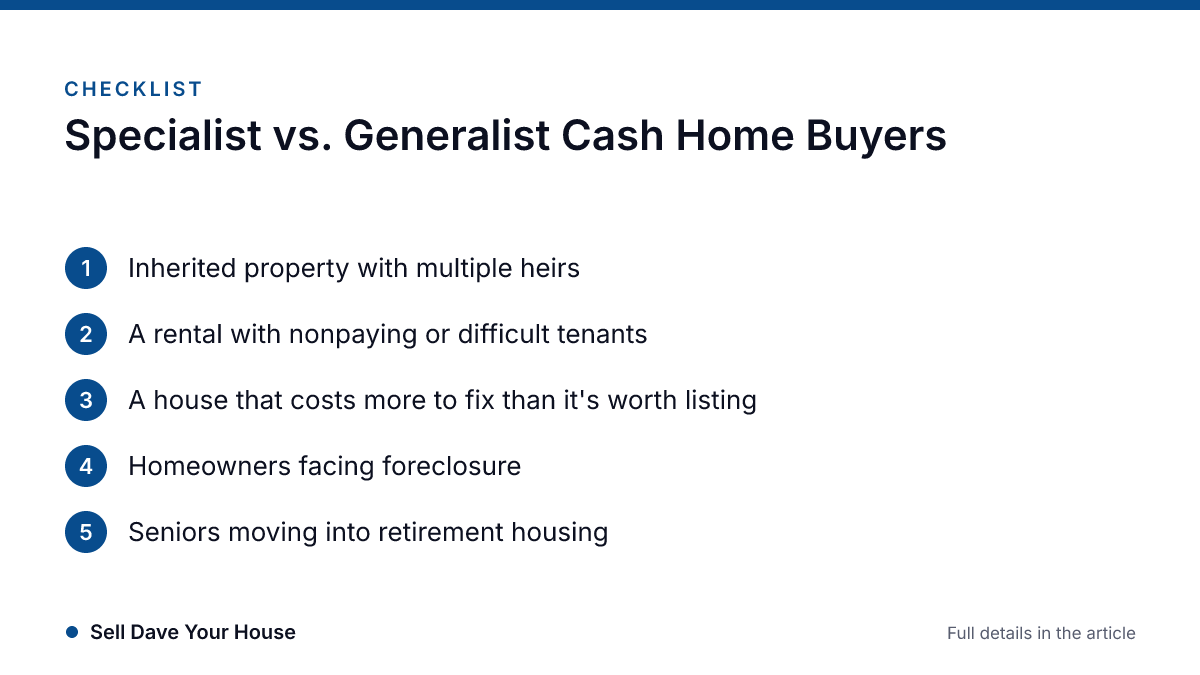
- Inherited property with multiple heirs who don't want to coordinate repairs, showings, and a mortgage payoff from three different area codes.
- A rental with nonpaying or difficult tenants where the landlord wants out without filing for eviction or waiting out a lease.
- A house that costs more to fix than it's worth listing, like foundation movement, a Federal Pacific panel nobody will insure, or storm damage that scares off a buyer's lender.
- Homeowners facing foreclosure who need a closing date measured in weeks and a payoff figure the title company can actually meet.
- Seniors moving into retirement housing who aren't about to manage a contractor and a 30-day listing at the same time.
- Out-of-state owners of Detroit-area property they've never physically walked through.
Whether the house sits in Detroit, Livonia, Dearborn, or Ferndale, a real specialist should be able to describe how they've handled each of those. Not just the one in their ad.
How do you compare offers when one buyer is a specialist and one isn't?
Compare net proceeds and certainty, never the headline number. An offer that gets cut 15% after inspection is worse than a smaller one that closes exactly as written. Get each number in writing, ask for proof of funds dated within the last 30 days, pin down a closing date, then line them up.
| Comparison factor | Specialist (local, metro-focused) | Generalist (national or multi-state) |
|---|---|---|
| Pricing accuracy | Usually tighter, built on street-level comps | Swings with data quality and how recently they've worked your area |
| Speed to offer | Often same day, or within 24–48 hours of a walkthrough | Can be quick, but a call-center layer and remote review slow some files |
| Local permitting knowledge | Has worked through Troy inspections and unpermitted-work issues before | Often learning the city's rules mid-transaction |
| Offer stability after inspection | Usually holds near the original number | More likely to renegotiate if ARV or repairs were off |
| Service area reach | Deep inside their core counties, thin outside them | Broad, useful if you own property in several states |
| Best fit | Sellers who want an accurate number on one specific street | Owners consolidating multiple out-of-state properties with one contact |
Pro tip: A verbal "we'd probably be around $300K" is not an offer. It's a conversation starter. Nothing counts until it's on paper with a proposed closing date and the words "as-is, no financing contingency" somewhere in it.
Which type of buyer should you actually call first?
If the house is in Metro Detroit and staying there, start with a specialist.
A buyer who's closed in Troy, Sterling Heights, and Southfield prices faster because they aren't waiting on a model. The bigger advantage is the bench behind them. Local buyers already have a title company that knows the county's probate desk, a roofer who'll give a real number over a photo, and an inspector who can get out in two days instead of two weeks. That's usually where the timeline is won or lost, not in the offer itself.
The generalist case is narrow but real. If you inherited a house here and another one in Arizona and you want one contact handling both, that convenience has value. Even then, get a second local opinion on the Michigan property before you sign. It costs you a phone call.
Troy's schools and its reputation as one of the safest cities in the state are a big part of why decent houses here draw competing interest from retail buyers, and that demand holds up resale value even on a house that needs work. A buyer who understands why that matters on your block will land closer to a fair number than one who doesn't.
What should you do next?
Get more than one number. Call a buyer who works Metro Detroit specifically, have them walk the house or review current photos, and ask for the offer and closing date in writing. If you're also weighing a national brand or an instant-offer tool, put that number through the same three questions: what are your comps, what's your repair estimate, and can the offer change after inspection?
If your property sits anywhere in Wayne, Oakland, or Macomb County, from Warren and Sterling Heights to Pontiac and Redford, call 586-500-7161 and get a local cash offer with no repairs, no agent fees, and no listing photoshoot.
Frequently asked questions
Can I negotiate a cash offer from either type of buyer?
Yes. Most legitimate buyers expect some back-and-forth, especially once you hand them information they didn't have: a five-year-old roof, a recent furnace, a clean inspection report, or comps you pulled yourself. Have that conversation before you sign, not after.
Does it matter which type of buyer I use if my house has multiple heirs or owners?
Not for the offer itself. It matters for the paperwork. A local buyer who's closed inherited properties can tell you whether your file needs full probate or whether a small-estate route works, how long your county's probate court is actually taking right now, and how the title company will split proceeds among heirs at closing. A call center a thousand miles away will tell you to ask your attorney.
Do I need to fix anything before getting a cash offer, regardless of who I call?
No. Both types buy as-is, so the repair cost is already inside their number. Spending $8,000 on a kitchen before you call rarely adds $8,000 to the offer. Keep the money and let the condition get priced in.