

How to Stop a Foreclosure Sale Fast in 2026
TL;DR:
- You can prevent foreclosure quickly by acting within a narrow window through bankruptcy, legal motions, or fast sales. Early communication with lenders and submitting complete applications more than 37 days before a sale can legally delay proceedings. Filing bankruptcy or selling to a cash buyer offers immediate relief and safeguards your financial future.
You can stop a foreclosure sale fast, but the window to act is narrow and every day counts. The most immediate options are filing for bankruptcy to trigger an automatic stay, submitting a complete loss mitigation application at least 37 days before the sale, or selling your home quickly to a cash buyer before the auction date. Federal law under Regulation X also prohibits servicers from starting foreclosure until you are more than 120 days delinquent, giving you a critical early window to act before the process even begins.
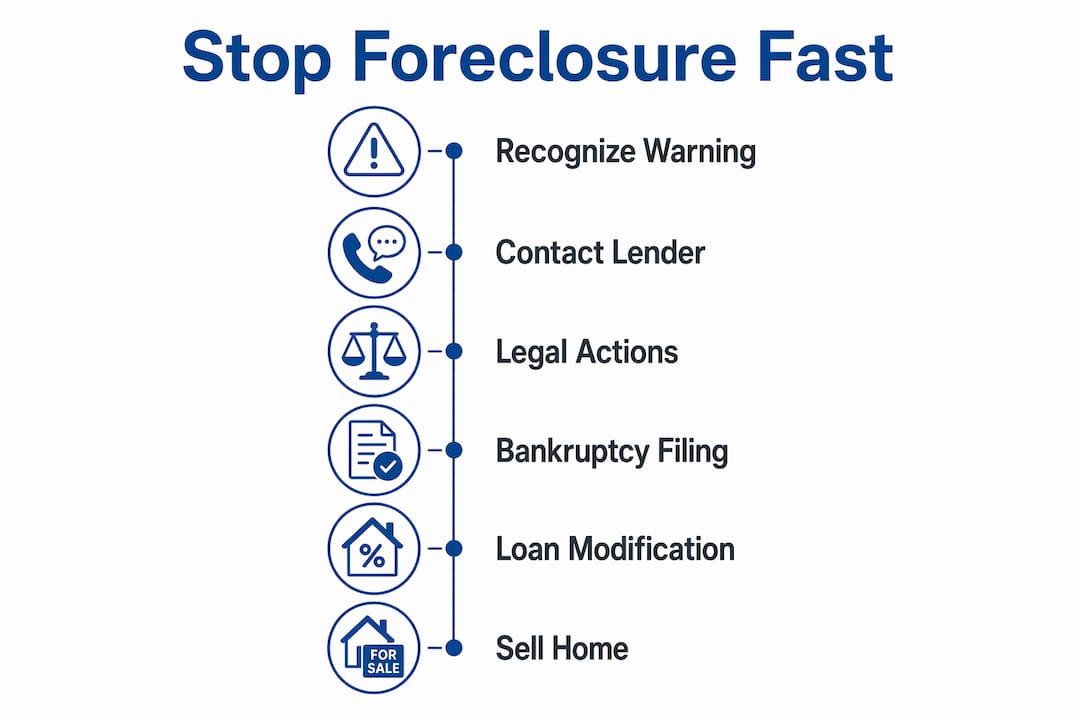
Here are the most urgent steps to take right now:
- Call your lender today. Request a loss mitigation application and ask about forbearance, repayment plans, or loan modification.
- Contact a HUD-approved housing counselor. Free counseling is available at HUD.gov and can help you assess every option quickly.
- Submit a complete loss mitigation application more than 37 days before any scheduled sale date to legally pause foreclosure proceedings.
- Consult a bankruptcy attorney if the sale is imminent. Filing Chapter 13 or Chapter 7 triggers an automatic stay that halts the auction immediately.
- Consider a fast cash sale. Selling your home before the auction date pays off the lender and stops the foreclosure entirely.
- Document everything. Keep records of every call, letter, and application you submit. Missed deadlines or incomplete paperwork can cost you your legal protections.
Pro Tip: The foreclosure sale date is not the deadline to start acting. It is the deadline by which you must have already acted. Begin your outreach, applications, and legal consultations the moment you receive any notice of default or foreclosure filing.
Why early communication with your lender can prevent foreclosure
The single biggest mistake homeowners make is waiting. Ignoring lender correspondence is the fastest path to losing your home, because every missed notice narrows your legal options and shortens your timeline. Reaching out to your servicer at the first sign of financial trouble, even before you miss a payment, opens the door to solutions that simply are not available once foreclosure proceedings begin.
Federal rules require servicers to notify you about loss mitigation options after you miss two consecutive payments. They must also assign you a dedicated point of contact by the 45th day of delinquency to help you navigate the process. That contact can tell you exactly what documents you need, the status of any application you have submitted, and what timelines apply to your situation.
A HUD-approved housing counselor can walk alongside you through this process at no cost. These counselors are trained to assess your full financial picture, identify which programs you qualify for, and communicate with your servicer on your behalf. Their involvement often leads to faster responses and better outcomes than homeowners navigating the process alone.
Common foreclosure prevention options available at the early stages include:
- Forbearance agreement: Temporarily reduces or pauses your payments while you recover financially.
- Repayment plan: Spreads your missed payments over several months added to your regular payment.
- Loan modification: Permanently changes your loan terms, such as the interest rate or repayment period, to make payments affordable.
- Reinstatement: Pays all overdue amounts in a lump sum to bring the loan current.
- Refinancing: Replaces your existing loan with a new one at better terms, if you still qualify.
Legal strategies that can stop or delay a foreclosure sale
Federal and state law give you real tools to delay or halt a foreclosure sale, but they require precise timing and proper documentation. Dual tracking protections under federal law require servicers to pause foreclosure when a complete loss mitigation application is pending and properly submitted. These are procedural safeguards, not a blanket cancellation of your debt, so the paperwork must be correct and timely.

Beyond the federal framework, some states offer additional protections. California’s Homeowner Bill of Rights, for example, prohibits dual tracking and gives borrowers extra time to submit applications and appeal denials. If your state has similar protections, a local housing attorney can help you use them strategically.
When a foreclosure sale is already scheduled, you may have grounds to seek a temporary restraining order or emergency injunction from a court. This is most effective when you can show the servicer violated procedural rules, failed to review a pending loss mitigation application, or made errors in the foreclosure process. Courts do not grant these orders automatically, so you need an attorney to file quickly and present a clear legal basis.
Key legal approaches and timing considerations:
- File a loss mitigation application more than 37 days before the sale to legally block the servicer from proceeding.
- Appeal a loan modification denial if your complete application was received 90 days or more before the scheduled sale.
- Challenge procedural errors in the foreclosure filing, especially in judicial foreclosure states where the lender must go through court.
- Request an emergency injunction when a servicer violates dual tracking rules or fails to evaluate a pending application.
- Understand your foreclosure type. Judicial foreclosure states (like Florida and New York) require court approval, which adds time. Non-judicial states (like Michigan and California) move faster, so your window is shorter.
- Act before the gavel falls. Foreclosure auctions transfer ownership immediately, and courts rarely reverse completed sales.
How bankruptcy filing can immediately stop a foreclosure sale
Filing for bankruptcy is one of the fastest legal tools available to stop a foreclosure sale. The moment you file, an automatic stay goes into effect under 11 U.S.C. § 362, which immediately halts all collection actions, foreclosure proceedings, and even phone calls from creditors. No court hearing is required for the stay to take effect. It happens automatically upon filing.
The chapter you file under makes a significant difference. Chapter 13 is the preferred path for homeowners who want to keep their property. It allows you to catch up on missed payments through a court-approved repayment plan spanning three to five years, while the automatic stay protects your home for the duration of the plan, as long as you continue making regular mortgage payments. Chapter 7, by contrast, typically provides only a short-term delay. Lenders can request relief from the stay, and courts often grant it in Chapter 7 cases where the homeowner has little equity or is not current on payments.
The automatic stay is powerful but not foolproof. If you have filed for bankruptcy multiple times in the past year, the stay may be limited to 30 days or may not apply at all. Courts also lift the stay in Chapter 7 cases when the debtor lacks equity or cannot demonstrate a path to repayment.
Key bankruptcy concepts to understand:
- Automatic stay: Takes effect the moment you file, stopping foreclosure sales, lawsuits, and collection calls.
- Chapter 13: Lets you keep your home by repaying arrears over a multi-year plan while staying current on ongoing mortgage payments.
- Chapter 7: Provides a temporary pause but rarely saves the home long-term; lenders typically obtain stay relief and resume foreclosure.
- Relief from stay: Lenders can petition the court to lift the stay, especially in Chapter 7 cases lacking equity.
- Filing deadline: You must file before the foreclosure sale is completed. Once the auction closes, the sale is final and bankruptcy cannot undo it.
Pro Tip: Do not file bankruptcy without an attorney. A bankruptcy lawyer can advise whether Chapter 13 or Chapter 7 fits your situation, help you file correctly the first time, and respond quickly if the lender moves to lift the stay.
Loan modification and loss mitigation options to avoid foreclosure sale
A complete loss mitigation application submitted more than 37 days before a scheduled foreclosure sale legally forces your servicer to pause the process and evaluate every option available to you. This is one of the most direct ways to prevent foreclosure quickly without filing bankruptcy or going to court. The CFPB’s mortgage servicing rules require the servicer to respond in writing within 30 days of receiving a complete application, explaining which options you qualify for and the reasons for any denial.
Loan modifications are the most common outcome of this process. A modification can lower your interest rate, extend your repayment term, or add missed payments to the back end of your loan. Federal Housing Administration loans have their own modification programs with specific eligibility criteria, and HUD resources can help FHA borrowers identify the right path. If your application is denied, you have the right to appeal as long as your complete application was received at least 90 days before the sale date.
Timely submission and complete documentation are what trigger these protections. A missing document or an incomplete form can disqualify your application and leave you without legal cover. Respond to every servicer request within the deadline given, and keep copies of everything you send.
Key mitigation options and steps:
- Loan modification: Permanently adjusts your loan terms to reduce monthly payments and bring the loan current.
- Forbearance: Pauses or reduces payments temporarily, with a repayment plan to follow.
- Repayment plan: Adds overdue amounts to future payments over an agreed period.
- Short sale: Sells the home for less than the balance owed, with lender approval, to avoid foreclosure on your record.
- Deed in lieu of foreclosure: Voluntarily transfers the home to the lender to satisfy the debt, avoiding a public auction.
- FHA programs: If your loan is FHA-insured, specialized modification and partial claim options may be available through HUD.
- Appeal a denial: Submit your appeal promptly in writing if your modification is denied and the sale is still 90 or more days away.
Selling your home quickly as an alternative to foreclosure
A fast home sale is often the most practical foreclosure rescue option when other strategies have not worked or time has nearly run out. Selling your home before the auction date pays off the outstanding mortgage balance, stops the foreclosure entirely, and lets you walk away with whatever equity remains rather than losing everything at auction. It also protects your credit far better than a completed foreclosure.

The challenge is speed. A traditional listing through a real estate agent typically takes weeks or months, which is time most homeowners in foreclosure do not have. Cash buyers are the practical solution here. They purchase homes as-is, skip the appraisal and financing contingencies that slow conventional sales, and can often close in as little as seven days. That speed is what makes the difference when a sale date is approaching.
Sell Dave Your House works specifically with Detroit-area homeowners in exactly this situation. With over 16 years of experience, the team provides a fair all-cash offer within 24 hours and can close on your schedule. You do not need to make repairs, clean the property, or pay agent commissions. The process is designed to move as fast as your situation demands. You can learn more about selling before foreclosure and what to expect from the timeline.
A short sale is another option worth considering if you owe more than the home is worth. The lender agrees to accept less than the full balance, which requires their approval and takes longer than a cash sale. For most homeowners racing against a sale date, a direct cash sale is faster and simpler.
Key urgent home sale strategies:
- Contact a cash buyer immediately to get an offer within 24 hours and understand your closing timeline.
- Notify your lender that a sale is pending; servicers often pause foreclosure when a legitimate sale is in progress.
- Gather your documents including the mortgage statement, title information, and any foreclosure notices to speed up the process.
- Compare net proceeds between a cash sale and a short sale to understand which leaves you in a better financial position.
- Confirm the closing date is before the scheduled foreclosure auction and get that confirmation in writing.
Pro Tip: If you are considering selling, read about how to sell without the usual stress before you engage any buyer. Understanding the process helps you move faster and avoid costly mistakes under pressure.
Are you ready to stop foreclosure fast? Sell Dave Your House can help.

If you are facing a foreclosure sale in the Detroit area and need to act now, Sell Dave Your House is ready to help. The team offers a fair all-cash offer within 24 hours and can close in as little as seven days, with no repairs, no agent fees, and no delays. Whether you are in Detroit, Harper Woods, Hazel Park, or anywhere across Metro Detroit, a fast cash sale may be the most direct path to stopping foreclosure and protecting your financial future.
Get a fast cash offer today and find out exactly what your home is worth and how quickly you can close.
Key Takeaways
Stopping a foreclosure sale fast requires acting before the auction date with the right legal or financial strategy, because completed sales are almost never reversed.
| Point | Details |
|---|---|
| Federal 120-day rule | Servicers cannot start foreclosure until you are more than 120 days delinquent, giving you an early window to act. |
| Loss mitigation deadline | Submit a complete application more than 37 days before the sale to legally pause foreclosure proceedings. |
| Bankruptcy automatic stay | Filing Chapter 13 or Chapter 7 halts foreclosure immediately, though Chapter 13 offers longer-term home protection. |
| Cash sale stops foreclosure | Selling to a cash buyer before the auction date pays off the lender and ends the foreclosure entirely. |
| Documentation is critical | Missed deadlines or incomplete applications can eliminate your legal protections, so respond to every notice promptly. |
FAQ
Does putting your house up for sale stop foreclosure?
Listing your home does not automatically stop foreclosure, but completing a sale before the auction date does. If the sale closes and the lender is paid off, the foreclosure ends entirely.
How fast can bankruptcy stop a foreclosure sale?
Bankruptcy triggers an automatic stay the moment you file, halting the foreclosure sale immediately. Chapter 13 can protect your home for years through a repayment plan, while Chapter 7 typically provides only a short delay.
What is the 37-day rule in foreclosure?
Federal law requires servicers to pause foreclosure and review your application if you submit a complete loss mitigation application more than 37 days before a scheduled sale. Missing that deadline removes this protection.
Can I stop a foreclosure sale at the last minute?
Yes, but your options narrow significantly. Filing bankruptcy or obtaining an emergency court injunction are the most immediate tools available when the sale is days away. Acting earlier gives you far more choices.
What happens if I do nothing before a foreclosure sale?
The auction proceeds, ownership transfers immediately, and courts rarely reverse completed sales. A completed foreclosure also causes lasting damage to your credit and eliminates any equity you had in the home.