

Tax Deed States Map: A Complete Investor Guide
A tax deed states map classifies every U.S. state and, in many cases, individual counties by whether they conduct tax deed sales, tax lien sales, or a hybrid of both. Your immediate next step: use the map to shortlist states that match your strategy, then open each county’s treasurer or tax collector page to confirm auction dates, redemption rules, and registration requirements. For initial orientation, Rocket Mortgage’s state guide and the Foreclosure Engine state notes are two of the most thorough secondary references available, and SmartAsset’s overview clearly explains the practical difference between owning a lien certificate versus acquiring property at auction.
The core distinction matters before you read a single map entry. A tax lien investor purchases a certificate and earns interest if the owner redeems the property. A tax deed investor bids on ownership of the property itself. Those two outcomes require completely different capital strategies, timelines, and risk tolerances.
Key Takeaways
A tax deed states map is a screening tool: use it to shortlist states, then verify every entry at the county level before you bid.
| Point | Details |
|---|---|
| Map as first filter | Use the map to narrow 50 states to a shortlist, then confirm rules at the county treasurer’s page. |
| No-redemption states | States like California, Michigan, and Ohio are commonly cited as having no post-sale redemption period. |
| Payment window | Winning bidders typically must pay in full within 48–72 hours; have certified funds ready before auction day. |
| CSV filtering | Filter a downloadable CSV by “no redemption” and “online auction” to match your capital and travel constraints. |
| Verify primary sources | Always confirm redemption language in the state statute and the county’s most recent auction notice before bidding. |
Table of Contents
- What does a tax deed states map actually show you?
- State-by-state chart: sale type, redemption period, and auction format
- What do the map’s sale-type labels actually mean?
- How redemption periods change your risk and timeline
- How to find county auction dates and registration rules
- Due diligence checklist and the main risks of tax deed buying
- How to use the map to prioritize which states to research first
- How to verify the map data before you act on it
- What experienced investors actually look for on the map
- Sources
- FAQ
What does a tax deed states map actually show you?
Most interactive tax deed states maps color each state by its dominant sale type: tax deed (often shown in one color), tax lien (another), and hybrid (a third). Clicking a state typically opens a panel with county-level details, redemption period notes, and links to county auction pages. That click-through layer is where the real value lives.
Several tools and resources are worth knowing:
- LienSuite aggregates county-level auction data, tracks upcoming sale dates, and lets you filter by state or sale type. It is particularly useful for investors who want a single dashboard rather than visiting dozens of county pages individually.
- Tax Sale Resources provides state-by-state data files and county auction calendars, with coverage that includes both online and in-person auction formats. Their data is updated periodically, so cross-check any auction date against the county’s own page before registering.
- Secrets of Tax Lien Investing (a widely circulated investor guide and course) walks through how to read state classification charts and explains the nuances of hybrid states. It is a useful orientation resource, especially for investors new to the asset class.
A static screenshot of a map is fine for a quick visual reference, but it tells you nothing about upcoming auction dates or recent rule changes. Use the live interactive version whenever you need county lists, current schedules, or downloadable CSV files. Pay attention to whether the map flags online vs. in-person auction formats, since many counties have shifted to online platforms post-2020. Also note that county coverage gaps exist on every third-party map: some rural counties update their auction schedules infrequently, and the map may lag by weeks or months.
As the Foreclosure Engine guide notes, state-by-state classifications are genuinely messy. Many states are hybrids where individual counties can choose either method, which means a state-level color on a map is a starting point, not a final answer.
State-by-state chart: sale type, redemption period, and auction format
The table below covers a representative set of states. Verify every entry at the county level before bidding; Taxdeedduediligence including sale type, redemption period, auction format, and county list links as the core columns in any investor reference table.
Important caveats:
- Texas is a notable example of state-specific complexity. Homestead properties carry a two-year redemption window; non-homestead properties carry six months. The premium owed on redemption also differs. Always confirm the property classification before bidding.
- Hybrid states like New York and Illinois have counties that operate under different rules within the same state. A county in upstate New York may run a tax deed sale while a neighboring county runs a lien sale.
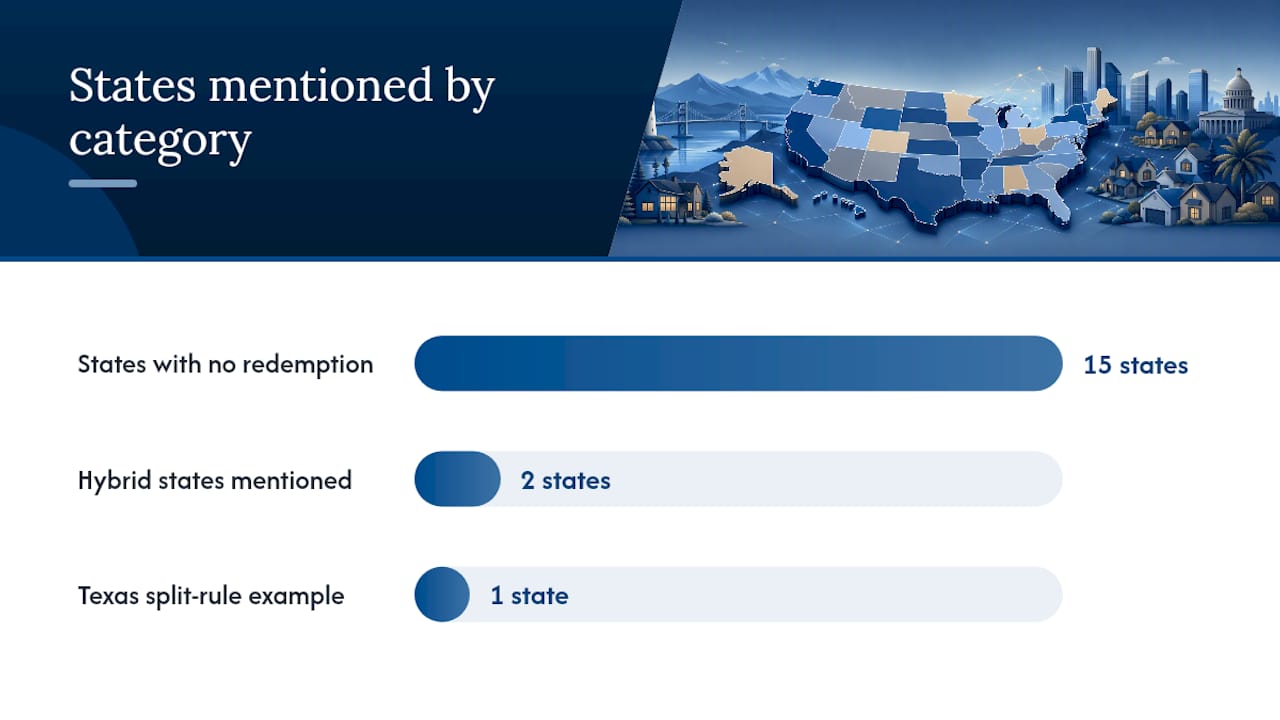
- States commonly cited as having no post-sale redemption period include California, Michigan, Ohio, North Carolina, Virginia, Delaware, Massachusetts, Maine, New Hampshire, Nevada, Minnesota, Wisconsin, Idaho, Utah, and North Dakota, among others, per Rocket Mortgage’s compiled state list. Treat that list as a screening tool, not a legal guarantee.
How to use a downloadable CSV:
- Filter the “sale type” column to “tax deed” and “no redemption” for the fastest path to clear title.
- Filter “auction format” to “online” if you cannot travel to in-person sales.
- Filter “redemption period” to short windows (under six months) if you want yield from redeemable deeds without a multi-year wait.
- Always open the “county list” link in the final column to confirm the data is current before adding a county to your watchlist.
What do the map’s sale-type labels actually mean?
Understanding the legend before you act on any map entry prevents costly misreads.
- Tax deed: The county sells the property itself at auction to recover unpaid taxes. The winning bidder receives a tax deed, which conveys ownership but may require a quiet title action to clear title for resale or financing.
- Tax lien (certificate sale): The county sells a lien certificate to an investor. The property owner retains the right to redeem by paying the back taxes plus interest. If the owner does not redeem within the statutory period, the lienholder can initiate foreclosure to obtain a deed.
- Redeemable deed: The winning bidder receives a deed at auction, but the original owner retains a statutory right to buy the property back within a defined redemption window by paying the purchase price plus a premium.
- Hybrid system: Some states allow individual counties to choose between deed and lien sales, or run both depending on property type or delinquency age.
- Redemption period: The window of time after a sale during which the original owner can reclaim the property by paying what is owed. It ranges from zero (no redemption) to several years.
- In rem foreclosure: A court-supervised process used in some states to extinguish liens and transfer title without naming individual lienholders as defendants. It can speed up title clearing.
- Quiet title action: A lawsuit filed to establish clear ownership and eliminate competing claims on a property acquired at tax sale. Many lenders require it before issuing a mortgage on a tax-deeded property.
The practical investor implication: a tax deed purchase targets property acquisition; a tax lien purchase targets interest income with a conditional path to ownership if the owner never redeems.
How redemption periods change your risk and timeline
Redemption periods are the single most important variable on any tax deed states map, because they determine how long you wait before you have clear, uncontested ownership.
- No redemption: States like California and Michigan allow no post-sale redemption. Once the auction closes and you pay, the prior owner’s right to reclaim the property is extinguished. Title clearing still takes time, but you are not waiting on a statutory clock.
- Short redemption (under six months): Texas non-homestead properties carry a six-month window. You hold the deed but cannot freely develop or resell until the period expires or the owner formally waives redemption.
- Long redemption (one to three years): Illinois and Arizona lien states can require two to three years before a lienholder can foreclose and obtain a deed. That timeline ties up capital and introduces the risk that the owner redeems at the last moment, leaving you with interest income but no property.
Example A (short redemption): You win a non-homestead property in Texas. The six-month clock starts at auction. If the owner does not redeem, you proceed to clear title around month seven. Total timeline from auction to usable deed: roughly eight to ten months including legal steps.
Example B (long redemption): You purchase a tax lien certificate in Illinois. The owner has up to three years to redeem. If they do, you collect interest. If they do not, you file for a tax deed around year three, then pursue quiet title. Total timeline to clear ownership: four years or more in a contested case.

Always confirm the exact statutory language at the county or state level before bidding. Redemption rules can vary by property type, delinquency age, or owner status, and a map’s summary label may not capture every condition.
How to find county auction dates and registration rules
State-level map data points you in the right direction. County pages close the deal.
- County treasurer or tax collector websites are the primary source for auction schedules, minimum bid amounts, and registration deadlines. Search “[county name] treasurer tax sale” to find the right page.
- County clerk or commissioner auction pages sometimes host the official notice separately from the treasurer’s site, particularly in states that require public notice publication.
- State-maintained public notice portals exist in several states (Florida’s Clerk of Courts portal and Michigan’s state treasury site are two examples) and aggregate county-level notices in one place.
Typical registration requirements include a refundable deposit (amounts vary widely by county), a government-issued bidder ID, and in some counties, proof of funds or a cashier’s check. Counties that use third-party online auction platforms, such as RealAuction, Bid4Assets, or GovEase, post their vendor links directly on the county treasurer’s page. Navigate to the county page first, then follow the vendor link to register.
Before adding a county to your watchlist, confirm: the next auction date, the redemption rules specific to that county, any title exceptions listed in the auction notice, and the minimum bid and payment deadline. Investopedia notes that winning bidders are typically required to remit full payment within 48–72 hours, so have funds ready before you bid, not after.
Due diligence checklist and the main risks of tax deed buying
Buying at a tax sale is not the same as buying through a traditional real estate transaction. You are acquiring a property with limited disclosure, often without an interior inspection, and sometimes with competing claims on title.
Top risks to assess before bidding:
- Outstanding mortgages or federal tax liens that survive the tax sale in some states
- Title defects from prior ownership gaps or recording errors
- Unknown property condition, deferred maintenance, or code violations
- Occupancy by former owners, tenants, or squatters
- Environmental hazards (underground storage tanks, contaminated soil)
- Redemption surprises, particularly in hybrid or redeemable-deed states
Pre-bid due diligence checklist:
- Pull a preliminary title search or title commitment from a local title company
- Review the full tax history and confirm the delinquency amount
- Estimate payoff for any surviving liens (federal tax liens do not always extinguish at tax sale)
- Check lien priority: IRS liens have a 120-day right of redemption even after a tax deed sale
- Drive by or arrange a physical inspection where possible
- Budget for quiet title legal costs, which can run several thousand dollars depending on complexity
- Confirm the payment window and have certified funds ready
Pro Tip: Before auction day, order a “O&E report” (Ownership and Encumbrance report) from a title company. It costs far less than a full title commitment and reveals mortgages, federal liens, and judgment liens in under 24 hours. Experienced bidders use it to screen out high-risk properties without spending on a full title search for every parcel.
Red flags that should give you pause:
- Federal tax liens recorded within the past 12 months (IRS redemption right applies)
- Active bankruptcy filings on the property owner (automatic stay may void the sale)
- Properties with environmental agency notices or open code enforcement cases
- Auction notices with unusually high minimum bids relative to assessed value
For investors handling probate or inherited properties acquired through tax sales, title clearing often involves additional steps beyond a standard quiet title action.
How to use the map to prioritize which states to research first
The map is a filter, not a decision. Use it to narrow a list of 50 states to three to five worth deeper research, then let county-level data drive the final call.
Priority checklist for filtering the map or CSV:
- Liquidity needs: If you need capital back within 12 months, filter to no-redemption tax deed states.
- Auction format preference: Filter to online auctions if you cannot travel. Many no-redemption states now offer fully online bidding.
- Redemption risk tolerance: If you are comfortable with a longer hold for higher yield, redeemable deed states like Texas or Georgia may suit you.
- State legal complexity: Some states require an attorney to complete the deed transfer or quiet title process. Factor legal costs into your return estimate.
- Title-clearing costs: States with active title insurance markets and established quiet title procedures (Florida, Michigan) tend to have lower legal friction than states where the process is less standardized.
Two example investor profiles:
Conservative investor (limited capital, wants fast acquisition): Filter the CSV to “tax deed / no redemption / online auction.” Michigan, California, and Ohio appear frequently on that filtered list. Research two to three counties in each state, focusing on counties with active online platforms and clear auction schedules.
Active acquirer (comfortable with 12-month hold, wants higher upside): Filter to “redeemable deed / short redemption / in-person or online.” Texas non-homestead and Georgia are common targets. The redemption premium adds yield if the owner redeems; if they do not, you acquire the property.
For investors thinking about long-term wealth building after acquiring properties, strategic tax planning can significantly affect net returns on tax-sale acquisitions.
How to verify the map data before you act on it
Secondary guides, including Rocket Mortgage and SmartAsset, are useful for initial orientation but sometimes list different redemption periods for the same state. Always link the map entry back to the primary statute or county notice before committing capital.
Authoritative sources to confirm:
- State statutes: Search “[state name] tax sale statute” or navigate to the state legislature’s official site. For example, Michigan’s General Property Tax Act (MCL 211.78) governs tax deed procedures; Florida’s Chapter 197 covers tax certificate and deed sales.
- County treasurer or tax collector pages: Confirm the county’s specific auction schedule, deposit requirements, and any local rules that differ from the state default.
- County recorder or register of deeds: Verify deed recording procedures and fees after a successful purchase.
- State judiciary or municipal code sites: Useful for confirming quiet title procedures and any recent statutory amendments.
Verification checklist:
- Confirm the relevant statute section and read the redemption language directly
- Check the county policy page for any local rules or exceptions
- Review the most recent auction notice posted by the county
- Confirm bidder registration requirements and payment windows
- Note whether the county uses a third-party platform and verify that platform’s own registration deadline
Practical cadence: Re-check the county page 30–45 days before the auction and again immediately after the county posts the official notice. Auction dates shift, minimum bids change, and registration deadlines can be shorter than you expect.
What experienced investors actually look for on the map
The workflow most experienced tax-sale investors follow is straightforward in theory and detail-heavy in practice. You shortlist states on the map, drill into two to three counties per state, run the due-diligence checklist on specific parcels, and register for the auction with funds already in place.
A few practical observations worth knowing before you start:
County pages are often incomplete. Redemption period language is sometimes missing from the auction notice itself and buried in a separate statutory reference. Budget time to find it. Payment windows are tighter than most new investors expect: the 48–72 hour window Investopedia describes is standard, and some counties require same-day payment for smaller sales. Maps go out of date. A state that ran in-person auctions in 2022 may have moved entirely online by now, and the map may not reflect that change. Always call the county treasurer’s office to confirm format and date if the online information is more than 60 days old.
If you acquire a tax-deeded property in Metro Detroit and want a fast exit, Sell Dave Your House has purchased properties in similar situations and can provide a cash offer within 24 hours. Closing in as little as seven days means you are not waiting months for a traditional buyer while carrying a property with unresolved title issues.
Sources
These resources cover different layers of the research process, from initial state screening to statutory confirmation:
- Tax Lien Investing vs. Tax Deed Investing
- Tax deed definition and auction mechanics — Investopedia
- Tax Deed vs. Tax Lien Sales — State-by-State Investor Guide | Foreclosure Engine
- Tax deed states: A complete guide for investors | Rocket Mortgage
- Taxdeedduediligence
FAQ
What states are tax deed states?
States commonly classified as tax deed states include California, Michigan, Ohio, North Carolina, Virginia, Delaware, Massachusetts, Maine, New Hampshire, Nevada, Minnesota, Wisconsin, Idaho, Utah, and North Dakota, among others. Many of these states have no post-sale redemption period, though you should confirm the rules for each county before bidding.
What are the risks of buying a tax deed?
The main risks include outstanding federal tax liens (which may survive the sale), title defects requiring a quiet title action, unknown property condition, active occupants, and environmental hazards. Running a preliminary title search and confirming lien priority before auction day reduces most of these risks significantly.
Is North Carolina a tax deed state?
Yes, North Carolina conducts tax deed sales and is generally listed as a no-redemption state, meaning the prior owner cannot reclaim the property after the auction closes. Confirm the specific county’s procedures on the county tax office website before bidding.
What is the difference between a tax deed and a tax lien?
A tax lien investor buys a certificate and earns interest if the property owner redeems; a tax deed investor bids on ownership of the property itself at auction. The two strategies differ in capital requirements, timelines, and the path to clear title.
How do I find county tax deed auction dates?
Start at the county treasurer or tax collector’s website and search for the tax sale or delinquent property auction page. Many counties now use third-party platforms like Bid4Assets or GovEase; the county page will link to the vendor platform where you register and bid.