

Timeline for Selling Home Before Relocating
If you have less than 30 days before you need to vacate, a cash or as-is offer is your best path. If you have 60 days or more and want the highest possible payout, a traditional listing usually wins. That’s the whole decision in one sentence, and everything else is execution.
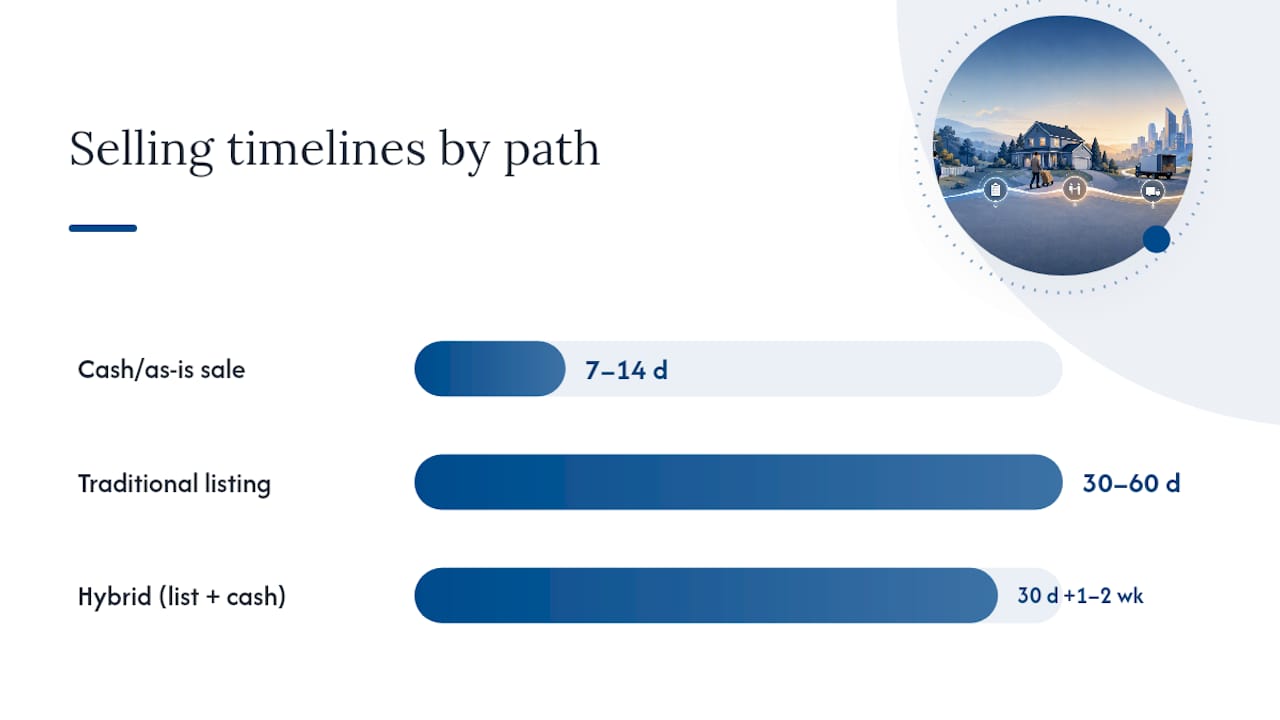
Here’s how the timeline breaks down: a cash sale with a buyer like Sell Dave Your House can close in 1 to 2 weeks, while a traditional sale typically takes 30 to 60 days once you’re under contract. Add in prep time, showings, and closing logistics, and a full buy-and-sell relocation often stretches to 2 to 6 months.
- Under 30 days to move: Go cash/as-is. Speed and certainty matter more than squeezing out the last dollar.
- 60+ days available: List traditionally to maximize net proceeds, with a cash offer as backup.
- Somewhere in between: Run both tracks at once, list the house while collecting a cash offer as insurance.
Key Takeaways
Choosing between a cash sale and a traditional listing depends almost entirely on how many weeks stand between today and your move-out date.
| Point | Details |
|---|---|
| Match strategy to your deadline | Choose cash/as-is if you have under 30 days; choose traditional listing if you have 60 or more. |
| Budget for carrying costs | Mortgage, taxes, insurance, and utilities on an empty house can erase much of a traditional sale’s price advantage. |
| Negotiate contingencies deliberately | Shorten inspection windows or add rent-back clauses to align closing with your actual move date. |
| Build in a buffer | Add 2 to 4 weeks of slack to any closing date to absorb title, inspection, or mover delays. |
| Consider a cash buyer for firm deadlines | Sell Dave Your House offers cash within 24 hours and can close in as little as 7 days for sellers facing a hard move-out date. |
Table of Contents
- Timeline Selling Home Before Relocating: Three Paths to Pick From
- What a Detailed Selling Schedule Looks Like Week by Week
- How Do You Choose the Right Selling Strategy?
- Financial Checklist: What Selling Really Costs You
- How Do You Negotiate a Contingency Period That Protects Your Move Date?
- When Does a Cash Buyer Make More Sense Than Listing?
- What Sixteen Years of Selling Homes Under Deadline Teaches You
- Sell Dave Your House Makes the Compressed Timeline Work
- Sources
- FAQ
Timeline Selling Home Before Relocating: Three Paths to Pick From
Every relocation sale boils down to three realistic paths, and picking the wrong one costs you either money or time you don’t have.
Cash sale. You accept an as-is offer from a company or investor, skip repairs and staging, and close whenever you’re ready, often within 7 to 14 days. The trade-off is a lower sale price in exchange for zero uncertainty.

Traditional MLS listing. You hire an agent, prep the house, and wait for the market. This route typically takes 30 to 60 days to close after you accept an offer, and it usually nets more money, assuming the sale doesn’t fall through during inspection or financing.
Hybrid fallback. You list the house for a short window, say 30 days, while simultaneously getting a cash offer in hand. If the market doesn’t deliver, you already have a fallback ready to close fast.
| Path | Typical duration | What runs in parallel |
|---|---|---|
| Cash/as-is sale | 7 to 14 days | Title search, document signing, no repairs needed |
| Traditional listing | 30 to 60 days after offer | Staging, showings, inspection, mortgage contingency |
| Hybrid (list + cash backup) | 30 days testing, then 1 to 2 weeks if you pivot | Marketing the listing while vetting a backup cash offer |
If your employer set a firm start date or your relocation package includes temporary housing, the cash and hybrid paths give you the most control over your calendar.
What a Detailed Selling Schedule Looks Like Week by Week
The tasks are the same whether you have two weeks or two months. What changes is how much you compress them.
Urgent timeline: under two weeks
- Day 1 to 2: Contact a cash buyer, share basic property details, request a written offer.
- Day 2 to 4: Schedule an on-site walkthrough, receive your offer (often within 24 hours of the visit).
- Day 4 to 6: Review and sign the purchase agreement, gather your mortgage payoff statement and deed.
- Day 6 to 10: Title company runs a title search and prepares closing documents.
- Day 10 to 14: Sign at closing, receive funds, hand over keys.
Standard timeline: 30 to 90 days
- Weeks 1 to 2: Interview and select an agent, order a pre-listing inspection to catch surprises early, especially for older sewer lines or roofing.
- Weeks 2 to 4: Handle minor repairs, declutter, and stage the home. Redfin’s research shows this pre-list prep window is where sellers most often run out of time.
- Week 4: Professional photos and the listing goes live.
- Weeks 4 to 6: Showings and open houses. Spring listings, particularly late May, tend to move faster than winter ones.
- Weeks 6 to 8: Offer negotiation, inspection period, and appraisal for the buyer’s lender.
- Weeks 8 to 12: Final walkthrough and closing.
While the house is on the market, your relocation prep should run on its own clock. Start requesting mover quotes the moment you list, not after you accept an offer. Confirm temporary housing options early if your new job’s start date lands before your closing date, and keep packing non-essentials throughout the listing period rather than waiting for an accepted offer.
Pro Tip: Build a 2 to 4 week buffer between your projected closing date and your actual move-out deadline. Title issues, inspection renegotiations, and mover scheduling conflicts are common enough that a tight timeline with zero slack usually breaks somewhere.
How Do You Choose the Right Selling Strategy?
Your decision comes down to a handful of concrete factors, not gut feeling.
- Hard move-out date: How many weeks do you actually have before you must be gone?
- Employer start flexibility: Can your new job’s start date shift by even a week if needed?
- Relocation benefits: Does your employer cover temporary housing or storage, buying you extra runway?
- Carrying-cost tolerance: Can you afford mortgage, taxes, and utilities on an empty house for an extra month or two?
- Local market speed: Are homes in your neighborhood moving in two weeks or two months?
- House condition: Does it need repairs you don’t have time or cash to make?
Weigh these against a simple trade-off: a traditional sale might net you $20,000 more on paper, but if it drags on for 60 extra days of mortgage payments, insurance, and a rental you’re also paying for, that gap shrinks fast. Early planning is what protects that math, since sellers who wait until the last month usually lose the option to test the market at all.
Pro Tip: If your timeline is uncertain, run a hybrid: list for 30 days with a firm cash offer already secured as a fallback. This protects your upside without risking your move date.
Financial Checklist: What Selling Really Costs You
Before you commit to a path, run the numbers. Net proceeds, not sale price, is what actually lands in your pocket.
- Mortgage payoff balance — get an updated payoff statement, not just your last statement balance.
- Property taxes and insurance owed through closing.
- Utilities and lawn or property care for every month the house sits unsold.
- Realtor commissions, typically the largest line item in a traditional sale.
- Repair costs needed to make the house market-ready.
- Closing costs, including title fees and transfer taxes.
- Temporary housing if your closing date lands after your move-out date.
- Moving and storage fees.
A simple example: say a traditional sale nets $15,000 more than a cash offer on paper. If it takes 60 extra days and you’re covering $1,800 a month in mortgage, taxes, and insurance on an empty house, that’s $3,600 gone before you even count temporary housing. Hidden carrying costs like these routinely narrow the gap between a cash offer and a retail sale more than sellers expect.
Cash sales close faster and carry a lower fall-through risk than traditional listings, which do collapse more often over financing or inspection disputes. That certainty has real value when your move date isn’t negotiable.
How Do You Negotiate a Contingency Period That Protects Your Move Date?
Contingency periods, the window a buyer has to inspect the home or secure financing, typically run 30 to 60 days. If your move date is tighter than that, you negotiate around it, not against it.
- Propose a shorter inspection contingency (7 to 10 days instead of 14) if your local market supports it.
- Add a rent-back clause letting you stay in the home for a set period after closing while you finish packing.
- Use an occupancy window or escrow holdback to separate your move date from the buyer’s closing date.
- Say plainly in your offer terms: “Seller requests a 45-day close with a 10-day post-closing occupancy period.”
If your employer offers a relocation coordinator, loop them in early. They’ve seen these timing conflicts before and can sometimes flex your start date by a week or two, which buys real breathing room for negotiation.
Pro Tip: Get your lender, title company, and agent talking to each other directly once you’re under contract. Most closing delays come from documents bouncing between parties, not from major problems.
When Does a Cash Buyer Make More Sense Than Listing?
Some situations don’t leave room for a 60-day process, no matter how well you plan.
A cash buyer like Sell Dave Your House gives you a fair offer within 24 hours and can close in as little as 7 days, which changes the math when your start date is fixed and non-negotiable. This route makes the most sense when:
- Your move-out date is under 30 days away.
- The house needs repairs you don’t have time or budget to make before listing.
- You’d rather skip showings, negotiations, and appraisal delays entirely.
Before you contact a cash buyer, gather your mortgage payoff statement, the deed, and recent utility bills. This speeds up the offer and closing process considerably.
Getting more than one cash offer before you accept anything lets you benchmark whether the price is fair for your specific situation, rather than assuming the first number you hear is the market rate.
Two offers, minimum. It costs you nothing but a day or two, and it tells you whether you’re getting a reasonable deal.
What Sixteen Years of Selling Homes Under Deadline Teaches You
Working backward from a hard move-out date isn’t just a planning trick, it’s the only approach that consistently works. Over 16-plus years of buying homes directly from owners facing relocation, foreclosure, and hardship, the Sell Dave Your House team has seen that sellers who start with their deadline and work backward avoid the last-minute scramble that traps everyone else.
Sell Dave Your House Makes the Compressed Timeline Work
If your move-out date is weeks away and a traditional listing simply doesn’t fit, Sell Dave Your House is the direct alternative to hiring an agent and waiting out a 30 to 60 day sale. There’s no staging, no repairs, no showings on your calendar, and no financing contingency that can fall apart three weeks before your closing.

Sell Dave Your House buys homes across Metro Detroit as-is, covers standard closing costs, and gives fair cash offers within 24 hours, with closings possible in as little as 7 days. This fits homeowners facing foreclosure, an inherited property they don’t have time to fix up, or simply a relocation deadline that a traditional sale can’t meet. If your situation involves a rental property rather than your primary residence, Sell Dave Your House also works with landlords selling in Detroit who need out from under a property before they move.
Get your no-obligation cash offer within 24 hours and see exactly how fast your specific timeline could move.
This article is general information, not a substitute for advice from a qualified financial advisor. Consult a qualified financial professional about your own circumstances before acting on anything here.
Sources
- Selling Your House for a Job Relocation: A Complete Guide - Redfin
- Timeline for selling your home - Zillow
- Moving timeline step-by-step guide for buyers & sellers - RE/MAX
FAQ
How long does it take to sell a house before relocating?
A cash sale typically closes in 1 to 2 weeks, while a traditional sale usually takes 30 to 60 days after you accept an offer. Full relocation timelines, including prep and closing, often run 2 to 6 months.
Should I sell my house before or after I move?
Selling before you move avoids double housing costs and lets you close out your mortgage cleanly, but it only works if your timeline allows it. If your move-out date is fixed and near, a cash sale like the one Sell Dave Your House offers can close before you have to be gone.
What’s the fastest way to sell a house for relocation?
An as-is cash sale is the fastest route, often closing in 7 to 14 days with no repairs, staging, or financing contingencies to slow things down.
How much notice should I give before listing my house?
Start preparing at least two months before you plan to list if you’re going the traditional route, since pre-list inspection, repairs, and staging take real time. If you have less runway than that, a cash offer avoids the prep phase entirely.
Can I negotiate a rent-back after closing to finish my move?
Yes. A rent-back clause lets you stay in the home for an agreed period after closing while you finish packing, and it’s a common way to align a buyer’s closing date with your actual move-out date.