

Close in 7 Days With a Cash Sale Despite Detroit Title Problems
Yes, you can sell a Detroit house with title issues, but the fastest guaranteed path is selling as-is to a local cash buyer or using an escrow holdback while curative work proceeds. A local cash buyer can close around most title defects. The exception is probate disputes or contested ownership claims, which usually require court time before any sale can close.
TL;DR:
- Most title issues in Detroit, such as unpaid liens or clerical errors, can be resolved before or during closing with proper payoffs or affidavits.
- Quiet title disputes caused by contested ownership or heirs typically take 60 to 120 days to resolve through court actions, which can significantly delay sales.
- A preliminary title report ordered early provides time to address minor defects like unpaid property taxes or recorded errors, avoiding last-minute surprises.
- Selling as-is to a cash buyer is the fastest alternative when title defects require court procedures or lengthy quiet title actions, often closing in as little as seven days.
- Legal assistance becomes essential only for complex disputes involving fraud, uncooperative heirs, or contested liens, while simpler issues are handled by title companies.
Table of Contents
- Common Title Defects Detroit Sellers Should Look For
- How Do You Confirm What’s on Your Title?
- What Fixes Cost, and How Long They Take
- When Should You Call a Real Estate Attorney?
- Your Fastest Options to Close Without Delay
- How a Local Buyer Handles Title Problems in Practice
- Get a Fast, As-Is Offer From Sell Dave Your House
- Where to Verify Title Rules and Get Official Help
- Sources
- FAQ
Common Title Defects Detroit Sellers Should Look For
Most Detroit title problems fall into a handful of predictable categories, and the sooner you spot them, the more selling options you keep. Unpaid liens, unresolved probate matters, unreleased mortgages, and clerical recording errors show up more often in Michigan than any other type of defect.
Here’s what typically surfaces on a title commitment for a Detroit property, along with how urgent each one really is:
- Unpaid property tax liens — appear as recorded encumbrances; usually solvable with a payoff at closing.
- Unreleased mortgages or HELOCs — the prior lender never filed a satisfaction; needs a payoff letter and recorded release.
- Contractor or mechanic’s liens — filed by unpaid tradespeople; often negotiable but can stall closing if contested.
- Unpaid municipal water or sewer charges — Detroit’s Water and Sewerage Department can attach charges to the property itself, not just the owner, so these follow the house even after a sale.
- Unresolved probate or inherited-owner issues — common in Detroit’s older housing stock where a deceased owner’s name is still on record; can require a quiet title action if heirs disagree.
- Clerical or recording errors — misspelled names, wrong legal descriptions; usually fixed fast with a corrective affidavit.
- Missing or forged deeds — rare but serious; almost always needs an attorney and possibly court involvement.
- Easements and boundary disputes — can slow a sale if a neighbor or utility company has an unresolved claim on part of the lot.
If you inherited the property, start with resources built specifically for that situation, like this guide on selling an inherited home in Detroit, since probate issues are the single most common reason Detroit title searches come back with red flags.
How Do You Confirm What’s on Your Title?
A title search is the process. A title commitment is the document that comes out of it. The search digs through public records at the county Register of Deeds, and it commonly surfaces liens, easements, mortgages, tax records, and judgments that affect whether you can transfer clear ownership.
A title company or the buyer’s attorney typically orders the search once you’re under contract, but you don’t have to wait that long. Requesting a preliminary title report before you list gives you weeks of lead time to cure minor issues instead of scrambling during escrow. When the commitment lands, focus on three things: the effective date (how current the information is), the schedule of exceptions (every recorded item that must be cleared before a policy issues), and the referenced document numbers, which point you to the exact recordings you’ll need copies of.
Before you list, gather these documents so cures move faster once problems surface:
- Payoff letters from any lender that may still show an open mortgage.
- Copies of recorded documents referenced in a prior title report, if you have one.
- Receipts or statements showing paid property taxes and municipal utility accounts.
- The recorded deed from when you (or the person you inherited from) took ownership.
Pro Tip: Order your preliminary title report the same week you decide to sell, not after you accept an offer. A defect found early is a phone call. A defect found during escrow is a delay.
What Fixes Cost, and How Long They Take
Not every title defect requires a lawyer or a courtroom. The cure depends entirely on whether the problem is administrative or contested, and that distinction drives both your timeline and your legal bill.
- Corrective affidavits and recorded releases. Clerical errors, name misspellings, and satisfied liens that were never officially released get fixed with a document filed at the Register of Deeds. Expect days to a couple of weeks, and cost is usually limited to recording fees.
- Lien and tax payoffs. A payoff letter from the lender or taxing authority lets the title company record a satisfaction at closing. If the payoff can’t be finalized before your closing date, an escrow holdback lets the sale proceed while funds are set aside to cover it.
- Probate transfers via quitclaim. When all heirs agree and are identified, a quitclaim deed can transfer interest without going to court.
- Quiet title actions. When heirs disagree, an owner can’t be located, or a lender no longer exists to release an old mortgage, Michigan law under MCL 600.2932 allows a court to issue a judgment settling ownership. Uncontested cases commonly take several weeks to a few months.
Cost scales with conflict, not complexity. Routine, uncontested quiet title cases typically run in the low thousands of dollars, while contested cases with multiple claimants or missing parties push both the timeline and legal fees considerably higher. A “ghost mortgage” from a defunct bank sounds like the scariest defect on paper, but it’s often resolved faster than a probate dispute between siblings who disagree about the will.
When Should You Call a Real Estate Attorney?
Title companies are excellent at coordinating payoffs and recording releases at closing, but they don’t provide legal representation when a dispute needs to be argued in front of a judge. That’s where an attorney earns their fee.
Call one when you’re facing:
- Heirs who disagree about ownership or inheritance shares.
- Suspected fraud, a forged deed, or a signature you can’t verify.
- A lender that dissolved or merged and never released a mortgage.
- A neighbor contesting a boundary line or claiming an easement right.
- Anyone challenging the validity of a recorded lien.
An attorney handles the parts a title company legally can’t touch: drafting a quiet title complaint that names every potential adverse claimant, representing you in court, negotiating lien releases directly with creditors, and pursuing service by publication when a defendant can’t be located, a specific procedure under Michigan court rules. Legal counsel is often the difference between a stalled sale and a closed one once a dispute moves past simple paperwork. Weigh attorney fees against what’s at stake: on a property worth six figures, a few thousand dollars in legal costs to protect your equity is rarely the expensive option.
Your Fastest Options to Close Without Delay
Once you know what’s wrong with your title, you have three realistic paths forward, and the right one depends on how fast the defect can actually be cured.
Escrow holdback or payoff escrow. Funds from the sale get placed in a controlled account instead of going to you directly, and they’re released once a specific claim, like an old lien, is satisfied. Title companies commonly accept this arrangement when the fix is straightforward but won’t be finished by closing day. You’ll need clear instructions in the settlement statement and a title company willing to structure it that way.
Selling as-is to a local cash buyer. This is the option that sidesteps the timeline problem entirely. A cash buyer purchases the property with the title issue disclosed, then works with a title company or attorney to resolve it after closing or as part of the transaction. You trade some negotiating leverage on price for speed and certainty, which matters most when you’re facing foreclosure, a probate deadline, or simply can’t afford months of holding costs.
Use this simple decision rule:
- If the defect is a quick administrative fix (payoff, corrective affidavit), proceed toward a normal closing with a payoff or holdback.
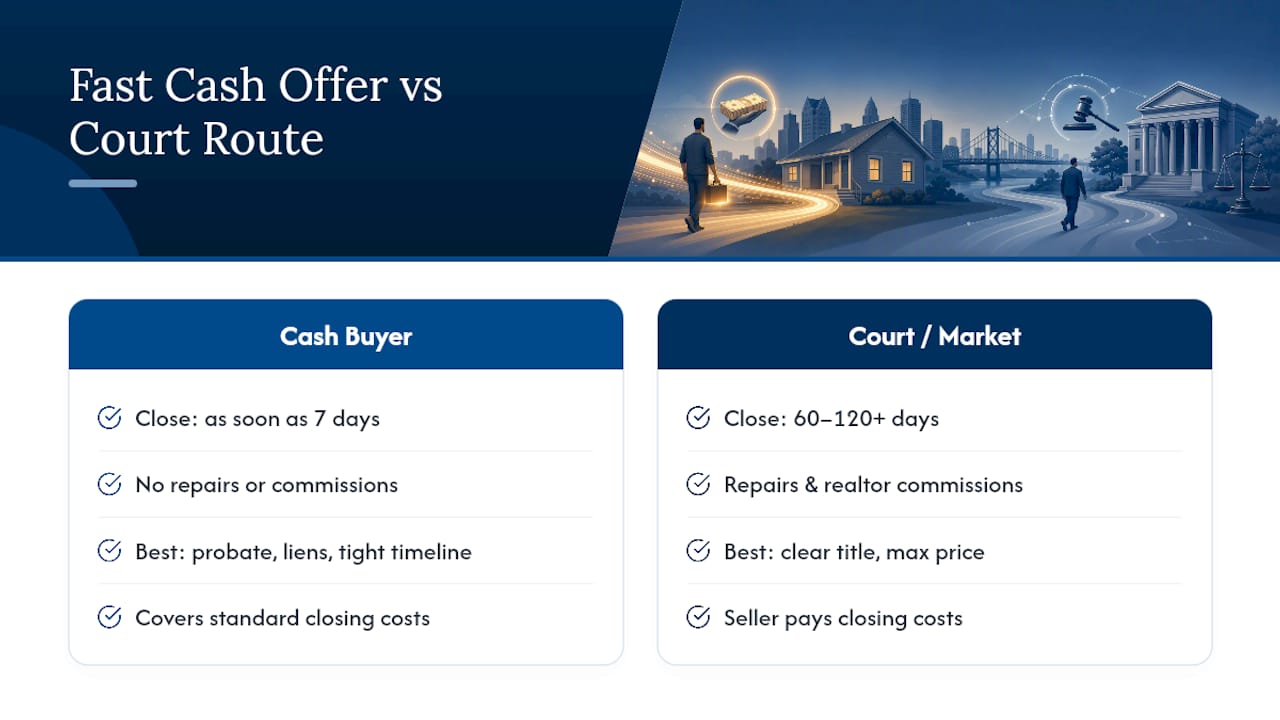
- If it requires probate court or a quiet title action, your timeline just extended by months. That’s when a cash sale to a buyer like Sell Dave Your House starts making the most sense.
Pro Tip: Don’t assume a title defect kills your sale price. Many buyers, including cash buyers, factor in a known and disclosed issue rather than walking away, especially when the defect has a clear cure path. Learn more about how a cash sale works from offer to closing.
How a Local Buyer Handles Title Problems in Practice
Some local buyers specialize in purchasing Detroit homes as-is, handling title complications as part of their routine. Sellers may receive a cash offer quickly and can close in as little as seven days on properties without complications. The buying team typically coordinates directly with title companies and, when needed, an attorney to handle curative documents like payoff letters or corrective affidavits.
If you’re sitting on a property with a lien, an old mortgage, or a probate question and you’re not sure what your options are, a no-obligation review costs you nothing and gives you clarity fast.
— Real Estate Team
Get a Fast, As-Is Offer From Sell Dave Your House
A local cash buyer can offer a direct alternative to waiting out a quiet title action or chasing down a defunct lender for a release. Sellers can receive a fair cash offer quickly, without repairs or commissions, and potentially close in as little as seven days once title work allows it.

This route makes the most sense for specific situations: probate that’s dragging past your patience, a lien you can’t get the original creditor to acknowledge, or simply a timeline that can’t stretch for a 60 to 120 day court process. Sell Dave Your House buys homes across Metro Detroit, including rental properties and inherited houses still working through probate, and covers standard closing costs along the way.
If you need to know your options today, get a fair cash offer now and find out exactly where your title situation stands.
Where to Verify Title Rules and Get Official Help
Confirm your county’s process at the Wayne County Register of Deeds, review Michigan’s quiet title statute, and read how title insurance protects you at closing before signing anything.
This article is general information, not a substitute for advice from a qualified lawyer. Consult a qualified legal professional about your own circumstances before acting on anything here.
Sources
- Common title defects in Michigan homes
- Quiet title in Michigan
- Michigan quiet title actions — Black River Law
- Quiet title actions: The reset button for title
FAQ
Can You Sell a House in Detroit With a Title Problem?
Yes, in most cases. Administrative defects like unpaid liens or clerical errors can be cured before or at closing, while contested issues like probate disputes may need a quiet title action first.
How Long Does a Quiet Title Action Take in Michigan?
Uncontested quiet title cases under MCL 600.2932 typically take 60 to 120 days. Contested cases with multiple claimants take longer and cost more.
What Does an Escrow Holdback Do?
An escrow holdback lets a sale close on schedule while funds are set aside in a controlled account to satisfy a specific title defect afterward. It’s a common workaround when a fix is simple but not yet finished.
Does Sell Dave Your House Buy Houses With Title Issues?
Yes. Sell Dave Your House buys Detroit homes as-is, including properties with liens, probate complications, or unresolved mortgages, and coordinates with title companies or attorneys as needed to move toward closing.
Do I Need an Attorney for a Minor Title Defect?
Usually not. Clerical errors, satisfied liens, and simple payoffs are typically handled by a title company. Reserve attorney fees for contested claims, suspected fraud, or missing parties who need to be served by publication.