

What Is a 24-Hour Cash Offer on Your Home?
TL;DR:
- A 24-hour cash offer is an all-cash proposal delivered within one day, enabling closings in as few as 7 to 14 days. It removes mortgage delays, reduces risks, and benefits homeowners facing foreclosure, divorce, or emergencies by providing faster, more certain sales. Though typically 70-80% of market value, cash offers save on commissions and repairs, making them a practical choice in urgent situations.
A 24-hour cash offer is a firm, all-cash purchase proposal delivered to you within one day of a buyer evaluating your property, bypassing the mortgage underwriting and appraisal delays that define traditional real estate sales. Unlike a conventional offer that depends on a lender’s approval, this type of proposal carries no financing contingency. That single difference is what makes cash transactions close in as few as 7–14 days, compared to the 30–60 days a standard sale typically requires. For homeowners facing foreclosure, a divorce, an inherited property, or a financial emergency, that speed is not a convenience. It is often the deciding factor.
What is a 24-hour cash offer and how does it work?
A 24-hour cash offer follows a straightforward sequence that replaces weeks of back-and-forth with a single, fast evaluation. Here is what you can expect at each stage.
- Property evaluation. A cash buyer reviews your home, either in person or through photos and public records. This assessment typically takes a few hours and focuses on condition, location, and comparable sales in your area.
- Offer delivery. Within 24 hours of the evaluation, you receive a written purchase proposal. The offer states the purchase price, the proposed closing date, and any remaining contingencies, usually limited to a title search.
- Proof of funds. A legitimate cash buyer provides a bank statement or a letter from a financial institution confirming the funds exist. This replaces the mortgage pre-approval letter used in traditional deals and signals real commitment.
- Contract signing. If you accept, both parties sign a purchase agreement. Because no lender is involved, there is no underwriting period.
- Closing. Title searches can extend closing to up to 21 days, but with a clear title, some deals close in as few as 5 business days. The funds transfer directly to you at closing.
Pro Tip: Ask for proof of funds before signing anything. A credible buyer will provide it without hesitation. If a buyer stalls on this request, treat it as a warning sign.
The absence of a lender removes the single biggest source of delay in residential real estate. No appraisal ordered by a bank, no underwriting committee, no rate-lock expiration. The timeline is controlled by paperwork and title work alone.

How do 24-hour cash offers compare to traditional home sales?
The financial and logistical differences between a quick cash sale and a traditional listing are significant. Understanding them helps you make a clear-eyed decision.
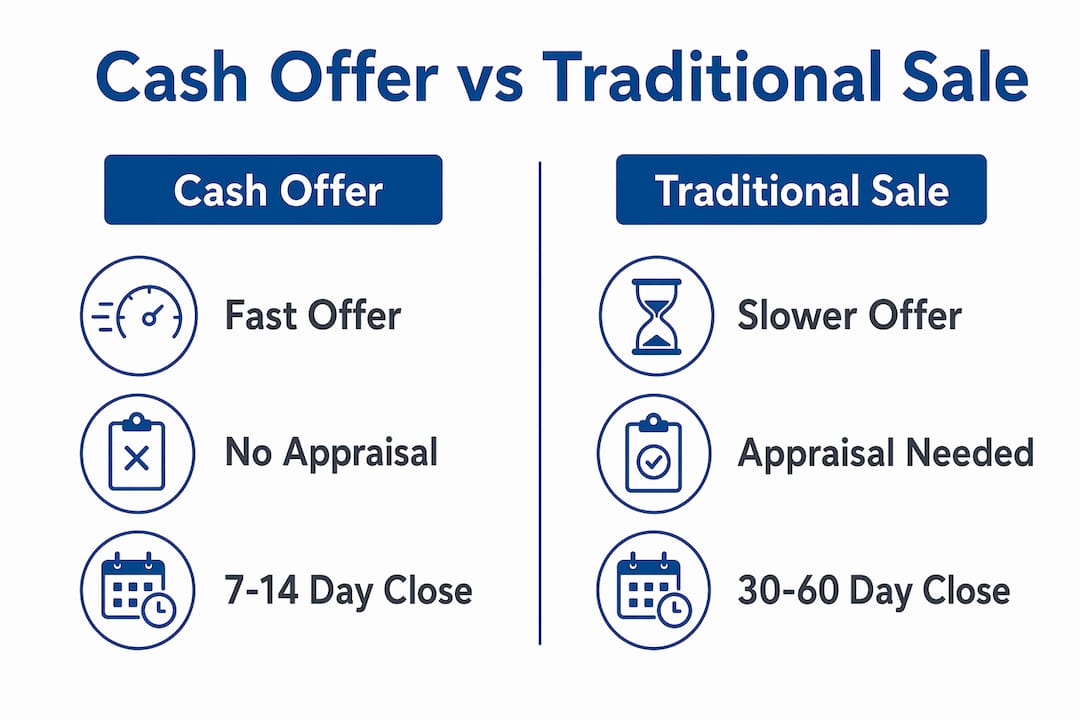
| Factor | Cash offer | Traditional sale |
|---|---|---|
| Time to receive an offer | Within 24 hours | Days to weeks after listing |
| Time to close | 7–14 days (up to 21) | 30–60+ days |
| Agent commissions | None | 5–6% of sale price |
| Seller closing costs | Typically covered by buyer | Paid by seller |
| Repairs and staging | Not required | Usually expected |
| Offer price | 70–80% of market value | 95–100% of market value |
| Deal fall-through risk | Very low | Higher with financing |
Cash offers carry a 95%+ success rate for closing. That compares favorably to financing-dependent deals, where a buyer’s loan can fall apart at any stage. The certainty alone has real financial value, especially if you are already carrying a mortgage, property taxes, and utility bills on a home you need to exit.
The trade-off is price. Investors typically offer 70–80% of market value to account for repair costs, holding expenses, and their own profit margin. That discount can feel significant. However, when you subtract the 5–6% agent commission, seller closing costs, and any repairs a traditional buyer would demand, the net difference often narrows considerably.
- You pay no agent commissions in a cash sale, which on a $200,000 home saves you $10,000–$12,000 immediately.
- Cash buyers cover repair and staging costs, removing expenses that can run into the tens of thousands on older homes.
- Holding costs, including mortgage payments, insurance, and taxes during a 60-day traditional sale, add up fast and eat into your final proceeds.
Pro Tip: Run a simple net proceeds calculation before deciding. Subtract commissions, estimated repairs, and two months of carrying costs from the traditional sale price. Then compare that number to the cash offer. The gap is usually smaller than it first appears.
What are the common misconceptions about cash offers?
Several misunderstandings about quick cash real estate offers lead homeowners to make poorly informed decisions. Knowing the facts protects you.
- “As-is” does not mean no disclosures. Sellers remain legally obligated to disclose known material defects even in cash transactions. Selling as-is means the buyer accepts the condition, not that you can hide a leaking roof or a foundation problem. Failing to disclose can expose you to legal liability after closing.
- Inspection contingencies can allow renegotiation. Some cash buyers include an inspection period in the contract. If the contract does not explicitly state that the price is final regardless of inspection findings, a buyer can use the inspection to push for a lower price at the last minute. Sellers should negotiate contracts that preclude renegotiation after inspection to prevent this tactic.
- Earnest money is your protection. Cash buyers provide earnest money deposits as a sign of commitment. If a buyer walks away without a valid contractual reason, you keep those funds. This gives you real leverage and makes the offer more than just a verbal promise.
- The discounted price reflects real costs. Buyers factor in repair costs, holding expenses, and profit margins when calculating their offer. The discount is not arbitrary. It reflects the risk and cost the buyer is absorbing so you do not have to.
- You are not obligated to accept. A cash offer is a no-obligation quote. You can review it, decline it, and walk away without penalty. No reputable buyer will pressure you into a decision.
Understanding these points puts you in a stronger position at the negotiating table. Read every contract clause carefully, and consider having a real estate attorney review the agreement before you sign.
Who benefits most from a 24-hour cash offer?
A fast cash sale is not the right fit for every homeowner. It is the right fit for specific situations where speed and certainty matter more than squeezing out the last dollar of market value.
The homeowners who benefit most include those dealing with:
- Foreclosure. If you are behind on mortgage payments and facing a foreclosure filing, a cash sale can close before the bank acts. That outcome protects your credit and puts money in your pocket instead of losing the home entirely.
- Divorce. Jointly owned property often needs to be liquidated quickly to divide assets and move forward. A fast cash sale removes the stress of a prolonged listing process during an already difficult time.
- Inherited property. Heirs who live out of state or who cannot afford to maintain an inherited home benefit from a quick sale that requires no repairs or showings. You can learn more about why homeowners sell fast and the real timelines involved.
- Relocation. A job transfer or military reassignment rarely waits for the housing market. A cash offer lets you close on your schedule, not the market’s.
- Financial emergencies. Medical bills, job loss, or mounting debt can make fast liquidity a necessity. A cash offer delivers funds in days, not months.
Beyond these situations, quick closings reduce holding costs directly. Every week a home sits on the market costs you money in mortgage interest, property taxes, homeowner’s insurance, and utilities. For homeowners who are motivated to sell fast, eliminating those carrying costs is a concrete financial benefit, not just a convenience.
A traditional listing makes more sense when your home is in excellent condition, the local market is hot, and you have the time to wait for a full-price offer. If those three conditions do not all apply to your situation, a cash offer deserves serious consideration.
Key Takeaways
A 24-hour cash offer gives homeowners a fast, certain exit from their property by trading a portion of market value for speed, zero commissions, and a dramatically lower risk of the deal collapsing.
| Point | Details |
|---|---|
| Speed advantage | Cash offers close in 7–14 days versus 30–60 days for traditional sales. |
| Price trade-off | Cash buyers typically offer 70–80% of market value to cover repair and holding costs. |
| Cost savings | Sellers pay no agent commissions or closing costs, saving 5–6% of the sale price. |
| Deal certainty | Cash transactions carry a 95%+ closing success rate, far above financing-dependent deals. |
| Seller protections | Earnest money deposits and disclosure requirements still apply in all cash transactions. |
What I have learned from 16 years of cash offer transactions
After working through hundreds of fast cash sales in the Detroit market, the concern I hear most often is simple: “Am I leaving too much money on the table?” It is a fair question. The honest answer is that it depends entirely on your situation, and most homeowners underestimate their true costs in a traditional sale.
The sellers who regret a cash offer are almost always the ones who had time, a move-in-ready home, and a strong local market. The sellers who are grateful for it are the ones who were three months behind on their mortgage, dealing with a property that needed a new roof, or trying to settle an estate from another state. For that second group, the speed and certainty of a cash offer is not a compromise. It is the best available outcome.
My strongest caution is this: verify proof of funds before you sign, and read every line of the inspection contingency clause. Lowball offers and last-minute renegotiations after inspection are real tactics used by less scrupulous buyers. A reputable buyer will not object to a contract that locks in the price regardless of inspection findings. If they push back on that clause, walk away.
— Real Estate Team
How Sell Dave Your House delivers fair cash offers fast
Sell Dave Your House has been helping Detroit-area homeowners sell quickly and fairly for over 16 years. The process is direct: you share your property details, receive a fair cash offer within 24 hours, and choose your closing date. No agent commissions, no repair requirements, and no hidden fees.

Whether you are facing foreclosure, managing an inherited property, or simply need to move fast, Sell Dave Your House covers the closing costs and buys your home as-is. You can get a fair cash offer today and have a closing date on the calendar within the week. If you want to understand the full process before reaching out, the how selling for cash works page walks you through every step in plain language.
FAQ
What does a 24-hour cash offer mean?
A 24-hour cash offer is a written, all-cash purchase proposal delivered within one day of a buyer evaluating your home. It requires no mortgage approval and typically enables closing in 7–14 days.
Is a cash offer always lower than market value?
Cash offers typically range from 70–80% of a home’s market value. Buyers price offers this way to account for repair costs, holding expenses, and their profit margin.
Do I still need to disclose defects in a cash sale?
Yes. Sellers are legally required to disclose known material defects even in as-is cash transactions. Failing to disclose can result in legal liability after the sale closes.
How quickly can a cash sale actually close?
With a clear title, some cash transactions close in as few as 5 business days. Title searches and document processing are the primary factors that can extend closing to up to 21 days.
Can I walk away from a cash offer if I change my mind?
A cash offer is a no-obligation quote until you sign a purchase agreement. You can decline the offer and walk away without any penalty before signing.