

Clear Title on an Inherited Home: What Heirs Need to Know
A clear title on an inherited home means the property’s ownership is undisputed, properly documented in public records, and free from liens, unpaid taxes, or other encumbrances that would block a sale or refinance. According to the Legal Information Institute at Cornell, a clear title is also called a clean, free-and-clear, or absolute title. If you’ve recently inherited a home, the first thing to do is confirm whether that standard has been met.
Three things you can do today:
- Order a title search through a local title company or real estate attorney.
- Gather the death certificate and the most recent recorded deed for the property.
- Find out whether a probate case was opened in the county where the property sits.
These three steps cost little time and tell you almost everything you need to know about what comes next.
Key Takeaways
A clear title on an inherited home requires an unbroken, recorded chain of ownership with no active liens or competing claims, and establishing it typically means completing probate, recording an affidavit of heirship, or pursuing a quiet title action before selling or refinancing.
| Point | Details |
|---|---|
| Clear title definition | Ownership is undisputed, recorded in public records, and free of liens or encumbrances. |
| Most common defects | Unrecorded transfers, judgment liens, unpaid taxes, and multiple co-heirs without a formal agreement. |
| Primary legal tools | Personal representative’s deed, affidavit of heirship, corrective deed, lien releases, and quiet title action. |
| Timeline reality | Simple recordings take weeks; probate runs months to a year; quiet title actions often exceed a year. |
| Sell Dave Your House | Buys inherited Metro Detroit homes for cash, as-is, closing in as little as seven days, with no commissions. |
Table of Contents
- What does a clear title on an inherited home actually mean?
- Why inherited homes often have clouded titles
- How probate and heirship affidavits affect your path to clear title
- What legal tools can you use to clear title on inherited property?
- How long does it take and what does it cost?
- Can you sell or close on an inherited home without a clear title?
- A practical checklist for heirs: documents and first steps
- What title companies actually look for in an inherited property search
- What families get wrong when handling title issues on their own
- Sell Dave Your House: a fast alternative for heirs who need to move quickly
- Sources
- FAQ
What does a clear title on an inherited home actually mean?
Investopedia defines clear title as ownership that is free of claims or disputes, confirmed by a title search that checks for easements, mortgages, judgments, and other encumbrances. For an inherited property specifically, “clear” means the chain of ownership in the public record runs unbroken from the original owner through the deceased and then to you as heir, with no competing claims or unpaid obligations attached.
Three related terms appear in title reports and closing paperwork, and they are not interchangeable:
- Clear title: No defects, no encumbrances, no competing claims. A buyer or lender accepts it without reservation.
- Marketable title: Title a reasonable buyer would accept, even if minor technical defects exist. Most purchase contracts require marketable title, not necessarily perfect title.
- Insurable title: Title a title insurer will cover despite known defects, because the insurer judges the risk acceptable. As Legal Clarity explains, insurable title does not remove the underlying defects; it just shifts the financial risk to the insurer.
For heirs, the practical takeaway is this: a title company may agree to insure a transaction even when the title is not perfectly clear, but unresolved ownership disputes will stop a closing entirely. Knowing which category your inherited property falls into shapes every decision that follows.
Why inherited homes often have clouded titles
Title clouds are common on inherited property, even in homes that have been occupied by the same family for decades. Informal family transfers, missed filings, and old debts all leave marks in the public record that buyers and lenders will flag.
Common defects include:
- Deeds recorded in the deceased’s name with no recorded transfer to heirs
- Misspelled names or incorrect legal descriptions in past deeds
- Unrecorded transfers (a handwritten agreement, a verbal promise)
- Unpaid property taxes or old contractor mechanic’s liens
- Judgment liens against the deceased from creditors or lawsuits
- Medicaid estate recovery claims filed after the owner’s death
- Multiple co-heirs with no formal agreement on ownership shares
Heir-specific complications add another layer. When someone dies without a will, ownership passes by intestacy law, but the public record often still shows the deceased as owner. Multiple heirs may each believe they have a claim, and missing or unknown heirs can surface years later to contest a transfer. Paying property taxes or living in the home does not create a recordable title in the heir’s name. That misconception is one of the most expensive mistakes families make.
A practical signal that title may be clouded: a lender refuses to approve a refinance, a title company lists exceptions on its commitment letter, or there is a visible gap in the deed chain at the county recorder’s office.
How probate and heirship affidavits affect your path to clear title
The route you take to establish clear title depends heavily on whether a will exists and whether probate was opened. Each path produces different recordable documents, and those documents are what actually update the public record.
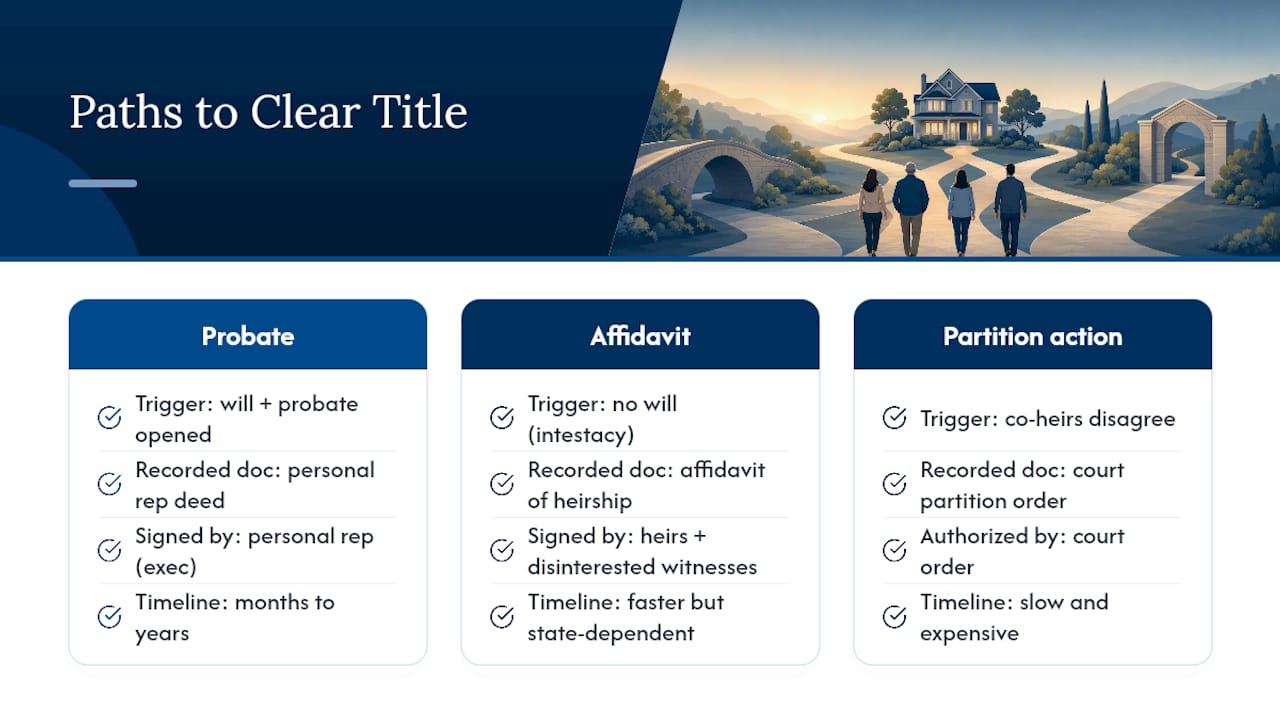
When a will exists and probate is opened: The probate court appoints a personal representative (executor), who can then sign a personal representative’s deed transferring the property to the heirs named in the will. That deed gets recorded at the county Register of Deeds or County Recorder’s office, creating a visible link in the chain of title. Some states also allow a muniment of title, where the will itself is admitted to probate and recorded as evidence of transfer without a full administration.
When there is no will (intestacy): Title vests in the heirs at the moment of death under state law, but the public record does not automatically reflect that. Recording probate documents or affidavits of heirship is typically required to make the transfer visible to buyers and lenders. An affidavit of heirship is a sworn statement identifying the deceased’s heirs, signed by disinterested witnesses and recorded in the county land records. Where state law permits it, this can substitute for probate on smaller or simpler estates.
When heirs disagree: If co-heirs cannot reach agreement on what to do with the property, a partition action may be the only option. A court can order a physical division of the land or, more commonly for a house, a forced sale with proceeds split among heirs. Partition actions are slow and expensive, so they are genuinely a last resort.
When small-estate procedures apply: Many states offer simplified affidavit or summary administration procedures for estates below a certain value. These are faster than full probate, but many lenders and title insurers still require full probate before they will accept the title.
Pro Tip: In some states, a two-year creditor claim period must pass before an affidavit of heirship carries full weight with title insurers. If you are in a hurry to sell, ask a probate attorney whether opening a formal estate and publishing notice to creditors might actually close faster than waiting out the affidavit period.
What legal tools can you use to clear title on inherited property?
Clearing title on inherited property typically involves one or more recordable instruments, depending on the defect. Here is the toolkit practitioners use most often:
- Personal representative’s deed / executor’s deed: Issued through probate; transfers title from the estate to the heirs. The most reliable instrument for lenders.
- Affidavit of heirship: Sworn statement of heirs recorded in county land records; useful where state law accepts it and the estate is straightforward.
- Muniment of title: The will itself is recorded as proof of transfer; available in some states as an alternative to full probate administration.
- Corrective deed: Fixes clerical errors (misspelled names, wrong legal descriptions) in a previously recorded deed.
- Quitclaim deed: Transfers whatever interest a grantor holds, without warranty. Useful for consolidating co-heir interests but does not cure ownership disputes.
- Lien satisfaction / release: Pays off or formally releases a mortgage, tax lien, or judgment lien so it no longer encumbers the property.
- Quiet title action: A court proceeding that asks a judge to declare the rightful owner and extinguish competing claims. Quiet title is typically the last resort when corrective recordings are unavailable or when claimants dispute ownership.
- Partition action: Forces a division or sale when co-heirs cannot agree.
The practical sequence most practitioners follow:
- Run a title search to identify every defect.
- Collect the certified death certificate, prior deeds, mortgage statements, and tax records.
- Attempt corrective recordings or obtain lien releases for any fixable defects.
- If corrective recordings are insufficient, open probate or record a muniment of title.
- If ownership is genuinely disputed or record gaps cannot be fixed by recording, file a quiet title action.
- If multiple heirs cannot cooperate, consider a partition action.
Pro Tip: Bring a probate attorney or title professional in at step one, not step four. An early title report from a title company often surfaces hidden liens, such as mechanic’s liens or Medicaid recovery claims, that would otherwise derail a sale weeks before closing.
How long does it take and what does it cost?
Setting realistic expectations matters here, because the range is wide.
- Simple corrective recordings (fixing a misspelled name, recording a missing deed): A few weeks, typically modest filing fees at the county recorder’s office.
- Probate administration: Several months to a year or more, depending on the state, the estate’s complexity, and whether creditors contest claims. Attorney fees, court filing fees, and publication costs all apply.
- Quiet title actions: Often six months to well over a year. Court filing fees, attorney fees, and costs to serve or publish notice to unknown claimants add up quickly. Contested quiet title cases are among the most expensive title-clearing routes.
- Partition actions: Frequently the longest and costliest path, particularly when heirs are adversarial or the property’s value is disputed.
Costs vary significantly by state, county, and the complexity of the defects involved. Unknown heirs, active creditor claims, and complex lien payoffs are the most common factors that push both time and cost higher. An early title search, ordered before you commit to any strategy, is the single most cost-effective step you can take because it tells you exactly which route is necessary.
Can you sell or close on an inherited home without a clear title?
The short answer: sometimes, with the right structure. It depends on the type of defect and what the buyer and lender will accept.
When a sale can proceed despite title issues:
- A title insurer may issue a policy with exceptions, covering the buyer against most risks while acknowledging specific known defects. The buyer accepts the risk on those exceptions.
- Liens can often be paid off at closing from sale proceeds, with the title company holding funds in escrow until payoff is confirmed.
- An escrow holdback can cover a disputed amount while the parties resolve a smaller claim after closing.
When a sale cannot proceed: Unresolved ownership disputes, meaning two or more parties with competing legal claims to the property, will stop most closings. No title insurer will cover a transaction where the seller’s right to convey is genuinely in question.
Selling as-is to a cash buyer is a practical option for heirs who want to avoid months of curative title work. Cash buyers often accept properties with title exceptions or pending probate, and they typically do not require a lender’s approval, which removes one major obstacle. The trade-off is price: a cash buyer will factor the title risk and curative costs into their offer. For heirs who value speed or want to avoid family conflict over a prolonged probate, that trade-off is often worth it. You can review how cash buyers handle probate homes to understand what that process looks like in practice.
Pro Tip: Before negotiating with any buyer, pull together the death certificate, the most recent deed, any known lien payoff statements, and a copy of the title search. Buyers who receive organized documentation upfront move faster and offer more confidently.
A practical checklist for heirs: documents and first steps
Getting organized early prevents the most common delays. Here is what to gather and what to do first.
Documents to collect:
- Certified death certificate (you will need multiple certified copies)
- Most recent recorded deed showing the deceased as owner
- Any existing will or trust documents
- Current mortgage statements and payoff information
- Property tax notices and any tax lien records
- Judgment records or known creditor claims against the deceased
- Proof of any payments made on the property since the owner’s death
First five actions:
- Order a title search from a licensed title company or real estate attorney.
- Contact the county Register of Deeds or County Recorder to confirm what is currently recorded on the property.
- Confirm whether a probate case was opened, and if so, obtain the case number and court.
- Consult a title company or probate attorney to review the title search results and identify the right curative path.
- Evaluate your selling options: listing on the market after clearing title, or selling as-is to a cash buyer now. The inherited home selling options guide lays out the trade-offs clearly.
Pro Tip: If you plan to use an affidavit of heirship, gather witness statements from people who knew the deceased and can attest to the family relationships. Disinterested witnesses (not heirs themselves) carry the most weight with title insurers and county recorders.
What title companies actually look for in an inherited property search
A title search is a systematic review of the public record going back as far as the chain of title requires, often 40 to 60 years. Title examiners pull records from the county recorder, the court clerk, and tax authorities. Here is what they are checking:
- Chain of title: Every recorded deed from one owner to the next, confirming no gaps or breaks.
- Liens and judgments: Mortgages, mechanic’s liens, tax liens, and court judgments recorded against the property or the owner.
- Tax records: Unpaid property taxes or special assessments that attach to the property.
- Easements and restrictions: Recorded rights of way or deed restrictions that limit use.
- Probate and estate records: Court filings that affect ownership, including letters of administration and distribution orders.
Gaps appear for predictable reasons: a deed recorded in the wrong county, a name spelled differently across documents, a transfer that was never formally recorded, or an old lien that was paid but never formally released. County-level filings at the Register of Deeds are essential to making the chain of title visible to buyers and lenders. A defect that seems minor to a family can be a genuine obstacle to a title insurer.
A title insurer may issue a policy despite known defects if the risk is deemed acceptable, but that insurance does not remove the underlying legal defect. Heirs should consult a title professional to determine whether a quiet title action is necessary or whether insurable title is sufficient for their specific transaction. — Legal Clarity
An early title report, ordered before you list the property or negotiate with buyers, is the most reliable way to avoid last-minute surprises. Practitioners consistently note that hidden liens, including mechanic’s liens and Medicaid recovery claims, surface most often at this stage, not during closing.
What families get wrong when handling title issues on their own
The most predictable mistake heirs make is treating informal family arrangements as legally sufficient. A conversation at the kitchen table, a handwritten note, or a verbal agreement among siblings does not create a recordable title. The county record still shows the deceased as owner until a formal instrument is recorded, and no buyer or lender will accept anything less.

A close second: assuming that paying property taxes establishes ownership. It does not. Taxes are a financial obligation tied to the property, not proof of title. Heirs who have paid taxes for years sometimes discover they cannot sell because the deed chain was never updated.
Skipping the title search is the third common error, and often the costliest. Families who try to sell quickly without ordering a title search frequently discover liens or competing claims only after a buyer is under contract, which collapses the deal and wastes months. An upfront title search, even when it reveals problems, gives you time to fix them on your schedule rather than under pressure.
When is handling this yourself reasonable? Simple corrective recordings, like fixing a misspelled name or recording a missing deed when all heirs agree, are manageable with county recorder guidance. When heirs disagree, when unknown claimants exist, or when creditor claims are involved, a probate attorney is not optional. The cost of professional guidance is almost always less than the cost of a failed closing or a contested quiet title action.
Sell Dave Your House: a fast alternative for heirs who need to move quickly
Clearing title takes time. For some heirs, that time is a resource they do not have, whether because of carrying costs, family disagreement, or simply the desire to close a difficult chapter.

Sell Dave Your House buys inherited homes in Metro Detroit for cash, as-is, with no repairs or cleaning required. There are no realtor commissions, no appraisal contingencies, and no lender approval to wait on. A cash offer typically arrives quickly, and closing can often be arranged within about a week. Standard closing costs are commonly covered. For heirs who are weighing months of probate and curative title work against a straightforward cash sale, that speed and certainty carry real value. Request a cash offer and find out what your inherited property is worth without any obligation.
Sources
These sources are reliable starting points for state-specific forms, procedural details, and professional referrals.
- clear title | Wex | US Law | LII / Legal Information Institute
- What steps do I need to take to clear the title on inherited property before selling or refinancing? NC | Pierce Law
- Clearing Title Guide | Texas Law Help
- Marketable vs insurable vs clear title: key differences | Legal Clarity
- Clear Title: Definition and Importance in Real Estate | Investopedia
This article is general information, not a substitute for advice from a qualified lawyer. Consult a qualified legal professional about your own circumstances before acting on anything here.
FAQ
What does clear title mean on a property?
Clear title means ownership is undisputed, properly recorded in public records, and free of liens, judgments, or encumbrances that could challenge the owner’s right to sell or transfer the property. It is also called clean, free-and-clear, or absolute title.
How do you clear title on an inherited home?
The most common routes are recording a personal representative’s deed through probate, filing an affidavit of heirship in the county land records where state law permits, or pursuing a quiet title action when ownership is disputed. Establishing a continuous, documented chain of ownership from the deceased to the heirs is the core requirement.
Can you close on a house without a clear title?
A closing can sometimes proceed when a title insurer agrees to cover known defects with exceptions, or when liens are paid off from sale proceeds at closing. Unresolved ownership disputes, where two parties have competing legal claims, will stop most closings entirely.
How long does it take for a home title to clear after inheritance?
Simple corrective recordings take a few weeks. Probate administration typically runs several months to a year depending on the state and estate complexity. Quiet title actions often take six months to well over a year, particularly when claimants must be located and served.
Can you sell an inherited home to a cash buyer before title is fully cleared?
Yes, in many cases. Cash buyers do not require lender approval, so they can often purchase properties with title exceptions or pending probate. Sell Dave Your House buys inherited homes in Metro Detroit as-is and can close in as little as seven days, making it a practical option for heirs who need speed over maximum sale price.