

TL;DR
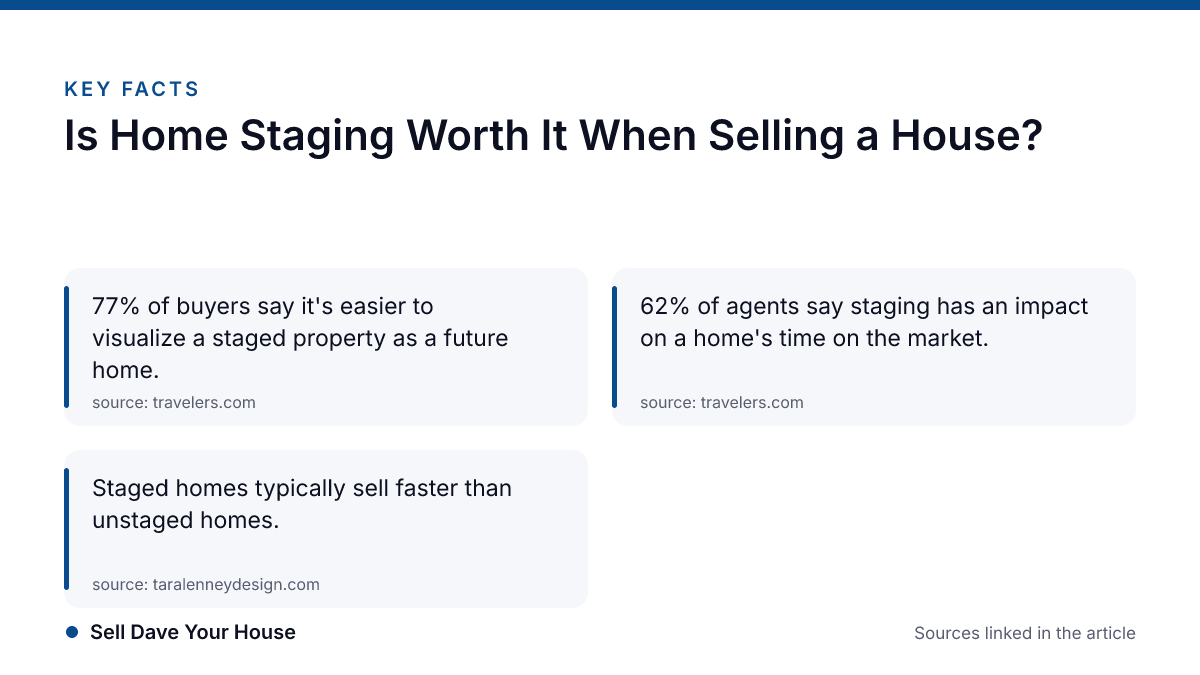
- Staging usually helps, but not universally. 62% of real estate agents say staging affects how long a home sits on the market, according to Travelers Insurance, and staged homes typically sell faster than unstaged ones, per Tara Lenney Design.
- Cost swings with scope. A consultation runs a few hundred dollars. Full-service staging with rented furniture for a vacant house commonly lands in the low-to-mid thousands and climbs from there on bigger homes.
- 77% of buyers say a staged home is easier to picture themselves living in, per Travelers. That advantage shows up in your listing photos more than anywhere else.
- Budget one day to three weeks. Declutter-and-rearrange can happen over a weekend. Full furniture rental and delivery takes longer.
- Staging isn't the only path. If the house needs repairs, sits vacant, or you're out of time and cash, selling as-is to a local cash buyer skips the whole process.
Staging earns its money on most homes going onto the traditional Metro Detroit market. Better photos, better showings, less time sitting. But it's a bad bet for plenty of sellers. If your house needs $30,000 in repairs, sits empty with nothing to work with, or you're trying to close in two weeks ahead of a foreclosure sale date, staging is a cost and a delay you can't absorb. Your condition, your timeline, and your selling method decide the answer.
Table of Contents
- Is it worth staging a home to sell?
- How much does staging cost when selling a house?
- How long does staging take before you can list and show the home?
- Do staged homes actually sell for more, or just faster?
- What are the pros and cons of staging a house for sale?
- What if you don't want to stage at all?
- Frequently asked questions
Is it worth staging a home to sell?
For a home in decent shape going through a traditional listing, yes. Staging pulls its weight.
Think of it as marketing, not repair. It won't fix a leaking roof or 1950s wiring. What it does is make a sound house photograph better and show better, and that brings more feet through the door.
The National Association of Realtors puts it simply: staging helps buyers imagine themselves in the space instead of seeing someone else's home. That's why 77% of buyers say a staged property is easier to picture as a future home, according to Travelers. With 62% of agents reporting a direct effect on days on market, this isn't decorating for its own sake. It changes what buyers do.
Where staging stops being worth it:
- The house needs major repairs. No arrangement of throw pillows offsets a cracked foundation or a roof at the end of its life. Buyers touring a distressed property are building a repair list in their heads before they ever notice the dining table.
- The house is vacant and you're carrying it. Every extra week of prep is another slice of mortgage, taxes, insurance, and a gas bill on a house nobody lives in.
- You're on a hard deadline. A sheriff's sale date, a relocation start date, or an estate you need closed out doesn't leave room for three weeks of prep plus a month on market.
Pro tip: before you spend a dollar, get a local agent to walk the house and give you a blunt read. A good one will tell you straight whether your money belongs in staging, in a $400 coat of Swiss Coffee on the main level, or nowhere at all because the house should be sold as-is.
How much does staging cost when selling a house?
Scope drives everything. Staging an occupied home with the furniture you already own is a different animal from furnishing an empty house with rented pieces that have to be delivered, arranged, and hauled back out. Here's how the tiers typically shake out for Metro Detroit sellers.
| Staging approach | Typical cost | Best for |
|---|---|---|
| Consultation only | A few hundred dollars for a walkthrough and room-by-room plan | Sellers doing the decluttering and rearranging themselves |
| Partial staging (your furniture + accents) | Roughly $500–$1,500, plus rental on any accent pieces | Occupied homes that need editing, not replacement |
| Full-service staging, occupied home | Roughly $2,000–$4,000 for the listing period | Furnished homes needing a refresh, not a full swap |
| Full-service staging, vacant home | Roughly $3,500–$8,000+ by square footage and length of stay | Empty homes, inherited properties, flips with nothing on site |
The meter keeps running the longer your home sits, because most staging companies bill monthly rent on the furniture. A vacant four-bedroom colonial in a neighborhood like Raintree costs meaningfully more to stage than a Troy starter ranch. More rooms to fill, and buyers shopping at that price expect furniture that looks like it belongs there. Troy's upscale acreage properties pull the same crowd.
Pro tip: get the monthly extension fee in writing before you sign anything. This is the line item that blindsides sellers. A contract quoted at "$3,200 for the first 30 days" can quietly become $5,000 when the house takes 90 days, and the staging company has no obligation to remind you before the invoice arrives.
How long does staging take before you can list and show the home?
One day to about three weeks, depending on whether you're rearranging what you own or bringing in rented furniture.
Consultation-and-declutter can be done over a weekend. You're pulling clutter, taking down family photos, and shifting furniture off the walls to open up sight lines. Full-service staging with rented pieces usually runs one to three weeks from the first walkthrough to photo-ready, because someone has to pull inventory, book the truck, and set every room.
Stage before the professional photos, never after. Buyers judge a listing in about the time it takes to scroll past it, and a gallery you swap out on day 12 doesn't get a second look from the people who already scrolled by on day one.
Then show fast. Furniture sitting untouched for three weeks with no showings starts looking like a house nobody wants, and you're paying rent on it either way.
Season matters here too. Troy gets its heaviest snowfall between December and January, according to Weather Atlas, which cuts your showing daylight to roughly 4:30 p.m. and makes porch furniture and planters a waste of money. Winter listing? Put everything into the interior and hold the curb appeal budget for a spring relist.
Do staged homes actually sell for more, or just faster?
Faster is the well-documented part. The price premium is murkier, and there's no clean national number behind it, so when a staging company quotes you "sells for X% more," ask where the figure comes from.
Here's what holds up: staged homes typically sell faster than unstaged homes, per Tara Lenney Design. And speed is worth real money even if your sale price doesn't budge. You can price that out yourself.
The formula: (days saved on market) × (daily carrying cost) = dollar value of a faster sale.
The worked example: You're selling near Troy's median price of roughly $425,000, per Michigan Home Sellers. Add up your monthly carrying costs — mortgage interest, property taxes, insurance, utilities — and say they come to $2,100. That's $2,100 ÷ 30 = $70 a day.
Now assume staging is part of why the house sells in 30 days instead of 60. Thirty days saved × $70 = $2,100 in costs you never paid. Put that against a $3,000 staging bill and you've recovered about 70% of the spend on carrying costs alone, before counting any bump in the offer itself.
Run it with your own figures. The rule of thumb we use: if carrying-cost savings cover at least half the staging quote, it's a reasonable bet. If they don't come close, or the house is priced right in a neighborhood where anything decent moves in two weeks, your money does more work as a $2,000 price cut than as rented furniture.
What are the pros and cons of staging a house for sale?
It's a trade: cash and time now for a faster, stronger sale later. The honest ledger:
- Pro: stronger first impression online. Buyers meet your house on a phone screen before they meet it in person. Staged photos beat empty rooms and cluttered rooms on click-throughs and showing requests, every time.
- Pro: easier buyer visualization. With 77% of buyers saying it's easier to picture themselves in a staged home, per Travelers, you're clearing a mental hurdle that sits between a walkthrough and an offer.
- Pro: fewer days on market. Fewer days means fewer carrying costs and less exposure to a rate move or a seasonal slowdown.
- Con: cash out of pocket. Several thousand dollars, spent before you've sold anything, and it doesn't come out of the proceeds.
- Con: it doesn't fix real problems. A beautifully staged kitchen doesn't stop the inspector from writing up the roof. Buyers renegotiate or walk once that report lands.
- Con: it costs you time. Facing a foreclosure date, a relocation, or an inherited house you're managing from Arizona? Three weeks of prep plus a month on market plus a 30-to-45-day close isn't a plan you can use.
Pro tip: on a tight budget, HGTV's staging tips come back to decluttering, depersonalizing, and letting light in. All free or close to it, and pound for pound the highest-return work in the whole process. If you do nothing else, pull half the furniture out of every room and put it in a storage unit.
What if you don't want to stage at all?
Selling as-is for cash removes staging from the equation entirely. No rented furniture, no photo shoot, no Saturday showings you have to leave the house for. That's the situation we handle daily at Sell Dave Your House: properties in disrepair, inherited houses sitting vacant, rentals with tenants still in them, and deadlines that won't wait for a 30-day market cycle.
The comparison usually comes down to this:
| Factor | Traditional listing with staging | As-is cash sale |
|---|---|---|
| Upfront cost | $500–$8,000+ staging, plus repairs and commission | $0 staging, $0 repairs, no commission |
| Typical timeline | Days to weeks of prep, then market time, then a 30–45 day close | Often 7–14 days from offer to closing |
| Condition requirements | Must show well; major repairs usually come first | Bought as-is, any condition |
| Certainty | Depends on buyer financing, inspection, appraisal | Cash offer, no financing contingency |
| Best fit | Move-in-ready homes with time to spare | Distressed homes, inherited property, foreclosure, landlords, fast relocations |
Weighing an offer from any cash buyer, ours included? Know what separates a fair number from a lowball. Our guide on 7 red flags to spot in we buy houses offers covers the pressure tactics some companies use and what a legitimate offer looks like in writing.
This route fits some situations especially well:
- Inherited property managed from out of state, where selling an inherited home differs from a standard sale in ways that catch people off guard: probate, multiple heirs who disagree, and a decade of deferred maintenance nobody wants to fund.
- Foreclosure timelines, where the sheriff's sale date is fixed and a traditional listing can't outrun it. Our guide on stopping a foreclosure sale fast lays out the realistic options.
- Landlords offloading a rental with tenants in place, no staging a house full of somebody else's furniture.
- Out-of-state owners trying to close out an estate sale from a distance without booking another flight to Detroit for a showing.
We buy houses across Wayne, Oakland, and Macomb Counties, including Detroit, Warren, Sterling Heights, Dearborn, Livonia, Royal Oak, Southfield, and Troy. You can read why sellers choose a cash sale over listing. Want a straight answer on what your house is worth as-is? Call 586-500-7161 and we'll walk you through the number and how we got there.
Frequently asked questions
Can I stage my house for free or cheap?
Yes. The highest-return moves cost effort, not money. Decluttering, deep cleaning, taking down personal photos, opening every curtain, and pulling furniture off the walls account for most of what buyers actually respond to. No staging budget required.
Do I need to stage a vacant house differently than an occupied one?
Yes. A vacant house needs furniture brought in, delivered, and set, which is why full-service staging for empty homes costs more than staging a house you're still living in. An occupied home usually just needs editing: less furniture, less clutter, nothing added.
Does staging matter if I'm selling my house for cash or as-is?
No. Cash buyers price on condition and market value, not on how the couch faces the window. If you're planning to sell your house fast to a cash buyer instead of listing, skip staging entirely and put that time toward closing.
Before you book a stager, do the arithmetic above on your own house: daily carrying cost, realistic days saved, staging quote. If the numbers don't cover at least half the bill, get a cash offer and compare the two paths side by side with real figures in front of you.